

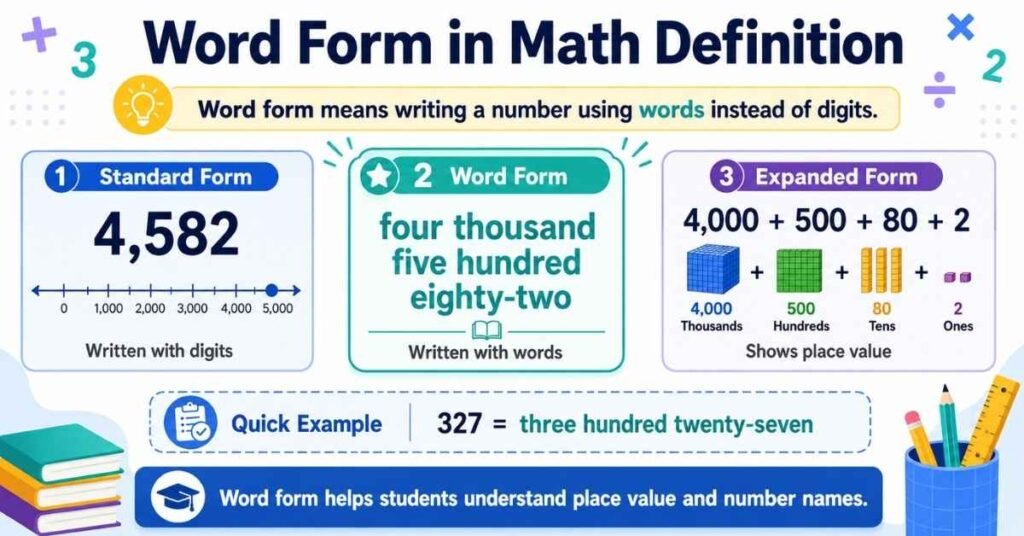
Word form in math definition means writing a number using words instead of digits. For example, the number 4,582 in word form is four thousand five hundred eighty-two. The quantity does not change; only the way the number is represented changes. Word form helps students connect number names, digits, place value, standard form, and expanded form, making it an important part of elementary number sense.
If a worksheet tells you to “write the number in word form,” the instruction is simpler than it sounds. You are simply replacing the numeral with its written number name.
Word Form in Math Definition in Simple Words
In simple terms, word form is the written name of a number.
Instead of writing:
327
you write:
three hundred twenty-seven
This is why word form is sometimes called a number name or, in some classrooms, written form.
Here are a few simple examples:
| Standard Form | Word Form |
|---|---|
| 8 | eight |
| 25 | twenty-five |
| 347 | three hundred forty-seven |
| 2,016 | two thousand sixteen |
| 45,908 | forty-five thousand nine hundred eight |
The important idea is that the numerical value stays exactly the same.
Whether you write 347 or three hundred forty-seven, both represent the same quantity.
Why Is It Called Word Form?
The word form refers to the way a number is represented.
A number can appear in several forms without changing its value.
Consider 4,582:
| Form | Representation |
|---|---|
| Standard form | 4,582 |
| Word form | four thousand five hundred eighty-two |
| Expanded form | 4,000 + 500 + 80 + 2 |
| Unit form | 4 thousands + 5 hundreds + 8 tens + 2 ones |
All four expressions represent the exact same number.
This is the deeper mathematical meaning behind word form. It is not simply a spelling exercise. It helps students understand how digits represent quantities in the base-ten number system.
Word Form vs. Standard Form
One of the most common sources of confusion is the difference between word form and standard form.
What Is Standard Form?
Standard form uses numerals or digits.
Example:
6,305
What Is Word Form?
Word form expresses the same number using words:
six thousand three hundred five
Here are more examples:
| Standard Form | Word Form |
|---|---|
| 52 | fifty-two |
| 408 | four hundred eight |
| 7,021 | seven thousand twenty-one |
| 36,504 | thirty-six thousand five hundred four |
So if a worksheet says:
Write 3,704 in word form.
The answer is:
three thousand seven hundred four
You should not write 3,000 + 700 + 4, because that would be expanded form.
Word Form vs. Expanded Form
Expanded form shows the value of each digit separately.
For example:
4,582
in expanded form is:
4,000 + 500 + 80 + 2
Its word form is:
four thousand five hundred eighty-two
The difference is simple:
- Standard form uses digits.
- Word form uses number words.
- Expanded form shows individual place values.
- Unit form names the place-value units.
For example:
9,406
Standard form: 9,406 Word form: nine thousand four hundred six Expanded form: 9,000 + 400 + 6 Unit form: 9 thousands + 4 hundreds + 6 ones
Understanding these relationships is more useful than memorizing separate definitions because they all come back to place value.
Why Place Value Matters in Word Form
Word form is fundamentally a place-value skill.
Each digit has a value based on where it appears.
Take the number:
482
The digits represent:
- 4 hundreds = 400
- 8 tens = 80
- 2 ones = 2
That is why we read the number as:
four hundred eighty-two
Now look at the digit 5 in different numbers:
- 52 → 5 means 50
- 502 → 5 means 500
- 5,002 → 5 means 5,000
The digit is the same, but its position changes its value.
That relationship can be summarized as:
digit position → place value → number name → word form
Once students understand this connection, writing numbers in words becomes much easier.
How to Write a Number in Word Form
A reliable method is the Group–Read–Write–Check method.
Step 1: Group the Number
For larger numbers, separate the digits into groups of three.
Example:
246,018
Think of it as:
246 | 018
The first group is in the thousands period.
Step 2: Read Each Group
Read 246 as:
two hundred forty-six
Read 018 as:
eighteen
Step 3: Add the Period Name
The first group represents thousands:
two hundred forty-six thousand
Then add the remaining part:
eighteen
Step 4: Write the Complete Word Form
246,018 = two hundred forty-six thousand eighteen
Step 5: Check Your Work
Convert your written number back into digits.
If:
two hundred forty-six thousand eighteen
becomes:
246,018
your answer is correct.
This reverse check is especially helpful with zeros and large numbers.
How to Write Two-Digit Numbers in Word Form
Two-digit numbers are the easiest place to begin.
Numbers From 1 to 19
These have individual number names, such as:
- 1 = one
- 7 = seven
- 13 = thirteen
- 19 = nineteen
Multiples of Ten
- 20 = twenty
- 30 = thirty
- 40 = forty
- 50 = fifty
- 60 = sixty
- 70 = seventy
- 80 = eighty
- 90 = ninety
Compound Two-Digit Numbers
Numbers such as 21, 46, and 99 normally use a hyphen:
- 21 = twenty-one
- 46 = forty-six
- 99 = ninety-nine
Common Spelling Mistakes
Pay particular attention to:
- forty, not “fourty”
- fifty, not “fivety”
- eighty, not “eightty”
Correct spelling matters because word form combines mathematical understanding with written number names.
How to Write Three-Digit Numbers in Word Form
For a three-digit number, identify the hundreds, tens, and ones.
Consider:
347
- 3 hundreds
- 4 tens
- 7 ones
The word form is:
three hundred forty-seven
Another example:
681
becomes:
six hundred eighty-one
The process becomes more interesting when zero appears.
How Zeros Work in Word Form
Zeros are one of the biggest reasons students make mistakes with numbers in word form.
Consider:
305
Its word form is:
three hundred five
You do not say:
three hundred zero five
Why?
Because the zero tells us that there are no tens. It acts as a placeholder in standard form, but there is no quantity in the tens place that needs to be named.
More examples:
| Standard Form | Word Form |
|---|---|
| 405 | four hundred five |
| 3,005 | three thousand five |
| 30,050 | thirty thousand fifty |
| 400,007 | four hundred thousand seven |
A Common Zero Mistake
Suppose someone writes:
4,006 = four thousand sixty
That is incorrect.
“Sixty” means 60, so “four thousand sixty” actually represents:
4,060
The correct word form of 4,006 is:
four thousand six
This is why understanding zero as a placeholder is more important than simply memorizing examples.
How to Write Large Numbers in Word Form
Large numbers become much easier when you divide them into three-digit periods.
Consider:
305,042
Separate it as:
305 | 042
The first period is:
three hundred five thousand
The second is:
forty-two
So the complete word form is:
three hundred five thousand forty-two
Thousands, Millions, and Billions
| Number | Word Form |
|---|---|
| 12,000 | twelve thousand |
| 305,000 | three hundred five thousand |
| 2,500,000 | two million five hundred thousand |
| 14,006,210 | fourteen million six thousand two hundred ten |
Commas in standard form help identify the different number periods:
- ones
- thousands
- millions
- billions
That makes even long numbers manageable.
Larger Example
Consider:
246,018,305
Break it into:
246 | 018 | 305
Now read each period:
- 246 million
- 18 thousand
- 305
The complete word form is:
two hundred forty-six million eighteen thousand three hundred five
How to Convert Word Form Back to Standard Form
Understanding word form in both directions is an excellent way to strengthen number sense.
Example 1
five thousand two hundred seven
Break it apart:
- five thousand = 5,000
- two hundred = 200
- seven = 7
Standard form:
5,207
Example 2
eighty thousand nine
Standard form:
80,009
Notice the zeros. They are necessary to keep the 8 in the ten-thousands place.
Example 3
six hundred four thousand twenty-eight
Standard form:
604,028
A useful self-check is to read your digits aloud after writing them. If the spoken number does not match the original word form, check your place values and zeros again.
How to Write Decimals in Word Form
Word form is also used with decimal numbers.
The key is understanding decimal place value.
The first three decimal positions are:
- tenths
- hundredths
- thousandths
Examples:
- 0.1 = one tenth
- 0.01 = one hundredth
- 0.001 = one thousandth
Decimal Examples
| Decimal | Word Form |
|---|---|
| 0.4 | four tenths |
| 0.04 | four hundredths |
| 2.5 | two and five tenths |
| 7.04 | seven and four hundredths |
| 12.305 | twelve and three hundred five thousandths |
Notice the difference between:
0.4 = four tenths
and:
0.04 = four hundredths
The 4 occupies a different place value, so the numbers are not equal.
When Do You Use “And” in Word Form?
In many U.S. math classrooms, and is commonly used to represent the decimal point.
For example:
342.05
is read as:
three hundred forty-two and five hundredths
For the whole number:
342
the classroom-style word form is commonly:
three hundred forty-two
rather than:
three hundred and forty-two
However, everyday spoken English varies. You may hear people include “and” when reading whole numbers aloud.
When completing schoolwork, follow the convention your teacher, textbook, or worksheet expects.
Do You Use Hyphens and Commas in Word Form?
Hyphens
Use hyphens in compound whole-number words such as:
- twenty-one
- thirty-eight
- fifty-six
- ninety-nine
Commas
Commas are important when numbers are written as digits:
245,018
They separate number periods and make large values easier to read.
When the number is written completely in words, you generally do not insert a comma every time the numeral would have one.
For example:
245,018
becomes:
two hundred forty-five thousand eighteen
Again, specific classroom or publishing style may vary.
Word Form, Number Name, and Written Form
Several math terms can sound similar.
Word Form
A number represented using words:
728 → seven hundred twenty-eight
Number Name
The spoken or written name of a number.
For elementary math, number name and word form often refer to essentially the same representation.
Written Form
Some teachers or worksheets may also use “written form” when referring to numbers written in words.
Terminology can vary slightly, but the underlying concept remains the same: representing a numerical quantity with language instead of digits.
Word Form vs. Word Problem
These terms should not be confused.
Word Form
A number written in words:
428 → four hundred twenty-eight
Word Problem
A mathematical question presented as a situation or story.
Example:
Mia has 428 stickers and gives 20 away. How many stickers remain?
That is a word problem, not word form.
Common Word Form Mistakes
Understanding common errors can make the concept easier to remember.
Mistake 1: Saying the Zero
Wrong:
305 = three hundred zero five
Correct:
three hundred five
Mistake 2: Changing the Place Value
Wrong:
4,006 = four thousand sixty
Correct:
four thousand six
Mistake 3: Confusing Expanded Form With Word Form
Question:
Write 452 in word form.
Wrong:
400 + 50 + 2
That is expanded form.
Correct:
four hundred fifty-two
Mistake 4: Confusing Decimal Places
Wrong:
0.04 = four tenths
Correct:
four hundredths
Mistake 5: Forgetting a Period Name
Wrong:
305,000 = three hundred five
Correct:
three hundred five thousand
Mistake 6: Forgetting Hyphens
Instead of:
twenty five
write:
twenty-five
How to Check Your Word Form Answer
A simple reverse-check method can catch many errors.
Step 1
Read the word form carefully.
Step 2
Convert it back into digits.
Step 3
Check the value of each digit.
Step 4
Look for missing zero placeholders.
Step 5
If it is a decimal, verify the final place value.
For example:
forty thousand seven
should convert to:
40,007
If you get 40,070, then you accidentally added seven tens instead of seven ones.
This method checks understanding rather than relying on memorization.
Why Students Learn Word Form in Math
Word form is useful because it supports several important mathematical skills.
It Builds Place-Value Understanding
Students learn that each digit has a value determined by its position.
It Strengthens Number Sense
A student begins to recognize the same quantity in multiple forms.
For example:
526
five hundred twenty-six
500 + 20 + 6
These all describe the same number.
LEARN MORE: What Does Measure of Center Mean?
It Improves Mathematical Communication
Being able to read and write numbers accurately is useful when discussing:
- money
- measurements
- populations
- statistics
- distances
- dates
- financial amounts
It Prepares Students for Decimals
Understanding ones, tens, hundreds, and thousands makes it easier to learn:
- tenths
- hundredths
- thousandths
Word form therefore supports a broader understanding of the base-ten place-value system.
What Grade Do Students Learn Word Form?
In U.S. elementary education, students typically encounter number names and word form during the early grades as part of place-value and number-sense instruction.
Younger students work with smaller whole numbers.
As they progress, they may encounter:
- hundreds and thousands
- larger multi-digit numbers
- millions
- decimals
- tenths, hundredths, and thousandths
The exact grade level and number range can vary depending on the state, school district, curriculum, and teacher.
The important progression is from recognizing simple number names to understanding how word form represents increasingly complex place values.
A Simple Way to Explain Word Form to a Child
A helpful explanation is:
“Look at each digit, figure out what place it is in, and then say the number from left to right.”
Take:
5,207
The number contains:
- 5 thousands
- 2 hundreds
- 0 tens
- 7 ones
Now read it:
five thousand two hundred seven
This method teaches the structure of the number instead of asking a child to memorize isolated answers.
Practice: Write These Numbers in Word Form
Try these before checking the answers.
Beginner
- 42
- 318
- 905
Intermediate
- 5,204
- 30,018
- 406,070
Advanced
- 4.06
- 12.305
- 2,005,009
Answers
- forty-two
- three hundred eighteen
- nine hundred five
- five thousand two hundred four
- thirty thousand eighteen
- four hundred six thousand seventy
- four and six hundredths
- twelve and three hundred five thousandths
- two million five thousand nine
Practice: Change Word Form to Standard Form
Now reverse the process.
- three hundred nine
- seven thousand forty-two
- ninety thousand six
- four hundred two thousand seventeen
- eight and five hundredths
Answers
- 309
- 7,042
- 90,006
- 402,017
- 8.05
If you can convert numbers in both directions, you probably understand the underlying place-value relationships, rather than simply recognizing examples.
Frequently Asked Questions About Word Form in Math
What is word form in math in simple words?
Word form in math means writing a number using words instead of digits. For example, 234 becomes two hundred thirty-four.
What is an example of word form?
The number 518 in word form is five hundred eighteen.
Is word form the same as a number name?
In elementary math, word form and number name generally refer to the same idea: expressing a numerical value using words.
What is the difference between word form and standard form?
Standard form uses digits, while word form uses words.
Example:
Standard: 3,205
Word: three thousand two hundred five
What is word form vs. expanded form?
Word form writes the number as words.
Expanded form separates its place values.
Example:
462
Word form: four hundred sixty-two
Expanded form: 400 + 60 + 2
Why is place value important in word form?
Place value determines what each digit means. Without understanding place value, it is easy to misread numbers containing zeros, large periods, or decimals.
How do zeros work in word form?
Zero usually acts as a placeholder. If a place contains zero, its value is usually not spoken.
For example:
3,005 = three thousand five
How do you write large numbers in word form?
Separate the number into groups of three digits, read each group, and add period names such as thousand, million, or billion.
How do you write decimals in word form?
Read the whole-number part, use and for the decimal point in many U.S. classroom conventions, and name the decimal according to its final place value.
Example:
4.07 = four and seven hundredths
When should number words use hyphens?
Compound numbers from twenty-one through ninety-nine generally use hyphens when they are not exact multiples of ten.
Examples:
twenty-four, sixty-eight, ninety-one
How do you convert word form to standard form?
Identify the place value described by each number word and write the matching digits, adding zero placeholders when necessary.
Is word form the same as a word problem?
No. Word form is a way of writing a number, while a word problem is a math question written as a story or real-life situation.
Final Thoughts on Word Form in Math
The word form in math definition is simple: it is a number written with words instead of digits. But understanding word form also teaches something more important—the relationship between digits, place value, number names, standard form, expanded form, and the base-ten system.
For example:
5,407
can be represented as:
- 5,407 in standard form
- five thousand four hundred seven in word form
- 5,000 + 400 + 7 in expanded form
- 5 thousands + 4 hundreds + 7 ones in unit form
The representation changes, but the value remains exactly the same.
If you remember one practical rule, make it this: identify each digit’s place value, read the number carefully from left to right, and convert your answer back into digits to check your work. That method works for simple whole numbers, numbers with zeros, large numbers, and even decimals.

1 thought on “Word Form in Math Definition: Meaning, Examples & Guide”