

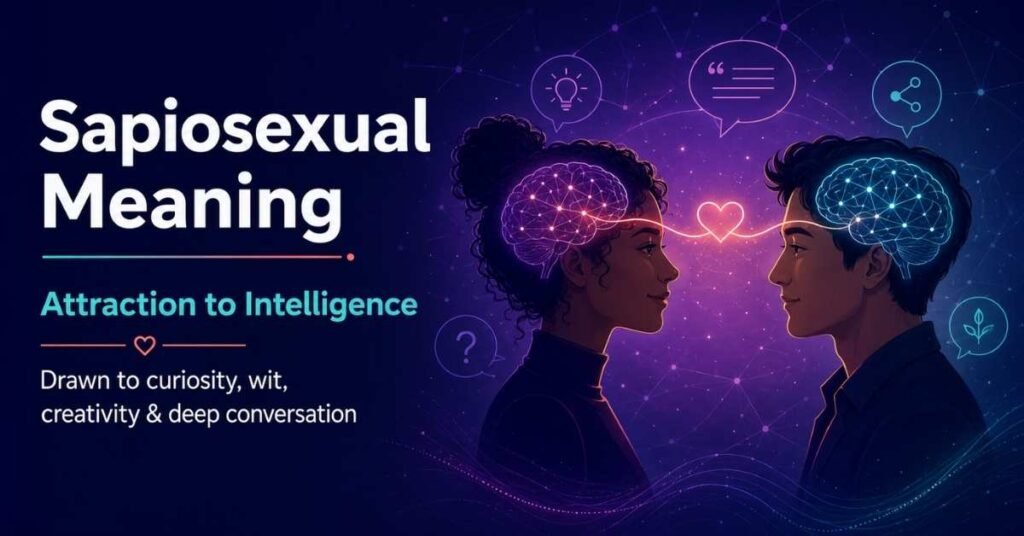
Sapiosexual meaning refers to experiencing romantic or sexual attraction to intelligence or the way another person thinks. A sapiosexual person may find curiosity, wit, creativity, emotional insight, problem-solving, or stimulating conversation especially attractive. For some people, intellectual connection creates the initial spark; for others, it makes an existing attraction stronger. The term may be used as an identity, preference, or microlabel, but it is not a medical condition or clinical diagnosis.
Importantly, being sapiosexual does not necessarily mean that physical appearance, gender, kindness, or emotional compatibility never matters. It simply means that intelligence plays a particularly important role in attraction.
What Does Sapiosexual Mean in Simple Words?
A sapiosexual is someone who feels strongly attracted to another person’s mind. The way a potential partner communicates, solves problems, explores ideas, or understands emotions may create romantic or sexual interest.
For many people, intelligence is simply one desirable quality among several. Someone who calls themselves sapiosexual generally means that intellectual stimulation is more central to their attraction than an ordinary preference for an educated or knowledgeable partner.
The label is personal. Two people may both identify as sapiosexual while being attracted to completely different expressions of intelligence.
Sapiosexual Meaning at a Glance
| Detail | Explanation |
|---|---|
| Term | Sapiosexual |
| Simple meaning | Someone strongly attracted to intelligence |
| Type of attraction | Romantic, sexual, or both |
| Part of speech | Noun and adjective |
| Pronunciation | say-pee-oh-SEK-shoo-uhl |
| Related noun | Sapiosexuality |
| Common use | Identity, microlabel, or attraction preference |
| Clinical diagnosis? | No |
| Gender-specific? | No |
A Simple Example of Sapiosexual Attraction
Imagine that someone feels neutral about a new date at first. As the evening continues, the date asks thoughtful questions, listens carefully, makes clever observations, and discusses unfamiliar ideas without trying to dominate the conversation.
That intellectual exchange creates a noticeable romantic or sexual spark.
The attraction is not based simply on the person having a degree or knowing many facts. It develops from how the person thinks, listens, communicates, and responds to new ideas.
What Does Being Attracted to Intelligence Actually Mean?
Intelligence is not one fixed quality. When people say they are attracted to intelligence, they may be describing several different mental, emotional, and creative qualities.
One sapiosexual person may enjoy analytical thinking, while another may find humor, curiosity, or emotional awareness more attractive.
Analytical Intelligence
Analytical intelligence includes the ability to:
- Recognize patterns
- Evaluate evidence
- Understand complicated ideas
- Solve logical problems
- Compare different possibilities
- Reach thoughtful conclusions
A person who explains a difficult subject clearly or approaches a problem from an unexpected angle may feel particularly attractive to someone who values analytical ability.
Verbal Intelligence and Wit
For some sapiosexual people, attraction develops through language.
They may be drawn to someone who:
- Communicates clearly
- Uses clever humor
- Tells engaging stories
- Enjoys wordplay
- Explains ideas effectively
- Listens and responds thoughtfully
A witty conversation can create chemistry because it reveals mental agility, timing, confidence, and attention.
Creativity
Intelligence can also appear through imagination and originality.
Creative intelligence may involve:
- Producing original ideas
- Making unusual connections
- Finding inventive solutions
- Expressing emotions through art
- Looking at familiar situations differently
- Questioning conventional assumptions
A person does not need to be an academic or scientist to demonstrate intellectual depth. An artist, craftsperson, musician, entrepreneur, or storyteller may express intelligence through creativity.
Emotional Intelligence
Emotional intelligence refers to the ability to understand and respond to emotions effectively.
It can include:
- Recognizing another person’s feelings
- Listening without immediately judging
- Expressing emotions clearly
- Handling conflict thoughtfully
- Showing empathy
- Understanding social situations
- Taking responsibility for mistakes
For some people, this kind of insight is more attractive than factual knowledge or academic achievement.
Practical Intelligence
Practical intelligence is the ability to apply knowledge in everyday life.
A practically intelligent person may:
- Adapt quickly to new circumstances
- Make sensible decisions
- Solve real-world problems
- Learn from experience
- Remain calm under pressure
- Turn ideas into effective action
Someone can possess practical wisdom without having advanced educational qualifications.
Curiosity and Intellectual Humility
Many people who identify as sapiosexual are attracted not just to knowledge but to a desire to keep learning.
Intellectual humility can be particularly compelling. It appears when someone:
- Admits that they do not know something
- Asks sincere questions
- Reconsiders an opinion
- Listens to opposing views
- Changes their mind when evidence changes
- Disagrees without becoming disrespectful
Knowing many facts may create admiration. However, curiosity, humility, and thoughtful communication often create a more meaningful intellectual connection.
Intellectual Attraction Is Not the Same as an Intelligence Test
People rarely know a potential partner’s IQ when attraction begins. They respond to what they perceive as intelligence through conversation, behavior, humor, decision-making, and emotional awareness.
Perceived intelligence can be influenced by:
- Speaking style
- Vocabulary
- Confidence
- Education
- Profession
- Cultural background
- Shared beliefs
- Sense of humor
- Social status
These signals can be imperfect. A confident person may appear more knowledgeable than they are, while a genuinely insightful person may communicate quietly or need more time to express an idea.
An IQ score also captures only certain cognitive abilities. It cannot fully measure creativity, wisdom, empathy, practical judgment, communication, or the ability to maintain a healthy relationship.
What Can Be Mistaken for Intelligence?
Certain behaviors may look intellectual without necessarily demonstrating good thinking:
- Using complicated words unnecessarily
- Correcting people constantly
- Dominating every discussion
- Mentioning qualifications repeatedly
- Speaking confidently about unfamiliar subjects
- Refusing to admit uncertainty
- Treating disagreement as ignorance
- Having greater access to formal education
Real intellectual depth often includes the ability to explain ideas simply, listen carefully, recognize uncertainty, and learn from other people.
Is Sapiosexuality a Sexual Orientation, Preference, or Identity?
There is no universally accepted answer. People use the word sapiosexual in different ways, and researchers, dictionaries, communities, and sexuality writers do not always classify it identically.
Some people consider it an identity. Others describe it as a preference, attraction pattern, or microlabel.
Why Some People Consider Sapiosexual an Identity
For some individuals, intelligence is more than an attractive bonus. Intellectual stimulation may be central to whether romantic or sexual attraction develops.
The label can help them:
- Understand repeated patterns in their relationships
- Explain what creates attraction
- Communicate their needs
- Find people who value mental connection
- Feel less unusual or misunderstood
If the term accurately communicates an important part of someone’s experience, they may reasonably choose to use it as an identity.
Why Others Consider It a Preference
Traditional sexual orientation labels generally describe the genders toward which someone experiences attraction. For example, heterosexual, gay, lesbian, bisexual, and pansexual describe patterns related to gender.
Sapiosexuality instead describes a quality that influences attraction.
For this reason, many people view it as a preference or secondary label rather than a standalone sexual orientation.
A person might identify as:
- Straight and sapiosexual
- Gay and sapiosexual
- Lesbian and sapiosexual
- Bisexual and sapiosexual
- Pansexual and sapiosexual
- Asexual-spectrum and sapioromantic
A simple distinction is that a gender-related orientation may describe who someone is attracted to, while sapiosexuality can describe how or why attraction develops.
Sapiosexual as a Microlabel
A microlabel is a specific term that adds detail to a broader identity or experience.
Someone may use sapiosexual alongside another label because it communicates that intelligence plays a defining role in their attraction. Another person with the same experience may avoid the term and simply say, “I am attracted to curious, thoughtful people.”
Both choices are valid. A label should help someone understand or communicate their experience—not make that experience more confusing.
Is Sapiosexuality a Medical Diagnosis?
Sapiosexuality is not a mental illness, psychological disorder, or clinical diagnosis.
It does not require:
- Medical treatment
- A psychological evaluation
- A professional diagnosis
- A specific test result
- Proof of intelligence
- A particular dating history
Therapy can help people work through relationship problems, communication difficulties, or questions about identity. However, identifying as sapiosexual is not itself a reason to seek treatment.
What Does Science Say About Sapiosexuality?
Research specifically examining sapiosexuality remains limited. However, at least one frequently cited study has investigated whether people differ in the degree to which they find intelligence sexually attractive.
The Sapiosexuality Questionnaire Study
A 2018 study by researchers Gilles Gignac, Joey Darbyshire, and Michelle Ooi examined attraction to intelligence and developed the Sapiosexuality Questionnaire, also called the SapioQ.
The research suggested that:
- People differ in how attractive they find intelligence.
- Some participants reported intelligence as a genuine source of sexual attraction.
- Valuing intelligence in a long-term partner is not necessarily the same as being sexually aroused by it.
- Extremely high estimated intelligence was not automatically considered more desirable.
- Average desirability reportedly peaked around an estimated IQ of 120 in the study’s assessment.
That final finding is important. Attraction did not simply rise with every suggested increase in IQ. This implies that people may be attracted to a balance of perceived intelligence and other interpersonal qualities rather than to the highest possible test score.
What the Research Supports
The available evidence provides some support for the idea that:
- Intelligence can contribute to sexual attraction.
- This effect is stronger for some people than for others.
- Intellectual attraction is not identical to general partner preference.
- Sapiosexuality can be studied as an individual difference.
What the Research Does Not Prove
The research does not establish that:
- Sapiosexuality is universally recognized as an independent orientation.
- Everyone who values intelligence is sapiosexual.
- One IQ score defines romantic desirability.
- All sapiosexual people experience attraction identically.
- Intelligence automatically produces compatibility.
- A questionnaire can assign someone a permanent identity.
The study relied on a particular research design and self-reported responses. It should be treated as useful evidence—not the final answer to every psychological, social, or identity question.
Why More Research Is Needed
Future research would benefit from:
- Larger and more culturally diverse samples
- Clear separation of romantic and sexual attraction
- Broader definitions of intelligence
- More attention to neurodiversity
- Research beyond self-reported labels
- Comparisons across age groups and relationship types
- Study of intellectual attraction in actual relationships
- Examination of education, class, and cultural bias
Until more evidence is available, strong universal claims about sapiosexuality should be approached cautiously.
How to Know Whether Sapiosexual Describes You
There is no official sapiosexual test, and a checklist cannot diagnose an identity. However, reflection can help you decide whether the word describes your experience.
Ask yourself:
- Does intellectual engagement merely make someone desirable, or does it noticeably create attraction?
- Do my feelings become stronger after a thoughtful conversation?
- Is mental connection consistently important across my relationships?
- Can I experience sexual attraction without intellectual stimulation?
- Which forms of intelligence attract me?
- Am I drawn to curiosity and humility or mainly to education and status?
- Does this term help me communicate something important?
- Would a simpler description feel more natural?
You do not need to satisfy every possible sign. You can also use the term temporarily, change your description later, or decide that you do not need a label.
Possible Signs of Sapiosexual Attraction
The term may resonate with you if:
- Thoughtful conversation significantly increases your attraction.
- Intellectual curiosity feels intimate, exciting, or erotic.
- You are drawn to how someone analyzes ideas or solves problems.
- Wit and mental agility create stronger interest than appearance alone.
- Attraction fades when communication lacks curiosity or depth.
- Feeling intellectually understood strengthens romantic chemistry.
- You value someone who can challenge your thinking respectfully.
- A person’s mind is central to your desire for closeness.
These are reflective clues rather than diagnostic criteria.
Traits That Do Not Automatically Make Someone Sapiosexual
None of the following proves that you are sapiosexual:
- Reading many books
- Enjoying museums
- Visiting libraries
- Having a high IQ
- Holding an advanced degree
- Being introverted
- Disliking small talk
- Preferring quiet dates
- Wanting an educated partner
- Enjoying documentaries or debates
These traits can reflect interests, personality, lifestyle, or educational background. The more relevant question is whether intelligence creates or significantly shapes romantic or sexual attraction.
Sapiosexual vs. Sapiophile, Demisexual, and Sapioromantic
Several related labels are often confused with sapiosexual.
| Term | Central meaning | Main distinction |
|---|---|---|
| Sapiosexual | Sexual or romantic attraction strongly influenced by intelligence | Intelligence acts as an attraction cue |
| Sapiophile | Someone who loves or feels strongly drawn to intelligence | May include admiration, romantic interest, or sexual attraction |
| Demisexual | Someone who generally experiences sexual attraction after a strong emotional bond forms | Emotional connection is central |
| Sapioromantic | Romantic attraction primarily influenced by intelligence | Focuses on romantic rather than necessarily sexual attraction |
| Intellectual attraction | Feeling drawn to someone’s ideas or mind | Does not always involve romance or sex |
Sapiosexual vs. Sapiophile
Sapiosexual and sapiophile are often used interchangeably, but some people make a subtle distinction.
The Sapiosexual usually emphasizes sexual or romantic attraction to intelligence. Sapiophile may be used more broadly for someone who loves intelligence, knowledge, or intelligent people.
A sapiophile might deeply admire someone’s mind without experiencing sexual attraction. However, this distinction is not universally accepted, so context matters.
Sapiosexual vs. Demisexual
Sapiosexuality focuses on intelligence as an attraction cue. Demisexuality describes an experience in which sexual attraction generally develops after a meaningful emotional bond has formed.
For example:
- A sapiosexual person may feel immediate attraction during an intellectually exciting conversation.
- A demisexual person may enjoy the same conversation but not experience sexual attraction until emotional trust develops.
Someone may identify with both terms if intellectual stimulation and emotional bonding are both central to their attraction.
Sapiosexuality should not automatically be described as a subtype of demisexuality. The two concepts can overlap, but one does not necessarily require the other.
Sapiosexual vs. Sapioromantic
Sapiosexual typically refers to sexual attraction, although people sometimes use it more broadly. Sapioromantic specifically describes romantic attraction influenced by intelligence.
An asexual person, for example, may not experience sexual attraction but may feel romantic attraction toward people whose minds they find compelling.
Intellectual Admiration, Attraction, and Compatibility Are Different
One of the most common misunderstandings is assuming that admiring someone’s intelligence means being sexually attracted to them.
| Experience | Meaning |
|---|---|
| Intellectual admiration | Respecting someone’s knowledge, ideas, or abilities |
| Intellectual attraction | Feeling personally drawn to the way someone thinks |
| Romantic attraction | Wanting romantic closeness or partnership |
| Sexual attraction | Experiencing sexual interest |
| Relationship compatibility | Being able to build a healthy life together |
Intelligence Can Create Attraction Without Compatibility
Two people may have extraordinary conversations and feel mentally energized by each other. At the same time, they may disagree about:
- Commitment
- Family
- Money
- Lifestyle
- Religion
- Honesty
- Communication
- Personal boundaries
Their intellectual chemistry can be genuine without making them suitable long-term partners.
Compatibility Can Exist Without Sexual Attraction
Two people may share interests, values, and communication styles while experiencing only friendship.
Likewise, someone can admire a professor, coworker, writer, or public figure without wanting a romantic or sexual relationship. Intellectual admiration does not automatically become sexual attraction.
How Sapiosexuality Can Affect Dating and Relationships
Sapiosexuality may influence how attraction begins, how partners connect, and what someone values in a relationship.
Attraction May Grow Through Conversation
Physical attraction can occur quickly because appearance is immediately visible. Intellectual attraction may take longer because another person’s curiosity, reasoning, creativity, and emotional awareness become clearer through interaction.
This does not necessarily make sapiosexuality the same as demisexuality. Time may simply allow intellectual qualities to become visible; an emotional bond is not always required.
Conversation Can Feel Like Intimacy
For someone who values intellectual connection, closeness may grow through:
- Exploring personal beliefs
- Discussing unfamiliar ideas
- Sharing books or creative work
- Asking challenging questions
- Learning together
- Playful debate
- Intellectual humor
- Feeling mentally understood
A thoughtful conversation may feel as intimate as a conventional romantic gesture.
Potential Relationship Strengths
Intellectual attraction may encourage:
- Curiosity about each other
- Shared learning
- Engaging communication
- Mutual personal growth
- Respect for different perspectives
- Long-term conversational connection
- Creative collaboration
However, these strengths depend on how both partners behave. Intelligence alone does not guarantee a healthy relationship.
Potential Relationship Challenges
Problems can arise when intellectual connection turns into pressure or competition.
Possible challenges include:
- Overanalyzing emotions
- Treating disagreements as contests
- Correcting instead of listening
- Expecting constant mental stimulation
- Making a partner feel intellectually tested
- Confusing cleverness with kindness
- Dismissing different communication styles
- Assuming education equals compatibility
- Losing sight of practical relationship needs
A partner should not feel required to perform intelligence to remain attractive.
Intelligence Does Not Replace Healthy Relationship Qualities
Even powerful intellectual chemistry cannot replace:
- Respect
- Consent
- Honesty
- Reliability
- Kindness
- Emotional availability
- Shared values
- Healthy boundaries
- Conflict resolution
- Lifestyle compatibility
A brilliant person can still be emotionally unavailable, disrespectful, dishonest, or incompatible.
How to Communicate This Preference Without Sounding Elitist
The word sapiosexual can be useful, but not everyone interprets it positively. Explaining what you actually value is often clearer than relying on the label alone.
On a Dating Profile
Instead of writing only:
Sapiosexual seeking intelligent people.
Try:
I’m drawn to curious people who enjoy thoughtful conversations, challenge ideas respectfully, and keep learning.
This sounds warmer and communicates the qualities behind the label.
During a Date
You might say:
Intellectual connection matters to me. I feel closest to people when we can be curious and explore ideas together.
This expresses your preference without testing or ranking the other person.
With an Existing Partner
You could say:
I feel more connected and attracted to you when we make time for deeper conversations and share what we’re learning.
This turns the preference into a practical relationship need.
What to Avoid
Avoid:
- Rating someone’s intelligence
- Testing a date’s knowledge
- Treating degrees as proof of worth
- Turning every conversation into a debate
- Belittling different learning styles
- Correcting harmless mistakes constantly
- Using the term to suggest personal superiority
- Assuming disagreement means low intelligence
Healthy intellectual attraction should create curiosity and connection, not humiliation or competition.
Why Is the Term Sapiosexual Controversial?
The term has been criticized as pretentious, elitist, classist, or ableist. These concerns deserve attention, but they do not mean everyone using the label intends harm.
The Elitism Concern
“Sapiosexual” can sound as though the speaker is dividing people into intellectually superior and inferior groups.
Attraction is personal, but problems arise when someone uses their preference to make statements about another person’s human worth. Saying “I am drawn to curiosity and thoughtful conversation” is different from declaring that certain people are beneath consideration.
The Classism Concern
Educational achievement is affected by:
- Family income
- Geography
- Disability
- School quality
- Work responsibilities
- Discrimination
- Access to higher education
- Personal circumstances
Someone without a university degree may be deeply intelligent, while a prestigious qualification does not guarantee curiosity, wisdom, or emotional maturity.
Equating intelligence with formal education can reinforce social and economic inequality.
Ableism and Neurodiversity
People learn, process information, and communicate in different ways.
A learning disability, speech difference, attention disorder, or neurodivergent communication style does not demonstrate a lack of intelligence. Traditional intelligence tests and conversational expectations may favor certain cognitive styles.
A more inclusive understanding recognizes intelligence in many forms and avoids judging people solely by speed, vocabulary, eye contact, academic performance, or conventional social behavior.
Cultural Bias
Ideas about intelligence are shaped by culture. Accent, language fluency, educational background, and familiarity with a particular subject can affect how intelligent someone appears.
A person communicating in a second language, for instance, may need more time to express an idea without possessing less insight.
Can Someone Use Sapiosexual Respectfully?
Yes. The key is to use the term to describe your own attraction, not to rank other people’s value.
A respectful approach emphasizes:
- Curiosity
- Connection
- Mental chemistry
- Communication
- Mutual learning
- Different forms of intelligence
The M.I.N.D. Self-Reflection Framework
If you are deciding whether sapiosexual describes you, use the M.I.N.D. framework.
M — Define the Meaning
Ask what intelligence means to you.
Are you attracted to:
- Knowledge
- Curiosity
- Creativity
- Humor
- Emotional awareness
- Practical judgment
- Intellectual humility
- Clear communication
A precise answer is more informative than simply saying “smart.”
I — Notice the Impact
Consider how intellectual connection affects your attraction.
Does it:
- Create the initial spark?
- Strengthen existing interest?
- Make emotional intimacy easier?
- Affect sexual desire?
- Matter without being essential?
- Function as one preference among many?
N — Keep the Nuance
Separate intelligence from:
- Education
- Income
- Profession
- Vocabulary
- Confidence
- Social status
- Relationship compatibility
Someone can be intellectually exciting and still be an unsuitable partner.
D — Discuss It Respectfully
Explain what helps you feel connected without judging the other person.
The goal is to communicate your needs, not to assign someone an intellectual score.
Realistic Examples of Sapiosexual Attraction
When Conversation Creates the Spark
Maya feels little attraction to a new acquaintance until they begin discussing music and creativity. She becomes interested as he listens carefully, connects ideas, and responds with thoughtful humor.
The change in attraction comes from the quality of mental interaction, not his qualifications.
When Admiration Is Not Attraction
Daniel respects a coworker’s expertise and enjoys discussing complex projects with her. However, he feels no romantic or sexual interest.
This is intellectual admiration, not necessarily sapiosexual attraction.
When Intellectual Chemistry Is Not Enough
Two people can talk for hours and challenge each other’s ideas. Nevertheless, one wants children and the other does not. Their intellectual attraction is genuine, but their long-term goals are incompatible.
When Intelligence Is Being Performed
A date uses complicated vocabulary, interrupts constantly, and corrects minor mistakes. Although the behavior is intended to appear intelligent, it reveals little curiosity, empathy, or intellectual humility.
For many sapiosexual people, genuine thoughtfulness is more attractive than intellectual performance.
Word Origin, Pronunciation, and Grammar
Where Does Sapiosexual Come From?
The term combines a form related to the Latin sapiens, meaning wise or discerning, with sexual.
The concept gained wider attention through internet culture, dictionaries, media coverage, and online dating. Sources disagree about the earliest informal use, so exact coinage dates should be treated cautiously.
LEARN MORE: FUPA Meaning
How to Pronounce Sapiosexual
Sapiosexual is commonly pronounced:
say-pee-oh-SEK-shoo-uhl
The main emphasis falls on SEK.
How to Use Sapiosexual in a Sentence
- “Jordan describes herself as sapiosexual.”
- “Intellectual curiosity plays an important role in his sapiosexual attraction.”
- “Her dating profile says she is attracted to witty and thoughtful people.”
- “They connected through conversation before developing romantic chemistry.”
Related Word Forms
| Word | Meaning and use |
|---|---|
| Sapiosexual | A noun or adjective describing attraction to intelligence |
| Sapiosexuals | Plural noun |
| Sapiosexuality | The attraction pattern, identity, or preference |
| Sapioromantic | Romantic attraction influenced by intelligence |
| Sapiophile | Someone who loves or is attracted to intelligence |
Frequently Asked Questions
What does sapiosexual mean in one sentence?
Sapiosexual means experiencing romantic or sexual attraction that is strongly influenced by another person’s intelligence, curiosity, wit, or way of thinking.
What attracts a sapiosexual person?
A sapiosexual person may be attracted to thoughtful conversation, creativity, humor, problem-solving, emotional intelligence, knowledge, curiosity, or intellectual humility. The specific qualities vary because people define and perceive intelligence differently.
Do sapiosexual people care about physical appearance?
Some do and some do not. Identifying as sapiosexual does not automatically eliminate physical, aesthetic, or gender-related attraction. It generally means that intellectual qualities play an especially important role.
Is sapiosexuality a real sexual orientation?
Sapiosexuality describes a real experience reported by some people, but its classification is debated. Some use it as an orientation or identity, while others consider it a preference or microlabel that accompanies another orientation.
Is sapiosexuality recognized by psychologists?
Researchers have studied attraction to intelligence, but sapiosexuality is not a clinical diagnosis. Scientific evidence suggests intelligence can produce sexual attraction for some people, although the research remains limited.
Is sapiosexuality a mental-health condition?
No. Sapiosexuality is not a mental illness or psychological disorder. It is a term people may use to describe how they experience attraction.
Can someone be straight and sapiosexual?
Yes. A person may identify as straight while also using sapiosexual to explain that intelligence strongly influences attraction. One label can describe toward whom attraction is directed, while the other describes an important attraction cue.
Can someone be bisexual or pansexual and sapiosexual?
Yes. Sapiosexuality is not limited to a specific gender. Someone may use it alongside bisexual, pansexual, gay, lesbian, heterosexual, or another orientation label.
Can an asexual person be sapioromantic?
Yes. An asexual person may experience little or no sexual attraction while still experiencing romantic attraction influenced by intelligence. They may choose the term sapioromantic if it fits their experience.
Is liking intelligent people enough to be sapiosexual?
Not necessarily. Most people value intelligence to some degree. Sapiosexual usually implies that intellectual qualities have an unusually important role in creating or strengthening romantic or sexual attraction.
What is the difference between sapiosexual and sapiophile?
Sapiosexual usually emphasizes romantic or sexual attraction to intelligence. Sapiophile can refer more broadly to someone who loves or is drawn to intelligence. However, the terms are often used interchangeably.
What is the difference between sapiosexual and demisexual?
Sapiosexuality centers on intelligence as an attraction cue. Demisexuality generally means sexual attraction develops after a meaningful emotional bond forms. A person can identify with both experiences.
Is sapiosexuality gender-neutral?
Yes. The term itself does not specify a gender. A sapiosexual person may experience attraction toward men, women, nonbinary people, multiple genders, or another personally defined group.
Is the term sapiosexual elitist or ableist?
The term is not automatically elitist or ableist. However, it can become harmful when intelligence is equated with education, wealth, neurotypical behavior, or human worth. Using it respectfully requires recognizing different forms of intelligence.
How should I mention sapiosexuality on a dating profile?
Explain the qualities you value instead of using the label alone:
I’m attracted to curious, thoughtful people who enjoy meaningful conversations, share ideas openly, and keep learning.
How do you pronounce sapiosexual?
It is commonly pronounced say-pee-oh-SEK-shoo-uhl, with the strongest emphasis on the “SEK” syllable.
Final Takeaway
Sapiosexual describes someone whose romantic or sexual attraction is strongly influenced by intelligence or the way another person thinks. That intelligence may appear through curiosity, wit, creativity, practical judgment, emotional awareness, or intellectual humility—not simply test scores or academic credentials.
Some people use sapiosexual as an identity, while others prefer to call it a dating preference or microlabel. It is not a diagnosis, and no checklist can decide whether it belongs to you. The most useful label is one that helps you understand your attraction and communicate it respectfully without measuring another person’s worth.
