

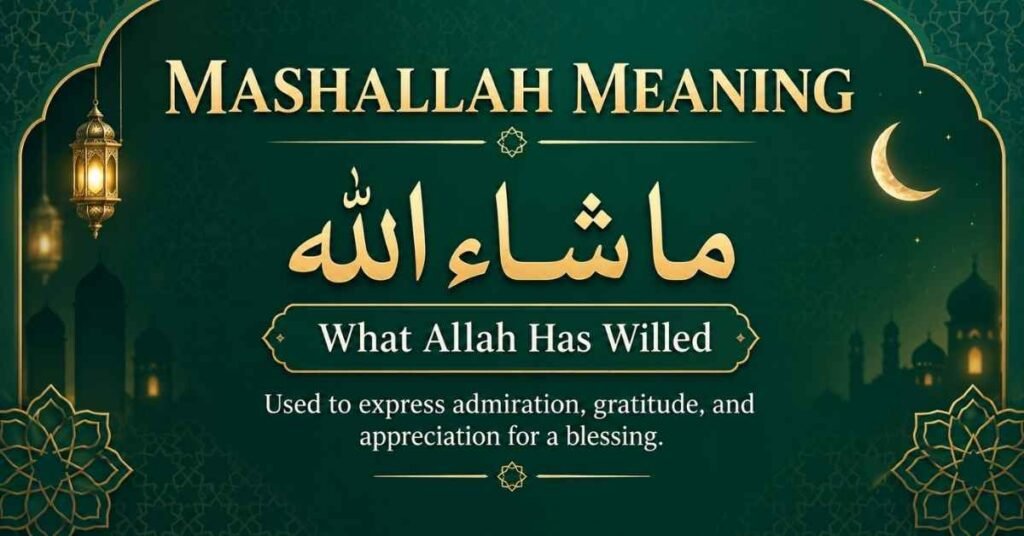
Mashallah meaning is “what Allah has willed” or “what God has willed.” It is an Arabic expression used when admiring something beautiful, celebrating good news, or recognizing a blessing. In everyday conversation, saying mashallah can feel similar to saying “How wonderful,” “What a blessing,” or “That is beautiful,” while acknowledging that the good thing exists through God’s will.
Mashallah is normally a positive and respectful expression. Someone may say it after seeing a healthy baby, hearing about a promotion, attending a wedding, or admiring another person’s home. Muslims also use it to express goodwill without envy, and many communities associate it with protection from the evil eye.
In Arabic, mashallah is written as ما شاء الله. A formal transliteration is mā shāʾ Allāh, although several English spellings are widely understood.
What Does Mashallah Mean?
Mashallah is an Arabic phrase that expresses admiration, appreciation, joy, or gratitude while recognizing Allah’s will.
The phrase has several connected layers:
- Literal meaning: “What Allah has willed”
- Religious meaning: This blessing exists through God’s will
- Emotional meaning: I am happy, amazed, or impressed
- Social meaning: What a wonderful thing
- Protective association: I admire this with goodwill rather than envy
These meanings work together, but they are not identical. “How beautiful” may capture the emotion behind mashallah, but it is not the word-for-word translation.
Mashallah meaning in simple English
In simple English, mashallah means “what God has willed.” People say it when they see or hear about something good and want to acknowledge it as a blessing.
Depending on the situation, it can communicate:
- “How wonderful!”
- “That is beautiful.”
- “What a blessing.”
- “I am impressed.”
- “I am happy for you.”
- “May this goodness continue.”
The last examples describe how the expression functions socially. Its literal meaning remains “what Allah has willed.”
What does it mean when someone says mashallah?
When someone says mashallah, they are usually expressing sincere admiration or happiness.
They may be telling you:
- Your child is beautiful.
- Your achievement is impressive.
- Your news makes them happy.
- Your home or possession is lovely.
- Your success is a blessing.
- They recognize the goodness in your life without envy.
If someone comments “Mashallah ❤️” under your photograph, it is generally a warm and positive response.
Is mashallah a compliment?
Yes, mashallah usually accompanies or functions as a compliment. However, it does not literally mean “beautiful.”
For example:
“Mashallah, you look beautiful.”
Here, “you look beautiful” is the direct compliment. Mashallah frames that praise by recognizing the beauty as something God has willed.
Similarly:
“Mashallah, your baby has such a lovely smile.”
The speaker is admiring the child while expressing goodwill and acknowledging the blessing.
The Literal and Spiritual Meaning of Mashallah
The Arabic expression ما شاء الله contains three main elements:
- Mā: What or that which
- Shāʾa: Willed
- Allah: God
Together, the phrase means approximately:
“What Allah has willed has occurred or exists.”
The expression recognizes that beauty, success, health, talent, and other blessings ultimately exist through God’s will.
What does Allah mean in mashallah?
Allah is the Arabic word for God. It is used by Muslims worldwide and by Arabic-speaking Christians when referring to God.
This distinction matters because Arabic and Muslim are not interchangeable identities:
- Arabic is a language.
- Arab refers to a broad cultural and linguistic identity.
- Muslim refers to a follower of Islam.
- Not all Arabs are Muslim.
- Most Muslims worldwide are not Arab.
Mashallah is Arabic in language and deeply connected with Islamic belief, but its use is not limited exclusively to ethnic Arabs.
Why do Muslims say mashallah?
Muslims say mashallah to:
- Acknowledge Allah’s will
- Recognize a blessing
- Express admiration
- Show gratitude
- Celebrate good news
- Avoid arrogance
- Show goodwill instead of envy
- Remember that success does not exist independently of God
For a religious speaker, mashallah carries more depth than an ordinary “wow.” It joins appreciation with humility.
For example:
“Mashallah, you received an excellent result.”
The speaker celebrates the person’s achievement without denying their effort. At the same time, the phrase recognizes the ability, opportunity, and outcome as blessings from Allah.
Is mashallah a prayer?
Mashallah is primarily an expression acknowledging Allah’s will. It is not structured as a direct request in the same way as a supplication.
However, people may say it with a prayerful intention. In everyday practice, admiration, gratitude, blessing, and protection often appear together.
A related expression is Allahumma barik, meaning approximately:
“O Allah, bless it” or “O Allah, bless them.”
The difference is useful:
- Mashallah acknowledges that a blessing exists through Allah’s will.
- Allahumma barik directly asks Allah to grant or preserve blessing.
A person may use both:
“Mashallah, Allahumma barik.”
This expresses admiration while also asking Allah to bless the person or thing being admired.
Mashallah in the Quran
The wording mā shāʾ Allāh appears in Surah Al-Kahf, verse 39. The verse occurs within the account of two men, one of whom takes pride in his gardens and possessions.
He is reminded that when entering his garden, he should have acknowledged:
“What Allah has willed; there is no power except through Allah.”
The passage connects the expression with:
- Recognizing Allah’s will
- Avoiding arrogance
- Appreciating blessings
- Remembering that wealth and power are not permanent
- Understanding that human ability is dependent on God
The lesson is not limited to praising other people. It also supports acknowledging the blessings in your own life.
What Quran 18:39 teaches about mashallah
The verse offers a practical principle: enjoy and appreciate what you have without acting as if you created every opportunity entirely by yourself.
A person might say mashallah when appreciating:
- Their family
- Their health
- Their home
- Their garden
- Their education
- Their work
- A personal achievement
In this context, mashallah is not false modesty. It combines happiness with humility.
When Should You Say Mashallah?
Say mashallah when you notice something good, beautiful, admirable, successful, or fortunate.
Common occasions include:
- Seeing a beautiful baby
- Hearing good news
- Congratulating someone
- Admiring a new home
- Celebrating a wedding
- Recognizing talent
- Praising an achievement
- Appreciating good health
- Observing your own blessings
The phrase is most meaningful when used sincerely.
When complimenting a baby or child
People commonly say mashallah when admiring a child’s:
- Beauty
- Smile
- Health
- Growth
- Intelligence
- Manners
- Talent
- Achievement
Natural examples include:
“Mashallah, your baby has such a beautiful smile.”
“He has grown so much, mashallah.”
“Mashallah, she is doing wonderfully at school.”
In many Muslim and regional cultures, adding mashallah to praise for a child communicates admiration without jealousy or harmful intention.
When congratulating someone
Mashallah can add spiritual meaning and warmth to congratulations.
You might say it when someone:
- Graduates
- Gets a new job
- Earns a promotion
- Becomes engaged
- Gets married
- Buys a home
- Starts a business
- Completes an important project
Examples:
“Mashallah, congratulations on your graduation.”
“You worked incredibly hard for this promotion—mashallah.”
“Mashallah, your business has grown so much.”
The expression acknowledges the achievement while recognizing it as a blessing.
When admiring someone’s appearance
Mashallah may accompany a respectful compliment about someone’s appearance:
“Mashallah, you look beautiful today.”
“Your wedding dress is lovely, mashallah.”
“Mashallah, that color looks wonderful on you.”
Using a religious expression does not remove ordinary social boundaries. The compliment should still be appropriate for your relationship and setting.
When hearing good news
Mashallah is natural when responding to news about:
- Pregnancy
- Recovery from illness
- Academic success
- Employment
- Engagement
- Marriage
- Family growth
- Business progress
For example:
“Your test results were clear? Mashallah, that is wonderful news.”
“Mashallah, I am so happy to hear about your engagement.”
When admiring your own blessings
You can say mashallah about something in your own life. The phrase is not limited to praising other people.
Examples:
“Mashallah, my garden has grown beautifully this year.”
“My children are doing well, mashallah.”
“Mashallah, the project turned out better than I expected.”
Used this way, mashallah recognizes the blessing without denying your work or responsibility.
Using mashallah on social media
On Instagram, TikTok, Facebook, and other platforms, people often write:
- “Mashallah ❤️”
- “Mashallah, so beautiful!”
- “Mashallah, congratulations.”
- “You did an amazing job, mashallah.”
- “Mashallah, may you always be happy.”
A mashallah comment under a family photograph, wedding post, achievement, or baby picture normally expresses admiration and goodwill.
It does not mean the commenter is calling the person “mashallah.” The expression frames their reaction to what they see.
Mashallah and the Evil Eye
The evil eye is a belief that envy or intense admiration can be associated with harm or misfortune. Versions of this belief appear across numerous religious and cultural traditions.
In many Muslim communities, people say mashallah before or after a compliment to:
- Acknowledge that the blessing comes from Allah
- Express admiration without envy
- Avoid pride
- Show good intentions
- Remember that protection comes from God
For example:
“Mashallah, your child is very talented.”
The speaker communicates admiration while avoiding language that could sound possessive, jealous, or excessively focused on the blessing.
Does saying mashallah prevent the evil eye?
Many Muslims associate saying mashallah with protection from envy and the evil eye. However, the phrase should not be treated as a magical formula or guaranteed shield.
Its literal function is to recognize Allah’s will. In Islamic belief, protection ultimately comes from Allah. People may also use direct prayers and supplications for blessing and protection.
A careful distinction is:
- Mashallah: Recognizes Allah’s will in an existing blessing
- Allahumma barik: Asks Allah to bless the person or thing
- Other prayers may directly seek protection from harm
Cultural habits differ. Some families strongly expect mashallah after a compliment, while others use it less frequently.
Do you have to say mashallah after every compliment?
Customs differ between families and communities. Many Muslims consider it good etiquette to say mashallah when admiring a blessing, especially a child, achievement, home, or appearance.
However, the phrase should encourage gratitude and sincere goodwill, not constant fear. If you forget to say it, do not assume that your innocent compliment automatically caused harm.
You can still offer a kind prayer:
“May Allah continue to bless you.”
Or:
“Allahumma barik.”
Mashallah vs. Allahumma Barik
Although the expressions often appear together, they do not have the same literal meaning.
| Expression | Literal meaning | Main function |
|---|---|---|
| Mashallah | What Allah has willed | Acknowledges an existing blessing |
| Allahumma barik | O Allah, bless [it/them] | Asks Allah to grant or preserve blessing |
Example:
“Mashallah, your daughter is very talented. Allahumma barik.”
The first sentence admires and acknowledges the blessing. The second asks Allah to bless her.
Can Non-Muslims Say Mashallah?
Yes, non-Muslims can generally say mashallah respectfully.
The phrase has significant religious meaning in Islam, but it is also part of everyday speech in many Arabic-speaking and Muslim communities. Some Arabic-speaking Christians and other non-Muslims also use it.
Most people are more concerned with your intention and context than with whether your pronunciation is perfect.
How to use mashallah respectfully
Follow these simple principles:
- Understand its basic meaning.
- Use it when sincerely admiring something good.
- Do not imitate an accent for humor.
- Avoid using it as a religious stereotype.
- Do not pair it with degrading or deliberately offensive content.
- Accept correction politely.
- Use it naturally rather than to display cultural knowledge.
For example, a non-Muslim coworker could respectfully say:
“Mashallah, congratulations on your promotion.”
The wording fits the situation and expresses genuine happiness.
Is saying mashallah cultural appropriation?
Respectful use of mashallah is generally different from cultural appropriation or mockery. Languages naturally share expressions, especially in diverse families, schools, neighborhoods, and workplaces.
The use becomes disrespectful when someone:
- Uses it to imitate Muslims mockingly
- Exaggerates the pronunciation as a joke
- Connects it with offensive stereotypes
- Uses sacred language in a degrading context
- Dismisses its meaning after being corrected
Individual reactions can still vary. If you are speaking within a particular family or community, listen to how its members prefer the expression to be used.
When an English compliment may be better
You do not need to use mashallah in every conversation with a Muslim. A sincere English compliment is better than forced Arabic.
Choose plain English when:
- You do not understand the expression
- The religious wording feels unnatural
- You are using it only to appear culturally knowledgeable
- The recipient has asked you not to use it
- The situation makes the phrase sound like a joke
Respect comes from sincerity, not performance.
How to Pronounce Mashallah
A helpful English pronunciation is:
maa-shaa-Allah
The phrase has three main parts:
- Maa
- Shaa
- Allah
The vowels in mā and shā are held slightly longer than short English vowels. The formal transliteration mā shāʾ Allāh includes an apostrophe-like mark representing a brief Arabic sound or glottal stop.
Beginners should focus on speaking clearly and respectfully. A sincere attempt matters more than producing a perfect native accent.
Common pronunciation mistakes
Common errors include:
- Saying “mash-a-lah” too quickly
- Shortening the long aa sounds
- Swallowing the middle of the phrase
- Stressing every syllable equally
- Exaggerating an Arabic accent
- Confusing mashallah with inshallah
Pronunciation can differ slightly by regional accent, so natural variation is expected.
How Do You Spell Mashallah?
There is no single universal English spelling because the phrase is transliterated from Arabic.
Common spellings include:
- Mashallah
- Masha Allah
- Masha’Allah
- Ma sha Allah
- Ma Shaa Allah
- Mā shāʾ Allāh
Mashallah is widely used and easily understood in English. Mā shāʾ Allāh is a more precise academic transliteration.
Mashallah in Arabic
The Mashallah is commonly written without pronunciation marks as:
ما شاء الله
With fuller marks, it may appear as:
مَا شَاءَ ٱللَّٰهُ
Arabic is written from right to left. Websites should check that the phrase renders correctly rather than displaying the letters in reverse order.
Should mashallah be capitalized?
English capitalization varies.
Capitalize Mashallah when it begins a sentence:
“Mashallah, your home is beautiful.”
Lowercase is acceptable within an ordinary sentence:
“Your home is beautiful, mashallah.”
In separated forms such as masha Allah, writers often capitalize Allah because it is the name used for God.
Mashallah vs. Inshallah
The simplest difference is:
- Mashallah recognizes something good that exists, is visible, or has happened.
- Inshallah refers to something intended, hoped for, or planned in the future.
| Situation | Correct phrase | Example |
|---|---|---|
| Admiring a graduation | Mashallah | “Mashallah, you graduated!” |
| Hoping to graduate | Inshallah | “I will graduate next year, inshallah.” |
| Admiring a present home | Mashallah | “Your home is beautiful, mashallah.” |
| Planning to buy a home | Inshallah | “We will buy a home soon, inshallah.” |
| Celebrating recovery | Mashallah | “You are feeling better, mashallah.” |
| Hoping for recovery | Inshallah | “You will feel better soon, inshallah.” |
A useful memory rule is:
Mashallah notices a blessing. Inshallah looks toward a future possibility.
It is sometimes said that mashallah is only for the past and inshallah is for the future. That shortcut is incomplete. Mashallah is also used for something visible in the present:
“Mashallah, this garden is beautiful.”
Mashallah vs. Alhamdulillah
The Mashallah and alhamdulillah are related but distinct expressions.
- Mashallah: “What Allah has willed”
- Alhamdulillah: “All praise is due to Allah”
Mashallah is often said when admiring or acknowledging a blessing. Alhamdulillah more directly expresses praise and gratitude to Allah.
Example:
“How is your family?”
“They are well, alhamdulillah.”
“Mashallah, I’m glad to hear that.”
The first speaker praises or thanks Allah for the family’s well-being. The second recognizes the good news as a blessing.
A person may also use both:
“Alhamdulillah, I passed my exam. Mashallah, the result was better than I expected.”
Mashallah vs. Subhanallah and Tabarakallah
Several Arabic and Islamic expressions involve praise, gratitude, or remembrance, but they are not interchangeable.
| Phrase | Core meaning | Common use |
|---|---|---|
| Mashallah | What Allah has willed | Admiring or acknowledging a blessing |
| Inshallah | If Allah wills | Discussing a future hope or plan |
| Alhamdulillah | All praise is due to Allah | Expressing gratitude or praise |
| Subhanallah | Glory be to Allah | Expressing awe or affirming God’s perfection |
| Tabarakallah | Blessed is Allah | Praising Allah and recognizing blessing |
| Allahumma barik | O Allah, bless [it/them] | Asking Allah to grant blessing |
What does mashallah tabarakallah mean?
People sometimes say “Mashallah, tabarakallah” when admiring something. Together, the expressions recognize what Allah has willed and praise Allah as the source of blessing.
Usage and preferred wording may differ between communities. The combination should not be presented as a mandatory formula for every compliment.
How to Use Mashallah in a Sentence
Mashallah can appear before or after the main compliment.
Both are natural:
“Mashallah, your baby is beautiful.”
“Your baby is beautiful, mashallah.”
Compliment examples
- “Mashallah, your dress looks beautiful.”
- “Your recitation has improved so much, mashallah.”
- “Mashallah, he is a talented artist.”
- “You look happy and healthy, mashallah.”
Baby and family examples
- “Mashallah, your baby has a lovely smile.”
- “Your family has grown, mashallah.”
- “She is doing wonderfully at school, mashallah.”
- “Mashallah, your children are so kind and respectful.”
Achievement examples
- “Mashallah, you earned an excellent result.”
- “Your business is doing well, mashallah.”
- “Mashallah, congratulations on your promotion.”
- “You completed the project beautifully, mashallah.”
Wedding and engagement examples
- “Mashallah, you make a wonderful couple.”
- “The wedding was beautiful, mashallah.”
- “Mashallah, may your life together be filled with happiness and blessings.”
- “Your engagement photographs are lovely, mashallah.”
Home and possession examples
- “Mashallah, your new home is beautiful.”
- “You have created a wonderful garden, mashallah.”
- “The renovation turned out perfectly, mashallah.”
Mashallah can help frame admiration for a possession as appreciation rather than material comparison.
Social-media and text examples
- “Mashallah ❤️”
- “Mashallah, so happy for you!”
- “You did an amazing job—mashallah.”
- “Mashallah, congratulations to your family.”
Inappropriate uses
Avoid using mashallah:
- To imitate Muslim speech mockingly
- As the punchline to a religious stereotype
- Beside degrading or deliberately offensive content
- To make someone uncomfortable with personal attention
- As a substitute for direct sympathy during a tragedy
- Without understanding its basic meaning
How to Respond When Someone Says Mashallah
There is no single mandatory response to mashallah. A simple acknowledgment is usually sufficient.
Simple English replies
- “Thank you.”
- “That’s very kind.”
- “I appreciate it.”
- “Thank you—I’m grateful.”
- “That means a lot.”
Common Muslim replies
Depending on the situation, someone may say:
- Alhamdulillah: All praise is due to Allah
- JazakAllahu khayran: May Allah reward you with goodness
- BarakAllahu feek: May Allah bless you
- Ameen: Used when the comment includes a prayer or blessing
For example:
“Mashallah, your daughter is very talented.”
“JazakAllahu khayran.”
A natural English response is equally acceptable:
“Thank you. That is very kind of you.”
Replying on social media
You can reply with:
- “Thank you ❤️”
- “Alhamdulillah, thank you.”
- “JazakAllahu khayran.”
- “That’s so kind of you.”
A like or heart reaction may also be enough in an informal conversation.
Common Misunderstandings About Mashallah
Mashallah literally means beautiful
It does not. The literal meaning is “what Allah has willed.” It can function like an expression of admiration when someone sees something beautiful.
Only Arab Muslims can say it
Mashallah is used by Muslims from many linguistic and cultural backgrounds. Some non-Muslim Arabic speakers also use it. Non-Muslims may generally say it respectfully.
Allah is a different God
Allah is the Arabic word for God. Arabic-speaking Christians also use the word. Religions may differ theologically, but the Arabic term itself is not exclusive to everyday Muslim speech.
Mashallah only refers to past events
Mashallah may acknowledge something completed, present, visible, or already realized. Inshallah is normally used for future hopes and plans.
Saying mashallah guarantees protection
Mashallah acknowledges Allah’s will and is associated with protection from envy in many communities. It should not be treated as a magical guarantee.
Only one English spelling is correct
Multiple English spellings exist because transliteration is not perfectly standardized.
You must give a specific reply
No particular response is required in every situation. A sincere “thank you” is appropriate.
LEARN MORE: ICYMI Meaning
The RESPECT Framework for Using Mashallah
Use this framework when you are unsure whether mashallah fits the situation.
R — Recognize its meaning
Understand that the phrase acknowledges something admirable as existing through God’s will.
E — Examine the context
Use it for a genuine blessing, achievement, beautiful quality, or piece of good news.
S — Speak sincerely
Do not use an exaggerated accent or turn the expression into a joke.
P — Preserve its religious significance
Avoid pairing it with degrading, profane, or deliberately offensive content.
E — Expect cultural variation
Muslim and Arabic-speaking communities do not all follow identical customs.
C — Choose clarity when uncertain
A sincere English compliment is better than Arabic used only to impress someone.
T — Thank or respond naturally
The recipient does not need to provide a complicated religious reply.
Frequently Asked Questions
What does mashallah mean in English?
Mashallah means “what Allah has willed” or “what God has willed.” It is commonly used to express admiration, happiness, or appreciation for a blessing.
Does mashallah mean “God bless you”?
Not literally. “God bless you” captures some of its goodwill, but mashallah literally acknowledges what God has willed. Allahumma barik is closer to a direct request for God to bless someone.
Is mashallah a positive phrase?
Yes. In a positive context, mashallah normally expresses admiration, gratitude, congratulations, or appreciation.
Can I say mashallah to a man or woman?
Yes. The phrase can be used when respectfully complimenting a man, woman, child, family, achievement, or possession.
Can you say mashallah about yourself?
Yes. A person can say mashallah while recognizing their own family, health, work, home, or achievement as a blessing.
Should mashallah come before or after a compliment?
Either position can sound natural:
- “Mashallah, your garden is beautiful.”
- “Your garden is beautiful, mashallah.”
Can mashallah be used sarcastically?
Some people use it humorously or sarcastically online. However, sarcastic use may sound disrespectful or confusing because the phrase carries religious significance.
What does mashallah mean on Instagram or TikTok?
It normally means the commenter admires the person, photograph, achievement, child, clothing, or news. It is usually a warm compliment.
What emoji goes with mashallah?
Depending on the context, people may use ❤️, ✨, 🤲, or 😊.
The 🧿 evil-eye symbol is culturally popular, but views about it differ. It should not be described as a universally accepted Islamic symbol.
What happens if I forget to say mashallah?
Do not panic. You can still express sincere goodwill or pray that Allah blesses and protects the person. For a personal religious ruling, consult a qualified scholar you trust.
What Mashallah Ultimately Expresses
Mashallah means “what Allah has willed.” It is said when admiring beauty, celebrating success, hearing good news, or recognizing a blessing. The phrase can be religious, cultural, and conversational at the same time.
You do not need perfect pronunciation to use it respectfully. What matters most is that you understand its basic meaning, choose an appropriate context, and say it with genuine goodwill.
Mashallah does more than praise what you see—it expresses admiration while acknowledging the blessing’s connection to God’s will.
