

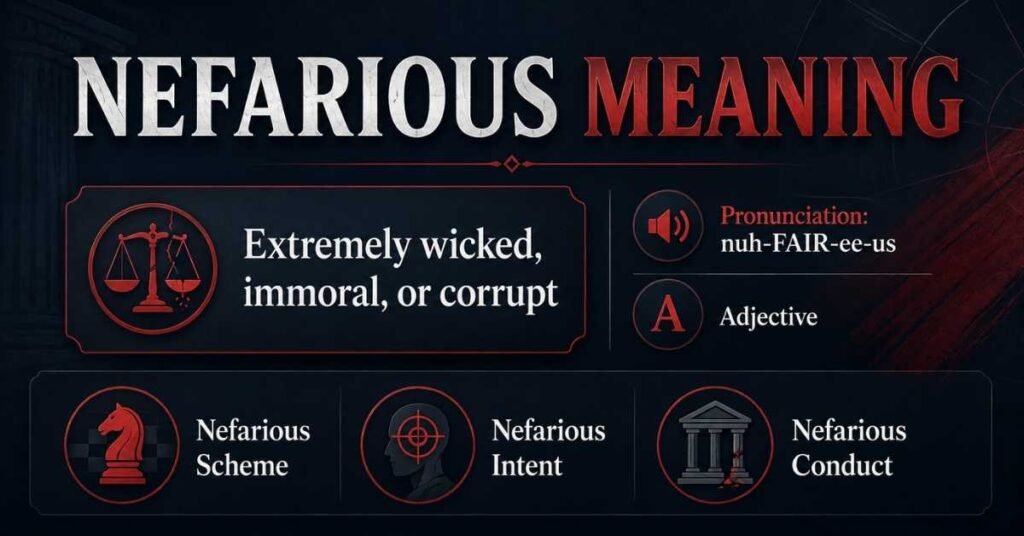
Nefarious meaning refers to something extremely wicked, immoral, corrupt, or deliberately harmful. The adjective usually describes serious wrongdoing, such as a nefarious scheme, plot, purpose, practice, activity, or intention. It is much stronger than simply calling something bad or wrong. In casual situations, people sometimes use the word humorously to make minor mischief sound like the work of a dramatic villain.
| Word detail | Quick answer |
|---|---|
| Meaning | Extremely wicked, immoral, or corrupt |
| Part of speech | Adjective |
| Pronunciation | nuh-FAIR-ee-us |
| Syllables | Four |
| Commonly describes | Schemes, plots, activities, purposes, and intentions |
| Tone | Strong, formal, literary, or dramatic |
| Adverb form | Nefariously |
| Noun form | Nefariousness |
What Does Nefarious Mean?
Nefarious means extremely wicked, immoral, criminal, or corrupt. It usually describes deliberate conduct intended to deceive, exploit, harm, or violate accepted moral standards.
For example, a group that creates a fake charity to steal donations is carrying out a nefarious scheme. The behavior is not merely careless or inappropriate. It involves planning, dishonesty, exploitation, and serious harm.
The word carries a strongly negative connotation. It may suggest:
- Deliberate deception
- Serious moral wrongdoing
- Corruption
- Planned harm
- Criminal activity
- Abuse of power
- Exploitation
- Hidden or dishonest intentions
A simple mistake is not normally nefarious. Neither is an ordinary disagreement, minor inconvenience, or harmless prank. The word is best reserved for behavior that appears flagrantly wicked or morally reprehensible.
How Do You Pronounce Nefarious?
In American English, nefarious is commonly pronounced:
nuh-FAIR-ee-us
The word has four syllables:
ne-FAR-i-ous
The strongest stress falls on the second syllable, which sounds similar to “fair.”
You can practice it in four steps:
- Say “fair.”
- Add a soft “nuh” before it.
- Add “ee-us” afterward.
- Blend the sounds: nuh-FAIR-ee-us.
Phonetic transcriptions may vary slightly across dictionaries because accents and transcription systems differ. The important point is to place the main emphasis on the second syllable rather than the first.
What Kind of Behavior Is Nefarious?
Nefarious behavior is normally seriously immoral, corrupt, exploitative, or deliberately harmful. It is more severe than ordinary bad judgment.
Consider the difference:
- Creating fake accounts to steal people’s passwords is nefarious.
- Forgetting your password is not.
- Hiding dangerous product defects from customers may be nefarious.
- Making an accidental mistake in a product description is not.
- Organizing a fraudulent investment operation is nefarious.
- Giving someone poor financial advice by mistake is not necessarily nefarious.
The word works best when the behavior involves some combination of planning, intent, significance, and harm.
Does Nefarious Always Mean Illegal?
No. Illegal and nefarious describe different aspects of an action.
- Illegal means prohibited by law.
- Nefarious expresses a strong moral judgment.
Many nefarious activities are illegal, including organized fraud, identity theft, bribery, and deliberate exploitation. However, not every illegal act is nefarious. A minor parking violation may be unlawful, but calling it nefarious would usually sound excessive.
Likewise, behavior can appear deeply unethical or exploitative even when its legal status has not been established. In that situation, a writer might describe the conduct as nefarious, but the word should be used carefully because it makes a serious accusation.
Does Nefarious Imply Intent?
The definition does not always state that intent is required. In natural usage, however, nefarious often suggests deliberate wrongdoing.
This implied intentionality explains why the adjective regularly appears with words such as:
- Plot
- Scheme
- Plan
- Purpose
- Motive
- Intention
- Operation
These nouns involve thought, preparation, or a defined objective. A person carrying out a nefarious plot usually understands what they are doing and intends to deceive or harm someone.
How to Use Nefarious in a Sentence
Nefarious is an adjective, so it modifies a noun. It usually appears immediately before the person, action, plan, or purpose it describes:
Nefarious + noun
Here are natural examples from several contexts.
Crime and Fraud
- “Investigators uncovered a nefarious scheme to steal customers’ identities.”
- “The organization used shell companies for nefarious purposes.”
- “Police disrupted a nefarious operation involving stolen credit cards.”
- “The group obtained personal information through nefarious means.”
Technology and Cybersecurity
- “The browser extension secretly collected passwords for nefarious actors.”
- “Hackers used the stolen data for nefarious activities.”
- “Any powerful technology can be exploited for nefarious purposes.”
- “The link installed malicious software designed to support a nefarious plan.”
Business and Politics
- “The audit exposed several nefarious practices inside the company.”
- “Critics accused the officials of hiding their nefarious intentions.”
- “Investigators found no evidence supporting claims of a nefarious plot.”
- “The executive used his authority to conceal the company’s nefarious conduct.”
Fiction and Storytelling
- “The detective discovered the mayor’s nefarious scheme before it could succeed.”
- “The villain concealed his nefarious motives behind a charming personality.”
- “Her friendly invitation was part of a more nefarious plan.”
- “The hero entered the warehouse hoping to stop the group’s nefarious operation.”
Playful Exaggeration
Nefarious can also be used humorously:
- “The cat developed a nefarious plan to steal my dinner.”
- “My brother had a nefarious scheme to take the last slice of pizza.”
- “The puppy returned with nefarious intentions toward my new shoes.”
These actions are not genuinely evil. The humor comes from describing trivial mischief with an extremely serious and dramatic word.
Common Words Used With Nefarious
Certain words appear naturally with nefarious because they involve intent, conduct, or an organized purpose.
| Common phrase | What it usually suggests |
|---|---|
| Nefarious scheme | An organized plan to deceive, exploit, or harm |
| Nefarious plot | A secret plan involving serious wrongdoing |
| Nefarious activity | Immoral, corrupt, or criminal conduct |
| Nefarious intent | A deliberately harmful purpose |
| Nefarious purpose | An immoral reason for an action |
| Nefarious practices | Repeated unethical or corrupt behavior |
| Nefarious actors | People or groups carrying out harmful actions |
| Nefarious means | Immoral methods used to achieve a goal |
| Nefarious conduct | Flagrantly improper behavior |
| Nefarious operation | Coordinated harmful or criminal activity |
| Nefarious motives | Hidden reasons involving wrongdoing |
| Nefarious deeds | Wicked or morally reprehensible actions |
Learning these common collocations is more helpful than memorizing the definition alone. They show how native English speakers naturally place the adjective in a sentence.
Can You Call a Person Nefarious?
Yes, a person can be described as nefarious, especially when they repeatedly engage in serious wrongdoing.
For example:
“The investigator exposed a nefarious businessman who had defrauded hundreds of customers.”
However, describing the person’s specific actions is often clearer:
“The businessman organized a nefarious investment scheme that defrauded hundreds of customers.”
The second version is more informative because it identifies the conduct behind the judgment.
This distinction matters when discussing a real person, company, or organization. Calling someone nefarious can function as a serious accusation. In careful factual writing, distinguish among:
- Proven conduct
- Formal allegations
- Someone’s opinion
- Unverified suspicion
Instead of writing, “The company has a nefarious agenda,” a responsible writer might say:
“Critics accused the company of concealing its financial motives.”
The revised sentence attributes the accusation instead of presenting it as an established fact.
Nefarious vs. Similar Words
The Nefarious has many synonyms, but they do not all communicate the same idea.
| Word | Primary emphasis | Strength | Example |
|---|---|---|---|
| Nefarious | Flagrant moral wrongdoing | Very strong | A nefarious fraud scheme |
| Evil | Broad, profound wickedness | Very strong | An evil act |
| Malicious | Intention to cause harm | Strong | Malicious software |
| Sinister | Threatening or suggestive of evil | Strong | A sinister warning |
| Corrupt | Betrayal of integrity for personal gain | Strong | A corrupt official |
| Heinous | Shockingly horrible conduct | Very strong | A heinous crime |
| Notorious | Famous for something bad | Varies | A notorious criminal |
| Mischievous | Playful or minor trouble | Mild | A mischievous child |
| Unethical | Violation of professional or moral standards | Moderate | Unethical business practices |
| Shady | Suspicious or dishonest | Mild to moderate | A shady deal |
Nefarious vs. Evil
Evil is a broad word for profound moral wickedness. It can describe a person, act, force, intention, or abstract idea.
Nefarious often points to a more specific scheme, activity, purpose, or pattern of corrupt behavior.
- “The dictator committed evil acts.”
- “The dictator developed a nefarious plan to silence opponents.”
The second sentence focuses on organized and deliberate wrongdoing.
Nefarious vs. Malicious
Malicious emphasizes an intention to cause harm. Nefarious emphasizes extreme immorality or corruption.
- “The attacker installed malicious software.”
- “The group used the software as part of a nefarious fraud operation.”
Malicious is particularly common in cybersecurity because it describes harmful code, files, links, and attacks. Nefarious works well when discussing the broader purpose or people behind the attack.
Nefarious vs. Sinister
Sinister describes something that appears threatening, ominous, or suggestive of evil. It can create suspicion before wrongdoing has been proven.
- “A sinister figure waited outside the house.”
- “Police uncovered the figure’s nefarious plan.”
The figure may look sinister. The proven plan is nefarious.
Nefarious vs. Notorious
These words are sometimes confused because both are negative, but they have different meanings.
Notorious means widely known for something bad:
“He was a notorious bank robber.”
Nefarious means extremely wicked or corrupt:
“He participated in a nefarious money-laundering scheme.”
A person can be both notorious and nefarious, but the words are not interchangeable.
Nefarious vs. Mischievous
Mischievous behavior is playful, troublesome, or mildly disobedient. Nefarious behavior is seriously immoral.
- A child hiding a sibling’s toy is mischievous.
- An adult stealing a child’s identity is nefarious.
Using nefarious for harmless mischief works only when the exaggeration is clearly humorous.
Nefarious vs. Heinous
Heinous emphasizes that an act is shockingly horrible or deserving of strong condemnation. It frequently modifies words such as crime and murder.
Nefarious often emphasizes a wicked plan, purpose, scheme, or ongoing operation.
- “The court sentenced him for a heinous crime.”
- “The investigation revealed the nefarious scheme behind it.”
Nefarious vs. Corrupt
Corrupt suggests that someone has betrayed their integrity, duties, or position for improper gain.
Nefarious makes a broader judgment that the conduct is flagrantly wicked.
- “The official accepted bribes and was found to be corrupt.”
- “The official participated in a nefarious effort to manipulate the election.”
Synonyms for Nefarious
The best synonym depends on what you want to emphasize.
General Wickedness
- Evil
- Wicked
- Villainous
- Vile
- Depraved
- Iniquitous
Harmful Intent
- Malicious
- Malevolent
- Spiteful
- Hostile
Corruption or Dishonesty
- Corrupt
- Unscrupulous
- Dishonest
- Underhanded
- Deceitful
Shockingly Serious Wrongdoing
- Heinous
- Atrocious
- Abominable
- Monstrous
Suspicious or Threatening Appearance
- Sinister
- Shady
- Ominous
- Menacing
A writer should choose according to severity, intent, legality, evidence, and tone. For example, “shady” may fit an informal conversation, while “unethical” is often better in a neutral professional report.
Antonyms for Nefarious
Common antonyms include:
- Honest
- Ethical
- Moral
- Honorable
- Virtuous
- Upright
- Lawful
- Benevolent
- Decent
- Trustworthy
The best opposite depends on the noun:
- Opposite of a nefarious scheme: an honest plan
- Opposite of nefarious conduct: ethical conduct
- Opposite of a nefarious person: an upright person
- Opposite of a nefarious purpose: a benevolent purpose
- Opposite of nefarious practices: lawful or responsible practices
When Nefarious Is the Wrong Word
Because nefarious is so strong, using it carelessly can make your writing sound melodramatic.
An Accidental Mistake
Unnatural:
“The accountant made a nefarious error.”
Better:
“The accountant made a serious calculation error.”
If the accountant deliberately changed the figures to deceive investors, then the conduct could reasonably be described as nefarious.
A Minor Rule Violation
Excessive:
“Parking there was a nefarious act.”
Better:
“Parking there violated the posted restrictions.”
A minor rule violation is not normally serious enough to deserve such a strong moral label.
Suspicious but Unproven Conduct
Potentially unfair:
“The business owner has nefarious motives.”
More careful:
“Customers questioned why the owner had not disclosed the additional fees.”
The second sentence describes the evidence instead of assuming hidden evil.
Ordinary Carelessness
Incorrect:
“Her nefarious spelling mistakes made the report difficult to read.”
Better:
“Her repeated spelling errors made the report difficult to read.”
Spelling errors may be careless, but they are not morally wicked.
Harmless Mischief
A prank is normally mischievous, not nefarious. You can still use nefarious if the dramatic exaggeration is clearly intended as a joke.
Use the WISH Test Before Choosing “Nefarious”
Before using the word, apply the WISH test:
- W — Wicked: Is the behavior seriously morally wrong?
- I — Intentional: Was it planned or knowingly carried out?
- S — Significant: Is it more serious than an ordinary mistake?
- H — Harmful: Does it exploit, deceive, corrupt, or harm others?
If most answers are yes, nefarious may be appropriate.
If they are not, choose a more accurate alternative:
- Careless for an unintentional mistake
- Mischievous for playful trouble
- Suspicious when the facts remain uncertain
- Unethical for a breach of professional standards
- Illegal when legal status is the main issue
- Malicious when intent to cause harm is central
- Corrupt when someone betrays a duty for improper gain
- Shady for informal descriptions of suspicious behavior
This framework prevents the word from becoming empty dramatic decoration.
Is Nefarious Formal, Literary, or Old-Fashioned?
Nefarious is standard modern English, but it is more common in writing than in everyday conversation.
The word often appears in:
- News reports
- Political commentary
- Crime writing
- Cybersecurity discussions
- Business investigations
- Thrillers
- Fantasy stories
- Historical writing
It can sound formal, literary, dramatic, or rhetorical. In casual speech, an American speaker might instead use:
- Evil
- Corrupt
- Shady
- Dishonest
- Really bad
- Up to no good
Nefarious is not obsolete, but it is emotionally charged. It strengthens writing when the conduct is serious and the strong moral judgment is intentional. It creates melodrama when used for an ordinary error, inconvenience, or disagreement.
LEARN MORE: ETA Meaning
Nefarious, Nefariously, and Nefariousness
The Nefarious belongs to a small word family.
| Word | Part of speech | Meaning | Example |
|---|---|---|---|
| Nefarious | Adjective | Extremely wicked or corrupt | “They uncovered a nefarious scheme.” |
| Nefariously | Adverb | In a wicked or corrupt manner | “The organization acted nefariously.” |
| Nefariousness | Noun | The quality of being nefarious | “The plan’s nefariousness became clear.” |
Nefarious is the most natural and widely used form.
“Nefariously” and “nefariousness” are grammatically correct, but they can sound formal or awkward. Depending on the sentence, words such as corruptly, wickedly, corruption, wrongdoing, or immorality may sound more natural.
Where Does the Word Nefarious Come From?
Nefarious has a Latin origin.
It is connected to the Latin word nefas, which referred to a crime, impiety, or violation of divine or moral law. That term combined the idea of “not” with what was considered right or permitted by moral law.
The related Latin adjective nefarius meant wicked, vile, or criminal. English adopted “nefarious” during the sixteenth century.
This history explains why the modern word feels much stronger than “wrong,” “unpleasant,” or “incorrect.” Its roots concern behavior that violates fundamental ideas of what is morally right.
What Does the Movie Title Nefarious Mean?
Nefarious is also the title of a 2023 American horror-thriller film. In the title, the word carries its standard sense of wicked, evil, or morally corrupt.
Capitalization and context help distinguish the title from the ordinary adjective:
- “The criminal developed a nefarious plan.” — adjective
- “We watched Nefarious last night.” — film title
Someone searching for information about the movie may want its plot, cast, reviews, or streaming availability. Those are separate from the dictionary meaning of the word.
Frequently Asked Questions
What Does Nefarious Mean in Simple Words?
Nefarious means extremely wicked, immoral, or corrupt. It describes serious wrongdoing rather than an ordinary mistake. A plan created to deceive and exploit vulnerable people could be called a nefarious scheme.
Is Nefarious Positive or Negative?
Nefarious is an extremely negative word. It expresses strong moral condemnation and suggests that a person, purpose, activity, or scheme is wicked, corrupt, or deliberately harmful.
What Part of Speech Is Nefarious?
Nefarious is an adjective. It modifies nouns, as in “nefarious scheme,” “nefarious activity,” and “nefarious purpose.” Its adverb form is “nefariously,” while its noun form is “nefariousness.”
Can a Person Be Nefarious?
Yes. A person who repeatedly commits serious immoral or criminal acts can be described as nefarious. However, identifying the person’s specific conduct is usually clearer than making a broad judgment about their character.
What Is an Example of Nefarious Behavior?
Creating a fake investment company to steal people’s savings is an example of nefarious behavior. It involves planning, deception, exploitation, and substantial harm.
Does Nefarious Mean Illegal?
Not exactly. Illegal means prohibited by law, while nefarious means extremely wicked or corrupt. Many nefarious acts are illegal, but a minor legal violation is not necessarily nefarious.
Does Nefarious Imply Harmful Intent?
It often does in ordinary usage. Nefarious frequently modifies words such as scheme, plan, motive, intent, and purpose, all of which suggest planning or deliberate action.
Is Nefarious Stronger Than “Bad”?
Yes. “Bad” can describe anything from disappointing weather to immoral behavior. Nefarious is reserved for conduct that is seriously wicked, corrupt, exploitative, or deliberately harmful.
Is Nefarious the Same as Evil?
The words are related, but evil is broader. Nefarious often describes a specific plan, purpose, activity, or pattern of flagrantly immoral conduct.
Can Nefarious Be Used Humorously?
Yes. Calling a cat’s attempt to steal food a “nefarious plot” is humorous because the word’s extreme moral seriousness contrasts with the harmless behavior.
Is Nefarious an Old-Fashioned Word?
No. Nefarious remains part of modern English, particularly in news reports, political commentary, crime writing, cybersecurity, and fiction. However, it can sound formal or dramatic in everyday conversation.
What Is the Opposite of Nefarious?
Possible antonyms include honest, ethical, moral, honorable, virtuous, upright, lawful, benevolent, and trustworthy. The best choice depends on the noun being described.
Final Takeaway
Nefarious means extremely wicked, immoral, corrupt, or deliberately harmful. It most naturally describes serious wrongdoing through phrases such as nefarious scheme, plot, purpose, intent, activity, and practice. Because the word carries a powerful moral judgment, it is usually too strong for ordinary mistakes or harmless mischief unless you are using it humorously. If “unethical” feels too mild and the conduct involves deliberate, significant harm or corruption, nefarious may be the precise word you need.
