

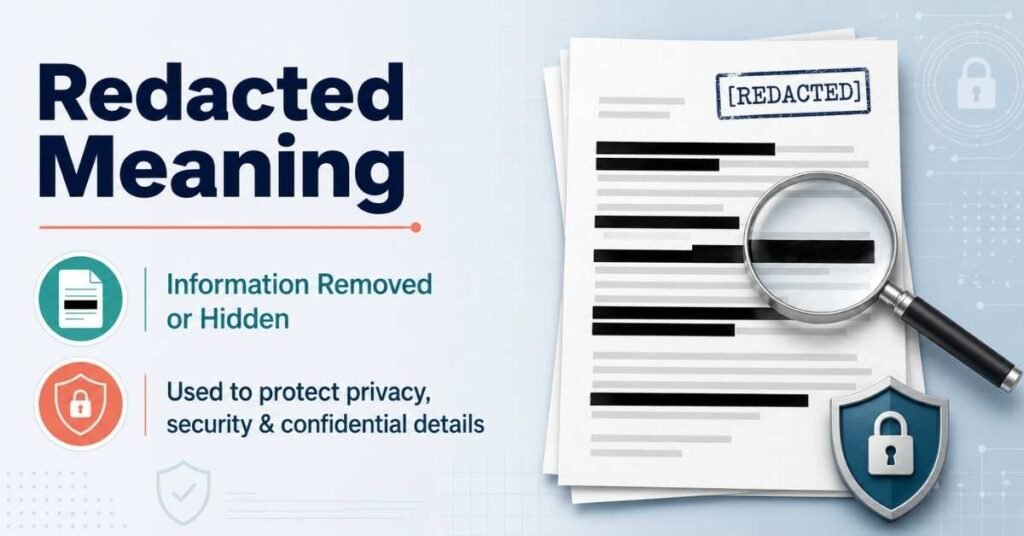
Redacted meaning refers to information that has been deliberately removed, hidden, blacked out, or obscured before a document, image, message, or recording is shared. People redact content to protect private details, confidential business information, crime victims, court records, or classified government material. In simple terms, if something is marked [REDACTED], you are being shown a version from which selected information has been withheld.
Redaction does not automatically mean someone is hiding wrongdoing. In many situations, it protects a person’s privacy, safety, identity, or legal rights while allowing the rest of the information to remain available.
What Does Redacted Mean in Simple Words?
Redacted means edited to hide or remove particular information. Instead of keeping an entire document secret, the person or organization responsible for it conceals only the protected portions and releases the rest.
Imagine that a court wants to publish a legal document containing someone’s home address. The court may hide the address but leave the person’s name and the rest of the case information visible. The document available to the public is the redacted version.
The complete document may still exist as an unredacted version, but access to it is normally restricted.
Redacted Meaning at a Glance
| Detail | Explanation |
|---|---|
| Word | Redacted |
| Simple meaning | Edited to hide or remove selected information |
| Root word | Redact |
| Part of speech | Adjective; past tense and past participle of redact |
| Pronunciation | rih-DAK-tid |
| Related noun | Redaction |
| Opposite | Unredacted |
| Common appearance | [REDACTED], black bars, blank spaces, or initials |
A Simple Redaction Example
Original sentence:
Emma Carter lives at 214 Pine Street in Denver.
Publicly shared version:
Emma Carter lives at [REDACTED] in Denver.
In this example, the street address was removed to protect Emma’s privacy. The remaining information can still be read and understood.
What Does [REDACTED] Mean?
When [REDACTED] appears inside square brackets, it indicates that information existed in that location but was deliberately withheld from the version you are viewing.
The missing content could be:
- A person’s name
- A home address
- An account number
- A confidential statement
- A password or access credential
- A classified detail
- A trade secret
- Information about a minor
- A crime victim’s identity
Redacted content does not always appear as a word inside brackets. It may be replaced with black bars, blank spaces, asterisks, initials, pixelation, blurred faces, or muted audio.
The method depends on the material being shared. Words can be removed from a PDF, a face can be blurred in a photograph, and identifying information can be muted in an audio recording.
What Does Heavily Redacted Mean?
A heavily redacted document contains numerous or extensive hidden sections. Several names, sentences, paragraphs, or even complete pages may be obscured.
This phrase commonly appears in news reports about court records and government files:
The agency released a heavily redacted copy of the investigation report.
Extensive redactions naturally make readers curious or suspicious. However, the number of hidden sections does not prove misconduct. Different passages may have been withheld for separate reasons, including personal privacy, national security, attorney-client privilege, or an active investigation.
Why Is Information Redacted?
Redaction allows an organization to balance transparency with privacy and security. Instead of withholding an entire record, it can release the safe portions while protecting sensitive details.
To Protect Personal Privacy
Public documents can contain information that criminals could exploit for identity theft, fraud, harassment, or unauthorized account access.
Commonly redacted personal information includes:
- Social Security numbers
- Financial account numbers
- Credit card details
- Dates of birth
- Home addresses
- Phone numbers
- Email addresses
- Medical information
- Signatures
- Login credentials
For example, a financial statement may display only the final four digits of an account number.
To Protect Children, Victims, and Witnesses
Courts, government agencies, and news organizations may redact details that could identify:
- Children
- Crime victims
- Confidential informants
- Vulnerable witnesses
- People receiving protected medical services
- Individuals facing a credible safety risk
A child’s full name may be replaced by initials, while a victim’s address and contact information may be removed completely.
These redactions protect real people from unwanted exposure, retaliation, harassment, or further harm.
To Preserve Legal Confidentiality
Lawyers and courts regularly handle material that cannot be placed in an unrestricted public record.
Protected information may include:
- Attorney-client communications
- Trade secrets
- Confidential settlement terms
- Sealed evidence
- Proprietary business information
- Details outside the permitted scope of disclosure
A redacted copy makes it possible to share relevant evidence without unnecessarily exposing unrelated or privileged information.
To Protect Investigations and National Security
Government agencies may withhold information when public disclosure could compromise:
- An active criminal investigation
- Intelligence sources
- Surveillance methods
- Security procedures
- Military operations
- Law-enforcement techniques
- Public safety
- Classified programs
However, redacted and classified do not mean exactly the same thing. Classified information is formally restricted for national-security reasons. Information can be redacted for many other reasons, including ordinary personal privacy.
To Follow Privacy and Disclosure Rules
Different laws and court rules govern the protection and disclosure of sensitive information. Relevant U.S. contexts can include:
- Federal court privacy rules
- Freedom of Information Act requests
- State public-record laws
- Medical privacy requirements
- Financial-data protections
- Court sealing orders
The applicable requirements depend on the jurisdiction, record type, and reason for disclosure. Not every organization follows the same redaction process.
What Does Redacted Mean in Different Contexts?
Although the core definition remains the same, the reason and effect of redaction can change according to the situation.
Redacted Meaning in Legal Documents
In a legal document, redacted means protected information has been removed or obscured from the copy being disclosed or filed publicly.
Redaction may appear in:
- Court filings
- Police reports
- Witness statements
- Legal discovery
- Contracts
- Evidence
- Judicial opinions
- Settlement documents
For example:
The attorney submitted a redacted copy of the medical report to protect the patient’s identity.
U.S. court rules commonly limit the public display of identifiers such as full Social Security numbers, account numbers, birth dates, and minors’ names. Exact requirements can differ between civil cases, criminal cases, and individual courts.
Redacted Meaning in Government Records
Government records may be released with selected information withheld because it falls under a recognized disclosure exemption.
A public version might conceal:
- Intelligence sources
- Law-enforcement methods
- Private personal information
- Confidential business material
- Details affecting an active investigation
- Information protected by another law
Under the Freedom of Information Act, federal agencies may release a record while redacting portions covered by applicable exemptions. This enables partial disclosure rather than requiring the agency to withhold the complete document.
In certain circumstances, a requester may ask for clarification or challenge an agency’s decision to withhold information.
Redacted Meaning in News Reports
In journalism, redaction may protect a confidential source, victim, child, or private individual. News organizations may remove a name, blur a face, hide an address, or omit identifying details from a leaked document.
For example:
The newspaper published the email with the employee’s phone number redacted.
A newsroom may also withhold information for safety or verification reasons. That editorial decision is different from an official government redaction, even if the visible result looks similar.
Redacted Meaning in Medical and Financial Documents
Medical and financial records contain information that could seriously harm someone if exposed.
Organizations may redact:
- Patient names
- Medical record numbers
- Insurance details
- Diagnoses connected to identifiable individuals
- Bank account numbers
- Taxpayer identification numbers
- Transaction details
- Credit card information
A hospital sharing a report for research purposes, for example, may remove the patient’s identifying details while preserving relevant medical data.
Redacted Meaning in Emails and Workplace Files
Workplace files may contain employee records, internal investigations, confidential contracts, customer information, passwords, or proprietary business plans.
Before sending a file to an outside party, a company may create a redacted copy that removes information the recipient does not need.
For example:
The manager shared the complaint with the witness’s personal details redacted.
This protects confidentiality while allowing the recipient to understand the relevant issue.
Redacted Meaning in Text Messages and Social Media
In a text message or social-media post, [REDACTED] usually means the writer has intentionally hidden a name, statement, place, or other detail.
It may be used seriously:
I removed the customer’s email address and replaced it with
[REDACTED].
It may also be humorous:
I went to dinner with
[REDACTED], but I’m not naming names.
In casual online communication, the word often creates secrecy, suspense, or playful mystery. It does not necessarily indicate that a formal redaction process occurred.
Redacted Meaning in Slang, Memes, and Games
In internet slang, memes, games, and fictional stories, redacted often suggests that information is forbidden, dangerous, embarrassing, or too secret to reveal.
Writers may use it to imitate classified government records:
The creature was last seen near Facility
[REDACTED].
This style is especially common in fictional archives, conspiracy-themed entertainment, role-playing communities, and SCP-inspired storytelling. The dramatic use comes from the real appearance of classified and confidential documents.
Redacted vs. Deleted, Censored, Classified, and Confidential
These words are related, but they are not always interchangeable.
| Term | Core meaning | Typical result |
|---|---|---|
| Redacted | Selected information is hidden or removed from a shared version | The remaining material can still be viewed |
| Deleted | Content is removed from a file, message, or system | The content may no longer appear there |
| Censored | Content or expression is suppressed or restricted | Publication or communication is limited |
| Classified | Government information receives restricted security status | Access is limited to authorized people |
| Confidential | Information is intended for limited recipients | The material remains private |
| Expunged | An official record is erased or legally treated as removed | Its legal status or availability changes |
| Anonymized | Identifying details are removed or transformed | Information should no longer identify a person |
Does Redacted Mean Deleted?
Redacted does not always mean deleted.
The information may remain in the protected original while being removed from the public copy. A court, attorney, government agency, or document owner may retain an unredacted document that authorized individuals can access.
However, in a properly prepared digital copy, redacted data should be removed in a way that prevents an unauthorized reader from accessing the underlying information.
Is Redacted the Same as Censored?
Redacted and censored overlap, but they are not identical.
Redaction normally removes selected details from material that is otherwise released. Censorship is a broader restriction on speech, images, publication, or communication.
For example:
- Removing a victim’s address from a police report is redaction.
- Preventing an entire article from being published may be censorship.
Purpose and context determine which term is more accurate.
Does Redacted Mean Classified?
No. Classified describes government information with an official security designation. Redacted describes the action or result of hiding selected material.
Classified details may be redacted before a government report is released, but nonclassified information can also be redacted. A child’s name, patient’s medical information, or customer’s account number may be sensitive without being classified.
Can Redacted Information Be Recovered?
Properly redacted information should not be recoverable from the released file. However, content that was merely covered, highlighted, recolored, or blurred may remain accessible.
This distinction is critical. A document can look redacted without being securely redacted.
Visual Hiding Is Not Always Secure Redaction
Unsafe methods include:
- Drawing a black rectangle over text
- Changing the font color to white
- Using an ordinary highlighting tool
- Cropping an image without removing hidden areas
- Leaving comments or annotations in the file
- Forgetting tracked changes
- Failing to remove searchable OCR text
- Sharing the original instead of the sanitized copy
Someone may be able to select, copy, search, or uncover text that remains beneath a visual overlay.
Information That May Remain Inside a File
Digital files can retain more than the reader sees on the screen. Hidden material may remain in:
- Metadata
- Text layers
- Comments
- Annotations
- Embedded objects
- Revision history
- Document properties
- OCR-generated text
- Previous versions
That is why real redaction requires more than placing a black box over a sentence.
Context Can Still Reveal Clues
Even when a document is securely redacted, surrounding details may allow readers to make educated guesses.
Clues can come from:
- Sentence structure
- The length of the hidden section
- Dates
- Locations
- Repeated references
- Visible names
- Previously published information
Inferring a word from context is different from technically recovering data that remained inside the file.
How to Redact a Document Safely
If you need to share a document containing private information, use a proper redaction feature and carefully review the exported copy.
The following S.A.F.E. redaction framework provides a practical starting point.
Select the Information
Identify precisely what should be protected. Depending on the file, this might include names, addresses, signatures, account numbers, health information, or trade secrets.
Avoid automatically hiding more information than necessary. Excessive redaction can make a document confusing or useless.
Apply a Genuine Redaction Tool
Use a dedicated redaction function in reputable document software. Do not rely on an ordinary drawing, marker, or highlighting tool.
Review:
- Visible text
- Images
- Headers and footers
- Signatures
- Scanned pages
- Attachments
- Repeated identifying details
Flatten and Sanitize the Released Copy
Remove or inspect hidden layers, comments, annotations, metadata, and revision information. Export a separate copy intended for sharing.
Keep the protected original in a secure, access-controlled location. Avoid overwriting it unless your organization’s document-retention policy specifically requires that action.
Examine the Final File
Open the exported document as if you were the recipient.
Try to:
- Search for the removed words
- Select and copy the redacted area
- Review document properties
- Inspect comments and annotations
- Check every page
- Confirm that the correct file is attached
For sensitive legal or business records, a second authorized person should review the final version.
Pre-Sharing Redaction Checklist
- [ ] The correct information has been selected.
- [ ] Underlying text has been removed from the shared copy.
- [ ] Comments and annotations have been inspected.
- [ ] Metadata has been reviewed.
- [ ] Searchable OCR text has been checked.
- [ ] The filename does not reveal private information.
- [ ] Every page has been reviewed.
- [ ] The copy-and-paste test has been completed.
- [ ] The final exported file has been reopened.
- [ ] The original is stored separately and securely.
Who Decides What Gets Redacted?
The person or organization responsible depends on the material.
Redaction decisions may be made by:
- Courts
- Judges
- Attorneys
- Government agencies
- Public-records officers
- Healthcare organizations
- Employers
- Journalists
- Publishers
- Document owners
- Privacy and compliance teams
These decisions may be governed by law, a court order, an organizational policy, or professional judgment.
A person cannot always hide information simply because it is inconvenient or embarrassing. Conversely, a public-record request does not automatically entitle the requester to every detail in an unredacted form.
Can You Challenge a Redaction?
In some circumstances, a government or public-record redaction can be challenged.
A general process may involve:
- Identifying the exemption or reason provided
- Asking the agency for clarification
- Requesting a less-redacted version
- Filing an administrative appeal
- Seeking qualified legal guidance when necessary
The available procedure depends on the agency, jurisdiction, record, and law involved. Private individuals and companies generally have different disclosure obligations from public agencies.
This information is educational and should not replace advice from a qualified attorney.
Examples of Redacted in Sentences
Everyday Examples
- “I sent the landlord a redacted copy of my bank statement.”
- “Her account number was redacted before the form was shared.”
- “The public version contains several redacted passages.”
Legal Examples
- “The attorney redacted the child’s name from the court filing.”
- “The judge reviewed the unredacted report in private.”
- “The witness’s address was redacted to protect her safety.”
Government and News Examples
- “The agency released hundreds of pages, but several sections were heavily redacted.”
- “The reporter published the email with the source’s contact information redacted.”
- “Classified details were redacted before the report became public.”
Online and Humorous Examples
- “I met
[REDACTED]after work, but I promised not to tell anyone.” - “The secret ingredient is
[REDACTED].” - “My weekend plans involve pizza, movies, and one highly redacted decision.”
The formal examples refer to genuine information protection. The humorous examples use the appearance of official secrecy to create curiosity or amusement.
Word Forms, Pronunciation, and Grammar
| Form | Part of speech | Meaning | Example |
|---|---|---|---|
| Redact | Verb | To hide or remove selected information | “Please redact the address.” |
| Redacts | Verb | Third-person present form | “The agency redacts private details.” |
| Redacted | Adjective or verb form | Hidden, removed, or edited | “We received a redacted copy.” |
| Redacting | Present participle | Performing the action | “She is redacting the file.” |
| Redaction | Noun | The process or result | “The redaction protected his identity.” |
| Unredacted | Adjective | Containing details omitted elsewhere | “The court reviewed the unredacted record.” |
How to Pronounce Redacted
The American pronunciation is approximately:
rih-DAK-tid
The strongest emphasis falls on the second syllable: DAK.
Synonyms and Related Words
Possible synonyms and near-synonyms include:
- Obscured
- Concealed
- Withheld
- Masked
- Removed
- Blacked out
- Sanitized
- Anonymized
- Censored
These words do not have identical meanings in every situation. For example, anonymization focuses on preventing identification, while redaction refers more broadly to withholding selected information.
Antonyms of Redacted
Depending on the context, antonyms include:
- Unredacted
- Disclosed
- Revealed
- Visible
- Published
- Uncensored
LEARN MORE: Sapiosexual Meaning
Common Misunderstandings About Redaction
“A Redaction Proves Someone Is Hiding Wrongdoing”
Not necessarily. Many redactions are used to protect children, victims, medical records, financial information, or legitimate security interests.
Excessive redaction can raise fair transparency questions, but the presence of black bars alone is not proof of misconduct.
“A Black Box Means the Information Is Gone”
A black box may only hide the text visually. If the underlying text layer remains in the file, someone may still be able to select, copy, search, or extract it.
Secure redaction removes access to the underlying information in the released copy.
“The Original Document No Longer Exists”
A redacted public copy does not necessarily replace the original. Courts, attorneys, agencies, and businesses may retain a protected unredacted version for authorized use.
“Anything Confidential Is Automatically Redacted”
Confidentiality and redaction are related but different. Confidential describes information intended for limited access. Redaction is an action used to remove or hide selected details before disclosure.
“All Redactions Are Legally Required”
Some redactions are required by law or court rules. Others are permitted under disclosure exemptions, company policies, contracts, or editorial decisions.
Frequently Asked Questions
What does redacted mean in one sentence?
Redacted means that selected information has been intentionally hidden or removed before a document, image, message, or recording is shared.
What does [REDACTED] mean in brackets?
It shows that information existed in that location but was deliberately withheld. The missing content might be a name, address, confidential statement, security detail, or humorous secret.
What does redacted mean in a text message?
In a text message, redacted usually means the sender has intentionally hidden a name, statement, place, or other detail. The term may be used seriously to protect privacy or jokingly to create mystery.
What does redacted mean in slang?
In slang, [REDACTED] humorously suggests that something is secret, forbidden, embarrassing, or too sensitive to reveal. This usage imitates confidential and classified documents.
Why are names redacted?
Names may be redacted to protect children, crime victims, witnesses, confidential sources, employees, patients, or people facing a safety or privacy risk.
Does redacted mean deleted?
Not always. Information may be removed from the publicly shared copy while remaining available in a protected original. Proper redaction should make it inaccessible in the released file.
Is redacted the same as censored?
Not exactly. Redaction normally hides selected information while leaving the remaining material available. Censorship can suppress broader content, communication, or publication.
Is redacted the same as classified?
No. Classified describes government information with restricted security status. Redacted describes selected information hidden from a particular version. Classified material may be redacted, but many redactions involve ordinary privacy.
Can redacted text be uncovered?
Properly removed information should not be recoverable from the shared file. However, text that was only covered by a shape, marker, highlight, or color change may remain accessible.
Does the original unredacted document still exist?
It often does. An authorized organization may retain the complete original while releasing a redacted copy to the public or another recipient.
What is a heavily redacted document?
It is a document with many hidden sections or a large amount of withheld information. Complete paragraphs or pages may sometimes be obscured.
What is the opposite of redacted?
Unredacted is the most direct opposite. It describes a version containing information that was hidden or removed from another copy.
Can images, audio, and video be redacted?
Yes. Faces can be blurred, identifying objects can be covered, audio can be muted, and sections of video can be removed to protect sensitive information.
Who can see an unredacted document?
Access depends on the circumstances. Judges, attorneys, government officials, records officers, employers, or other specifically authorized individuals may be permitted to view it.
Final Takeaway
Redacted means that selected information has been intentionally removed, concealed, or made inaccessible before something is shared. The protected material may still exist in an authorized original even though it does not appear in the public version.
Most importantly, drawing a black box over digital text does not always remove it. Proper redaction must protect the underlying data, not merely make it invisible on the screen.

1 thought on “Redacted Meaning: Definition, Uses, and Examples”