

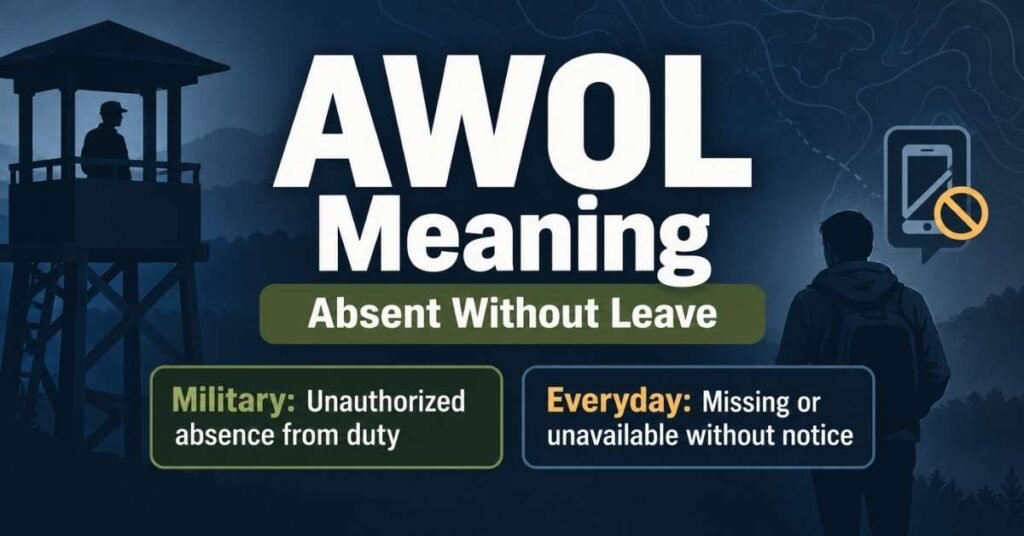
AWOL meaning is “absent without leave.” In the U.S. military, AWOL describes a service member who is absent from an appointed place of duty without proper authority. In everyday conversation, “go AWOL” usually means someone disappeared, stopped communicating, or failed to appear where expected.
The recognized AWOL full form is absent without leave, not “absent without official leave.” Although the expression originated in the military, Americans now use it casually for missing coworkers, unavailable friends, absent students, and even misplaced objects.
What Does AWOL Mean?
AWOL stands for “absent without leave.” It originally referred to military personnel who were away from an assigned place of duty without authorization.
The expression contains two central ideas:
- The person was required to be somewhere.
- The person did not have permission to be absent.
In military usage, AWOL can have serious disciplinary consequences. In civilian conversation, however, it is normally an informal way of saying someone is unexpectedly absent, missing, or unreachable.
For example:
“Ryan has been AWOL from the group chat all week.”
Ryan is not being accused of a military offense. The speaker simply means that he has not participated or responded as expected.
AWOL at a Glance
| Question | Answer |
|---|---|
| What does AWOL stand for? | Absent Without Leave |
| Original context | Military service |
| Military meaning | Unauthorized absence from required duty |
| Civilian meaning | Unexpectedly absent, missing, or unreachable |
| Workplace meaning | Often an unapproved absence or no-call/no-show |
| Pronunciation | Usually “AY-wall” |
| Word type | Acronym; also used as an adjective, adverb, or noun |
| Is AWOL desertion? | No, they are separate military concepts |
| Is AWOL always a crime? | No; casual and civilian use has no automatic military implication |
Is It “Absent Without Leave” or “Absent Without Official Leave”?
The correct and standard expansion is absent without leave.
Some people mistakenly say “absent without official leave” because they assume each letter in AWOL must represent a separate word. However, the O comes from within the word “without.”
The abbreviation can be understood as:
- A — Absent
- W-O — Without
- L — Leave
Authoritative dictionaries and Article 86 of the Uniform Code of Military Justice use absence or absent without leave.
“Absent without authorized leave” may occasionally appear as a descriptive explanation, but it is not the standard AWOL full form.
A simple way to remember it is:
AWOL = Absent + Without + Leave
What Does “Leave” Mean in AWOL?
The word leave can create confusion because it has more than one meaning.
In everyday English, “leave” can mean to depart:
“I need to leave the office.”
In military and employment contexts, however, leave means authorized time away from duty. It may include approved vacation, emergency leave, medical leave, or another permitted absence.
A service member who is away on properly approved leave is not AWOL merely because they are physically absent from their unit. The issue arises when someone fails to report, leaves, or remains away without proper authority.
Approved Leave vs. AWOL
| Approved leave | AWOL |
|---|---|
| Permission has been granted | Proper authorization is absent |
| The dates and conditions are known | The absence is unauthorized |
| Required procedures were followed | The person failed to report, left, or remained absent without authority |
| It is not misconduct by itself | It may lead to military discipline |
The word “leave” therefore refers to permission, not simply the physical act of leaving.
What Does AWOL Mean in the U.S. Military?
In the United States military, AWOL generally refers to an unauthorized absence from a required place of duty.
Article 86 of the Uniform Code of Military Justice, commonly called the UCMJ, addresses absence without leave. In plain English, a service member may face an Article 86 allegation when they fail to appear, leave without permission, or remain absent from a required location without proper authority.
Three Ways an Unauthorized Absence Can Occur
Failing to Report
A service member does not arrive at an appointed place of duty at the required time.
For example:
A soldier misses a required morning formation without authorization.
This does not necessarily require the person to disappear for several days. The issue begins with failing to report at the prescribed time without proper authority.
Leaving a Place of Duty
A service member reports to the required location but leaves without permission.
For example:
An airman leaves an assigned duty post before being properly released.
The person initially appeared as required, but the unauthorized departure may still create an Article 86 issue.
Remaining Absent
A service member stays away from a unit, organization, or duty location where they are required to be.
For example:
A service member does not return when approved leave ends and has not received an extension.
The original absence may have been authorized, but remaining away after permission expires can change the situation.
What Does “Proper Authority” Mean?
Permission generally needs to come from a person authorized to approve the absence. An informal comment from a coworker may not equal official authorization from a commander, supervisor, or other designated authority.
Relevant information might include:
- Duty orders
- Work schedules
- Approved leave documents
- Messages from the chain of command
- Medical instructions
- Attempts to request or extend leave
- Transportation records
- Emergency circumstances
Individual cases depend on their facts. A general definition cannot determine whether a particular absence violates military law.
How Long Before Someone Is Considered AWOL?
A common misconception is that a service member cannot be AWOL until they have been absent for at least 24 hours.
Article 86 does not establish a universal 24-hour waiting period. Its language covers failing to report to an appointed place of duty at the prescribed time, leaving that place without authority, or remaining absent from a required location.
That means an unauthorized absence can be relevant even if it lasts less than a full day.
Duration still matters because it may affect:
- How the absence is administratively recorded
- The seriousness of the situation
- The available evidence
- Potential military consequences
- How the command handles the matter
- Questions about the person’s intent
- Whether additional allegations are considered
It is important to distinguish between:
- When an unauthorized absence begins
- When a person is administratively listed as AWOL
- How the conduct is eventually charged
- What consequences may follow
These are related questions, but they are not necessarily identical.
AWOL vs. Unauthorized Absence
AWOL and unauthorized absence describe closely related concepts.
Some military branches and communities use the term UA, meaning unauthorized absence, more frequently. AWOL remains widely understood throughout the U.S. military and civilian culture.
AWOL and Related Terms
| Term | Full form | Typical use |
|---|---|---|
| AWOL | Absent Without Leave | Broad military and civilian usage |
| UA | Unauthorized Absence | Common military terminology, especially in naval contexts |
| Article 86 absence | Absence Without Leave | Statutory UCMJ language |
| Unapproved absence | Not an acronym | Civilian workplace policy |
| No-call/no-show | Not an acronym | Civilian employee misses work without providing notice |
The underlying idea is similar: a person is absent without the required permission. However, terminology, procedures, and consequences may vary by military branch and situation.
AWOL vs. Desertion
AWOL and desertion are not interchangeable. Both can involve unauthorized absence from military duty, but desertion is a separate offense involving additional legally relevant intent.
The AWOL generally focuses on the fact that someone was absent without authority. Desertion may involve an intent to:
- Remain away permanently
- Avoid hazardous duty
- Avoid important military service
- Leave with no intention of returning under circumstances covered by military law
Key Differences Between AWOL and Desertion
| AWOL or unauthorized absence | Desertion |
|---|---|
| Focuses on unauthorized absence | Involves a separate offense with additional intent |
| May begin with failing to report or leaving duty | Often includes an intention to remain away permanently or avoid particular service |
| Duration can affect seriousness | Duration alone does not establish every legal element |
| Generally associated with Article 86 | Generally associated with Article 85 |
| Does not automatically mean permanent abandonment | Commonly involves intent beyond the unauthorized absence itself |
Does AWOL Automatically Become Desertion After 30 Days?
Not necessarily. A lengthy absence may affect administrative handling, evidence, and the seriousness of the allegations, but duration alone does not explain every element of desertion.
The person’s intent and the specific circumstances remain important. Statements such as “AWOL automatically becomes desertion after 30 days” are too simplistic to serve as a complete legal explanation.
Why People Confuse AWOL and Desertion
The terms are often confused because:
- Movies and television use them loosely.
- News reports sometimes simplify military terminology.
- A prolonged absence can raise questions about intent.
- Both involve being away without authorization.
- Some commercial legal pages reduce the distinction to a fixed number of days.
The clearest distinction is that AWOL concerns unauthorized absence, while desertion requires additional legally significant intent or purpose.
What Does “Go AWOL” Mean in Slang?
Outside the military, go AWOL means becoming unexpectedly absent, unavailable, or unreachable.
A person might be described as AWOL if they:
- Stop replying to messages
- Fail to attend an event
- Disappear from a group
- Miss an expected deadline
- Stop completing an assigned responsibility
- Become unavailable without explanation
Everyday AWOL Examples
“Jason has gone AWOL from the group chat.”
Jason has stopped participating or responding.
“Our photographer went AWOL two days before the event.”
The photographer became unreachable at a time when others expected communication or work.
“She has been AWOL from social media for a month.”
She has not posted or appeared online for an unusual period.
In these situations, AWOL is being used figuratively. It does not suggest that the person committed a military offense.
Can an Object Go AWOL?
Yes. Americans sometimes use AWOL humorously when an object is missing.
“My car keys have gone AWOL again.”
“The TV remote is AWOL.”
The speaker obviously does not mean that the object left without official permission. AWOL simply adds humor to the idea that something has mysteriously disappeared.
Does AWOL Mean “Gone Rogue”?
AWOL and gone rogue can overlap, but they are not synonyms.
- AWOL means absent, missing, or unavailable without authorization or explanation.
- Gone rogue means acting independently, unpredictably, or against instructions.
Someone can go rogue while remaining physically present. Likewise, someone can be AWOL because of confusion or an emergency without intentionally rebelling against authority.
What Does AWOL Mean at Work?
In a civilian workplace, AWOL is commonly used for an employee who does not report for work, has no approved leave, and fails to provide the expected notice.
A manager might say:
“The employee has been AWOL since Monday.”
In this context, the manager probably means the employee has missed scheduled work and has not communicated properly.
However, military Article 86 does not govern an ordinary civilian employee. Workplace absence is usually handled under:
- Company attendance policies
- Employment contracts
- Collective bargaining agreements
- Call-in procedures
- Protected-leave rules
- Disability and accommodation requirements
- Applicable state and federal employment laws
AWOL vs. No-Call/No-Show vs. Job Abandonment
| Term | Typical workplace meaning |
|---|---|
| AWOL | Informal description of an unauthorized or unexplained absence |
| No-call/no-show | Employee misses a scheduled shift without giving the required notice |
| Unapproved absence | The absence was not authorized under company policy |
| Job abandonment | Employer treats an extended or repeated absence as evidence the employee quit |
| Absenteeism | A broader pattern of frequent or habitual absence |
Does One Missed Shift Mean Job Abandonment?
Not necessarily. Employers may need to consider the company’s written policy and the circumstances surrounding the absence.
Possible explanations include:
- A medical emergency
- Hospitalization
- A family emergency
- Communication failure
- Incorrect scheduling information
- Protected leave
- A disability-related issue
- Transportation disruption
- An inability to contact the employer
Calling someone AWOL does not automatically settle whether they abandoned their job or whether employment protections apply.
Is Calling Someone AWOL Rude?
Calling someone AWOL can sound playful, concerned, frustrated, or accusatory, depending on the situation.
AWOL Tone Examples
| Sentence | Likely tone |
|---|---|
| “My coffee mug has gone AWOL.” | Humorous |
| “You’ve been AWOL from the chat all week!” | Playful or mildly critical |
| “The contractor went AWOL before finishing the job.” | Frustrated |
| “The service member was reported AWOL.” | Formal and serious |
| “She may be in danger, but she’s probably just AWOL.” | Dismissive and inappropriate |
In civilian conversation, the expression often carries some degree of judgment. It suggests that the person was expected to appear or communicate but failed to do so.
Avoid using it casually when someone may genuinely be missing, vulnerable, or unsafe.
When Someone Is Genuinely Missing
The slang meaning of AWOL should not replace a proper response to a possible emergency.
If someone’s disappearance is unusual, consider:
- Whether there are signs of immediate danger
- Whether the person has a medical or mental health vulnerability
- Whether they missed critical responsibilities unexpectedly
- Whether their phone, vehicle, or personal items were left behind
- Whether anyone has been able to contact them
- Whether emergency assistance or a welfare check may be appropriate
If there is an immediate threat to someone’s safety, contact emergency services or the appropriate local authority. Do not assume a concerning absence is merely someone “going AWOL.”
What Happens If a Service Member Is AWOL?
Possible military consequences depend on the specific circumstances, including:
- How the absence occurred
- Its duration
- The duty or assignment involved
- Whether the person returned voluntarily
- Attempts to communicate with the unit
- Evidence concerning intent
- Prior disciplinary history
- Additional alleged conduct
- How the command resolves the matter
Depending on the facts and legal process, possible responses may include:
- Administrative action
- Counseling or corrective measures
- Nonjudicial punishment
- Court-martial charges
- Reduction in grade
- Forfeiture of pay
- Confinement
- A punitive or administrative discharge
The maximum possible consequence is not necessarily the likely outcome. Service members dealing with an actual AWOL allegation should obtain current advice from military legal assistance or qualified military-defense counsel.
How Do You Pronounce AWOL?
The most familiar AWOL pronunciation is:
AY-wall
“AY” rhymes with day, while “wall” is pronounced normally.
Some people also spell out the letters:
A-W-O-L
Because AWOL is commonly pronounced as a word, acronym is an appropriate linguistic classification.
Is AWOL an Acronym or an Abbreviation?
AWOL is an abbreviation formed from “absent without leave.” More specifically, it is commonly classified as an acronym because people often pronounce it as a word.
Compare:
- AWOL: commonly pronounced “AY-wall”
- FBI: normally pronounced one letter at a time
An abbreviation pronounced letter by letter is more precisely called an initialism. AWOL can sometimes be spelled aloud, but its word-like pronunciation is widely recognized.
How to Use AWOL in a Sentence
Military Context
“The service member was accused of remaining AWOL after authorized leave ended.”
This uses AWOL in its original military sense.
Civilian Workplace
“The project stalled after the contractor went AWOL.”
The contractor became unexpectedly absent or unreachable.
Social Setting
“You’ve been AWOL from our weekly dinners.”
This is an informal observation that someone has stopped attending.
Online Communication
“She went AWOL from social media during her exams.”
The person disappeared from online platforms temporarily.
Humorous Use
“The TV remote has gone AWOL again.”
An object has been misplaced.
Incorrect or Misleading Use
“He took his approved vacation, so he is AWOL.”
This is incorrect in the military sense because approved leave is authorized.
LEARN MORE: Redacted Meaning
AWOL Grammar and Capitalization
Should AWOL Be Capitalized?
AWOL is the standard spelling. Lowercase awol occasionally appears in informal writing, but uppercase is clearer in educational, professional, and military contexts.
Correct:
“The soldier was reported AWOL.”
Informal but understandable:
“My headphones have gone awol.”
What Part of Speech Is AWOL?
AWOL can function in several ways.
As an Adjective
“The AWOL service member returned to the unit.”
AWOL describes the service member.
As a Predicate Adjective or Adverbial Expression
“The soldier was AWOL.”
The term describes the person’s status.
As a Noun
“The report described him as an AWOL.”
This noun use exists, particularly in military contexts, but it is less common in everyday American English.
Is “Went AWOL” Correct?
Yes. “Went AWOL” and “go AWOL” are the most common civilian constructions.
Examples include:
- “My editor went AWOL before publication.”
- “The dog went AWOL through an open gate.”
- “Several volunteers went AWOL after lunch.”
Use the LEAVE Test to Understand AWOL
The LEAVE test can help you determine how the word is being used.
L — Location
Where was the person required or expected to be?
E — Expected Time
When were they supposed to report, arrive, or return?
A — Authorization
Did they have proper permission to be absent?
V — Version of the Term
Is AWOL being used under military law, workplace policy, or casual slang?
E — Evidence and Explanation
What orders, schedules, messages, emergencies, or other facts explain the absence?
The LEAVE test helps identify the context. It does not determine guilt, military discipline, employment rights, or legal consequences.
Frequently Asked Questions
What does AWOL stand for?
AWOL stands for “absent without leave.” It originated as a military expression for being absent from required duty without authorization.
Is AWOL “absent without official leave”?
No. The recognized AWOL full form is absent without leave. “Absent without official leave” is a common but nonstandard expansion.
What does AWOL mean in simple words?
It means someone is not where they are required or expected to be and does not have proper permission or a clear explanation for the absence.
Is AWOL only a military term?
No. It originated in military usage, but people now use it informally for anyone or anything that has unexpectedly disappeared or become unavailable.
Can Someone Be AWOL for Less Than 24 Hours?
Yes. Article 86 does not impose a universal 24-hour minimum. Failing to report at the required time without authority may fall within its scope.
Is AWOL the Same as Desertion?
No. AWOL generally concerns unauthorized absence. Desertion is a separate military offense involving additional legally relevant intent or purpose.
What Does AWOL Mean in Texting?
In texting, AWOL normally means someone stopped replying, disappeared from a conversation, or has been unusually unavailable.
What Does AWOL Mean at Work?
It commonly refers to an unapproved absence or no-call/no-show. Specific consequences depend on the employer’s policy, the facts, and applicable law.
Can an Object Go AWOL?
Yes, humorously. If someone says their keys “went AWOL,” they mean the keys are missing.
Is Going AWOL a Crime?
Unauthorized military absence may be punishable under the UCMJ. Casual and civilian use of AWOL does not automatically describe a crime.
Is AWOL Pronounced “AY-wall”?
Yes. “AY-wall” is the most familiar pronunciation, although some speakers say each letter individually.
Final Takeaway
AWOL means “absent without leave.” In the military, it refers to being absent from required duty without proper authority. In civilian slang, it usually means that someone or something is unexpectedly missing, unavailable, or unreachable.
AWOL is not automatically the same as desertion, and Article 86 does not create a universal 24-hour waiting period. The meaning and seriousness depend on whether the term is being used in military law, workplace policy, or casual conversation.
