

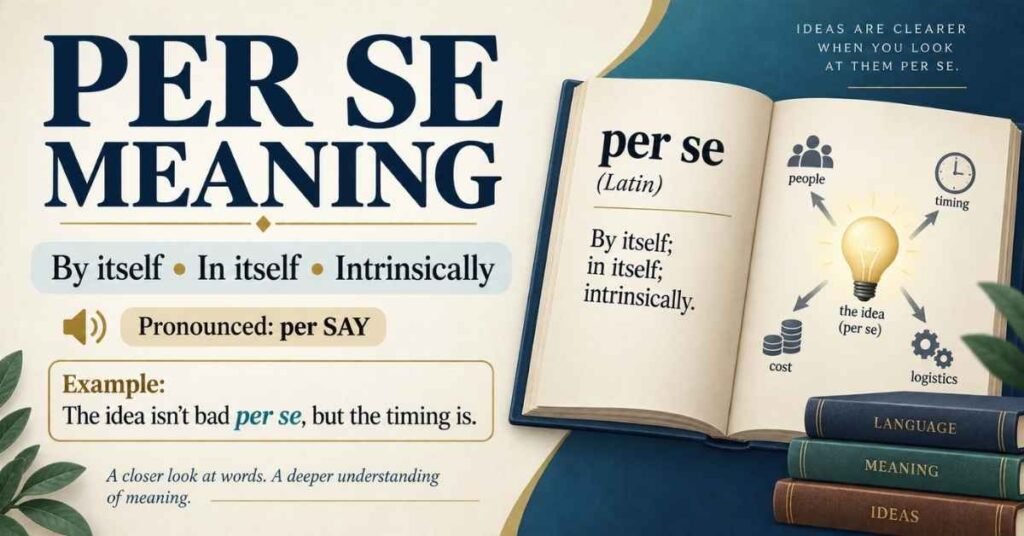
Per se meaning is “by itself,” “in itself,” or “intrinsically.” You use this Latin phrase when you want to consider something on its own, separate from its consequences, implementation, or surrounding circumstances. For example, “The job isn’t difficult per se, but it takes a lot of time” means the job is not inherently difficult; its time requirements create the problem. The correct spelling is always per se, not “per say” or “perse.”
What Does Per Se Mean?
Per se means that something is being considered by itself rather than in connection with other factors. It helps you separate the inherent nature of a subject from the way it is used, experienced, or affected by outside circumstances.
Consider this sentence:
The policy is not harmful per se, but the way it is enforced creates problems.
The speaker is making a precise distinction between:
- The policy in itself
- The way people enforce that policy
The policy may not be inherently harmful. The problems arise from its implementation.
Per Se at a Glance
| Detail | Explanation |
|---|---|
| Meaning | By itself, in itself, or intrinsically |
| Origin | Latin |
| Pronunciation | Per SAY |
| Correct spelling | Per se |
| Incorrect spelling | Per say |
| Typical function | Separates a subject from its context |
| Formality | Neutral to formal |
| Common pattern | “Not X per se, but Y” |
| Closest plain-English alternative | In itself |
Per se does not automatically mean:
- Exactly
- Basically
- Technically
- Personally
- For example
- According to
- Generally speaking
These words may occasionally appear in similar sentences, but they do not communicate the same relationship.
The Core Idea Behind Per Se
A dictionary may define per se as “by itself,” but understanding the phrase requires one additional step.
When someone uses per se, they are separating the subject from something associated with it.
The basic relationship is:
The thing itself is not necessarily the same as its use, effects, implementation, or surrounding circumstances.
For example:
Technology is not harmful per se; its effects depend on how people design and use it.
This sentence does not claim that technology can never cause harm. It says technology is not inherently harmful in every situation. Its design and use determine the outcome.
Here are several other examples:
- “The rule is not unfair per se, but its enforcement is inconsistent.”
- “The product is not expensive per se, but the subscription fees add up.”
- “The city is not unpleasant per se, but its traffic can be exhausting.”
- “The idea is not unrealistic per se; the proposed deadline is the problem.”
What Is Being Separated?
| Subject considered on its own | Surrounding factor |
|---|---|
| A policy | How officials enforce it |
| A product | Its subscription or maintenance costs |
| A job | Its hours, schedule, or workload |
| A city | Its traffic or cost of living |
| Technology | How people design and use it |
| An idea | How someone implements it |
| A course | Its pace or assessment method |
| A relationship | A particular disagreement |
Per se helps writers and speakers avoid broad, inaccurate judgments. Instead of saying an entire thing is bad, difficult, dangerous, or ineffective, you can identify the specific factor causing the problem.
Where Does Per Se Come From?
Per se is a Latin phrase. Its literal meaning is approximately “by itself” or “through itself.”
The two parts are:
- Per: by, through, or by means of
- Se: itself, himself, or herself
English speakers have used the expression for so long that it now appears naturally in journalism, academic writing, business communication, legal documents, and everyday conversation.
You do not need to understand Latin grammar to use it correctly. The important question is whether you are discussing something on its own merits, apart from other factors.
How Do You Pronounce Per Se?
In American English, per se is commonly pronounced:
per SAY
The second word sounds like the English word “say,” even though it is spelled se.
This pronunciation explains why many people mistakenly write “per say.” They hear the expression before seeing it in writing and spell it according to its sound.
Avoid pronunciations such as:
- “Per see”
- “Purse”
- “Per-suh”
- “Per-see”
A useful memory trick is:
You pronounce the final word like “say,” but you spell it se.
Per Se or Per Say: Which Spelling Is Correct?
Per se is the correct spelling. When you mean “by itself” or “in itself,” per say is incorrect.
The phrase should also be written as two separate words. Do not combine or hyphenate it.
| Correct | Incorrect |
|---|---|
| The plan is not risky per se. | The plan is not risky per say. |
| Cost is not the problem per se. | Cost is not the problem perse. |
| The method works per se. | The method works per-se. |
Does “Per Say” Have a Meaning?
“Per say” does not have the same meaning as per se. However, the separate English words per and say can occasionally appear beside each other by coincidence.
For example:
“The fee could be calculated per, say, 100 units.”
In this sentence:
- Per means “for each.”
- Say means “for example.”
The commas show that “say” is a parenthetical expression. This unusual construction has nothing to do with the Latin phrase per se.
Is “Perse” a Word?
“Perse” may have rare meanings outside this expression, including an old color term. However, it is not the correct spelling when you mean “in itself.”
Always write:
per se
Is Per Se Hyphenated?
No. Standard English writes per se without a hyphen.
Correct:
“The strategy is not ineffective per se.”
Incorrect:
“The strategy is not ineffective per-se.”
How to Use Per Se Correctly
Use per se when you want to isolate the essential nature of something from its related conditions.
The simplest way to test your sentence is to replace per se with “in itself.”
Original:
“The course isn’t difficult per se, but the workload is heavy.”
Test:
“The course isn’t difficult in itself, but the workload is heavy.”
The sentence still communicates the intended distinction, so per se is being used correctly.
Per se should normally refer clearly to the subject or idea immediately before it. If the reader cannot tell what is being considered independently, the sentence needs revision.
The Common “Not X Per Se, but Y” Pattern
The most familiar use of per se follows this structure:
[Subject] is not [description] per se, but [another factor creates the actual issue].
This pattern works because it performs three tasks:
- It rejects or limits a broad judgment.
- It considers the subject by itself.
- It identifies the true concern.
Everyday Examples
“The movie wasn’t bad per se, but it was much too long.”
The movie was not inherently bad. Its length reduced the viewer’s enjoyment.
“I don’t dislike the city per se; I dislike the traffic.”
The speaker separates the city itself from one frustrating feature.
“The assignment isn’t difficult per se, but it requires careful research.”
The concepts may be manageable, while the research demands make the work challenging.
“The phone isn’t expensive per se, but the monthly plan is.”
The device’s price is not the main concern. The ongoing expense is.
“He isn’t unfriendly per se; he is simply quiet around new people.”
The speaker avoids defining the person as unfriendly and offers a more accurate explanation.
Why the “But” Clause Is Useful
Consider this incomplete thought:
“The restaurant isn’t bad per se.”
The sentence is grammatical, but it may leave the listener wondering what the speaker actually dislikes.
Now compare:
“The restaurant isn’t bad per se, but the service is painfully slow.”
The contrast makes the intended meaning clear.
A “but” clause is not grammatically mandatory, but it frequently provides the context that makes per se useful.
Other contrast words can serve the same function:
- Although
- However
- Rather
- Instead
- Yet
- The problem is
- What concerns me is
For example:
“The software is not unreliable per se. However, it struggles when several users log in simultaneously.”
Can You Use Per Se Without “Not”?
Yes, per se can be used without “not.” Positive uses are grammatically correct, although they often sound more formal, academic, philosophical, or legal.
Examples include:
- “Privacy has value per se, regardless of its practical benefits.”
- “The experience was rewarding per se.”
- “The research method is valid per se, although its application was flawed.”
- “Money has no moral quality per se.”
- “The creative process is meaningful per se, even when the work is never published.”
In these sentences, per se means that the stated quality belongs to the subject in itself, independent of external results.
In casual conversation, plain English may sound more natural:
“The experience was rewarding in itself.”
Both sentences are correct. The second is simpler and less formal.
Per Se Examples in Everyday Conversation
The best way to understand the phrase is to see what it separates in realistic situations.
Everyday Life
“I’m not tired per se; I’m mentally drained.”
The speaker distinguishes physical tiredness from mental exhaustion.
“I don’t hate cooking per se, but I dislike cleaning afterward.”
Cooking is not the problem. The cleanup is.
“The neighborhood isn’t dangerous per se, though it becomes noisy at night.”
The speaker rejects a broad safety judgment while identifying another concern.
“I’m not hungry per se; I just want something sweet.”
The desire to eat does not come from ordinary hunger.
Workplace Communication
“The proposal is not risky per se, but the deadline is unrealistic.”
The proposal itself may be sound. The timing creates risk.
“Cost is not the issue per se; the lack of measurable value is.”
The speaker is not objecting to spending money in general. The concern is whether the expense produces results.
“Remote work is not unproductive per se, but weak communication can make it ineffective.”
The work model is separated from poor implementation.
“The new system is not complicated per se; the training materials are unclear.”
The technology itself may be manageable. The instructions create confusion.
Academic Writing
“Social media is not harmful per se; its effects depend on its design and use.”
This avoids an unsupported generalization.
“Correlation does not establish causation per se.”
A relationship between two variables is not, by itself, proof that one caused the other.
“The theory has intellectual value per se, independent of its immediate application.”
Here, per se is used positively and formally.
“Economic growth per se does not guarantee an equal distribution of wealth.”
Growth considered alone cannot prove that everyone benefits equally.
Product Reviews
“The laptop is not slow per se, but demanding software exposes its limitations.”
The laptop may perform ordinary tasks well but struggle under heavier demands.
“The subscription is not expensive per se; the problem is that essential features cost extra.”
The base price is separated from additional charges.
“The camera is capable per se, but its default settings produce inconsistent results.”
The hardware is not the issue; configuration affects the output.
Relationships and Social Situations
“I’m not upset with you per se; I’m frustrated by what happened.”
The speaker softens a personal accusation and identifies the event as the problem.
“She isn’t avoiding the group per se—she has been overwhelmed with work.”
The speaker proposes an alternative explanation for her behavior.
“I don’t disagree with the idea per se, but I’m concerned about the timing.”
The idea itself is acceptable. The circumstances are not.
This use of per se can help people communicate criticism more carefully. It narrows the complaint instead of condemning the entire person, idea, or situation.
Incorrect Uses of Per Se—and How to Fix Them
Per se becomes distracting when it adds formality without adding meaning.
Using Per Se to Mean “Basically”
Incorrect:
“The event was per se very successful.”
Better:
“The event was very successful.”
“Per se” does not mean “basically,” and the original sentence contains no distinction between the event itself and a related factor.
Using Per Se to Mean “Exactly”
Incorrect:
“That is per se what I meant.”
Better:
“That is exactly what I meant.”
Use exactly when you want to indicate precision or complete agreement.
Using Per Se to Mean “Technically”
Unclear:
“He isn’t an employee per se.”
This sentence may be correct, but it needs context.
Clearer:
“He isn’t an employee per se; he works with us as an independent contractor.”
Per se distinguishes a formal employee from a different working relationship.
Using Per Se as Conversational Filler
Weak:
“The food was, per se, kind of good.”
Better:
“The food was fairly good.”
The original phrase does not isolate a quality or create a meaningful contrast.
Using Per Se Without a Clear Reference
Unclear:
“It wasn’t good per se because everything was confusing.”
The reader may not understand what “it” refers to or what distinction the writer intends.
Clearer:
“The presentation wasn’t poorly researched per se, but its structure made the findings difficult to follow.”
Now the sentence separates research quality from organization.
Why Do People Misuse Per Se?
People commonly misuse the phrase because they:
- Hear it before seeing it written
- Understand its tone but not its literal meaning
- Mistake it for “basically”
- Use it to fill a pause
- Associate Latin expressions with intelligence
- Copy unclear conversational usage
- Want to soften a statement
- Confuse it with “technically”
The phrase often appears in cautious speech:
“I’m not against it, per se…”
When speakers pause after per se, it can begin to sound like verbal filler. The underlying intention is usually to avoid making an overly broad statement.
Does Using Per Se Make You Sound Pretentious?
Per se does not sound pretentious when it creates a precise distinction. It sounds forced when the sentence would mean exactly the same thing without it.
Natural:
“I don’t oppose remote work per se; I oppose requiring it for every role.”
Forced:
“The meeting was per se very useful.”
A useful editing question is:
What distinction would disappear if I removed per se?
If removing it destroys an important contrast, keep it.
If removing it changes nothing, delete it or replace it with clearer language.
Does Per Se Need Commas?
Per se does not always require commas. Punctuation depends on where the phrase appears and how much emphasis the writer wants to create.
Per Se Without Commas
When the phrase flows directly with the surrounding sentence, commas are often unnecessary:
“The policy is not harmful per se.”
“Large expenses per se do not guarantee better results.”
“I don’t object to testing per se.”
These versions are clear and natural.
Per Se With Commas
Commas can present per se as a parenthetical interruption:
“The policy is not, per se, harmful.”
“The expense, per se, is not the problem.”
These sentences are grammatical, but they sound more deliberate and formal. In many cases, removing the commas produces smoother prose.
Per Se at the End of a Sentence
End placement is common:
- “I don’t dislike the proposal per se.”
- “The additional cost is not the problem per se.”
- “The product is not defective per se.”
If the sentence continues with a contrast, place the comma according to the normal clause structure:
“The product is not defective per se, but its design is inconvenient.”
The comma belongs before but because it joins two contrasting clauses—not because per se always requires punctuation.
Should Per Se Be Italicized?
Per se usually does not need italics in general English writing. It is a well-established borrowed expression that most readers recognize.
Standard modern usage:
The rule is not unfair per se.
Some academic journals, publishers, courts, or organizations may follow a house style that italicizes certain Latin terms. If you are writing for a specific publication, follow its style guide.
The key is consistency. Do not italicize per se in one paragraph and leave it in regular type elsewhere without a reason.
Quotation marks are also unnecessary unless you are discussing the phrase itself:
The expression “per se” comes from Latin.
Is Per Se Formal or Informal?
Per se is generally neutral to formal. It appears naturally in:
- Educated conversation
- Journalism
- Academic essays
- Business reports
- Product criticism
- Legal writing
- Analytical discussions
It may sound unnecessarily formal in a simple text message.
Formal:
“The procedure is not inefficient per se, but it lacks adequate oversight.”
Plainer:
“The procedure itself is not inefficient, but it lacks adequate oversight.”
Casual:
“The procedure isn’t the problem. The lack of oversight is.”
All three versions communicate a similar distinction. Choose the one that suits your audience.
| Context | Is per se natural? | Plainer alternative |
|---|---|---|
| Academic analysis | Yes | In itself |
| Legal writing | Common | Inherently |
| Business report | Usually | By itself |
| Casual conversation | Sometimes | On its own |
| Simple instructions | Often unnecessary | Rewrite directly |
| Text message | Can sound formal | “Itself” or two short sentences |
Per Se Synonyms and Their Differences
Several expressions overlap with per se, but they are not interchangeable in every context.
In Itself
“In itself” is usually the closest plain-English synonym.
“The policy is not harmful in itself.”
This preserves the idea of considering the policy separately from its effects or application.
Inherently
Inherently means that a quality belongs naturally or permanently to something.
“The activity is not inherently dangerous.”
This sentence focuses on whether danger is built into the activity’s nature.
Intrinsically
Intrinsically emphasizes an internal, essential, or built-in quality.
“The work is intrinsically rewarding.”
It frequently appears in discussions of value, motivation, beauty, and worth.
Essentially
Essentially means “in its most basic or important respects.”
“The two plans are essentially the same.”
It summarizes the fundamental character of something. It does not necessarily separate the subject from its surrounding circumstances.
As Such
As such often means “in the role, category, or condition just mentioned.”
“She is the department head and, as such, approves the budget.”
Replacing “as such” with per se would change the meaning. The sentence is about her stated role, not her inherent nature.
Technically
Technically refers to strict facts, definitions, or rules.
“Technically, he is an independent contractor.”
Compare:
“He isn’t an employee per se; he is an independent contractor.”
The first sentence corrects a formal classification. The second separates a traditional employee from another type of worker.
Fundamentally
Fundamentally refers to the basic or foundational nature of something.
“The two proposals are fundamentally different.”
It often makes a stronger claim than per se.
Synonym Comparison
| Expression | Central idea | Best used when |
|---|---|---|
| Per se | Considering something alone | Separating a subject from context |
| In itself | The thing considered independently | Replacing per se in plain English |
| Inherently | A built-in quality | Discussing natural characteristics |
| Intrinsically | Internal or essential value | Discussing worth or motivation |
| Essentially | Basic summary | Reducing an idea to its main character |
| As such | In a stated role or category | Referring back to a classification |
| Technically | Strict factual accuracy | Correcting an informal description |
| Fundamentally | Foundational nature | Emphasizing a basic difference |
Per Se vs. In and of Itself
Per se and “in and of itself” are close in meaning. Both ask readers to consider something independently.
Compare:
“The technology is not harmful per se.”
“The technology is not harmful in and of itself.”
The second sentence is longer and more emphatic. It may also sound more conversational or rhetorical.
Use per se when concise, formal precision suits the sentence. Use “in and of itself” when you want greater emphasis or want to avoid Latin.
Per Se vs. Pro Se
Per se and pro se are different Latin expressions.
| Expression | Meaning | Common context |
|---|---|---|
| Per se | By itself or inherently | General, academic and legal writing |
| Pro se | On one’s own behalf | Self-representation in court |
Examples:
“Certain conduct may be treated as illegal per se.”
“The defendant appeared pro se without an attorney.”
Because both phrases appear in legal writing and look similar, readers sometimes confuse them. Remember:
- Per se concerns the nature of something.
- Pro se concerns representing yourself.
LEARN MORE: Complacent Meaning
What Does Per Se Mean in Law?
In law, per se still means “by itself” or “inherently.” However, it often appears inside a specific legal doctrine that gives the phrase a more technical effect.
A legal rule may classify conduct in a particular way once defined conditions are met, without requiring the same broader analysis that would otherwise apply.
The precise effect depends on:
- The legal doctrine
- The jurisdiction
- The relevant statute
- Court decisions
- The facts of the case
- Available defenses
- Required proof
The following explanations provide general information, not legal advice for a specific case.
What Is Negligence Per Se?
Negligence per se is a legal doctrine connected to violations of statutes or regulations.
In general, a statutory violation may establish or support the breach element of a negligence claim when the relevant legal requirements are met.
A simplified example would involve a contractor violating a safety code designed to prevent a particular type of injury. If that violation causes the kind of harm the rule was intended to prevent, the injured person may rely on negligence per se.
However, a statutory violation does not necessarily mean automatic liability in every U.S. jurisdiction. The claimant may still need to establish matters such as:
- The statute applies to the defendant
- The claimant belongs to the protected group
- The harm is the type the statute intended to prevent
- The violation caused the injury
- Legally recognized damages occurred
- No valid excuse or exception applies
Some jurisdictions treat the violation as negligence, while others may treat it as a presumption or evidence of negligence.
What Does Illegal Per Se Mean?
Illegal per se describes conduct categorized as inherently unlawful under a particular legal rule once its defining elements are established.
It does not mean that anything described as questionable is automatically illegal. The conduct must fall within the relevant legal category.
The phrase often appears in U.S. antitrust discussions.
What Is a Per Se Antitrust Violation?
In antitrust law, courts may analyze conduct under either a per se rule or a broader rule of reason, depending on the conduct and governing precedent.
- A per se approach categorically treats certain conduct as unlawful once the necessary conduct is proven.
- A rule-of-reason analysis considers market context, competitive effects, and other surrounding circumstances.
Horizontal price fixing and certain forms of market allocation are frequently discussed in connection with per se treatment. The exact analysis is legally complex and should not be reduced to the phrase’s everyday meaning.
What Is Defamation Per Se?
Defamation per se generally refers to categories of defamatory statements considered inherently damaging under applicable law.
Depending on the state and claim, these categories may involve allegations concerning:
- Serious criminal conduct
- Professional incompetence or misconduct
- Certain serious diseases
- Other traditionally recognized forms of reputational harm
The categories, required proof, presumed damages, and available defenses can vary substantially by jurisdiction.
Per Se vs. Per Quod
In defamation law, per quod generally refers to statements whose defamatory meaning depends on additional facts or context.
In simplified terms:
- Per se: The damaging meaning is apparent from the statement itself.
- Per quod: Outside information is needed to reveal or explain the damaging meaning.
Everyday Meaning vs. Legal Meaning
| Everyday use | Legal use |
|---|---|
| Considers something on its own | Applies an established legal classification |
| Often qualifies an opinion | May affect how a legal element is analyzed |
| Flexible conversational function | Doctrine- and jurisdiction-specific |
| Usually low-stakes | May carry serious legal consequences |
| Often replaceable with “in itself” | Requires attention to the complete legal phrase |
The SOLO Test for Using Per Se Correctly
Use the SOLO test whenever you are unsure whether per se belongs in a sentence.
S — Separate the Subject
Identify the exact subject you want the reader to consider.
In this example, the subject is remote work:
“Remote work is not unproductive per se, but poor communication can make it ineffective.”
O — Omit the Surrounding Circumstances
Temporarily remove factors such as implementation, consequences, motivation, and context.
Ask whether remote work is inherently unproductive before considering communication quality.
L — Look for a Real Contrast
The sentence contrasts:
- Remote work itself
- Poor communication within remote teams
That distinction gives per se a meaningful job.
O — Opt for Plain English When Clearer
Replace per se with “in itself.”
“Remote work is not unproductive in itself, but poor communication can make it ineffective.”
The meaning remains intact, so the original use is correct.
Quick Editing Checklist
Before keeping per se in your sentence, ask:
- Am I considering something on its own?
- Have I separated it from a related factor?
- Does “in itself” preserve the meaning?
- Have I spelled it as two words?
- Is the intended contrast clear?
- Do the commas improve readability?
- Would plain English sound more natural?
- Am I using the phrase only to sound formal?
- Could the reader confuse it with a legal term?
- Have I repeated it too often?
If per se does not clarify a genuine distinction, removing it will usually strengthen your writing.
Frequently Asked Questions
What does per se mean in simple English?
Per se means “by itself” or “in itself.” It tells the reader to consider something separately from its surrounding circumstances.
Is it per se or per say?
Per se is correct. “Per say” is a common misspelling caused by the pronunciation of se, which sounds like “say.”
How do you pronounce per se?
In American English, per se is commonly pronounced “per SAY.”
Is per se one word or two?
Per se is written as two separate words. “Perse” is incorrect when you mean “in itself.”
Is per se hyphenated?
No. The standard spelling is per se, without a hyphen.
Why do people say “not per se”?
“Not per se” limits a broad judgment. It indicates that the subject itself is not necessarily the problem, although something connected to it may be.
Can you use per se without “not”?
Yes. Positive uses are correct, although they often sound more formal:
“The creative process has value per se.”
Do you put commas around per se?
Not always. Commas may set it off as a parenthetical expression, but they are unnecessary when it flows directly with the sentence.
Should per se be italicized?
Usually not. Per se is well established in English. Follow a specific publisher or academic style guide when one applies.
Is per se formal?
Per se is neutral to formal. It is common in academic, business, journalistic, and legal writing but can also appear in everyday conversation.
Does per se mean “technically”?
No. Technically concerns strict facts or definitions. Per se means considering something in itself.
Does per se mean “exactly”?
No. Use exactly when you want to express precision or complete agreement.
What is the closest synonym for per se?
“In itself” is usually the closest plain-English replacement. “Inherently” and “intrinsically” may also work in certain contexts.
Does using per se sound pretentious?
It does not sound pretentious when it expresses a useful distinction. It can sound forced when used as filler or when simpler wording would be clearer.
What does per se mean in legal terms?
In law, per se generally means “inherently” or “by itself,” but its exact effect depends on the complete legal phrase, doctrine, and jurisdiction.
What is the difference between per se and pro se?
Per se means “by itself.” Pro se means representing yourself in a legal proceeding without an attorney.
Final Takeaway
Per se means “by itself,” “in itself,” or “intrinsically.” It is useful when you need to separate the inherent nature of something from its application, effects, or surrounding circumstances.
Remember three points:
- Spell it per se, not “per say.”
- Pronounce it approximately “per SAY.”
- Replace it with “in itself” to check whether you are using it correctly.
Use per se when it creates precision. Remove it when it merely creates formality.
