

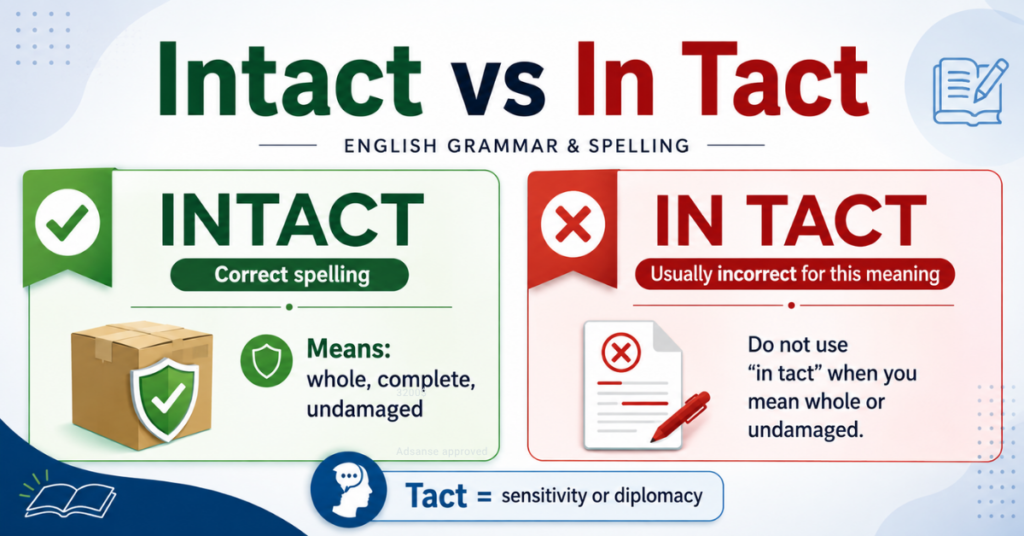
Intact vs in tact is easy to understand once you know one simple rule: intact is the correct one-word adjective when you mean whole, complete, undamaged, unchanged, or unbroken. Writing in tact is normally incorrect when you are trying to express that meaning. The confusion happens because in and tact are both real English words, so “in tact” can look reasonable at first glance. However, tact is a separate noun that means sensitivity or diplomacy when dealing with people.
If a package arrives without damage, you write:
Correct: The package arrived intact.
Not:
Incorrect: The package arrived in tact.
A useful way to remember it is simple: if something is intact, keep the word intact—do not break it into two pieces.
Intact vs In Tact: Quick Comparison
| Form | Correct? | Meaning | Example |
|---|---|---|---|
| intact | Yes | Whole, complete, undamaged, unchanged | The building remained intact. |
| in tact | Usually no for this meaning | Incorrect separation of intact | The building remained in tact. ❌ |
| tact | Yes | Diplomacy or sensitivity | She handled the issue with tact. |
The key distinction is therefore:
- intact describes the condition of something
- tact describes how sensitively someone behaves
- in tact should not be used as an alternative spelling of intact
What Does Intact Mean?
Intact is an adjective meaning something has remained whole, complete, undamaged, unaltered, or unimpaired.
You can use it for both physical objects and abstract things.
Physical examples
- The phone screen remained intact after the fall.
- The package arrived intact.
- Most of the historic building is still intact.
- The protective seal was intact when we opened the box.
- The original structure survived the storm largely intact.
In each example, intact tells us that the thing has not been seriously damaged or broken apart.
Abstract examples
The word is equally useful for things you cannot physically touch.
- Her reputation remained intact after the investigation.
- Their friendship stayed intact despite the disagreement.
- The original agreement remains intact.
- His confidence was still intact.
- The team’s unbeaten record remains intact.
- Most of the original plan was left intact.
So the intact meaning extends well beyond physical damage. It can describe anything that remains essentially whole, preserved, unchanged, or unaffected.
Is Intact One Word or Two?
Intact is one word.
When you mean whole or undamaged, always write:
intact
—not—
in tact
—and not—
in-tact
This applies in American English and British English. There is no important regional spelling difference here.
Examples:
Correct: The document is still intact. Incorrect: The document is still in tact.
The Correct: Please keep the original design intact. Incorrect: Please keep the original design in tact.
Correct: The evidence remained intact. Incorrect: The evidence remained in-tact.
If you are asking “is intact one word or two?”, the answer is straightforward: one word.
Why Do People Write “In Tact”?
The mistake is understandable because the pronunciation of intact can make it sound as though it consists of two familiar English words:
in + tact
Both exist independently.
- in is a common preposition
- tact is a real noun
That makes in tact look grammatically plausible even when it is being used incorrectly.
This is essentially a word-boundary or word-segmentation error. The writer mentally divides one established word into two parts that seem meaningful.
It is similar to other English spelling confusions where people misinterpret where one word ends and another begins.
Why Spell-Check May Not Catch “In Tact”
A basic spelling checker is often good at detecting impossible words.
For example, it would likely flag:
inntackt
But in and tact are both legitimate words.
That means some spell-check tools may not automatically recognize in tact as wrong because neither individual word is misspelled.
The error becomes clear only when the software examines context and grammar.
That is another reason the mistake appears even in otherwise well-edited writing.
What Does Tact Mean?
Tact is a noun meaning sensitivity, diplomacy, good judgment, or the ability to deal with difficult situations without unnecessarily offending people.
Examples:
- She handled the complaint with tact.
- The manager showed considerable tact during the conversation.
- You need tact when giving someone difficult feedback.
- He lacked the tact required for such a sensitive discussion.
Notice that these examples have nothing to do with something being whole or undamaged.
That gives us an easy distinction:
Intact
Describes a state or condition.
The system remained intact.
Tact
Describes social sensitivity or diplomacy.
She handled the situation with tact.
Intact vs Tact
Although the words look related, they perform different grammatical jobs.
| Word | Part of Speech | Meaning | Example |
|---|---|---|---|
| intact | Adjective | Whole, complete, undamaged | The file remained intact. |
| tact | Noun | Diplomacy or sensitivity | He answered with tact. |
| tactful | Adjective | Showing tact | She gave a tactful response. |
| tactfully | Adverb | In a tactful way | He tactfully changed the subject. |
| tactless | Adjective | Lacking tact | The comment sounded tactless. |
These relationships are useful because many people searching intact vs in tact are actually confusing intact with the noun tact.
Is “In Tact” Ever Correct?
When you mean whole, undamaged, or unchanged, use intact, not in tact.
That rule should guide almost every ordinary situation.
For example:
Wrong: The package arrived in tact. Correct: The package arrived intact.
The Wrong: The relationship stayed in tact. Correct: The relationship stayed intact.
Wrong: The database remained in tact. Correct: The database remained intact.
However, because tact is an independent noun, it is theoretically possible for the words in and tact to appear next to each other in a sentence where they perform separate grammatical functions.
Even then, natural English usually prefers phrasing such as:
with tact
or:
tactfully
For example:
Natural: She responded with tact.
Natural: She responded tactfully.
So for practical writing purposes, if your intended meaning is whole or undamaged, there is no ambiguity: choose intact.
Is “In-Tact” Correct With a Hyphen?
No. In-tact is not the standard spelling of the adjective.
Use:
intact
not:
in-tact
not:
in tact
Examples:
Correct: The seal is intact. Incorrect: The seal is in-tact.
Correct: Their reputation remained intact. Incorrect: Their reputation remained in-tact.
The simplest approach is to remember that intact stays intact as one word.
How to Pronounce Intact
In American English, intact is commonly pronounced approximately:
in-TAKT
IPA:
/ɪnˈtækt/
The stress falls on the second syllable:
in-TACT
This pronunciation is another reason people sometimes hear the word as two units, even though it is written as one.
Where Does the Word Intact Come From?
The history of intact helps make its spelling easier to remember.
The word ultimately comes from Latin intactus, carrying the idea of something untouched.
A simplified historical relationship looks like this:
in- = not tactus = touched
So the underlying idea is:
not touched → untouched → undamaged → intact
This historical meaning fits modern uses remarkably well.
If something remains intact, its essential condition has not been damaged, disturbed, or destroyed.
That gives you a better memory device than simply memorizing the spelling:
Intact originally carries the idea of “untouched.”
Is Intact a Compound Word?
It may look like a modern English combination of:
in + tact
but that is not the best way to understand it.
Intact is an established lexical word with Latin roots, rather than an English phrase formed by placing the preposition in before the modern noun tact.
That distinction explains why:
in tact
is not an acceptable alternative spelling for the adjective.
How to Use Intact in a Sentence
The most natural way to understand the word is through its common sentence patterns.
Remain intact
This is one of the most common combinations.
- The original architecture remained intact.
- Her reputation remained intact.
- The agreement remained intact after negotiations.
- Most of the system remained intact.
Stay intact
- The packaging stayed intact during shipping.
- Their friendship stayed intact despite the argument.
- The data stayed intact after migration.
Keep intact
- Try to keep the original layout intact.
- The update should keep existing files intact.
- We want to keep the historical structure intact.
Leave intact
- The restoration team left the original walls intact.
- The update left user settings intact.
- The agreement was revised but its core terms were left intact.
Arrive intact
- The glassware arrived intact.
- Every item arrived intact and undamaged.
- The package should arrive intact if it is packed correctly.
Still intact
- The warranty is still intact.
- The original seal is still intact.
- Their working relationship is still intact.
- The building’s foundation is still intact.
These natural collocations help reinforce the correct spelling without forcing the keyword unnaturally.
“Still Intact” or “Still In Tact”?
The correct form is:
still intact
Example:
The original contract is still intact.
Not:
The original contract is still in tact.
The phrase still intact means that something continues to remain whole, valid, undamaged, unchanged, or preserved.
“Keep Intact” or “Keep In Tact”?
Use:
keep intact
Example:
Keep the original files intact during the transfer.
This means the files should remain unchanged or undamaged.
Do not write:
keep in tact
when that is your intended meaning.
“Remain Intact” or “Remain In Tact”?
Use:
remain intact.
Examples:
- The evidence must remain intact.
- Most of the original structure will remain intact.
- Their partnership could remain intact.
- The system should remain intact after installation.
This is one of the most common contexts in which writers mistakenly split the word.
Physical vs Figurative Uses of Intact
Understanding both uses helps you use the word more naturally.
Physical condition
Use intact when a physical object has not been damaged.
Examples:
- The roof remained intact.
- The bottle arrived intact.
- The screen is completely intact.
- The ancient wall is largely intact.
Figurative or abstract condition
Use intact when an abstract thing remains unaffected or preserved.
Examples:
- Her dignity remained intact.
- Their relationship is intact.
- The company’s reputation remains intact.
- The original strategy is largely intact.
- His confidence stayed intact.
- The record remains intact.
The same core meaning applies in both cases: the essential whole has been preserved.
Intact in Technical and Digital Writing
The word is also common in technical contexts.
Examples:
- The database remained intact after the migration.
- Verify that the metadata is intact.
- The backup restored successfully with all files intact.
- The folder structure remained intact.
- Encryption keeps the data intact during transfer.
In this context, intact often communicates that data integrity has been preserved.
This can be particularly useful in IT, cybersecurity, software migration, backups, and system administration.
Intact in Legal and Academic Writing
In professional writing, intact often conveys preservation.
Examples:
- Investigators kept the evidence intact.
- The original document remains intact.
- The primary terms of the contract remain intact.
- The research design was kept largely intact.
- The historical record survives substantially intact.
Because these contexts require precision, writing in tact instead can make the sentence look careless.
Common Mistakes With Intact
Mistake 1: Writing “in tact”
Incorrect: The vase was still in tact.
Correct: The vase was still intact.
Mistake 2: Hyphenating it
Incorrect: The structure was in-tact.
Correct: The structure was intact.
Mistake 3: Confusing intact with tact
Incorrect meaning: She handled the complaint intact.
If you mean diplomacy:
Correct: She handled the complaint with tact.
Mistake 4: Assuming tact and intact are interchangeable
They are not.
Tact refers to sensitivity in communication.
Intact describes something remaining whole or undamaged.
Mistake 5: Thinking online usage proves correctness
You may occasionally see in tact on blogs, social media, forums, or even published websites.
That does not make it the standard spelling for the “undamaged” meaning.
Common mistakes can become highly visible online simply because many people make the same error.
Why Published Websites Sometimes Use “In Tact”
It is easy to assume that if a phrase appears on a professional-looking website, it must be correct.
That is not always true.
Web content may contain:
- typographical errors
- rushed editing
- speech-to-text mistakes
- copied material
- user-generated text
- automated content
- spelling errors missed by software
Because in and tact are both legitimate English words, the error can sometimes survive automated proofreading.
When in doubt, rely on standard dictionary usage and context, not raw frequency on the web.
Is There an American English vs British English Difference?
No meaningful spelling difference exists for this word.
Both American English and British English use intact for the adjective meaning:
- whole
- complete
- undamaged
- unchanged
- unbroken
So U.S. writers should use:
intact
and British writers should also use:
intact.
There is no need to choose a different spelling depending on your audience.
Synonyms for Intact
Depending on context, useful synonyms include:
- whole
- complete
- undamaged
- unbroken
- unharmed
- untouched
- unaltered
- unimpaired
- preserved
- sound
- unchanged
Examples:
The building remained intact.
Could become:
The building remained undamaged.
Or:
The building remained structurally sound.
However, the exact synonym depends on context. Unchanged is not always identical to undamaged, and preserved can carry a slightly different nuance.
Opposites of Intact
Useful antonyms include:
- damaged
- broken
- destroyed
- altered
- impaired
- incomplete
- fragmented
- compromised
- disrupted
Example:
The database remained intact.
Opposite:
The database was corrupted or compromised.
Understanding these opposites reinforces the central idea of wholeness and preservation.
The Replacement Test: An Easy Way to Choose
When you are unsure between intact or in tact, try replacing the word with:
- whole
- undamaged
- unchanged
- unbroken
If the sentence still makes sense, use intact.
Example:
The package arrived undamaged.
Therefore:
The package arrived intact.
Another example:
Her reputation remained undamaged.
Therefore:
Her reputation remained intact.
If you mean diplomacy or sensitivity, use the noun tact instead.
Example:
She handled the complaint with tact.
This replacement test solves most uncertainty within seconds.
A Simple Memory Trick for Intact vs In Tact
The easiest memory trick is:
Keep “intact” intact.
If intact means something that has not been broken apart, then the word itself should not be broken apart either.
Think:
intact = one complete word
Not:
in + tact
You can also remember its historical sense:
intact ≈ untouched
Both memory tricks connect the spelling directly to the meaning.
Intact vs In Tact Examples
Here are common sentences you might encounter in everyday writing.
Correct
- The package arrived intact.
- The documents remained intact.
- Her reputation is still intact.
- The evidence was preserved intact.
- Their friendship remained intact.
- The system stayed intact after the update.
- Most of the original structure is intact.
- His confidence remains intact.
- The seal was completely intact.
- The company’s original plan remains largely intact.
Incorrect
- The package arrived in tact.
- The documents remained in tact.
- Her reputation is still in tact.
- The evidence was preserved in tact.
- Their friendship remained in tact.
In all these incorrect examples, the intended word is the adjective intact.
Intact vs In Tact vs Tact: The Fastest Rule
If you remember nothing else, use this three-part rule:
Use intact
When you mean:
whole, complete, undamaged, unchanged, or preserved
Do not use in tact
As an alternative spelling for intact.
Use tact
When you mean:
diplomacy, sensitivity, or careful social judgment
Example:
The package arrived intact, and the customer-service agent handled the complaint with tact.
That single sentence shows both words correctly.
Frequently Asked Questions
Is It Intact or In Tact?
Intact is correct when you mean whole, complete, or undamaged.
Example:
The glass remained intact.
Writing in tact for this meaning is incorrect.
Is Intact One Word?
Yes. Intact is always written as one word when used as the adjective meaning whole or undamaged.
Is “In Tact” a Word?
In and tact are individual English words, but in tact is not the standard spelling of intact.
When you mean diplomacy, the more natural phrase is usually with tact.
Is “In-Tact” Correct?
No. Do not hyphenate it.
Use:
intact
What Does Intact Mean?
Intact means remaining whole, complete, undamaged, unimpaired, or unchanged.
What Does Tact Mean?
Tact means sensitivity or diplomacy when dealing with people or difficult situations.
Example:
She handled the criticism with tact.
Why Do People Spell Intact as Two Words?
Because the pronunciation can sound like in + tact, and both parts are real English words.
That makes the incorrect form visually believable.
Is “Still Intact” Correct?
Yes.
Examples:
- The warranty is still intact.
- Their relationship is still intact.
- The seal is still intact.
Can Intact Describe a Relationship?
Yes.
You can say:
Their relationship remained intact.
Here, intact means the relationship survived or continued without being destroyed.
Can Intact Describe a Reputation?
Yes.
Example:
Her reputation remained intact.
This is a common figurative use of the word.
Can Intact Describe Data?
Yes.
For example:
The data remained intact during the migration.
Here, intact means the information was preserved without corruption or loss.
Is Intact Spelled Differently in American and British English?
No. Both varieties of English use intact.
What Is Another Word for Intact?
Depending on context, good synonyms include whole, complete, undamaged, unbroken, preserved, unharmed, and unchanged.
Final Takeaway
The difference in intact vs in tact is simpler than it first appears. Use intact as one word when something remains whole, complete, undamaged, unchanged, or preserved. Do not write in tact as an alternative spelling for that meaning.
Remember that tact is a separate noun referring to diplomacy and sensitivity:
The package arrived intact.
She handled the problem with tact.
When you are unsure, use the replacement test: if whole, undamaged, or unchanged fits the sentence, choose intact.
And the easiest memory trick remains the best:
If something is intact, keep the word intact.
