

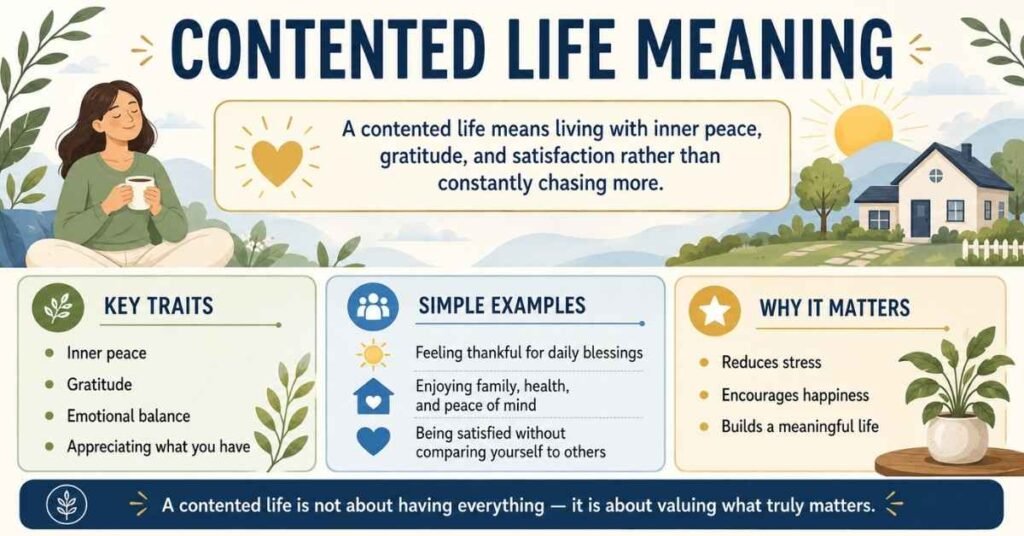
Contented life meaning refers to living with a genuine sense of satisfaction, peace, acceptance, and appreciation for your present circumstances. A contented person does not believe life must be perfect before it can feel worthwhile. You may still have goals, problems, responsibilities, and ambitions while being grateful for what you already have.
Put simply, a contented life is a life where you can say, “Things may not be perfect, but I appreciate what I have and feel generally at peace with where I am.”
That makes contentment different from constant happiness, laziness, or complacency. It is closer to a steady feeling that your life has value now, even while you continue working toward a better future.
Contented Life Meaning in Simple Words
The easiest way to understand the meaning of contented life is to look at the word contented itself.
Contented means feeling satisfied, comfortable, pleased, or at peace with your circumstances.
So, when someone talks about living a contented life, they usually mean living in a way where they are reasonably satisfied with their:
- relationships
- work
- home
- financial situation
- personal choices
- everyday experiences
- progress in life
Being contented does not require having everything you have ever wanted.
A person with an average income, a modest home, meaningful relationships, and a peaceful routine may feel more content than someone with greater wealth who constantly believes they need more.
One-Sentence Definition
A contented life is a life characterized by calm satisfaction, appreciation, acceptance, and a sense that what you have can be enough, even though you may still want to grow or improve.
What Does Living a Contented Life Actually Look Like?
Understanding the dictionary definition is useful, but the phrase becomes clearer when you picture it in everyday life.
A contented life does not necessarily look impressive from the outside.
It is more about how you experience your circumstances.
You Appreciate What You Have
A contented person notices what is already going well.
That could include:
- supportive family members
- reliable friends
- meaningful work
- a safe home
- enough food and necessities
- physical comfort
- free time
- hobbies
- personal progress
This does not mean ignoring problems. You can acknowledge what is difficult while still appreciating what is good.
You Accept Imperfection
A contented person understands that no life is completely free from disappointment.
Careers have frustrating days. Relationships require effort. Plans fail. Money can become stressful. People change.
Contentment is not pretending those problems do not exist.
It means those imperfections do not automatically convince you that your whole life is inadequate.
You Can Enjoy Today While Planning for Tomorrow
This is one of the most important aspects of a contented life.
You can be satisfied with your current job while wanting a promotion.
The You can appreciate your home while saving for a larger one.
You can accept yourself while developing healthier habits.
In other words, contentment and personal growth can exist together.
Contented Life vs. Happy Life
People often use contented and happy as though they mean exactly the same thing. They overlap, but there is an important difference.
Happiness describes a broad positive emotional experience.
You may feel happy because:
- you received good news
- you met a friend
- you bought something you wanted
- you achieved a goal
- you went on vacation
Contentment is usually quieter.
It is closer to calm satisfaction with your life or circumstances.
| Contentment | Happiness |
|---|---|
| Calm satisfaction | Positive emotional state |
| Often steady | Can change quickly |
| Connected with acceptance | Often connected with experiences or events |
| “What I have can be enough.” | “I feel good right now.” |
| Can exist during difficult periods | May temporarily decrease during difficulties |
You could therefore have a bad day but still feel broadly content with your life.
Likewise, you could experience an exciting happy moment while remaining deeply dissatisfied with your overall circumstances.
Can You Be Content Without Being Happy All the Time?
Yes.
A contented person does not need to feel cheerful every hour of every day.
Imagine someone who enjoys their family, likes their home, values their work, and feels their life has meaning.
One stressful Monday does not erase that deeper sense of satisfaction.
Contentment is therefore better understood as an overall relationship with your life, rather than a permanent pleasant mood.
Contentment vs. Complacency
One of the biggest misunderstandings about contentment is that it means settling for less.
It does not.
Contentment Means
- appreciating the present
- recognizing what is good
- accepting some imperfections
- feeling satisfied without needing constant validation
- pursuing improvement without hating where you are now
Complacency Means
Complacency occurs when someone becomes so satisfied that they stop recognizing genuine problems or necessary improvements.
For example:
Contentment: “I am grateful for my current career, but I would still like to develop new skills and earn a promotion.”
Complacency: “My performance is declining, but I do not need to change anything.”
The difference is important.
Contentment says, “I appreciate what I have.”
Complacency says, “Nothing needs improvement.”
Can You Be Contented and Still Ambitious?
Absolutely.
Ambition and contentment answer two different questions.
Contentment asks: How do I feel about my life today?
Ambition asks: What would I like to create, achieve, or improve tomorrow?
You can have both.
Career Example
You may enjoy your current role, appreciate your coworkers, and feel financially secure while still preparing for a senior position.
That is not dissatisfaction. It is contentment combined with growth.
Money Example
You may appreciate your current standard of living while building savings, investing, or working toward greater financial security.
Personal Growth Example
You can accept your personality, appearance, strengths, and weaknesses while continuing to improve your habits or abilities.
Healthy ambition says:
“My future can become better.”
Chronic dissatisfaction often says:
“My present life has no value until my future becomes better.”
That distinction matters.
Content, Contented, and Contentment: What’s the Difference?
These three related words can confuse English learners.
Content
When pronounced kuhn-TENT and used as an adjective, content means satisfied.
Example: “I am content with my life.”
Contented
Contented is also an adjective and describes someone or something showing or experiencing satisfaction.
Example: “She lives a contented life.”
Contentment
Contentment is the noun form.
It describes the state or feeling of being content.
Example: “He found contentment in spending time with his family.”
| Word | Part of Speech | Simple Meaning | Example |
|---|---|---|---|
| Content | Adjective | Satisfied | I am content with my life. |
| Contented | Adjective | Feeling peacefully satisfied | She lived a contented life. |
| Contentment | Noun | State of being content | He experienced contentment. |
The phrase “a contented life” sounds natural because contented directly describes the kind of life someone experiences.
Examples of “Contented Life” in Sentences
Here are several natural examples showing how the phrase is used.
- She lived a quiet and contented life with her family in the countryside.
- Although he never became wealthy, he enjoyed a peaceful and contented life.
- After years of chasing success, she realized that meaningful relationships were more important to a contented life.
- He wanted to advance professionally but was already grateful for his contented life.
- A simple routine, close friendships, and meaningful work helped her create a more contented life.
- Their home was small, but they considered their family life comfortable and contented.
Notice that these examples do not suggest that people have stopped growing.
Instead, they emphasize satisfaction, appreciation, peace, and meaningful relationships.
Real-Life Examples of a Contented Life
A Contented Career
Imagine someone who likes their profession, earns enough to meet their needs, and enjoys working with their colleagues.
They may still pursue additional qualifications or a promotion.
Their ambition does not prevent them from appreciating their current career.
A Contented Financial Life
A contented financial life does not require extraordinary wealth.
Someone may live within their means, pay their bills, enjoy occasional treats, save for future goals, and avoid constantly comparing their possessions with other people’s.
A Contented Family Life
Families are rarely perfect.
People disagree, become stressed, and face unexpected problems.
A contented family life can still exist when people feel safe, loved, respected, and connected despite ordinary difficulties.
A Contented Personal Life
Someone may acknowledge areas they want to improve while still respecting who they are today.
That balance between self-acceptance and personal growth is an important part of mature contentment.
Signs of a Contented Life
There is no official checklist that determines whether someone is content, but certain patterns commonly reflect life satisfaction and inner peace.
You may feel contented when:
- you appreciate what you already have
- you enjoy ordinary moments
- you do not constantly compare yourself with others
- other people’s success does not automatically make your life feel inadequate
- you have meaningful relationships
- you can accept some imperfections
- your goals motivate rather than control you
- you do not depend completely on external approval
- you understand the difference between a need and a want
- you can feel proud of progress without demanding perfection
- you generally feel comfortable with the direction of your life
Contentment is often less dramatic than happiness.
It can appear as a simple feeling of:
“My life is not perfect, but there is a lot here worth appreciating.”
What a Contented Life Does Not Mean
Understanding what contentment does not mean is just as important as understanding its definition.
It Does Not Mean You Are Happy Every Day
Contented people still experience:
- sadness
- stress
- disappointment
- anger
- frustration
- uncertainty
Those emotions are part of normal life.
It Does Not Mean You Have No Goals
You can be grateful for the present while building a different future.
It Does Not Mean Accepting Harmful Circumstances
Contentment should never be confused with remaining passive in an unsafe, abusive, exploitative, or seriously unhealthy situation.
It Does Not Mean Laziness
Someone can work hard and remain contented.
It Does Not Mean You Never Want Anything
Wanting a holiday, better job, new home, healthier lifestyle, or financial security does not automatically make someone discontented.
It Does Not Require Wealth
Money can improve comfort and security, but a contented life is not defined solely by possessions.
Why Is It Sometimes Hard to Feel Content?
Modern life constantly encourages comparison.
You see other people’s:
- homes
- careers
- holidays
- relationships
- achievements
- cars
- clothes
- lifestyles
This can quietly move your definition of “enough.”
Something that once felt satisfying may suddenly seem inadequate because another person appears to have more.
Constant Comparison
Comparison often changes the question from:
“Am I satisfied with my life?”
to:
“Is my life better than theirs?”
Those are completely different standards.
Moving Goalposts
Another obstacle is constantly telling yourself:
- I’ll be happy when I earn more.
- I’ll be satisfied when I buy a house.
- I’ll feel successful when I get promoted.
- I’ll enjoy life when I reach my goal.
Once one goal is achieved, another often appears.
Goals themselves are not the problem.
The problem begins when your permission to appreciate life is always postponed.
External Validation
People can also become dependent on:
- praise
- likes
- professional titles
- social status
- possessions
- other people’s approval
When self-worth depends entirely on external validation, contentment becomes difficult because outside approval is never completely under your control.
How to Build More Contentment Without Losing Your Drive
Contentment does not usually come from forcing yourself to “just be happy.”
It is more practical than that.
1. Decide What “Enough” Means to You
Ask yourself:
- How much money would genuinely meet my needs?
- Which possessions actually improve my life?
- What level of professional success matters to me?
- Which goals are personally meaningful?
- Which goals exist mainly because I am comparing myself with others?
Without a personal definition of enough, there is always room for “more.”
2. Separate Appreciation From Stagnation
Try this simple sequence:
Appreciate what is good → identify what genuinely needs improvement → take useful action
You do not have to criticize your whole life in order to improve one part of it.
3. Make Gratitude Specific
Instead of simply thinking:
“I should be grateful.”
Notice something concrete:
- I enjoyed breakfast with my family.
- My friend checked on me today.
- I completed difficult work.
- I had enough time to rest.
- I learned something useful.
Specific appreciation feels more real than vague positivity.
4. Reduce Unnecessary Comparison
If certain social media accounts or environments repeatedly make your ordinary life feel inadequate, reducing exposure may help you judge your circumstances by your own values instead of someone else’s highlight reel.
5. Pursue Values, Not Only Achievements
Achievements are useful, but values give those achievements direction.
Examples of values include:
- family
- learning
- honesty
- independence
- creativity
- service
- stability
- friendship
- health
A goal feels more meaningful when it supports something you actually value.
6. Enjoy Progress Before the Finish Line
If you only allow yourself to feel satisfied after reaching the final result, much of life becomes a waiting room.
Notice progress too.
Learning, improving, saving, building, practicing, and recovering are all parts of the journey.
LEARN MORE: Toat Definition
A Simple Contentment Check
If you are wondering whether your goals support a contented life, ask yourself five questions.
Appreciation
What is already good in my life today?
Acceptance
Which imperfections can I realistically accept?
Action
Which problems genuinely need attention?
Ambition
Am I pursuing this goal because it matters to me or because I am comparing myself with somebody else?
Enough
What would genuinely be enough in this area of my life?
The point is not to eliminate ambition.
It is to prevent ambition from making every present achievement feel worthless.
Contented vs. Satisfied vs. Happy vs. Fulfilled
These words are related but not identical.
| Word | Main Meaning |
|---|---|
| Contented | Calmly satisfied with one’s circumstances |
| Satisfied | Needs, expectations, or requirements have been adequately met |
| Happy | Experiencing positive feelings or pleasure |
| Fulfilled | Feeling that something meaningful or important has been achieved |
| Peaceful | Calm and relatively free from disturbance or conflict |
| Grateful | Appreciative of something received or experienced |
| Complacent | Excessively satisfied despite reasons to improve |
Best Synonyms for Contented
Depending on context, synonyms can include:
- satisfied
- happy
- pleased
- peaceful
- comfortable
- fulfilled
However, these are near-synonyms, not perfect replacements.
For example, fulfilled often suggests meaning or achievement, while contented emphasizes settled satisfaction.
What Is the Opposite of a Contented Life?
Common antonyms and contrasting terms include:
- discontented
- dissatisfied
- restless
- unhappy
- frustrated
- unfulfilled
A discontented life usually involves persistent dissatisfaction with circumstances.
But being ambitious is not automatically the same as being discontented.
Ambition vs. Discontentment
Ambition says:
“There is something meaningful I would like to achieve.”
Chronic discontent says:
“Nothing I have is ever enough.”
One can inspire growth.
The other can make every achievement feel temporary or inadequate.
Why a Contented Life Is Different From a Successful Life
Success is often measured externally.
People may measure it through:
- income
- job title
- education
- possessions
- professional reputation
- public recognition
Contentment is more internal.
It relates to:
- satisfaction
- appreciation
- self-acceptance
- relationships
- purpose
- inner peace
- values
- enoughness
Someone can therefore be highly successful but deeply dissatisfied.
Another person may have fewer possessions or achievements but feel peaceful and fulfilled.
Of course, contentment and success can also exist together.
The point is simply that success does not automatically create contentment.
Frequently Asked Questions About Contented Life Meaning
What does contented life mean in simple words?
A contented life means being generally satisfied, peaceful, and appreciative of your circumstances. It does not mean everything is perfect or that you have stopped pursuing goals.
What does it mean to live a contented life?
To live a contented life means appreciating what you have, accepting some imperfections, maintaining meaningful relationships, and pursuing goals without believing that your present life has no value until you achieve them.
Does contented mean happy?
Contented and happy are similar but not identical. Happy describes a broad positive emotional state, while contented usually suggests calmer and more settled satisfaction.
Is contented a positive word?
Yes. Contented is generally a positive word describing someone who feels satisfied, peaceful, or comfortable with their circumstances.
What is an example of a contented person?
A person may enjoy their current job, appreciate their family, live comfortably within their means, and still work toward future goals. That person could reasonably be described as contented.
What is the difference between content and contented?
Both can describe satisfaction. You might say “I am content with my life” or “I live a contented life.” Contentment is the noun describing the state of feeling content.
Is contentment the same as happiness?
Not exactly. Happiness can be temporary and connected to specific experiences, while contentment often describes a steadier sense of satisfaction and acceptance.
Does contentment mean settling for less?
No. Contentment means appreciating the present. Settling or complacency means refusing necessary change simply because it feels easier.
Can an ambitious person be content?
Yes. You can appreciate your current circumstances while pursuing better opportunities, stronger relationships, financial goals, or personal development.
What is another word for contented?
Common synonyms include satisfied, pleased, happy, peaceful, and comfortable, depending on the sentence.
What is the opposite of contented?
The closest opposite is usually discontented or dissatisfied.
How do you use “contented life” in a sentence?
Example:
“After retiring, he enjoyed a quiet and contented life surrounded by family and friends.”
Another example:
“She pursued new goals while remaining grateful for her already contented life.”
Final Thoughts on the Meaning of a Contented Life
A contented life is not a perfect life, a passive life, or a life without ambition. It is a life where satisfaction, acceptance, gratitude, inner peace, and personal growth can exist together.
You can want tomorrow to be better without treating today as worthless.
You can pursue success without making success the only condition for happiness.
And you can recognize problems without allowing those problems to erase everything that is already meaningful.
Ultimately, living a contented life means understanding a simple but powerful idea: you can appreciate where you are while still becoming who you want to be.
