

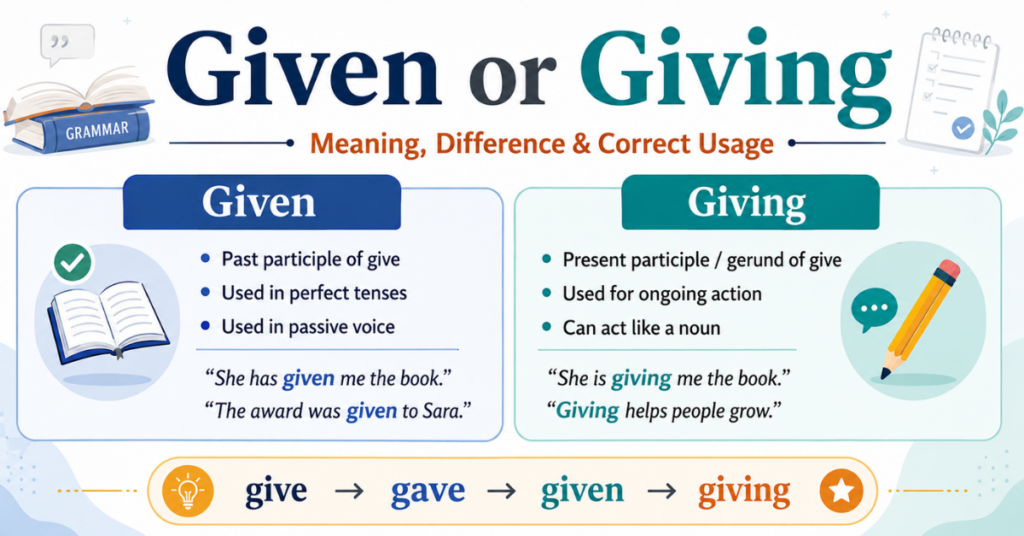
Given or giving are both correct forms of the verb give, but they are used in different grammatical situations. Giving is the present participle of give and is commonly used for actions in progress or as a gerund, while given is the past participle and is commonly used with have, has, had, or in passive constructions such as was given. For example, “She is giving advice” describes an action in progress, while “She has given advice” describes an action that has already happened. The easiest way to choose between given vs giving is to look at the helper verb, the role of the subject, and the meaning you want to express.
If you have ever stopped mid-sentence wondering whether you should write given or giving, you are dealing with a very common English grammar problem. The confusion usually happens because both forms come from the same irregular verb, give, but they do very different jobs inside a sentence.
This guide explains the difference between given and giving, how each form works, the most common mistakes, and a practical way to choose the correct word without guessing.
Given vs Giving at a Glance
Here is the simplest way to understand the difference.
| Form | Grammar Role | Common Pattern | Main Use | Example |
|---|---|---|---|---|
| giving | Present participle / gerund | is, are, was, were + giving | Ongoing action or activity | She is giving instructions. |
| given | Past participle | have, has, had + given | Perfect tense | She has given instructions. |
| given | Past participle | is, was, were + given | Passive voice | She was given instructions. |
A useful shortcut is:
- have / has / had + given
- is / are / was / were + giving when someone is performing an action in progress
- is / was / were + given when someone is receiving something
- giving when the activity itself acts like a noun
- given when it means considering, specified, or assumed
These patterns work well, but they are not complete grammar rules by themselves. The deeper difference involves verb form, grammatical aspect, and active vs passive voice.
Give, Gave, Given, and Giving: Understand the Whole Verb Family
The easiest way to understand given or giving is to see how both fit into the full verb family.
The verb give is irregular, which means its past forms do not follow the usual -ed pattern.
| Verb Form | Use | Example |
|---|---|---|
| give | Base form | I give feedback every Friday. |
| gave | Simple past | I gave feedback yesterday. |
| given | Past participle | I have given feedback already. |
| giving | Present participle | I am giving feedback now. |
This pattern—give, gave, given, giving—is essential because many mistakes happen when learners confuse gave with given or assume giving is simply the present tense.
Why “Given” and “Gave” Are Not Interchangeable
Gave is the simple past form.
I gave him the document yesterday.
Given is the past participle.
I have given him the document already.
This means:
❌ I have gave him the document.
is incorrect.
The correct sentence is:
✅ I have given him the document.
After have, has, or had, English normally requires the past participle, which is why given is correct.
Why “Giving” Is Not Simply the Present Tense
It is common to hear:
Giving is present tense.
That is not technically accurate.
Giving is the present participle. It can appear in sentences referring to the past, present, or future.
She is giving a presentation now.
She was giving a presentation yesterday.
She will be giving a presentation tomorrow.
The word giving stays the same. The helper verb tells us when the action happens.
When to Use “Giving”
Use giving when the sentence describes an action in progress, an activity, or sometimes a personal quality.
Use “Giving” for an Action in Progress
When someone is actively doing the action of give, giving often appears after a form of be.
She is giving a presentation.
They are giving customers free samples.
He was giving me directions.
We were giving updates throughout the day.
These are examples of progressive or continuous constructions.
The structure is usually:
be + giving
For example:
- am giving
- is giving
- are giving
- was giving
- were giving
- will be giving
The key idea is that the action is viewed as in progress.
Use “Giving” After “Been” in Perfect Continuous Constructions
The pattern becomes slightly more advanced when been appears.
She has been giving lessons all week.
They had been giving customers regular updates.
We have been giving this issue a lot of thought.
In these sentences, giving is part of a perfect continuous construction.
This is important because many learners assume:
have/has/had = given
That is often true, but not always.
Compare:
She has given three presentations.
with:
She has been giving presentations all month.
Both are correct.
The first focuses more on a completed result or total.
The second focuses more on an activity continuing over time.
Use “Giving” as a Gerund
Giving can also function as a gerund, meaning an -ing form that behaves like a noun.
Giving advice can be difficult.
Giving to charity can help a community.
I enjoy giving useful feedback.
In these examples, giving names an activity rather than simply describing an action happening at that moment.
This is why the rule:
giving = something happening now
is too limited.
Use “Giving” as an Adjective
Giving can describe a person who is generous or willing to help others.
She is a very giving person.
He has a warm and giving personality.
Here, giving is not describing the act of handing something to someone. It describes a personal quality.
Modern U.S. Use: “It’s Giving”
In informal American English, especially online and on social media, you may hear:
It’s giving summer vacation.
That outfit is giving 1990s energy.
Here, “it’s giving” means something like:
It has the feeling, style, mood, or appearance of something.
This is informal slang and should be kept separate from standard grammar explanations.
When to Use “Given”
Use given when it functions as the past participle of give, especially in perfect tenses and passive voice. It also has several additional meanings in English.
Use “Given” After Have, Has, or Had
The most common pattern is:
have / has / had + given
Examples:
I have given my answer.
She has given permission.
They had given us enough time.
He has given me several opportunities.
These are perfect constructions.
Because given is the past participle, it fits after have, has, and had.
Use “Given” in Passive Voice
Given is also commonly used in the passive voice.
He was given a warning.
Students were given more time.
She has been given another opportunity.
Employees were given new instructions.
In these sentences, the subject is not performing the action. The subject is receiving something.
That difference is one of the most important keys to understanding given vs giving.
Use “Given” as an Adjective
Given can also mean a specific, particular, or stated thing.
At any given moment
On a given day
Under a given condition
In these examples, given functions more like an adjective than a verb.
Use “Given” to Mean “Considering”
Another common use is:
Given the weather, we decided to stay home.
Given the circumstances, her reaction was understandable.
Given the current situation, delaying the project makes sense.
Here, given means approximately considering or taking into account.
This is a different grammatical use from the past participle of give.
Use “Given” as a Noun
You may also hear:
That result is a given.
A given is something accepted as certain, obvious, or already assumed.
For example:
Strong communication is a given in this job.
Was Given or Was Giving? The Difference Most Learners Miss
One of the most confusing questions is:
Should I use “was given” or “was giving”?
The answer depends on whether the subject is performing or receiving the action.
“Was Giving” Means the Subject Performs the Action
Mark was giving Lisa a ticket.
Mark performs the action.
- Mark = giver
- ticket = thing being given
- Lisa = recipient
“Was Given” Means the Subject Receives the Action
Mark was given a ticket.
Mark receives the ticket.
The sentence is passive.
This is why both phrases can be correct.
Compare the Meaning
She was giving an award.
She was presenting or handing out an award.
She was given an award.
She received an award.
Another pair:
He was giving instructions.
He was telling other people what to do.
He was given instructions.
Someone else told him what to do.
And another:
They were giving support.
They were helping someone.
They were given support.
Someone was helping them.
The key question is not:
Which form looks more grammatical?
It is:
Is the subject doing the giving or receiving something?
Has Given or Has Been Giving?
These two forms are both correct but express different aspects of the action.
“Has Given” Focuses on Result or Completion
She has given three presentations this month.
The sentence focuses on the completed presentations.
He has given me enough information.
The information has already been provided.
“Has Been Giving” Focuses on Duration or Repetition
She has been giving presentations all month.
The emphasis is on the ongoing or repeated activity.
He has been giving me updates every morning.
The action has happened repeatedly over a period of time.
Compare Them Directly
She has given five lessons.
Focus: number or result.
She has been giving lessons all week.
Focus: activity over time.
This is the difference between perfect aspect and perfect progressive aspect.
Has Been Given or Has Been Giving?
This comparison is especially useful because only one word changes, but the meaning changes dramatically.
Has Been Given
She has been given several opportunities.
She receives the opportunities.
This is a perfect passive construction.
Has Been Giving
She has been giving other people opportunities.
She performs the action.
This is a perfect progressive active construction.
The difference involves three ideas:
- aspect
- voice
- the role of the subject
When you understand these relationships, choosing given or giving becomes much easier.
Giving vs Being Given
Another useful contrast is giving vs being given.
Giving
Giving advice can be helpful.
The person performs the action.
Being Given
Being given advice can sometimes feel frustrating.
The person receives the action.
This is a simple way to understand active and passive meaning without getting lost in grammar terminology.
Active and Passive Voice: The Hidden Key to Given vs Giving
Many articles explain given vs giving only as:
ongoing vs completed
That shortcut helps beginners, but it does not explain every sentence.
The deeper issue is often active vs passive voice.
Active Pattern
English commonly follows this pattern:
giver → thing → recipient
Sarah is giving John the book.
Here:
- Sarah = giver / agent
- book = direct object
- John = recipient / indirect object
English can also say:
Sarah is giving the book to John.
Both patterns are natural.
Passive Pattern
Now change the sentence:
John was given the book.
John becomes the grammatical subject because the sentence focuses on the recipient.
You can also say:
The book was given to John.
This time, the object itself becomes the subject.
Understanding this relationship is more reliable than memorizing a simple rule such as:
giving = present given = past
Common Given vs Giving Mistakes — And Why They Happen
Learning why an error happens makes it easier to avoid it in the future.
Mistake 1: “I Have Giving”
❌ I have giving you the answer.
Correct:
✅ I have given you the answer.
But this is also correct:
✅ I have been giving you regular updates.
Why?
Because:
- have + given = perfect construction
- have been + giving = perfect progressive construction
Mistake 2: “She Has Gave”
❌ She has gave me permission.
Correct:
✅ She has given me permission.
Remember:
- gave = simple past
- given = past participle
Mistake 3: Assuming “Was” Always Takes Giving
Both can be correct.
She was giving advice.
Active progressive.
She was given advice.
Passive.
The correct form depends on the subject’s role.
Mistake 4: Treating Given as Simply “Past”
Consider:
She will be given instructions tomorrow.
The sentence refers to the future, yet given is still correct.
This proves that given is a past participle, not simply “the past tense.”
Mistake 5: Treating Giving as Something Happening Only Now
Consider:
She was giving instructions yesterday.
She will be giving instructions tomorrow.
Giving instructions clearly is important.
The word giving can appear in past, future, or noun-like constructions.
Mistake 6: Choosing by Sound Instead of Structure
If a sentence “sounds right” but you are unsure, check:
- the helper verb
- whether the subject performs or receives the action
- whether the action is ongoing, completed, or repeated
- whether the word acts as a noun, adjective, or preposition
A Practical Decision Tree for Choosing Given or Giving
Here is a quick framework you can use in real writing.
Question 1: Is There Have, Has, or Had?
If yes, given is often correct.
She has given me the answer.
But watch for been:
She has been giving me updates.
Question 2: Is the Subject Performing an Action in Progress?
Use giving.
He is giving instructions.
Question 3: Is the Subject Receiving Something?
Use given in a passive construction.
He was given instructions.
Question 4: Is the Word Naming an Activity?
Use giving.
Giving feedback takes practice.
Question 5: Does “Given” Mean Considering or Specified?
Use given.
Given the situation, we should wait.
At any given moment
Question 6: Still Unsure?
Ask yourself:
- Is someone doing the giving?
- Is someone receiving something?
- Has the action already been completed?
- Is the sentence describing an ongoing activity?
- Is giving being used as a noun?
- Is given being used to mean considering?
That usually makes the correct form obvious.
Given or Giving in Real-Life U.S. English
Natural examples are often more helpful than textbook-style sentences.
At Work
I am giving a presentation at 2 p.m.
I have given my manager the report.
We were given new instructions.
She has been giving the team daily updates.
At School
The teacher is giving us homework.
The teacher has given us extra time.
Students were given another attempt.
He has been giving tutoring sessions after school.
In Everyday Conversation
Thanks for giving me a heads-up.
I’ve given it some thought.
She was given another chance.
He keeps giving me the same advice.
In Community and Charity Contexts
Giving back can strengthen local communities.
The organization has given scholarships to students.
Volunteers have been giving their time every weekend.
These examples show how the same verb appears naturally in different grammatical patterns.
Given vs Giving: Minimal-Pair Examples
Minimal pairs are useful because they show how changing only one form changes the entire meaning.
| Giving | Given | Meaning |
|---|---|---|
| She is giving advice. | She has given advice. | ongoing vs completed/result |
| He was giving a ticket. | He was given a ticket. | giver vs receiver |
| They have been giving support. | They have been given support. | active vs passive |
| I enjoy giving feedback. | The feedback given was useful. | gerund vs participle modifier |
| She is giving instructions. | She was given instructions. | performing vs receiving |
These comparisons are more useful than memorizing isolated definitions because they show how sentence meaning changes with grammar.
How to Check Your Own Sentence in 10 Seconds
When you are writing an email, essay, assignment, or work document, use this method.
Step 1: Find the Helper Verb
Look for:
- have
- has
- had
- am
- is
- are
- was
- were
- been
- be
Step 2: Ask Who Performs the Action
Is the subject doing the giving?
She is giving advice.
Or receiving something?
She was given advice.
Step 3: Identify the Meaning
Are you describing:
- an action in progress?
- an action already completed?
- repeated activity?
- passive receipt?
- an activity used as a noun?
- a condition or assumption?
Step 4: Insert the Form
Choose given or giving based on the structure.
Step 5: Read the Meaning Again
Do not only ask whether the sentence sounds natural. Ask whether it says what you actually intend.
For example:
He was giving a warning.
means he was delivering a warning.
He was given a warning.
means he received one.
Both are grammatical. The meaning decides which is correct.
Advanced Grammar Note: Tense, Aspect, and Voice Are Different
A deeper understanding of given vs giving comes from separating three grammar concepts.
Tense
Tense mainly locates an action in time.
For example:
- present
- past
- future
Aspect
Aspect describes how an action unfolds.
It can show:
- ongoing activity
- completed activity
- repetition
- duration
Examples:
She was giving instructions.
Past progressive.
She has given instructions.
Present perfect.
She has been giving instructions.
Present perfect progressive.
Voice
Voice tells us whether the subject performs or receives the action.
Active:
She is giving instructions.
Passive:
She was given instructions.
This distinction explains why simple shortcuts can fail.
A Simple Memory Trick
You can remember the difference this way:
Giving = Doing
Think:
Someone is actively doing the giving.
Example:
She is giving me advice.
Given = Received or Already Supplied
Think:
Something has been supplied, received, or completed.
Example:
She has given me advice.
or:
I was given advice.
This is a useful memory tool, but remember that given and giving have additional grammatical uses, so context still matters.
LEARN MORE: What Does Contentment Mean in the Bible?
Quick Practice: Choose Given or Giving
Choose the correct form.
- She has ___ me enough information.
- He was ___ a warning.
- They are ___ free samples today.
- We have been ___ customers regular updates.
- ___ the circumstances, the delay is understandable.
- I enjoy ___ practical advice.
- The instructions ___ yesterday were unclear.
- She had already ___ him another chance.
- He was ___ directions when I arrived.
- Employees have been ___ new security instructions.
Answers and Explanations
1. given
She has given me enough information.
Has requires the past participle here.
2. given
He was given a warning.
He receives the warning, so the sentence is passive.
3. giving
They are giving free samples today.
The action is happening in progress.
4. giving
We have been giving customers regular updates.
The pattern is have been + giving.
5. Given
Given the circumstances, the delay is understandable.
Here, given means considering.
6. giving
I enjoy giving practical advice.
Giving functions as a gerund.
7. given
The instructions given yesterday were unclear.
Given describes the instructions that were provided.
8. given
She had already given him another chance.
Had requires the past participle.
9. giving
He was giving directions when I arrived.
The action was in progress.
10. given
Employees have been given new security instructions.
Employees receive the instructions, so the sentence is passive.
Frequently Asked Questions
Is It “Given” or “Giving”?
Both are correct. Use giving for an ongoing action or when the activity acts as a noun. Use given as the past participle, especially after have, has, had, or in passive constructions.
Is Given Past Tense?
Not exactly. Given is the past participle of give. The simple past form is gave.
Correct:
I gave him the file yesterday.
I have given him the file already.
Is Giving Present Tense?
Giving is the present participle, not a tense by itself. It can appear in present, past, or future constructions.
is giving
was giving
will be giving
Is It “Have Given” or “Have Giving”?
Normally:
✅ have given
not:
❌ have giving
However:
✅ have been giving
is also correct.
Is It “Has Given” or “Has Gave”?
The correct form is:
has given
because given is the past participle.
Is It “Was Given” or “Was Giving”?
Both can be correct.
She was giving advice.
She performed the action.
She was given advice.
She received the advice.
Can “Given” Be an Adjective?
Yes.
At any given time
On a given day
Here, given means something like specified or particular.
Can “Giving” Be a Noun?
Yes. Giving can function as a gerund.
Giving to others can be rewarding.
What Does “Given the Circumstances” Mean?
Given the circumstances means considering the circumstances or taking the circumstances into account.
Example:
Given the circumstances, postponing the event was reasonable.
What Does “It’s Giving” Mean?
In modern informal U.S. English, “it’s giving…” means that something creates a certain feeling, appearance, or style.
It’s giving summer vacation.
This is slang and different from the standard grammar comparison.
What Is the Difference Between “Being Given” and “Giving”?
Giving means performing the action.
Giving advice can help.
Being given means receiving the action.
Being given advice can be useful.
Can I Say “I Am Given”?
Yes, if the sentence is passive.
I am given ten minutes for each task.
This means someone gives you ten minutes.
Can I Say “I Am Giving”?
Yes.
I am giving a presentation.
This means you are performing the action.
Final Takeaway
The difference between given and giving becomes much easier once you stop choosing based on sound alone. Giving is the present participle and is commonly used for ongoing actions, progressive constructions, gerunds, and some adjectival uses. Given is the past participle and commonly appears after have, has, and had, in passive constructions, and in expressions such as given the circumstances.
The most reliable method is simple: check the helper verb, identify whether the subject is doing or receiving the action, and focus on the meaning of the sentence.
Remember the core verb family:
give → gave → given → giving
Once you understand that pattern, questions such as was given or was giving, has given or giving, have gave or have given, and being given vs giving become much easier to solve confidently.
