

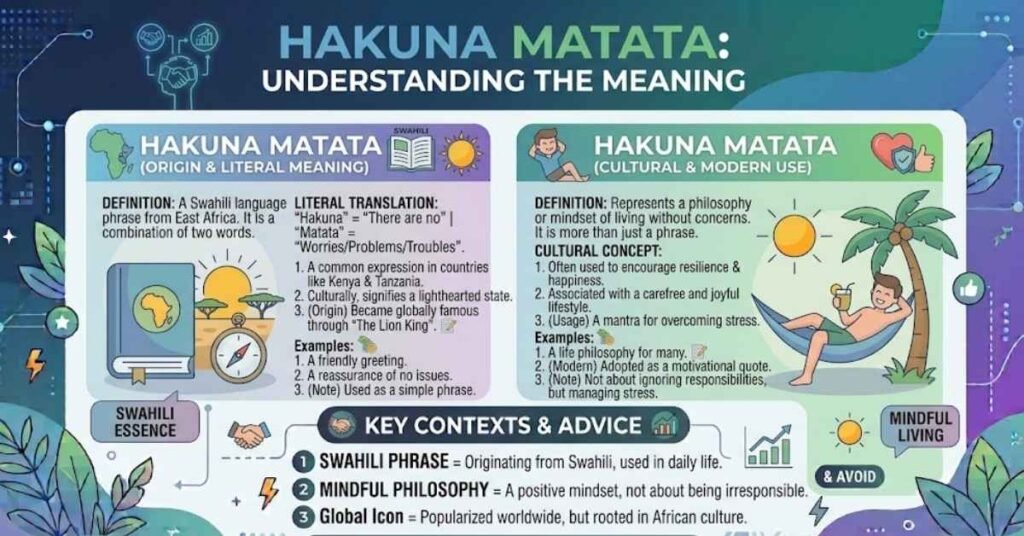
Have you ever heard someone say “Hakuna Matata” and wondered what those two catchy words actually mean? The Hakuna Matata meaning is essentially “no worries” or “there are no troubles.” It comes from Swahili, a major language of East Africa, and became famous around the world through Disney’s The Lion King.
However, there is a little more to the phrase than a memorable Disney song. Its literal meaning, everyday use, and connection to Swahili are worth exploring.
What Does Hakuna Matata Mean?
Hakuna Matata means “no worries,” “no trouble,” or “there are no problems.”
The phrase comes from Swahili. In a literal sense, hakuna expresses the idea that something does not exist or is not present, while matata refers to troubles, problems, or difficulties. Put together, the phrase conveys the idea that there are no troubles to worry about.
In natural English, “no worries” is usually the easiest translation.
Depending on the context, it can communicate ideas such as:
- No worries.
- No problem.
- Don’t worry about it.
- Everything is okay.
- Take it easy.
So, when someone uses hakuna matata in English, they are usually expressing a relaxed, carefree attitude.
Hakuna Matata Meaning in Swahili
Swahili, also known as Kiswahili, is widely spoken in East Africa, particularly in countries such as Kenya and Tanzania.
Learn the Hakuna Matata meaning, its Swahili origin, literal translation, pronunciation, and connection to The Lion King. The phrase itself is genuine Swahili rather than a word invented for The Lion King. The film helped introduce it to a huge international audience, but the expression existed before the movie.
The basic breakdown is:
| Swahili | Approximate English meaning |
|---|---|
| hakuna | there is no / there are no |
| matata | troubles / problems |
| hakuna matata | there are no troubles / no worries |
This explains why the phrase works so well as an expression of reassurance. It essentially tells someone that there is no trouble worth worrying about.
What Does “Hakuna” Mean?
The word hakuna expresses absence. In simple English, it can correspond to ideas such as “there is no” or “there are no.”
For example, the phrase hakuna matata uses hakuna to establish that the troubles being referred to are absent.
That is why translating the entire phrase simply as “no worries” captures the natural meaning, while “there are no troubles” comes closer to its literal sense.
What Does “Matata” Mean?
Matata refers to troubles, problems, or difficulties.
When combined with hakuna, the phrase communicates the absence of those troubles. Therefore, the literal idea behind hakuna matata is roughly “there are no troubles.”
The English expression “no worries” sounds more natural in everyday conversation, which is why it became the familiar translation.
Is Hakuna Matata a Swahili Phrase?
Yes. Hakuna Matata is a Swahili phrase.
This is an important point because many people first encounter the expression through Disney and assume that The Lion King created it.
It did not.
The phrase existed in Swahili before the 1994 animated film. For example, the Kenyan group Them Mushrooms used hakuna matata in their earlier song “Jambo Bwana.” The phrase later became much more widely known internationally through The Lion King.
In other words, Disney popularized the phrase globally; it did not invent the Swahili expression.
Hakuna Matata in The Lion King
For many English speakers, hakuna matata is almost inseparable from Disney’s The Lion King.
In the 1994 animated movie, the phrase becomes the carefree motto of Timon and Pumbaa. They introduce it to Simba as a way of leaving his worries behind and living a more relaxed life. Disney’s film notes describe the song as being based on the Swahili expression meaning “no worries.”
The song helped turn a regional Swahili expression into one of the best-known foreign-language phrases in popular English-speaking culture.
That connection remains strong today. If someone says hakuna matata, many people immediately think of Simba, Timon, Pumbaa, and The Lion King.
What Does Hakuna Matata Mean in the Disney Song?
In The Lion King, hakuna matata is presented as a carefree philosophy: don’t let past problems control your life, and try not to spend your days worrying about things you cannot change.
That idea is broader than a simple dictionary translation.
The Swahili phrase itself means “no worries” or “there are no troubles,” while the movie turns it into a larger theme about living without unnecessary worry.
How Do You Pronounce Hakuna Matata?
In English, the phrase is commonly pronounced approximately:
huh-KOO-nuh muh-TAH-tuh
Dictionary.com gives an English pronunciation close to /həˈkuːnə məˈtɑːtə/.
The pronunciation you hear in The Lion King may sound slightly different from natural Swahili pronunciation because the phrase is incorporated into an English-language musical performance.
If you are learning the phrase as Swahili rather than simply quoting the movie, it is better to treat the original language and the Disney song as two related but distinct contexts.
How Is Hakuna Matata Used?
The phrase can express reassurance or a relaxed attitude.
For example:
- “Sorry I forgot to call you.” “Hakuna matata.” → “No worries.”
- “Are you worried about the delay?” “Hakuna matata.” → “There’s no problem.”
- “We missed the bus, but hakuna matata.” → “We missed the bus, but there’s no need to worry.”
In English, however, people often use hakuna matata playfully or as a reference to The Lion King. Its use in English-speaking popular culture is therefore different from simply encountering the phrase in a Swahili-speaking setting.
Is Hakuna Matata a Word or a Phrase?
Hakuna Matata is a phrase, not a single word.
It contains two separate words:
- hakuna
- matata
Because the expression became famous through a song, some people treat it almost like a slogan or motto. Linguistically, though, it is a Swahili phrase.
That distinction matters if you are writing about the term or explaining its meaning.
Is Hakuna Matata the Same as “No Problem”?
Not exactly, but the meanings overlap.
“No problem” can be used to respond to an apology, request, or inconvenience. “No worries” often carries a similar reassuring tone.
Hakuna matata can express this general idea of having no trouble or concern, although its exact interpretation depends on context.
For English learners, these are useful approximate equivalents:
- Hakuna matata → No worries
- Hakuna matata → No problem
- Hakuna matata → There are no troubles
- Hakuna matata → Don’t worry about it
The first option, “no worries,” is the translation most strongly associated with The Lion King.
Why Did Hakuna Matata Become So Famous?
The phrase became internationally famous because of The Lion King, released by Disney in 1994.
The movie paired the memorable Swahili phrase with an upbeat song performed by Timon, Pumbaa, and Simba. As a result, millions of viewers encountered the expression even if they had never studied Swahili.
The popularity of the song also gave the phrase a second life in English. Today, people may use hakuna matata humorously, casually, or simply to reference the movie.
So, although the expression has real linguistic roots, its modern worldwide recognition is closely tied to Disney.
LEARN MORE: Heast Meaning
Does Hakuna Matata Literally Mean “No Worries”?
Not quite word for word.
The most natural English translation is “no worries,” but the more literal sense is closer to “there are no troubles” or “there are no problems.”
This is common when translating between languages. A literal translation may sound unnatural in English, while a natural translation communicates the same idea more smoothly.
So both of these explanations are useful:
- Literal sense: There are no troubles.
- Natural English meaning: No worries.
Neither contradicts the other.
Common Synonyms for Hakuna Matata
If you are looking for English expressions with a similar meaning, consider:
- No worries
- No problem
- Don’t worry
- It’s all good
- Take it easy
- Don’t stress
- Everything is fine
- No need to worry
The best choice depends on the situation. For example, “no worries” sounds friendly and casual, while “everything is fine” provides more direct reassurance.
Frequently Asked Questions About Hakuna Matata
What is the exact meaning of Hakuna Matata?
Hakuna Matata means “no worries” or “there are no troubles.” It is a Swahili phrase that expresses the idea that there is nothing to worry about.
Is Hakuna Matata a real Swahili phrase?
Yes. Hakuna Matata is a real Swahili expression. It existed before The Lion King, although Disney’s 1994 film made it famous around the world.
What language is Hakuna Matata?
Hakuna Matata is Swahili, a widely spoken language in East Africa. The expression is particularly associated with the East African cultural and linguistic context of countries such as Kenya and Tanzania.
Does Hakuna Matata mean “everything is fine”?
It can communicate a similar idea, especially when someone uses it to reassure another person. However, its more direct meanings are “no worries,” “no problem,” or “there are no troubles.”
Who says Hakuna Matata in The Lion King?
In the original animated The Lion King, Timon and Pumbaa introduce the phrase to Simba. It becomes their carefree motto and the central phrase of the film’s well-known song.
Did Disney invent Hakuna Matata?
No. Disney did not invent the phrase. It is a pre-existing Swahili expression. The Lion King popularized it internationally, especially among English-speaking audiences.
What does Hakuna Matata mean in English?
The most common English translation is “no worries.” A more literal translation is “there are no troubles.”
Final Thoughts on the Hakuna Matata Meaning
The Hakuna Matata meaning is simple: “no worries” or, more literally, “there are no troubles.”
The phrase comes from Swahili and existed long before The Lion King. However, Disney’s 1994 film transformed it into a worldwide pop-culture expression through the unforgettable song performed by Timon, Pumbaa, and Simba.
So the next time you hear someone say hakuna matata, you’ll know that it is more than just a catchy movie line. It is a genuine Swahili phrase that has traveled far beyond its original linguistic setting and taken on a familiar meaning in English: don’t worry—there’s no trouble.

1 thought on “Hakuna Matata Meaning: What It Really Means”