

When you see PICU written on a hospital chart or hear a doctor mention it, the abbreviation can sound confusing, especially during an already stressful situation. So, what is the PICU meaning?
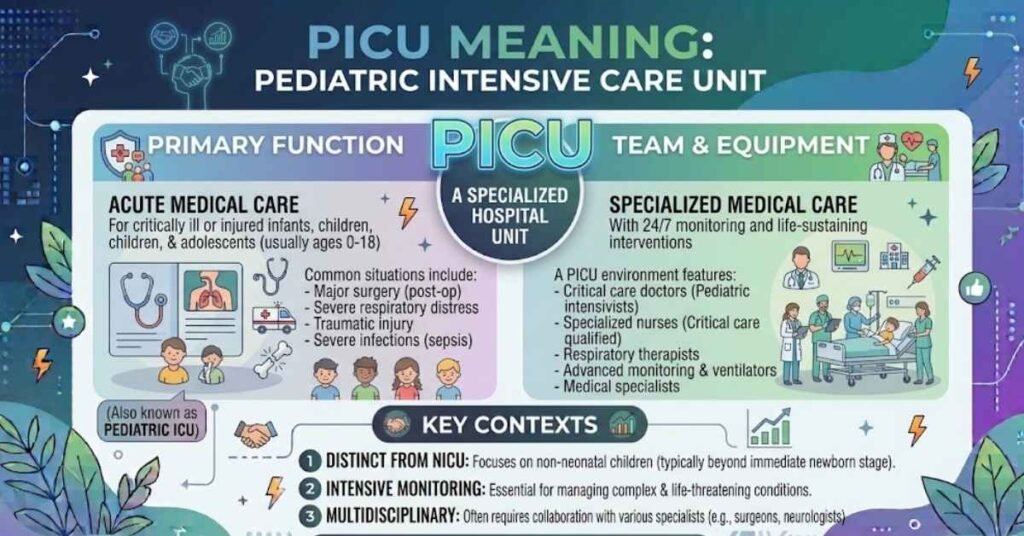
PICU stands for “Pediatric Intensive Care Unit.” It is a specialized hospital unit that provides intensive, closely monitored care for infants, children, and adolescents who are seriously ill or injured. The exact age range can vary by hospital.
A PICU has specialized doctors, nurses, respiratory therapists, equipment, and other healthcare professionals who care for children who need a higher level of monitoring or treatment than a regular hospital unit can provide.
What Does PICU Stand For?
PICU stands for Pediatric Intensive Care Unit.
Here is what each part means:
- P = Pediatric
- I = Intensive
- C = Care
- U = Unit
In simple terms, a PICU is an intensive care unit designed specifically for children.
Children in a PICU may need continuous monitoring, specialized medications, breathing support, or other advanced treatments. Pediatric critical care specialists coordinate care with nurses and other healthcare professionals.
What Is the PICU?
The Pediatric Intensive Care Unit is a hospital area for children who are critically ill, seriously injured, or require intensive monitoring and treatment.
Critical care generally involves around-the-clock observation and specialized treatment. In a PICU, the medical team can closely monitor vital signs and respond quickly if a child’s condition changes.
The environment may look different from a regular pediatric hospital room. You may see:
- Heart and breathing monitors
- Oxygen-monitoring equipment
- IV lines and medication pumps
- Breathing-support equipment
- Specialized medical devices
- Ventilators in some cases
Seeing numerous wires, tubes, and alarms can understandably be frightening for parents. However, these devices allow the medical team to monitor the child closely and provide treatment when needed.
Why Would a Child Go to the PICU?
A child may need PICU care when an illness, injury, or medical procedure requires intensive monitoring or treatment.
The American Academy of Pediatrics lists several situations that can lead to pediatric critical care, including severe asthma attacks, serious infections, major injuries, kidney or liver failure, and certain cancer or blood-related crises.
Other situations may include:
- Severe breathing problems
- Serious infections
- Major trauma
- Complications after major surgery
- Severe neurological problems
- Serious heart or lung conditions
- Poisoning or certain drug overdoses
- Conditions requiring advanced organ support
For example, a child with severe respiratory failure may need a ventilator and continuous monitoring. A child recovering from major surgery may also spend time in the PICU while the medical team watches closely for complications.
Importantly, being admitted to the PICU does not automatically mean a child will need every type of intensive treatment. The level of care depends on the child’s condition and the resources available at that particular hospital.
What Happens in a Pediatric Intensive Care Unit?
Once a child arrives in the PICU, the healthcare team evaluates the child’s condition and determines what monitoring and treatment are needed.
The care may include:
- Continuous monitoring The team may monitor heart rate, breathing, blood pressure, and oxygen levels.
- Medication and fluids Children may receive medicines or fluids through an IV.
- Breathing support Some children need supplemental oxygen, noninvasive breathing support, or a ventilator.
- Specialized treatment Depending on the illness, the PICU may provide advanced treatments that are not available on a standard pediatric floor.
- Frequent reassessment Doctors and nurses regularly assess the child’s condition and adjust treatment as necessary.
Children’s Hospital of Philadelphia, for example, describes PICU care for critically ill or injured infants, children, and adolescents and lists advanced technologies such as specialized ventilation, ECMO, and continuous renal replacement therapy among the resources available in pediatric critical care.
Who Works in the PICU?
PICU care involves a multidisciplinary team rather than one doctor working alone.
Depending on the child’s needs and the hospital, the team may include:
- Pediatric critical care physicians
- Pediatricians
- Nurses
- Respiratory therapists
- Pharmacists
- Nutrition specialists
- Physical or occupational therapists
- Social workers
- Other medical specialists
Pediatric critical care physicians receive specialized training to care for seriously ill children. The American Academy of Pediatrics notes that these specialists work with a broader healthcare team to diagnose, monitor, and treat critically ill pediatric patients.
This team-based approach matters because critically ill children may need several types of care at the same time.
PICU vs. ICU: What’s the Difference?
The main difference is who the unit is designed to treat.
An ICU, or Intensive Care Unit, provides intensive care for patients with serious or life-threatening illnesses or injuries. A PICU is specifically designed around the medical needs of children.
Children are not simply small adults. Their bodies, medication needs, equipment requirements, and communication abilities can differ significantly from those of adults.
That is why pediatric intensive care involves healthcare professionals and equipment specifically suited to children.
PICU vs. General Pediatric Unit
A general pediatric unit usually cares for children who need hospitalization but do not require the same level of continuous monitoring or intensive treatment.
A PICU is intended for children who are critically ill or whose condition requires intensive care.
In simple terms:
Pediatric floor: Hospital care with regular monitoring PICU: Intensive care with much closer monitoring and specialized treatment
The exact admission criteria vary between hospitals.
PICU vs. NICU: What’s the Difference?
PICU and NICU are easy to confuse because both are intensive care units for children.
The PICU means Pediatric Intensive Care Unit, while NICU means Neonatal Intensive Care Unit.
The key distinction is that a NICU specializes in newborns, particularly babies who are premature or have serious medical conditions shortly after birth.
A PICU generally cares for infants, children, and adolescents who need pediatric critical care. However, the exact age boundaries and how hospitals divide patients can differ.
| PICU | NICU |
|---|---|
| Pediatric Intensive Care Unit | Neonatal Intensive Care Unit |
| Treats critically ill children | Specializes in newborns |
| May care for infants through teenagers | Primarily cares for newborn babies |
| Handles many types of pediatric emergencies and serious illnesses | Commonly cares for premature or seriously ill newborns |
There can be exceptions. For example, some hospitals may transfer an infant between a NICU and PICU depending on the child’s age, condition, and the type of specialized care required.
Does Being in the PICU Mean a Child Is in Critical Condition?
Generally, PICU admission means a child needs intensive monitoring or treatment because of a serious medical condition, injury, or procedure.
However, PICU admission alone does not tell you exactly how sick a child is or what the outcome will be.
Some children require intensive care because they need close monitoring after major surgery. Others may require advanced life-support treatments because of a severe illness or injury.
The child’s medical team is the best source of information about the individual situation.
How Long Does a Child Stay in the PICU?
There is no standard PICU length of stay.
Some children may need intensive care for a relatively short period, while others with complex or severe illnesses may remain there much longer. The duration depends on factors such as:
- The child’s diagnosis
- Severity of the illness or injury
- Response to treatment
- Need for breathing support
- Recovery after surgery
- Need for specialized treatments
For that reason, it is better not to assume that a PICU stay will last a particular number of days.
As a child’s condition improves, the medical team may determine that intensive care is no longer necessary. The child may then move to another hospital unit for continued recovery.
What Equipment Is Used in the PICU?
PICUs contain specialized equipment designed to monitor and support critically ill children.
Depending on the child’s condition, you may see:
Heart and vital-sign monitors
Monitors can continuously track measurements such as heart rate, breathing rate, blood pressure, and oxygen saturation.
IV pumps
These devices deliver fluids and medicines at controlled rates.
Oxygen equipment
Some children need extra oxygen or other forms of breathing support.
Ventilators
A ventilator can help a child breathe when the child cannot breathe adequately without assistance. Not every child in a PICU needs a ventilator.
Specialized life-support equipment
Some PICUs have advanced technologies such as ECMO, which can provide specialized support for the heart and lungs in certain critically ill patients.
The equipment can look overwhelming at first, but each device has a specific purpose. Parents should feel comfortable asking the care team what a particular monitor, tube, or machine is doing.
What Does PICU Mean for Parents and Families?
A PICU stay can be stressful, particularly when everything is unfamiliar.
Parents may hear medical abbreviations, see alarms and monitors, and meet several specialists in a short period. Asking questions can make the situation easier to understand.
Useful questions may include:
- What is my child’s main problem right now?
- What treatments is my child receiving?
- What are the monitors measuring?
- Does my child need breathing support?
- What changes should I expect today?
- What needs to happen before my child can leave the PICU?
- Who should I speak with if I have questions?
Hospital policies about visiting, sleeping arrangements, and family participation vary. Therefore, families should ask their child’s hospital about its specific policies.
LEARN MORE: Hakuna Matata Meaning
Does PICU Mean Life Support?
No. PICU does not automatically mean life support.
A child can be admitted to a PICU for intensive monitoring or treatment without needing a ventilator or other form of life support.
At the same time, some critically ill children in a PICU may need life-support measures. The treatment depends entirely on the child’s medical condition.
Therefore, it is important to distinguish the location of care from the specific treatment a child receives.
What Happens After the PICU?
When a child becomes stable enough to leave intensive care, the medical team may transfer them to another hospital unit.
The next step could be:
- A pediatric medical or surgical floor
- A specialized pediatric unit
- A rehabilitation facility
- Home, depending on the child’s condition and discharge plan
The transition depends on the child’s recovery and ongoing medical needs.
Some children may still require medications, oxygen, feeding support, therapy, or follow-up care after leaving the PICU. The healthcare team should explain the next stage of treatment before discharge.
Frequently Asked Questions About PICU Meaning
What does PICU stand for?
PICU stands for Pediatric Intensive Care Unit. It is a specialized hospital unit that provides intensive care to seriously ill or injured infants, children, and adolescents.
What is the PICU meaning in medical terms?
The PICU meaning is Pediatric Intensive Care Unit. It refers to a hospital unit designed to provide close monitoring and specialized treatment for children who need critical care.
Is PICU the same as ICU?
No. PICU is a specialized type of intensive care unit designed for pediatric patients. A general ICU may primarily care for adults, although hospital organization varies.
What is the difference between PICU and NICU?
A PICU provides intensive care for children, while a NICU specializes in newborns. NICUs commonly care for premature babies and newborns with serious medical conditions.
Is PICU only for babies?
No. A PICU can care for infants, children, and adolescents. The precise age range varies between hospitals.
Why would a child be admitted to the PICU?
A child may need PICU care because of a serious illness, injury, breathing problem, severe infection, major surgery, or another condition requiring intensive monitoring or specialized treatment.
Does being in the PICU mean a child is dying?
No. PICU admission means that a child needs intensive medical care or monitoring. It does not by itself predict the child’s outcome.
Some children enter the PICU after major surgery or because they temporarily need close observation, while others require treatment for severe or life-threatening illness.
How long does a child stay in the PICU?
There is no fixed length of stay. It depends on the child’s illness, injury, treatment, and recovery.
What does PICU stand for in a hospital?
In a hospital, PICU stands for Pediatric Intensive Care Unit. It is the specialized intensive care area for children who need a higher level of care than a regular pediatric unit can provide.
Final Thoughts on PICU Meaning
The PICU meaning is straightforward: PICU stands for Pediatric Intensive Care Unit.
It is a specialized hospital unit where critically ill or injured children can receive close monitoring, specialized treatment, and care from a team trained in pediatric critical care.
PICU, ICU, and NICU are related terms, but they are not interchangeable. In particular, the NICU focuses on newborns, while the PICU serves a broader pediatric population.
If you came across the term PICU because a child is currently receiving care there, the child’s medical team can explain exactly why the unit is needed, what treatments are being used, and what the next steps may be.

1 thought on “PICU Meaning: What Does PICU Stand For?”