

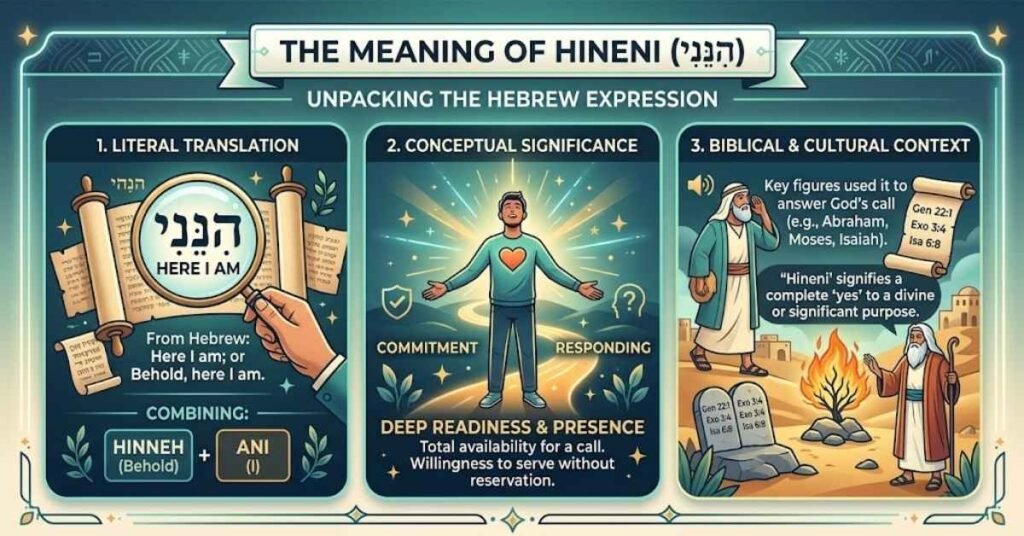
Have you ever come across the word Hineni and wondered what it means? The Hineni meaning is essentially “Here I am” or “I am here.” However, in the Bible, Hineni carries a deeper sense than simply stating your location. It can express readiness, attentiveness, willingness, and a response to a call from God.
The word comes from Hebrew and appears several times in the Hebrew Bible. Understanding its context can reveal why such a short expression has become so meaningful in Jewish and Christian religious traditions.
What Does Hineni Mean?
Hineni (הִנְנִי) is a Hebrew expression that literally means “Here I am.”
The word combines the Hebrew particle hinneh, which can mean “behold” or “look,” with the first-person pronoun -i, meaning “I” or “me.” Together, the expression functions as a way of saying, “Here I am,” often with a sense of presenting oneself before another person.
Depending on the context, Hineni can communicate:
- “Here I am.”
- “I am present.”
- “I’m listening.”
- “I’m ready.”
- “I am available.”
- “I am willing to respond.”
So, while “Here I am” is the most direct translation, the meaning can extend beyond physical presence.
Hineni Meaning in Hebrew
In Hebrew, Hineni is written as הִנְנִי.
It is generally transliterated into English as Hineni, Hinneh-ni, or similar forms.
The expression is associated with the Hebrew verb or particle hinneh, which draws attention to something or someone. The attached first-person element indicates the speaker.
Therefore, the expression can be understood as a concise declaration of one’s presence.
However, biblical usage gives the expression additional significance. A person saying Hineni may be responding to someone who has called them, particularly in a situation involving responsibility or divine instruction.
What Does Hineni Mean in the Bible?
In the Bible, Hineni means “Here I am,” but its significance often goes beyond location.
Several biblical figures use the expression when responding to a call. One well-known example occurs when God calls Abraham in Genesis 22. Abraham responds, “Here I am.”
The expression also appears when God calls Moses from the burning bush in Exodus 3. Moses answers the divine call with Hineni.
Another notable example occurs in Isaiah 6, when Isaiah responds to God’s call by saying, “Here am I; send me.”
These examples give Hineni an important biblical association with:
- Presence — The speaker acknowledges that they are present.
- Attention — The speaker indicates that they are listening.
- Readiness — The speaker shows an openness to respond.
- Willingness — In certain contexts, the response suggests a willingness to accept a task or responsibility.
The exact meaning depends on the passage and its surrounding context.
Hineni in the Old Testament
The Hebrew word Hineni appears in several important passages of the Old Testament, also called the Hebrew Bible.
Abraham and Hineni
In Genesis 22, God calls Abraham, and Abraham responds with Hineni.
The word appears again later in the story when Abraham answers his son’s call. This shows that Hineni can function as an ordinary response to someone calling a person’s name.
The surrounding story, however, gives the expression considerable theological significance because Abraham is being called to an extraordinary task.
Moses and the Burning Bush
In Exodus 3, God calls Moses from the burning bush. Moses responds with Hineni.
Here, the expression signals that Moses has heard the call and is ready to engage with the speaker.
The passage is particularly important because Moses subsequently receives a mission: to lead the Israelites out of Egypt.
Isaiah’s Response
Isaiah 6 provides perhaps the most recognizable example of Hineni’s association with willingness.
After Isaiah encounters a vision of God and hears a question about whom God should send, Isaiah responds:
“Here am I; send me.”
In this context, Hineni forms part of a response expressing readiness to accept a mission.
Is Hineni a Hebrew Word?
Yes. Hineni is a Hebrew expression written הִנְנִי.
It is not simply an English religious term borrowed from Hebrew. Its meaning comes from its use within the Hebrew language and biblical texts.
The spelling Hineni is a transliteration. Because Hebrew uses a different writing system from English, several transliteration styles can represent the same Hebrew expression.
You may therefore encounter slightly different English spellings while referring to the same Hebrew word.
What Is the Spiritual Meaning of Hineni?
The spiritual meaning of Hineni is often understood as a declaration of presence, attentiveness, availability, and willingness.
In religious discussions, someone may use Hineni to express an attitude such as:
“I am here, I am listening, and I am willing to respond.”
That interpretation comes particularly from biblical passages where people use the expression when responding to God.
However, it is important to distinguish the literal meaning from a broader spiritual interpretation. Literally, Hineni means “Here I am.” Its deeper implications come from how the expression functions in particular biblical contexts.
Why Is Hineni Important?
Hineni is significant because it turns a simple statement of presence into a meaningful response to a call.
Imagine someone calling your name. You could simply answer, “Yes?” But saying “Here I am” can communicate something more personal: you are present, attentive, and ready to hear what comes next.
This helps explain why Hineni has become an important concept in Jewish and Christian thought.
It can represent the idea of being fully present rather than merely physically nearby.
Hineni vs. “Here I Am”
The English phrase “Here I am” provides the closest basic translation of Hineni. However, the two expressions can carry different associations depending on context.
| Hineni | “Here I am” |
|---|---|
| Hebrew expression | English expression |
| Written הִנְנִי | Written in English |
| Literally means “Here I am” | Direct equivalent |
| Frequently discussed in biblical contexts | Used broadly in everyday English |
| Can imply attentiveness or readiness in context | Usually indicates presence or identification |
Therefore, translating Hineni as “Here I am” is accurate, but understanding its biblical context can provide additional meaning.
LEARN MORE: INR Meaning
How Is Hineni Used Today?
Today, Hineni is sometimes used in Jewish, Christian, spiritual, literary, and cultural discussions.
People may use it to describe an attitude of:
- Being fully present
- Listening carefully
- Accepting responsibility
- Responding to a calling
- Offering oneself for a task
- Being available to help
Some modern religious writers also use Hineni as a personal or spiritual practice—a reminder to remain attentive to one’s responsibilities and values.
Its modern interpretation, however, varies depending on the community and context.
Is Hineni a Name?
Hineni can appear as a name or title in modern religious and cultural contexts, but its original Hebrew use is an expression rather than a conventional personal name.
If you encounter “Hineni” as someone’s name, organization name, book title, song title, or project name, the intended meaning may be based on the biblical idea of responding, “Here I am.”
Hineni Meaning in Simple Words
If you want the simplest explanation:
Hineni means “Here I am.”
In a biblical or spiritual context, it can also convey:
“I am here, I am listening, and I am ready to respond.”
The second interpretation should be understood as a contextual or spiritual sense rather than the word-for-word translation.
Frequently Asked Questions About Hineni
What does Hineni mean?
Hineni means “Here I am” in Hebrew. In biblical contexts, it can also communicate attentiveness, readiness, or willingness to respond.
What does Hineni mean spiritually?
Spiritually, Hineni is often understood as an expression of being present, attentive, available, and willing to respond to a call or responsibility.
What does Hineni mean in the Bible?
In the Bible, Hineni literally means “Here I am.” Biblical figures such as Abraham and Moses use the expression when responding to a call. Isaiah also uses it when responding to God’s question about whom He should send.
What is the Hebrew spelling of Hineni?
Hineni is written הִנְנִי in Hebrew.
Is Hineni Hebrew for “here I am”?
Yes. Hineni (הִנְנִי) is a Hebrew expression that can be translated as “Here I am.”
What is the significance of Hineni?
Its significance comes from both its literal meaning and its biblical contexts. It can represent presence, attentiveness, readiness, and willingness to respond.
Is Hineni used only in religious contexts?
No. Although Hineni is strongly associated with biblical and religious language, the concept is also used in modern cultural, literary, and spiritual discussions.
Conclusion: Hineni Meaning Explained
So, what is the Hineni meaning? At its simplest, Hineni means “Here I am” in Hebrew. In biblical contexts, however, the expression can carry a richer sense of being present, attentive, ready, and willing to respond.
Its appearances in stories involving figures such as Abraham, Moses, and Isaiah help explain why Hineni has become an important expression in Jewish and Christian thought.
If you are studying biblical Hebrew, religious terminology, or the meanings behind familiar biblical expressions, understanding the context of words like Hineni can add another layer to your reading.

1 thought on “Hineni Meaning: Definition, Origin & Biblical Use”