

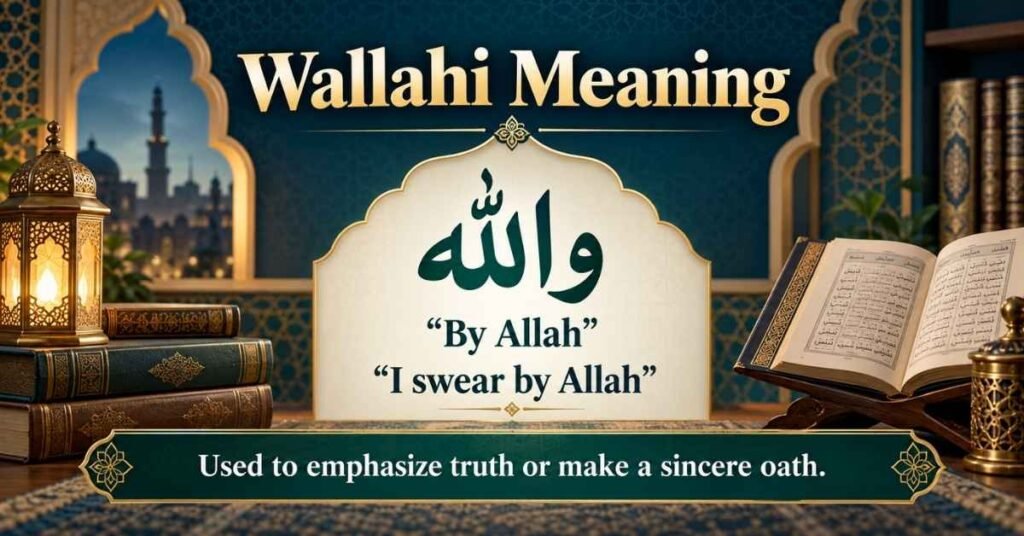
Wallahi meaning is “By Allah” or “I swear by Allah.” People use this Arabic expression to emphasize that they are telling the truth or making a sincere promise. Although “wallahi” often appears in casual conversations and social media posts, it carries the weight of an oath in an Islamic context. Therefore, you should not use it carelessly, jokingly, or to support a lie.
The expression has spread far beyond Arabic-speaking communities. You may hear it in Pakistan, Somalia, the United Kingdom, the United States, and many other places with Muslim populations. However, its growing popularity has also caused confusion about its spelling, meaning, and appropriate use.
What Does Wallahi Mean?
Wallahi means “I swear by Allah,” “By Allah,” or, more generally in English, “I swear to God.” A speaker uses it to strengthen a statement and assure the listener that the statement is true.
For example:
“Wallahi, I did not take your phone.”
In this sentence, the speaker is not simply saying that they did not take the phone. They are calling upon Allah as a witness to emphasize their honesty.
Depending on the context, wallahi may communicate:
- A sincere oath
- A strong promise
- Confirmation that something is true
- Surprise or disbelief
- Emotional emphasis
- Frustration or seriousness
The central meaning, however, remains connected to swearing by Allah.
Wallahi Meaning in Arabic
Wallahi is written in Arabic as وَاللّٰهِ or commonly without vowel marks as والله. Its more precise transliteration is wallāhi.
The expression can be divided into two parts:
- Wa (وَ): an Arabic particle used here to mean “by”
- Allah (الله): the Arabic name for God
In Arabic grammar, this use of wa is associated with an oath. Therefore, the literal translation is “By Allah.”
The final “i” sound appears because Allah takes the genitive form after the oath particle. In everyday speech, however, pronunciations and written spellings vary.
How Do You Pronounce Wallahi?
Wallahi is commonly pronounced:
wah-LAH-hee
The stress usually falls on the middle syllable:
- Wah
- LAAH
- Hee
The long “ah” sound should receive slightly more emphasis. Pronunciation may differ across Arabic dialects and non-Arabic-speaking Muslim communities.
Wallahi, Wallah or Wallahi—Which Spelling Is Correct?
Because wallahi comes from Arabic, it does not have only one fixed spelling in the Latin alphabet. Several English transliterations appear online, including:
- Wallahi
- Wallah
- Wallahi
- Wallāhi
- Wallahi billahi
Wallahi is a widely recognized spelling when the full Arabic pronunciation is intended. Wallah is also common in casual speech and online messages.
The spelling wallāhi is more precise in academic transliteration because the line above the “a” indicates a long vowel. Still, most English speakers write it as wallahi.
What Is the Islamic Meaning of Wallahi?
In Islam, wallahi can constitute a serious oath made in Allah’s name. It is not merely an expression for making a sentence sound convincing.
The Quran distinguishes between thoughtless oaths and deliberate ones. It also discusses expiation for a deliberately made oath that is broken and instructs believers to guard their oaths. Quran 5:89
Moreover, the Quran warns people not to use Allah’s name in their oaths as an excuse to avoid righteousness, piety, or reconciliation. Quran 2:224
Consequently, a Muslim should understand the seriousness of the phrase before using it.
Is Saying Wallahi Haram?
Simply saying wallahi is not automatically haram. It can be used for a truthful and sincere oath.
However, the situation becomes religiously serious when someone:
- Uses wallahi while knowingly lying
- Makes a promise they do not intend to keep
- Swears about trivial matters constantly
- Uses Allah’s name as part of a joke
- Makes a deliberate oath and then breaks it
Specific religious rulings can depend on the speaker’s words, intention, and circumstances. Therefore, anyone concerned about a particular oath should consult a qualified Islamic scholar rather than relying only on general online advice.
What Happens If You Break a Wallahi Promise?
Not every casual occurrence of the word necessarily has the same legal status as a deliberate oath. Intention and context matter.
Nevertheless, Quran 5:89 states that deliberate oaths carry accountability. The verse describes expiation for a broken oath: feeding ten people in need, clothing them, or freeing an enslaved person; someone unable to do those things must fast for three days. It also tells believers to be mindful of their oaths. Quran 5:89
Because personal circumstances can affect the ruling, seek guidance from a knowledgeable scholar if you believe you have broken a binding oath.
Wallahi Meaning in Text and Social Media
In text messages, TikTok videos, memes, and online conversations, wallahi often means:
- “I swear”
- “Honestly”
- “I am serious”
- “Believe me”
- “I promise”
- “For real”
For example:
“Wallahi, that was the best meal I’ve had all year.”
Here, the speaker may be emphasizing a strong opinion rather than making a carefully considered formal promise.
Another example is:
“Wallahi, I’ll send it tomorrow.”
In this case, the phrase may function as a serious promise. Therefore, the speaker should avoid saying it unless they genuinely intend to fulfil that commitment.
Wallahi Meaning in Slang
As slang, wallahi adds emotional force, certainty, or credibility to a statement. Young speakers sometimes shorten it to wallah or use abbreviations in messages.
Common slang uses include:
To Show Honesty
“Wallahi, I’m telling you the truth.”
The speaker wants the listener to believe the statement.
To Express Surprise
“Wallahi, that actually happened?”
Here, the expression communicates amazement or disbelief.
To Strengthen an Opinion
“Wallahi, this restaurant is amazing.”
The speaker strongly supports the opinion.
To Make a Promise
“Wallahi, I’ll help you finish the work.”
This use is more serious because the speaker connects the phrase to a future commitment.
Even when used as slang, its religious meaning does not disappear. Therefore, respectful use remains important.
Examples of Wallahi in Sentences
The following examples show how the phrase may appear in different situations.
- “Wallahi, I saw him at the store yesterday.” The speaker strongly confirms what they witnessed.
- “Wallahi, I will return your money on Friday.” The speaker makes a serious promise.
- “Wallahi, this view is beautiful.” The phrase emphasizes admiration.
- “I didn’t break it, wallahi.” The speaker insists that they are innocent.
- “Wallahi, you need to watch this movie.” The speaker strongly recommends something.
- “Wallahi, I had no idea about the meeting.” The phrase reinforces the speaker’s claim.
- “Wallahi, I won’t repeat that mistake.” The speaker promises to change their behaviour.
These examples are grammatically natural. Still, using wallahi in every sentence can make the phrase sound careless and may weaken its seriousness.
When Should You Say Wallahi?
You should reserve wallahi for situations in which you are truthful, sincere, and aware of its meaning.
It may be appropriate when:
- You need to confirm an important truth
- You are making a sincere statement
- You fully intend to keep a promise
- The cultural and religious context makes its use suitable
Before saying it, ask yourself:
- Is my statement completely true?
- Is an oath genuinely necessary?
- Do I intend to fulfil this promise?
- Am I treating Allah’s name respectfully?
If the situation does not require an oath, ordinary phrases such as “honestly,” “I promise,” or “I’m serious” may be more appropriate.
When Should You Avoid Saying Wallahi?
Avoid the expression when you are unsure of the facts or cannot guarantee a future action.
You should not say wallahi:
- To make a lie sound believable
- To manipulate someone
- As part of a prank
- To win an unimportant argument
- When exaggerating a story
- When making a promise you may not keep
- Repeatedly as a meaningless verbal habit
In short, do not use a sacred oath as conversational decoration.
Wallahi vs Inshallah
Wallahi and inshallah are Arabic expressions, but they do not mean the same thing.
| Expression | Meaning | Typical purpose |
|---|---|---|
| Wallahi | By Allah; I swear by Allah | Confirms truth or strengthens a promise |
| Inshallah | If Allah wills | Expresses hope or intention about the future |
Consider these examples:
“Wallahi, I completed the work.”
The speaker swears that the work has already been completed.
“I will complete the work tomorrow, inshallah.”
The speaker intends to complete it while acknowledging that the outcome depends on Allah’s will.
Therefore, you should not treat the expressions as interchangeable.
Wallahi vs Mashallah
Mashallah generally means “what Allah has willed.” People commonly say it when expressing appreciation, admiration, or gratitude for something good.
In contrast, wallahi is an oath used to affirm truth or sincerity.
For example:
- Wallahi: “Wallahi, I am telling the truth.”
- Mashallah: “Mashallah, your new home is beautiful.”
The first emphasizes honesty. Meanwhile, the second expresses admiration and acknowledges Allah’s will.
Wallahi vs Billahi and Tallahi
Arabic has several oath constructions involving Allah’s name:
- Wallahi: By Allah
- Billahi: By Allah
- Tallahi: By Allah
They share a similar essential meaning but use different Arabic oath particles. Wallahi is especially widespread in everyday conversation.
You may also hear “wallahi billahi” when someone wants to intensify an oath. However, repeating or expanding the expression does not make a dishonest claim acceptable. Truthfulness remains the essential requirement.
Can Non-Muslims Say Wallahi?
Wallahi is an Arabic expression rather than the name of a religious ritual. Arabic speakers from different backgrounds may use expressions containing the word Allah, which is simply the Arabic word for God.
However, wallahi carries sacred significance for Muslims because it invokes Allah’s name as an oath. A non-Muslim who uses it should understand that meaning and avoid treating the phrase as a joke, trend, or imitation.
Respectful awareness matters more than using a fashionable expression without understanding it.
Why Has Wallahi Become Popular Online?
Wallahi has become more visible because social media brings Arabic, Islamic, Somali, South Asian, and multicultural youth vocabulary into global conversations.
The phrase is short, expressive, and emotionally powerful. As a result, people use it in:
- TikTok videos
- YouTube content
- Instagram comments
- Group chats
- Gaming conversations
- Memes
- Multicultural urban slang
However, online popularity does not erase its original meaning. It still refers to an oath by Allah, even when speakers use it casually.
LEARN MORE: Vice Versa Meaning
Common Mistakes People Make With Wallahi
Using It Without Knowing the Meaning
Some people repeat the phrase because they heard it online. Yet they may not realize that it means “I swear by Allah.”
Saying It While Exaggerating
An exaggerated story may seem harmless. However, attaching an oath to information you know is inaccurate makes the matter more serious.
Treating It Like a Filler Word
Frequent repetition can turn wallahi into a verbal habit. Instead, use it selectively and consciously.
Confusing It With Inshallah
Wallahi confirms or emphasizes a claim. Inshallah expresses hope or intention regarding the future.
Making Promises Too Easily
Do not say, “Wallahi, I will do it,” unless you sincerely plan and expect to fulfil the promise.
Frequently Asked Questions
What is the simple meaning of wallahi?
Wallahi simply means “By Allah” or “I swear by Allah.” It emphasizes that a statement is true or a promise is sincere.
What does wallahi mean in English slang?
In English slang, it may function like “I swear,” “honestly,” “seriously,” or “for real.” Nevertheless, its original meaning remains religiously significant.
Is wallahi an Arabic word?
Yes. It comes from the Arabic expression والله, meaning “By Allah.”
Does wallahi mean “I promise”?
It can communicate a strong promise, particularly when followed by a future commitment. Its literal meaning, however, is “By Allah” or “I swear by Allah.”
Is wallahi only used by Muslims?
It is strongly associated with Muslim speech and Islamic oaths. However, it is also an Arabic expression, and usage can extend beyond Muslims depending on language and culture.
Can you say wallahi as a joke?
You should avoid using it jokingly because it invokes Allah’s name. In an Islamic context, oaths should be truthful and treated seriously.
What is the difference between wallah and wallahi?
Both forms can refer to the same Arabic oath. Wallahi represents the fuller pronunciation, while wallah often appears in casual speech or informal transliteration.
How do you reply when someone says wallahi?
There is no required universal reply. Your response depends on the conversation. You might say, “I believe you,” “Okay,” or ask for clarification if the matter is important.
Does saying wallahi always create a binding oath?
Not necessarily in every situation. Intention, wording, and context can affect whether it counts as a deliberate oath under Islamic law. Consult a qualified scholar about a specific case.
Conclusion
Wallahi meaning is “By Allah” or “I swear by Allah.” The expression can confirm the truth, strengthen a promise, or add emphasis to a statement. Although it has become common in text messages and social media slang, it remains connected to a serious oath in Islam.
Use wallahi truthfully, respectfully, and only when necessary. If you are simply adding emphasis to an everyday conversation, words such as “honestly” or “seriously” may be better choices. You can also explore related expressions such as inshallah, mashallah, alhamdulillah, and astaghfirullah to understand their distinct meanings and appropriate uses.

1 thought on “Wallahi Meaning: Definition, Usage and Examples”