

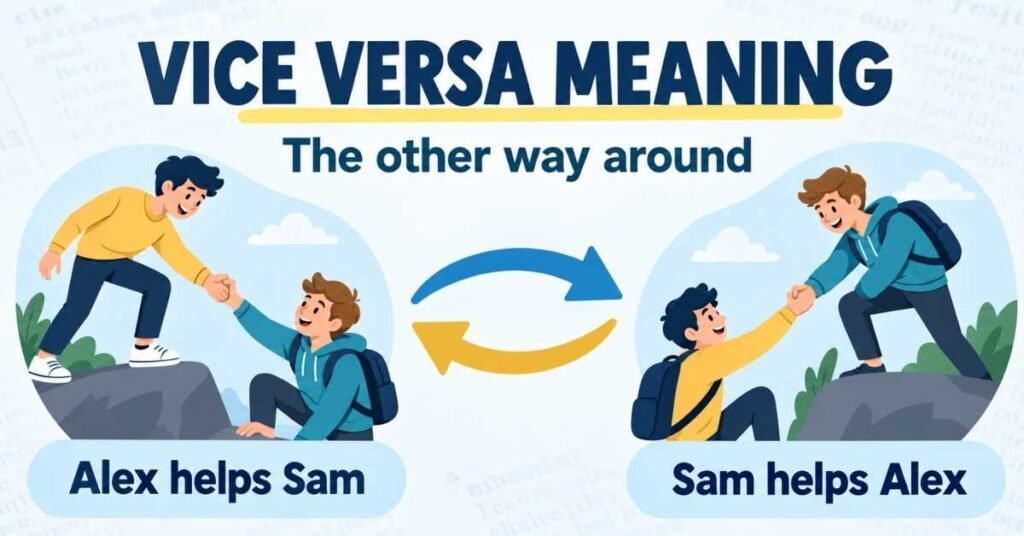
Vice versa meaning is “the other way around” or “with the order, direction, or relationship reversed.” For example, “I help my sister, and vice versa” means that my sister helps me too. The phrase is common in American English and is used in conversations, emails, academic writing, business communication, and everyday sentences.
What Does Vice Versa Mean?
Vice versa is an English phrase and adverb that shows the reverse of a previously mentioned idea is also true.
In simple terms:
A → B Vice versa = B → A
For example:
Dogs can learn from people, and vice versa.
This means that people can learn from dogs too.
The phrase may describe a reversed:
- Relationship
- Action
- Direction
- Order
- Comparison
- Translation
- Exchange
Major dictionaries define vice versa as “the other way around,” “in reverse order,” or with the relations reversed. Merriam-Webster, Dictionary.com
Vice Versa in Simple Words
Imagine two people, objects, or directions connected by an action.
A helps B.
If the same relationship works in reverse:
B helps A.
You can say:
A helps B, and vice versa.
This saves you from repeating the entire sentence. Instead of saying:
“I support my brother, and my brother supports me.”
You can write:
“I support my brother, and vice versa.”
The phrase works because the reader can easily understand what is being reversed.
What Does “And Vice Versa” Mean?
“And vice versa” means that the reverse of the statement is also true.
Consider this example:
Students learn from teachers, and vice versa.
The first statement is:
Students learn from teachers.
The reversed statement is:
Teachers learn from students.
Therefore, “and vice versa” means that teachers can learn from students too.
The phrase usually refers to the people, objects, actions, or directions mentioned immediately before it. You should always check the previous part of the sentence to understand what is being reversed.
What Does “Or Vice Versa” Mean?
“Or vice versa” means that either direction or arrangement is possible.
For example:
You can travel from Chicago to Detroit or vice versa.
This means you can travel:
- From Chicago to Detroit
- Or from Detroit to Chicago
Another example is:
You can translate the sentence from English to Spanish or vice versa.
This means the sentence can be translated from English into Spanish or from Spanish into English.
How to Use Vice Versa in a Sentence
Use this simple three-step method:
- Identify the first relationship or direction.
- Reverse the people, objects, actions, or places.
- Make sure the reversed statement is logical and true.
Reciprocal Actions
I teach my brother, and vice versa.
This means your brother teaches you too.
The coach motivates the players, and vice versa.
This means the players also motivate the coach.
Relationships Between People
Parents influence their children, and vice versa.
This means children can influence their parents as well.
They respect one another, and vice versa.
This sentence is slightly repetitive because one another already suggests a mutual relationship. A clearer version might be:
The students respect their teacher, and vice versa.
This means the teacher respects the students too.
Directions and Travel
The train runs from Boston to New York and vice versa.
This means the train also runs from New York to Boston.
The road connects Austin to Dallas and vice versa.
This means the road connects Dallas to Austin as well.
Technology and Translation
The app converts speech into text and vice versa.
This means it can convert:
- Speech into text
- Text into speech
The software translates English into French and vice versa.
This means it also translates French into English.
This is one of the clearest modern uses of vice versa because the direction of translation is easy to reverse.
Comparisons
Some people prefer working remotely, and vice versa.
This sentence is unclear because the reverse preference is not fully stated. A better example is:
Some employees prefer working remotely, while others prefer working in an office, and vice versa.
However, you should use vice versa only when the reversed meaning is genuinely clear. If the sentence becomes confusing, write the complete idea instead.
Vice Versa Examples With Meanings
| Sentence | What is reversed? | Meaning |
|---|---|---|
| I help my cousin, and vice versa. | The helping relationship | My cousin helps me too. |
| Students learn from teachers, and vice versa. | The learning relationship | Teachers learn from students too. |
| The app changes text into speech and vice versa. | The conversion direction | It changes speech back into text. |
| The bus travels from Miami to Orlando and vice versa. | The travel direction | It also travels from Orlando to Miami. |
| She dislikes him, and vice versa. | The feeling | He dislikes her too. |
| The customer depends on the business, and vice versa. | The dependency | The business depends on the customer too. |
Vice Versa vs. the Opposite
The Vice versa does not always mean “the opposite.” It usually means that the same relationship or action is reversed.
| Expression | Meaning |
|---|---|
| Vice versa | The same relationship in reverse |
| The other way around | A simple synonym for vice versa |
| The opposite | Something contrary or completely different |
| Conversely | A more formal way to introduce a reversed or contrasting idea |
For example:
The customer depends on the business, and vice versa.
This means the business depends on the customer too. It does not mean the business dislikes or opposes the customer.
The word opposite can sometimes cause confusion because it may refer to a contrary meaning. In contrast, vice versa normally reverses the order, direction, or relationship.
Vice Versa vs. Conversely
The Vice versa and conversely can both introduce a reversed idea, but they are not always interchangeable.
Vice versa
- Common in everyday English
- Natural in emails and conversations
- Useful when the reversed relationship is obvious
- Usually appears at the end of a sentence
Example:
I support my friend, and vice versa.
Conversely
- More formal
- Common in essays, reports, and analytical writing
- Often introduces a contrasting or reversed point
Example:
The first method is inexpensive. Conversely, the second method requires a larger budget.
You can usually use vice versa when you mean “the other way around.” Use conversely when you want a more formal or analytical tone.
Is “Visa Versa” Correct?
No. “Visa versa” is a common misspelling. The correct spelling is “vice versa.”
The phrase is normally written as two separate words:
- Correct: vice versa
- Incorrect: visa versa
- Incorrect: viceversa
- Usually unnecessary: vice-versa
People often write “visa versa” because the phrase is heard in conversation before it is seen in writing. Remember that the correct phrase begins with vice, not visa.
LEARN MORE: STG Meaning in Text
How Do You Pronounce Vice Versa?
In American English, vice versa is commonly pronounced:
VYS VUR-suh
A common American pronunciation is represented as:
/ˌvaɪs ˈvɝːsə/
Some speakers pronounce the first part closer to “VY-see.” British pronunciation may sound slightly different. Both pronunciation patterns are recognized in English dictionaries. Vocabulary.com, Oxford Learner’s Dictionaries
Is Vice Versa Formal?
Yes. Vice versa is acceptable in both casual and formal writing when the meaning is clear.
You can use it in:
- Everyday conversations
- Text messages
- Emails
- Business communication
- Journalism
- School assignments
- Academic writing
However, avoid it when the reader may not know what is being reversed. In technical, legal, or highly complex writing, a complete sentence may be clearer.
For example:
The policy applies to employees and contractors, and vice versa.
This may be confusing if the policy does not apply to both groups in exactly the same way. A clearer version would be:
The policy applies to employees, and the same rule applies to contractors.
Grammar and Punctuation
What Part of Speech Is Vice Versa?
Vice versa is generally classified as an adverb. It modifies or completes the meaning of a previous statement by showing that the reverse is also true.
Where Does Vice Versa Appear?
It usually appears at the end of a sentence or clause:
I trust her, and vice versa.
It may also appear after a direction:
The service operates from New York to Boston and vice versa.
Does Vice Versa Need a Comma?
There is no single comma rule for every sentence. Punctuation depends on the sentence structure.
Examples:
I help her, and vice versa.
The app translates English into Spanish and vice versa.
The main priority is clarity. If the phrase is added to a long or complicated sentence, rewrite the sentence if the reversed meaning becomes difficult to identify.
Common Mistakes to Avoid
1. Writing “Visa Versa”
The correct spelling is vice versa.
2. Treating It as One Word
Write it as two words:
vice versa
3. Assuming It Always Means “The Opposite”
It generally means the reverse relationship, not a contradictory idea.
4. Using It When the Reverse Is Not True
Unclear: I prefer tea to coffee, and vice versa.
The reverse preference creates confusion. If the reverse statement is not logical, do not use the phrase.
5. Making the Reference Unclear
Confusing: Sarah told Maria that she needed help, and vice versa.
It is unclear who needed help. Use a complete sentence instead.
6. Using It Only to Sound Sophisticated
Do not add vice versa unnecessarily. If repeating the statement makes the meaning clearer, repeat it.
Word Origin of Vice Versa
Vice versa comes from Latin and refers to an arrangement or position being turned around. The phrase entered English centuries ago and developed into a common expression meaning “with the order reversed.” Merriam-Webster, Collins Dictionary
It is related in meaning or form to words such as:
- Reverse
- Converse
- Versatile
- Conversion
The etymology is interesting, but the practical meaning remains simple: the same idea applies in the other direction.
Quick Test: Can You Use Vice Versa Correctly?
Consider this sentence:
I listen to my friend, and vice versa.
What is reversed?
The answer is:
My friend listens to me too.
Now try this example:
The machine changes heat into energy and vice versa.
This means the machine can also change energy into heat.
Before using the phrase, ask yourself:
- What is the first relationship?
- What would it look like in reverse?
- Is the reverse statement actually true?
- Will the reader understand what is being reversed?
Frequently Asked Questions
What is the easiest meaning of vice versa?
Vice versa means “the other way around.” It shows that the reverse of a previously mentioned statement, relationship, order, or direction is also true.
What does “and vice versa” mean?
And vice versa means that the reverse statement is also true. “I help my friend, and vice versa” means that your friend helps you too.
Is vice versa the same as the opposite?
Not exactly. Vice versa usually means a reversed relationship or direction, while “the opposite” can mean something completely contrary.
Is visa versa correct?
No. Visa versa is a misspelling. The standard form is vice versa, written as two words.
Is vice versa one word?
No. The standard spelling is vice versa—two separate words.
Is vice versa an adverb?
Yes. Dictionaries generally classify vice versa as an adverb.
Can I use vice versa in formal writing?
Yes. It is acceptable in academic, business, and formal writing when the reversed meaning is clear.
What is another word for vice versa?
Common alternatives include the other way around, conversely, in reverse, and with the order reversed.
What is an example of vice versa?
The teacher learns from the student, and vice versa.
This means the student learns from the teacher, and the teacher learns from the student.
Final Answer
Vice versa means “the other way around.” It is used when the reverse order, direction, action, or relationship is also true.
Remember:
A → B Vice versa = B → A
Use vice versa when the reversed meaning is clear, logical, and easy for the reader to understand.

1 thought on “Vice Versa Meaning: Definition, Examples & Correct Usage”