

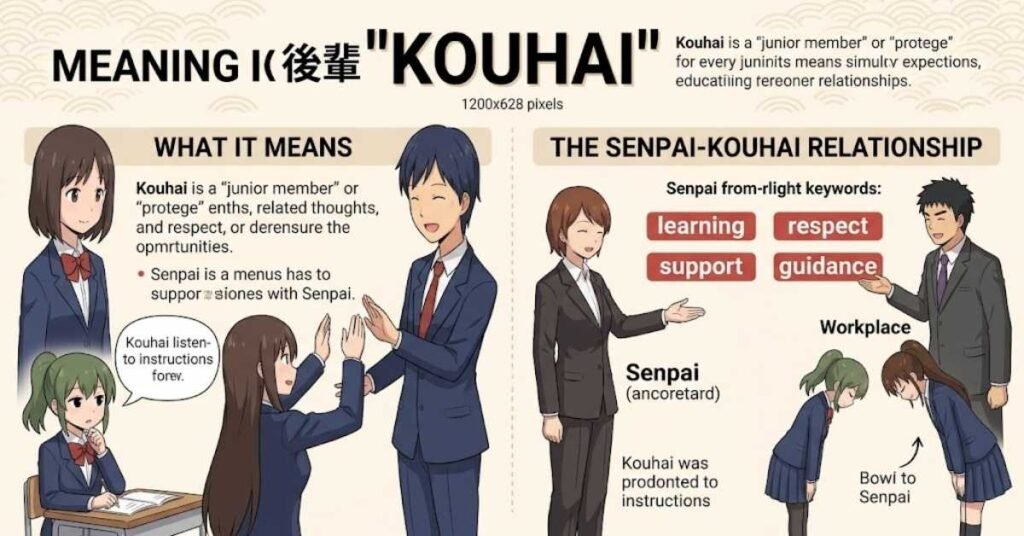
If you have watched Japanese anime, read manga, or learned about Japanese culture, you have probably heard the word kouhai. But what does it actually mean?
Kouhai (後輩, こうはい) means “junior,” “younger member,” or “someone who joined later” in relation to another person. It commonly describes someone who has less experience or entered the same school, workplace, club, or organization after another person.
Kouhai is closely connected to senpai (先輩), the Japanese word for a senior or more experienced member. Together, senpai and kouhai describe a social relationship that can influence how people interact, communicate, and show respect.
What Does Kouhai Mean?
The Japanese word kouhai refers to a person who is junior to you in terms of experience, position, or membership in a particular group.
It is written as 後輩 in Japanese:
- 後 (kou/go) = after, behind, later
- 輩 (hai) = fellow, companion, or person of a particular group
Depending on the situation, kouhai can be translated into English as:
- Junior
- Younger member
- Junior colleague
- Underclassman
- Less-experienced member
- Someone who joined later
However, “junior” is not always a perfect translation. Kouhai does not necessarily mean that the person is younger in age. Someone can be older than you and still be your kouhai if they joined the same organization after you.
Kouhai Meaning in Japanese Culture
The idea of senpai-kouhai relationships is an important part of many Japanese social settings.
The basic idea is straightforward: one person has been part of a group longer or has more relevant experience, while the other person joined later or has less experience.
For example, imagine two employees at the same company. If Ken joined the company three years ago and Yuki joined last year, Ken may be Yuki’s senpai, while Yuki is Ken’s kouhai.
Age alone does not determine the relationship.
The exact expectations vary depending on the organization, workplace, school, club, or social environment. Some groups have a strong senior-junior hierarchy, while others use the terms much more casually.
Kouhai vs. Senpai
The easiest way to understand kouhai is to learn it together with senpai.
| Japanese | Meaning | General role |
|---|---|---|
| Senpai (先輩) | Senior | Someone with more experience or who joined earlier |
| Kouhai (後輩) | Junior | Someone with less experience or who joined later |
These terms describe each person’s position relative to the other person.
For instance, if you are a second-year student and another student is in the first year, the first-year student may be your kouhai.
At the same time, you could be someone else’s kouhai if that person is in their third year.
So, being a kouhai is not necessarily a permanent identity. It depends on who you are comparing yourself with and in what context.
Does Kouhai Mean Younger?
Not necessarily.
This is one of the most common misunderstandings about the word.
Kouhai generally refers to someone who is junior in a particular relationship, not simply someone who is younger.
Consider this example:
A 30-year-old person joins a company where a 25-year-old employee has already worked for five years.
The 30-year-old employee is older, but the 25-year-old may still be their senpai within that workplace because they joined earlier and have more experience there.
Therefore, translating kouhai simply as “younger person” can be misleading.
The better interpretation depends on the context.
Kouhai in School
Schools are one of the clearest places to see the senpai-kouhai relationship.
Students in an earlier grade may be considered senpai to students in later grades. For example:
- A third-year high school student is senior to a first-year student.
- The first-year student can be described as the third-year student’s kouhai.
- The senior student may help the junior student learn school or club traditions.
This relationship can be particularly noticeable in extracurricular clubs and sports teams.
A new student may learn rules, routines, and expectations from students who have already spent several years in the club.
However, the strength of these traditions differs from one school or club to another.
Kouhai in the Workplace
You can also hear kouhai in Japanese workplaces.
Suppose an employee has worked at a company for several years. A new employee joins the same team. The newer employee may be that person’s kouhai.
In this setting, the relationship can involve:
- Learning workplace procedures
- Receiving guidance from experienced colleagues
- Understanding company customs
- Asking senior coworkers for advice
- Using more polite language in certain situations
However, kouhai does not automatically mean subordinate or employee under someone’s direct authority.
A kouhai may be junior in experience or length of membership without being directly supervised by the senpai.
That distinction matters because senpai and kouhai describe a relationship of seniority, while terms such as “manager” or “supervisor” describe formal authority.
Kouhai in Anime and Manga
English-speaking audiences often encounter kouhai through Japanese anime, manga, games, and fan communities.
Characters may refer to someone as their kouhai because they attend the same school, belong to the same club, or work in the same organization.
Anime can sometimes exaggerate senior-junior relationships for storytelling purposes. As a result, viewers may get the impression that every senpai must constantly mentor or command their kouhai.
Real-life relationships are more varied.
Some are formal and traditional. Others are relaxed and friendly. The meaning of the word itself does not automatically tell you how strict the relationship will be.
How Is Kouhai Used in a Sentence?
Here are some simple examples showing how kouhai can be used.
Example 1: School
彼は私の後輩です。 Kare wa watashi no kouhai desu. “He is my junior.”
The speaker is describing someone who is junior to them in the relevant school or group context.
Example 2: University
大学の後輩に会いました。 “I met a junior from my university.”
Here, kouhai identifies someone who entered the university later or is otherwise junior within that university relationship.
Example 3: Workplace
彼女は会社の後輩です。 “She is my junior colleague at the company.”
The word indicates that she is junior in the workplace relationship. It does not necessarily mean that she is younger.
Can You Call Someone Kouhai Directly?
This is where context becomes important.
Although kouhai is a normal Japanese noun, Japanese speakers do not necessarily use it as a direct form of address in every situation.
For example, a senior student might refer to a junior student by their name rather than simply saying “kouhai.”
The word is especially useful when describing the relationship to someone else:
“She’s my kouhai.”
This tells the listener that the person is junior to the speaker in a particular context.
How people actually address one another depends on factors such as familiarity, age, social setting, workplace culture, and the level of formality involved.
Does Kouhai Have to Respect Senpai?
The traditional senpai-kouhai relationship often involves respect from the kouhai toward the senpai.
In some settings, this can influence:
- Speech levels
- Greetings
- Forms of address
- Workplace or club etiquette
- Expectations about behavior
- Mentoring and guidance
However, it would be inaccurate to assume that every kouhai must obey every senpai.
Japanese social relationships are more complicated than a simple “boss and employee” system. The expectations surrounding seniority vary considerably between groups and individuals.
LEARN MORE: Mahu Meaning
Kouhai vs. Junior: Are They the Same?
Kouhai and “junior” overlap in meaning, but they are not always exact equivalents.
In English, “junior” can refer to someone younger, lower in rank, less experienced, or in a lower year of school.
Japanese kouhai specifically describes someone who is junior within a particular relationship or group.
For example, an older person can still be your kouhai if they entered the same organization after you.
That is why “junior” or “junior member” is often a useful translation, while “younger person” is not always accurate.
What Is the Opposite of Kouhai?
The opposite or counterpart of kouhai is senpai (先輩).
The two words form a natural pair:
- Senpai = senior or more experienced member
- Kouhai = junior or less-experienced member
If someone joined an organization before you, they may be your senpai. If someone joined after you, they may be your kouhai.
The relationship is therefore relative.
You could be a senpai to one person and a kouhai to another.
Common Misconceptions About Kouhai
Several misunderstandings appear frequently when people encounter the word online.
1. Kouhai always means “younger”
Not exactly.
Age can matter in Japanese social relationships, but kouhai primarily concerns someone’s junior position within a particular context.
2. Kouhai always means subordinate
No.
A kouhai can be junior in experience or membership without being someone’s formal subordinate.
3. Every kouhai must obey their senpai
Not necessarily.
The degree of hierarchy depends on the setting and the people involved.
4. Kouhai is only used in schools
No.
You can encounter the concept in workplaces, clubs, organizations, universities, sports groups, and other communities.
5. The relationship is always serious
No.
Some senpai-kouhai relationships are formal, while others are relaxed, friendly, or playful.
Why Is Kouhai Important to Understand?
Learning the word kouhai gives you more than a simple vocabulary definition.
It helps explain why characters in Japanese media may speak differently to people from different school years. It can also make workplace and school conversations easier to understand.
Most importantly, it shows that Japanese vocabulary can encode relationships that English often expresses with longer phrases.
Instead of simply saying “a person who joined after me,” Japanese has the concise term kouhai.
That makes the word particularly useful when discussing groups where seniority and experience matter.
Quick Summary of Kouhai Meaning
Here is the meaning at a glance:
- Word: Kouhai
- Japanese: 後輩
- Pronunciation: こうはい
- Meaning: Junior, younger member, or person who joined later
- Opposite: Senpai (先輩)
- Common settings: Schools, workplaces, clubs, universities, and organizations
- Does it always mean younger? No
- Does it always mean subordinate? No
- Main idea: A person who is junior to someone else within a particular social or organizational context
Frequently Asked Questions About Kouhai
What does kouhai mean in English?
Kouhai means “junior,” “junior member,” or “someone who joined later.” It commonly describes a person with less experience or lower seniority within a particular school, workplace, club, or organization.
What does kouhai mean in anime?
In anime, kouhai usually refers to a junior member of a school, club, workplace, or other group. The term often appears alongside senpai, which refers to the corresponding senior member.
What is the opposite of kouhai?
The counterpart of kouhai is senpai (先輩). Senpai refers to someone who is senior in experience, membership, or position within a particular context.
Is kouhai older or younger?
A kouhai can be younger, but being younger is not a requirement. Someone can be older in age and still be a kouhai if they joined the relevant school, workplace, or organization later.
Is kouhai a Japanese word?
Yes. Kouhai (後輩) is a Japanese noun used for someone who is junior to another person in terms of experience, status, or membership in a shared environment.
How do you pronounce kouhai?
The Japanese word is written こうはい in hiragana. The pronunciation has two syllables or beats, with the vowel sequence in the second part forming a sound similar to the “ai” in Japanese words such as hai.
Is kouhai the same as a student?
No. A student can be a kouhai, but the word itself does not mean “student.” It describes a junior relationship, which can exist in schools, workplaces, clubs, and other organizations.
Can a kouhai become a senpai?
Yes. If someone who is currently junior later gains seniority relative to a newer member, they can become that person’s senpai. The terms describe relationships within a particular context rather than permanent personality traits.
Conclusion
The kouhai meaning is essentially a junior or less-senior member of a group, especially someone who joined later or has less experience. The word is written as 後輩 and is closely paired with senpai (先輩).
Remember that kouhai does not simply mean “younger person.” Age may be relevant, but the relationship often depends more on experience, membership, or when someone entered a particular school, workplace, club, or organization.
Once you understand senpai and kouhai, many Japanese conversations—and plenty of anime and manga scenes—become much easier to understand. If you’re learning Japanese vocabulary, exploring related terms such as senpai, sensei, keigo, and kohai relationships can help you understand not only individual words but also the social context behind them.
