

A word that looks simple can sometimes have several completely different meanings. Mahu meaning is a good example because mahu appears in more than one language and cultural context.
In Malay, mahu means “to want,” “to wish,” “to be willing,” or “to desire.” In Hawaiian and broader Polynesian contexts, māhū refers to a person associated with a traditional third-gender role and particular social and spiritual roles.
Therefore, the right definition depends on where you encountered the word, how it was spelled, and what language the surrounding text uses.
What Does Mahu Mean?
The word mahu has several documented meanings.
The two most important ones for English-language readers are:
- Malay: mahu means “to want,” “to wish,” “to be willing,” or “will.”
- Hawaiian/Polynesian: māhū refers to a traditional third-gender identity associated with particular cultural and social roles in Hawaii and Tahiti.
These meanings are not interchangeable. If you see mahu in a Malay sentence, it will generally relate to wanting, wishing, or willingness. If you see māhū in a discussion about Hawaiian culture, it has a very different meaning.
Mahu Meaning in Malay
In Malay, mahu is a common verb.
The official Malaysian language reference Pusat Rujukan Persuratan Melayu (PRPM) lists meanings including to want, to desire, to be willing, and to intend. It can also function in expressions relating to willingness or future action.
For example, a Malay sentence might use mahu when someone expresses a desire to do something.
Common Malay meanings of mahu
Depending on the sentence, mahu can correspond to:
- Want
- Wish
- Desire
- Be willing to
- Be prepared to
- Will
- Intend
The precise English translation depends on the surrounding words.
Example of mahu in Malay
A simple example is:
Saya mahu makan.
This can be translated as:
“I want to eat.”
Here, mahu expresses a desire or intention.
Another example could involve willingness:
Dia mahu membantu.
This can convey the idea:
“He/She is willing to help.”
So, when you encounter mahu in Malay, think primarily about wanting, wishing, or being willing to do something.
Mahu vs. Mau in Malay and Indonesian
One reason the word can cause confusion is that mahu and mau are closely related forms.
In Malay, mahu is the established form meaning “want” or “wish,” while mau is also used as an alternative form. In Indonesian, mau is the common modern form with meanings such as “want” or “wish.”
For example:
- Malay: Saya mahu pergi.
- Indonesian: Saya mau pergi.
Both express the idea of wanting to go, although the normal form differs between the languages.
This distinction is useful if you encountered mahu while comparing Malay and Indonesian vocabulary.
Mahu Meaning in Hawaiian Culture
Another important meaning appears in Hawaiian culture.
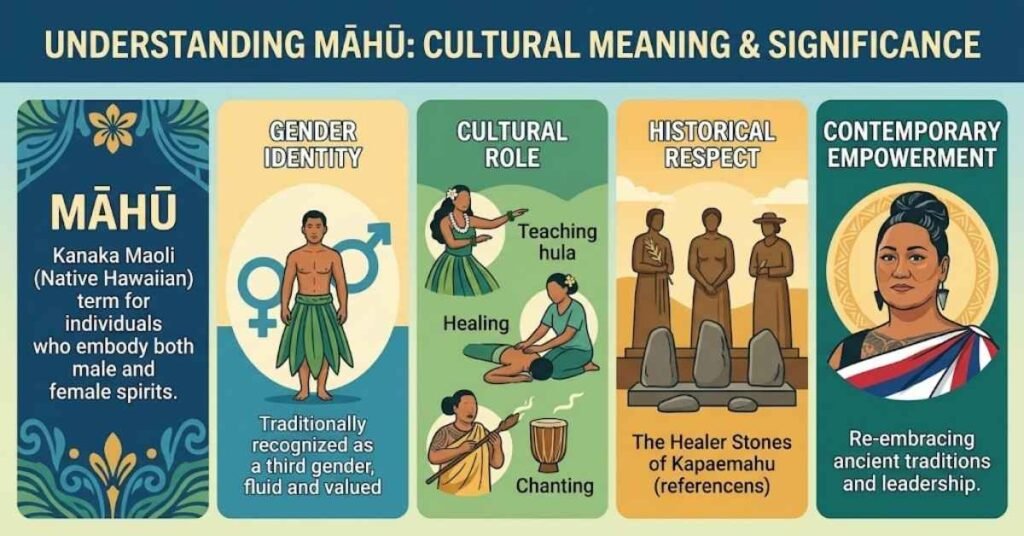
The Hawaiian word is more accurately written māhū, with a long vowel marked by the macron. In traditional Hawaiian and Tahitian cultural contexts, māhū refers to a person occupying a recognized third-gender role with particular social and spiritual significance.
The term therefore should not simply be reduced to an English label such as “gay” or “transgender.” Its cultural meaning comes from specific Polynesian traditions and does not map perfectly onto modern Western identity categories.
What did māhū traditionally mean?
Historical descriptions associate māhū with roles within community and cultural life.
Depending on the historical and cultural context, māhū could be associated with:
- Traditional knowledge
- Cultural practices
- Spiritual or ceremonial roles
- Community responsibilities
- A gender role outside a simple male/female classification
The word has also experienced changes in meaning over time, particularly following colonial influence. As a result, historical usage and modern usage should be considered carefully.
Is Mahu a Hawaiian Word?
The English word mahu is documented as deriving from Hawaiian māhū. English-language dictionary sources describe the Hawaiian-derived term as referring to a person of the third gender with traditional social and spiritual roles in Hawaii and Tahiti.
However, spelling matters.
Māhū includes a macron over the first “a.” That mark indicates a long vowel in Hawaiian orthography.
So:
- māhū → Hawaiian/Polynesian cultural term
- mahu → may be an unmarked spelling or a completely different word depending on context
It is therefore better not to assume that every instance of mahu refers to the Hawaiian term.
Mahu Meaning in Text
If you saw “mahu” in a text message, social media post, or online conversation, context becomes especially important.
Ask yourself:
- What language is the conversation using?
- Is the word written mahu, māhū, or mau?
- Is the discussion about Malay or Indonesian?
- Is the topic Hawaiian or Polynesian culture?
- Does the surrounding sentence provide a clue?
For example, if someone is writing in Malay and says:
Saya mahu pergi.
mahu means “want” or “wish.”
On the other hand, if someone is discussing Hawaiian history or culture and writes māhū, they are referring to the culturally specific Polynesian term.
Is Mahu a Slang Word?
Not necessarily.
Mahu is not simply an English slang abbreviation or internet acronym. It is a word or term with documented meanings in multiple languages and cultural contexts.
In particular, the Hawaiian-derived term has also appeared in derogatory usage in some contexts. Modern discussions should therefore avoid assuming that an English-language use automatically carries the traditional Hawaiian meaning or treating the word as a generic insult.
Context and cultural sensitivity matter.
How Do You Pronounce Mahu?
The pronunciation depends on which word you mean.
The Malay word mahu is pronounced with two syllables, approximately ma-hu. Dictionary sources give the pronunciation as [ma.hu].
The Hawaiian māhū has a long vowel in the first syllable, which is why the macron is important in careful spelling.
If you are writing about Hawaiian culture, using māhū rather than simply mahu can make the intended word clearer.
Mahu Meaning vs. Mau
It is easy to confuse mahu with mau, particularly when reading Malay or Indonesian.
Here is the basic distinction:
| Word | Language/context | General meaning |
|---|---|---|
| mahu | Malay | Want, wish, be willing |
| mau | Indonesian | Want, wish |
| māhū | Hawaiian/Polynesian | Traditional third-gender cultural term |
The first two are closely related linguistically, while māhū belongs to a different cultural and linguistic context.
Therefore, spelling and context are essential.
Common Misunderstandings About Mahu
1. Mahu has only one meaning
It does not.
The word appears in different languages and has different meanings. Context determines which definition applies.
2. Mahu always refers to Hawaiian culture
No.
Mahu is also a Malay word meaning things such as “want,” “wish,” or “be willing.”
3. Mahu simply means “gay”
That is an oversimplification.
The Hawaiian māhū has a distinct cultural history and traditional meaning. Some English sources also document derogatory uses, but those should not be treated as the definition of the traditional cultural term.
4. Mahu and mau are completely unrelated
Not in the Malay-Indonesian context.
Malay mahu and Indonesian mau are closely related forms associated with wanting or wishing.
Why Context Matters With the Word Mahu
Words borrowed across languages can create confusing search results because the same spelling may point to unrelated definitions.
That is exactly what happens with mahu.
If you search only for the letters mahu, you may encounter information about:
- Malay vocabulary
- Indonesian vocabulary
- Hawaiian culture
- Polynesian languages
- Historical names
- Other languages that happen to contain the same spelling
Consequently, the surrounding text is often more useful than the spelling alone.
LEARN MORE: WYS Meaning in Text
Mahu Meaning: Quick Answer
If you need the shortest possible answer:
Mahu can mean different things depending on the language.
In Malay, mahu means “to want,” “to wish,” “to desire,” or “to be willing.”
In Hawaiian, māhū refers to a traditional third-gender cultural role associated with Hawaii and Tahiti.
Therefore, always check the language and context before translating the word.
Frequently Asked Questions About Mahu Meaning
What does mahu mean in Malay?
In Malay, mahu means “to want,” “to wish,” “to desire,” or “to be willing.” It can also have meanings connected with intention or future action depending on the sentence.
What does māhū mean in Hawaiian?
Māhū is a Hawaiian cultural term for a person associated with a traditional third-gender role and particular social and spiritual roles in Hawaiian and Tahitian cultures.
Is mahu the same as mau?
Not always. In the Malay-Indonesian context, mahu and mau are related forms associated with wanting or wishing. However, māhū is a different Polynesian cultural term.
Does mahu mean “want”?
Yes, when it is the Malay word mahu. One of its main meanings is “want,” although “wish,” “desire,” and “be willing” can also fit depending on context.
Is mahu an English word?
Mahu is not primarily an everyday English vocabulary word. English has borrowed mahu from Hawaiian in the context of Hawaiian and Polynesian culture, while the same spelling also occurs in other languages.
What does mahu mean in Indonesian?
The usual Indonesian form is mau, which means “want,” “wish,” or a similar expression of desire. Mahu is documented as an alternative or related form, but mau is the familiar modern Indonesian spelling.
How do you pronounce mahu?
The Malay mahu is pronounced in two syllables, approximately “ma-hu.” The exact pronunciation of the Hawaiian māhū differs because of the long vowels represented by the macrons.
Is māhū a gender identity?
The term māhū refers to a culturally specific traditional third-gender role in Hawaiian and Tahitian contexts. It should not automatically be treated as an exact equivalent of any modern Western gender identity because the cultural concepts are not identical.
Conclusion
The mahu meaning depends on the language and context. In Malay, mahu means “to want,” “to wish,” “to desire,” or “to be willing.” In Hawaiian cultural contexts, māhū refers to a traditional third-gender role with its own historical and cultural significance.
So, if you encounter the word online, don’t rely on the spelling alone. Check the surrounding sentence, the language being used, and whether the writer means Malay mahu or Hawaiian māhū.
That small distinction can completely change the meaning.
