

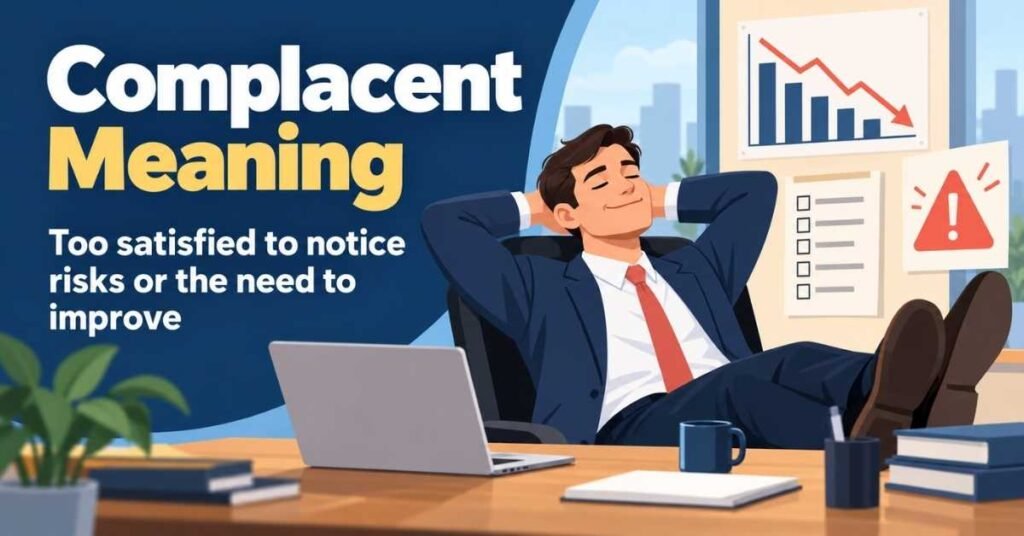
Complacent meaning: being too satisfied or comfortable with yourself or a situation, causing you to stop making an effort, overlook risks, or assume that nothing needs to improve. For example, a successful student may become complacent and stop studying because they expect good grades to continue automatically.
The word complacent usually carries a negative meaning. It does not simply describe someone who is happy, relaxed, or content. It suggests that a person’s comfort has reduced their awareness, preparation, attention, or motivation.
If someone calls you complacent, they probably think you have become so comfortable with your current position that you are no longer noticing what needs attention.
What Does Complacent Mean in Simple Words?
In simple words, complacent means feeling so safe or satisfied that you stop trying, checking, or preparing—even though risks or problems still exist.
Complacency usually develops through three connected stages:
- A person feels comfortable, successful, or secure.
- That feeling reduces their effort or awareness.
- They overlook weaknesses, changes, or potential dangers.
Imagine that a basketball team wins several games easily. The players begin to assume that the next game will also be easy, so they train less seriously. If they lose because they underestimated their opponent, their earlier attitude could be described as complacent.
The problem was not that they felt confident. The problem was that their confidence made them stop preparing properly.
The shortest definition of complacent
Complacent means overly satisfied and insufficiently aware of possible problems.
What complacent does not automatically mean
Being complacent does not necessarily mean someone is:
- Completely lazy
- Intentionally careless
- Arrogant
- Unhappy
- Unintelligent
- Unmotivated in every area
- Satisfied in a healthy way
A hardworking person can become complacent after years of success. Similarly, a confident person can become complacent if they begin treating success as guaranteed.
How to Pronounce Complacent
In American English, complacent is pronounced:
kuhm-PLAY-suhnt
Its phonetic pronunciation is /kəmˈpleɪsənt/.
The stress falls on the second syllable: PLAY.
Say it in three parts:
com–PLAY–cent
A common mistake is pronouncing the middle of the word like “place.” It should sound like the word play.
Is Complacent a Positive or Negative Word?
Complacent is usually a negative or disapproving word. It suggests that someone’s satisfaction is excessive, unwarranted, or preventing necessary action.
There is nothing wrong with feeling pleased after accomplishing something. Satisfaction becomes complacency when it leads you to:
- Ignore warning signs
- Stop improving
- Prepare less carefully
- Reject useful feedback
- Underestimate a challenge
- Take people or opportunities for granted
- Assume previous success guarantees future success
Consider these two reactions:
“I’m proud of what I achieved, but I know I still have more to learn.”
This shows healthy confidence.
“I succeeded before, so I don’t need to prepare this time.”
This shows complacency.
The key difference is not happiness. It is whether satisfaction causes a decline in effort, awareness, or judgment.
Is calling someone complacent an insult?
Calling someone complacent is usually a criticism, but its severity depends on the speaker’s tone and the situation.
If a manager says, “Your work is good, but you’re becoming complacent,” they probably mean that your previous success has led to less care, initiative, or attention. They are not necessarily saying that you lack ability.
The criticism may be uncomfortable, but it often refers to a changeable behavior, not a permanent personality trait.
A helpful response would be:
“What specific behavior have you noticed that makes you think I’m becoming complacent?”
That question moves the conversation away from labels and toward evidence.
What Does Complacency Look Like in Real Life?
Complacency can appear wherever comfort, routine, or previous success creates a false sense of security. It affects individuals, relationships, teams, businesses, and even entire organizations.
Complacent at work
A complacent employee may continue meeting basic expectations while gradually becoming less careful or curious.
Possible signs include:
- Checking work less thoroughly
- Ignoring constructive feedback
- Depending on past achievements
- Avoiding new skills or responsibilities
- Assuming customers will remain loyal
- Failing to notice changes in the industry
- Treating familiar procedures as automatically safe
For example:
After receiving excellent performance reviews for three years, Marcus became complacent and stopped double-checking his reports.
Marcus may not be generally lazy. His previous success has simply convinced him that his usual level of attention is no longer necessary.
Businesses can also become complacent. A market-leading company may ignore emerging competitors because it believes its current position is secure. In this context, complacency can lead to stagnation, missed opportunities, and declining standards.
Complacent in a relationship
Complacent in a relationship means feeling so secure that you stop giving the relationship the attention and effort it still needs.
Possible signs include:
- Taking your partner for granted
- Showing less appreciation
- Avoiding meaningful conversations
- Stopping shared activities
- Assuming problems will resolve themselves
- Paying less attention to emotional or physical intimacy
- Becoming uninterested in your partner’s changing needs
For example:
The couple loved each other, but they had become complacent and stopped making time for meaningful conversations.
Feeling comfortable with your partner is not unhealthy. In fact, emotional security is an important part of a stable relationship. Complacency begins when comfort becomes an excuse to stop communicating, listening, or showing care.
Routine alone is not proof of relationship complacency. The important question is whether both people still feel noticed, appreciated, and emotionally supported.
Complacent at school
A student may become complacent after performing well on several assignments or exams.
For example:
Nina earned the highest grade on the first two tests, became complacent, and barely prepared for the final exam.
Her confidence was supported by previous success, but it became harmful when it reduced her preparation.
Other signs of academic complacency include:
- Assuming a subject will remain easy
- Delaying assignments
- Ignoring difficult topics
- Refusing to review mistakes
- Depending on natural ability instead of preparation
Complacent in sports
In sports, complacency often appears when a player or team underestimates an opponent after repeated victories.
The team became complacent after building a large lead and allowed its opponent to recover.
Coaches commonly tell athletes not to get complacent because confidence must remain connected to discipline, preparation, and respect for the competition.
Complacent about health and safety
People can become complacent about health or safety when repeated good outcomes make precautions feel unnecessary.
Examples include:
- Ignoring recurring symptoms
- Skipping routine safety checks
- Driving less carefully after years without an accident
- Disregarding workplace procedures
- Assuming a previous false alarm means future warnings are harmless
Complacency does not mean that someone intentionally wants a bad outcome. It means their sense of security has reduced appropriate caution.
However, the word should not be used to blame people for events they could not reasonably predict or control.
Complacent vs. Content: What Is the Difference?
Content and complacent both involve satisfaction, but they do not mean the same thing.
| Complacent | Content |
|---|---|
| Too satisfied to recognize a need for action | Satisfied with or appreciative of the present |
| May ignore risks and weaknesses | Can remain fully aware of problems |
| Often reduces effort | Can coexist with continued effort |
| Usually carries a negative connotation | Usually carries a positive connotation |
| May lead to stagnation | Often suggests peace or acceptance |
A content person can appreciate their current life while continuing to learn and grow. A complacent person assumes that improvement, attention, or preparation is no longer necessary.
A useful way to remember the distinction is:
Contentment says, “I appreciate where I am.” Complacency says, “Nothing here needs my attention.”
Can you be content without becoming complacent?
Yes. Contentment and ambition can exist together.
You can feel grateful for your career while developing new skills. You’rs can feel secure in a relationship while continuing to communicate and show affection. You can celebrate an achievement while preparing for the next challenge.
Satisfaction becomes complacency only when it weakens your awareness, responsibility, or willingness to act.
LEARN MORE: RFP Meaning
Complacent vs. Lazy
Although the words can describe similar behavior, complacent and lazy are not exact synonyms.
- Lazy means unwilling to work or make an effort.
- Complacent means believing that additional effort, concern, or improvement is unnecessary.
A lazy person may know that work needs to be done but not want to do it. A complacent person may incorrectly believe that everything is already fine.
For example:
Daniel avoided the assignment because he did not want to work.
Daniel may be lazy.
Daniel assumed his previous grades guaranteed another good result, so he did not study.
Daniel is being complacent.
Complacent vs. Confident
Confidence means trusting your abilities while remaining aware of challenges. Complacency means becoming so certain of success that you underestimate those challenges.
- Confidence encourages decisive action.
- Complacency reduces preparation.
- Confidence recognizes possible difficulties.
- Complacency dismisses them.
- Confidence is earned but adaptable.
- Complacency treats past success as a guarantee.
Remember:
Confidence says, “I can handle this.” Complacency says, “I don’t need to prepare.”
Complacent vs. Arrogant
Arrogance involves believing that you are better, more important, or more capable than other people. Complacency involves excessive satisfaction or a false sense of safety.
An arrogant person may look down on competitors. A complacent person may simply fail to take those competitors seriously.
Someone can be both arrogant and complacent, but one quality does not automatically prove the other.
Complacent vs. Apathetic
An apathetic person lacks interest, emotion, or concern. A complacent person may care about an outcome but incorrectly assume that no action is required.
For example:
- “She did not care whether the project succeeded.” This suggests apathy.
- “She assumed the project would succeed without further work.” This suggests complacency.
Both attitudes can produce inaction, but the reasons behind that inaction are different.
Complacent vs. Nonchalant
Nonchalant describes someone who appears calmly unconcerned. The word can describe behavior, mood, or style without necessarily suggesting self-satisfaction.
Complacent carries a clearer warning. It suggests that a person’s lack of concern is unwarranted because real risks, weaknesses, or responsibilities remain.
Complacent, Compliant, Complicit, and Complaisant
These four words look or sound similar, but their meanings are different.
| Word | Meaning | Memory cue |
|---|---|---|
| Complacent | Too satisfied to notice risks or the need for improvement | Too comfortable |
| Compliant | Willing to follow a rule, request, or standard | Follows |
| Complicit | Involved in or helping with wrongdoing | Participates |
| Complaisant | Eager to please or accommodate others | Pleases |
Complacent vs. compliant
A compliant person follows instructions, rules, or requirements. A complacent person is excessively satisfied or unconcerned.
The employee was compliant with every safety requirement.
The employee became complacent and stopped checking the equipment.
Complacent vs. complicit
A complicit person participates in, supports, or knowingly contributes to wrongdoing. A complacent person may fail to act because they do not recognize the seriousness of a situation.
Complacency can sometimes allow harm to continue, but that does not automatically make the person legally or morally complicit. Complicity requires a stronger connection to the wrongdoing.
Complacent vs. complaisant
Complaisant means eager or willing to please other people. It is relatively uncommon in everyday American English.
Although complacent and complaisant sound alike and share historical connections, they have different modern meanings:
- A complacent manager ignores a growing problem.
- A complaisant host eagerly accommodates every guest.
Examples of Complacent in a Sentence
The following examples demonstrate how the word is naturally used in different situations.
Everyday examples
- We were pleased with our progress, but we did not want to become complacent.
- His complacent attitude prevented him from recognizing the warning signs.
- Repeated success can make even a hardworking person complacent.
- She looked complacent, as though nothing could possibly go wrong.
- This is not the time to get complacent.
Workplace examples
- Strong quarterly results made the company complacent about new competition.
- The manager believed the experienced team had become too complacent.
- Businesses cannot afford to be complacent about customer complaints.
- Past success made the leadership team complacent about changing consumer needs.
Relationship examples
- They became complacent in their relationship and stopped planning meaningful time together.
- Feeling secure should not make partners complacent about showing appreciation.
- His partner worried that comfort had gradually turned into complacency.
School and sports examples
- The student became complacent after passing the first two exams.
- A large halftime lead made the players complacent.
- The defending champions remained confident without becoming complacent.
Correct and incorrect usage
Incorrect: “She followed every rule because she was complacent.”
Correct: “She followed every rule because she was compliant.”
Following rules describes compliance, not complacency.
Unclear: “He was complacent because he was happy.”
Better: “He became complacent after his early success and stopped preparing.”
The revised sentence shows the excessive satisfaction and reduced effort that make the word appropriate.
How to Use Complacent Correctly
Complacent is an adjective, so it describes a person, attitude, expression, response, organization, or situation.
Common sentence patterns include:
- Become complacent
- Grow complacent
- Get complacent
- Feel complacent
- Complacent about something
- Complacent attitude
- Complacent response
- Dangerously complacent
- Too complacent
The preposition about is especially common:
We cannot become complacent about online security.
The company was complacent about customer retention.
Forms of complacent
| Word | Part of speech | Example |
|---|---|---|
| Complacent | Adjective | The team became complacent. |
| Complacency | Noun | Complacency weakened the team. |
| Complacently | Adverb | He responded complacently. |
When not to use complacent
Do not use complacent when you only mean:
- Relaxed after completing difficult work
- Grateful for your current life
- Satisfied with a reasonable outcome
- Willing to follow instructions
- Calm during a stressful situation
- Deliberately resting or recovering
Complacency requires some sense that comfort or satisfaction has reduced necessary awareness or effort.
Synonyms for Complacent
The best synonym depends on what you want to emphasize.
| Intended meaning | Suitable word |
|---|---|
| Excessively pleased with yourself | Self-satisfied |
| Proud in an irritating way | Smug |
| Not worried enough | Unconcerned |
| Not paying sufficient attention | Careless |
| Too certain of success | Overconfident |
| Showing little interest | Apathetic |
| Casually unconcerned | Nonchalant |
| Unaware that improvement is needed | Complacent |
Other related words include indifferent, inattentive, unwary, passive, untroubled, and incurious. These terms overlap with complacent but should not be treated as perfect substitutes in every sentence.
Antonyms of Complacent
Possible opposites include:
- Alert
- Vigilant
- Attentive
- Watchful
- Concerned
- Careful
- Prepared
- Motivated
- Diligent
- Ambitious
- Proactive
- Improvement-minded
The best antonym depends on the context. Vigilant works well when the subject is safety, while motivated may be more appropriate when discussing effort or career growth.
Why Do People Become Complacent?
Complacency often develops quietly. People rarely decide to ignore problems deliberately. Instead, positive experiences gradually make future success feel more certain than it really is.
Previous success creates false certainty
When the same approach succeeds repeatedly, a person may assume it will always work. They stop questioning whether circumstances have changed.
Familiarity makes risks less visible
A repeated activity can feel safe simply because nothing bad has happened yet. This false sense of security can reduce appropriate caution.
Comfort replaces curiosity
People ask fewer questions when a familiar routine appears to be working. Over time, they may stop looking for better methods or emerging problems.
Useful feedback disappears
Successful people and leaders sometimes receive less honest criticism. Without feedback, declining standards can remain unnoticed.
Small declines become normal
Performance, communication, or attention may deteriorate gradually. Because there is no sudden failure, each small decline begins to feel acceptable.
Are You Content or Becoming Complacent?
Feeling satisfied does not automatically make you complacent. Use the SAFE check to examine whether comfort is beginning to affect your judgment.
S — Satisfaction
Do you believe the current situation is good enough simply because it has worked in the past?
A — Awareness
Are you still noticing new risks, changing expectations, and areas that need attention?
F — Further effort
Are you continuing to prepare, check your work, communicate, and improve?
E — Exposure
Could your reduced attention create an avoidable problem for you or someone else?
If satisfaction is present but your awareness and effort remain strong, you are probably content rather than complacent.
What Should You Do If Someone Calls You Complacent?
First, ask for a specific example. The word can feel personal, but vague criticism is difficult to evaluate.
You might say:
“Can you show me where my effort or attention has declined?”
Then examine the evidence:
- Have you stopped checking important details?
- Are you depending too heavily on past success?
- Has your preparation declined?
- Have you dismissed useful feedback?
- Are you overlooking a changing situation?
- Have you begun taking someone’s effort for granted?
If the criticism is valid, choose one visible corrective action. You could resume a quality check, request feedback, update a skill, review a neglected risk, or schedule an honest conversation with your partner.
The goal is not to become permanently dissatisfied. It is to restore awareness and intentional effort.
Origin of the Word Complacent
Complacent comes from the Latin word complacēre, associated with being pleasing or very pleasing.
Earlier English uses were closer to pleasant or eager to please. Over time, the word developed its modern meaning of being pleased with oneself, particularly when that satisfaction is excessive or uncritical.
This history also explains why complacent and complaisant look and sound similar. In modern American English, however, their meanings are clearly different.
Quick Complacent Meaning Test
Scenario 1
A student celebrates a high grade and begins preparing for the next exam.
Answer: The student is satisfied, but not necessarily complacent.
Scenario 2
A student assumes one high grade guarantees another and stops studying.
Answer: The student has become complacent.
Scenario 3
An employee carefully follows every workplace requirement.
Answer: The employee is compliant, not complacent.
The deciding question is:
Has satisfaction caused awareness, preparation, or effort to decline?
If the answer is yes, complacent may be the correct word.
Frequently Asked Questions
What does complacent mean in one sentence?
Complacent means being so satisfied or comfortable that you fail to recognize risks, weaknesses, or the need to keep making an effort.
What is a complacent person?
A complacent person feels excessively secure or satisfied and therefore pays less attention to possible problems or opportunities for improvement.
Is complacent another word for lazy?
Not exactly. A lazy person may know that effort is required but not want to make it. A complacent person may incorrectly believe that further effort is unnecessary.
Is complacent a bad word?
Complacent is usually negative because it suggests unwarranted satisfaction, reduced effort, or insufficient awareness.
Is calling someone complacent rude?
It can sound critical, especially without an explanation. However, it often identifies a behavior that can be changed rather than attacking the person’s entire character.
What does complacent mean in a relationship?
In a relationship, complacent means feeling so secure that you stop communicating, showing appreciation, or making an intentional effort to maintain the connection.
What does complacent mean at work?
At work, complacent describes someone who relies too heavily on previous success and no longer gives sufficient attention to quality, feedback, risk, or professional growth.
Can you be confident without being complacent?
Yes. Confidence means trusting your abilities while continuing to prepare and recognize challenges. Complacency begins when confidence makes preparation seem unnecessary.
What is the opposite of complacent?
Depending on the context, opposites include vigilant, alert, attentive, concerned, motivated, careful, diligent, and proactive.
What does “don’t get complacent” mean?
It means you should not let comfort or success cause you to stop trying, preparing, improving, or paying attention.
What is the noun form of complacent?
The noun form is complacency.
The team’s complacency contributed to its defeat.
What is the adverb form of complacent?
The adverb form is complacently.
He complacently dismissed the warning.
What is the difference between complacent and compliant?
Complacent means too satisfied or unconcerned. Compliant means willing to follow instructions, rules, or requirements.
Final Takeaway
Complacent means more than comfortable, calm, or satisfied. It describes a situation in which comfort or previous success causes someone to stop noticing, preparing, improving, or making an appropriate effort.
The easiest distinction to remember is:
Contentment appreciates the present. Confidence prepares for the challenge. Complacency assumes nothing needs to change.

1 thought on “Complacent Meaning: Definition, Examples, Synonyms & Usage”