

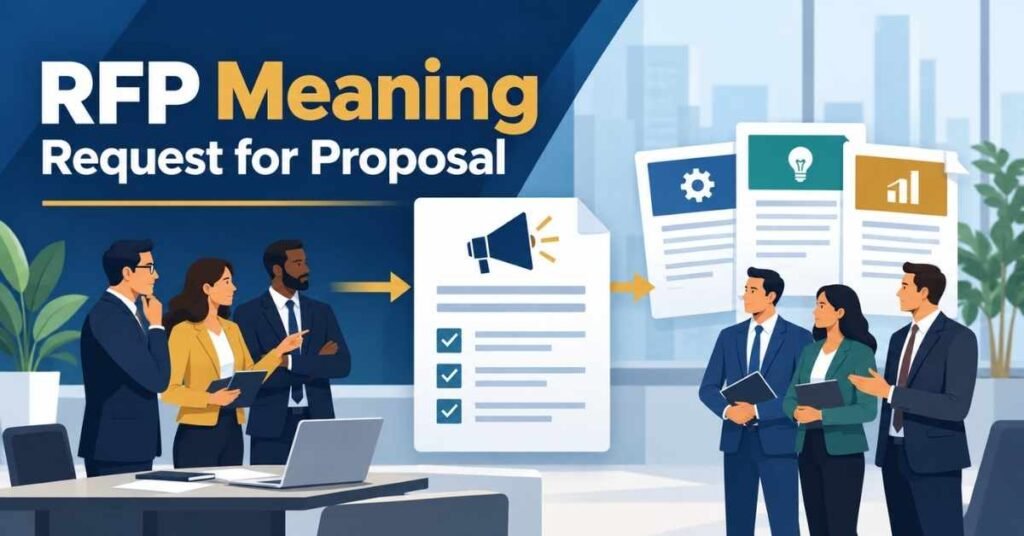
RFP meaning: RFP stands for Request for Proposal, a formal document an organization issues to invite qualified vendors to explain how they would complete a project, provide a service, or solve a defined business problem. Unlike a basic request for a price, an RFP normally evaluates each vendor’s solution, experience, methodology, timeline, capabilities, risks, and cost.
The organization issuing the RFP is commonly called the buyer, issuer, or requesting organization. Companies submitting responses may be called vendors, suppliers, contractors, respondents, bidders, or offerors.
An RFP creates a structured procurement process, but it is not usually the final contract. The selected proposal may still go through clarification, negotiation, due diligence, and legal review before both parties sign an agreement.
What Does RFP Stand For?
RFP stands for Request for Proposal.
In simple words, an RFP is a document that says:
“This is the problem we need to solve. Tell us how you would solve it, how long it would take, what experience you have, and how much it would cost.”
Businesses, government agencies, nonprofits, educational institutions, healthcare organizations, and other entities use RFPs to compare multiple vendors using the same general requirements and evaluation criteria.
The three main parties in an RFP
An RFP process usually involves three groups:
- The issuer or buyer: Creates and distributes the RFP.
- The vendor or respondent: Reviews the requirements and submits a proposal.
- The evaluation team: Scores responses and recommends a vendor.
The final decision-maker may be separate from the evaluation committee. In a large organization, procurement, finance, legal, security, information technology, and department leaders may all participate.
A simple RFP example
Imagine that a growing company needs a new customer-support platform. The company does not want vendors to provide only a software price. It also needs to understand:
- How the platform will integrate with its CRM
- How customer data will be protected
- How existing records will be migrated
- How employees will be trained
- How long implementation will take
- What support will be available after launch
- What the total three-year cost will be
The company creates an RFP document containing these requirements. Qualified software vendors then submit detailed proposals describing their solutions.
This is an RFP because the buyer is comparing different approaches and complete solutions, not merely prices.
What Is the Purpose of an RFP?
The purpose of an RFP is to help an organization define a need, invite competitive proposals, and select the vendor offering the strongest overall solution.
A well-structured RFP can help a buyer:
- Communicate project requirements consistently
- Compare multiple vendors fairly
- Evaluate technical and commercial factors
- Discover different ways to solve a problem
- Reduce purchasing and implementation risks
- Document how a decision was reached
- Encourage competition
- Establish an audit trail
- Align internal stakeholders
- Negotiate from a clearer starting position
An RFP also helps potential vendors understand whether the project fits their services, experience, resources, and commercial goals.
What does receiving an RFP mean?
Receiving an RFP means an organization is inviting your company to consider submitting a proposal. It does not automatically mean:
- You have won the project
- You are the preferred vendor
- You are one of only a few shortlisted companies
- The buyer is required to select you
- Your proposed price will be accepted
- A contract already exists
Some RFPs are sent to a small group of prequalified vendors. Others are posted publicly and may attract many respondents.
Before investing time in an RFP response, determine whether your company can meet the mandatory requirements and has a realistic reason to compete.
When Should an Organization Use an RFP?
An RFP is most useful when a purchase is complex, valuable, risky, or open to several possible solutions.
An organization may use an RFP when:
- The project requires specialized knowledge
- Different vendors may recommend different approaches
- Technical capabilities matter
- Price is important but not the only factor
- Implementation quality will affect business operations
- Several departments need to participate
- Vendor experience must be evaluated
- Long-term support is important
- The purchase has security or compliance implications
- A documented competitive process is required
Common RFP use cases
RFPs are commonly used for:
- Software selection and implementation
- Information technology services
- Website design and development
- Marketing agency selection
- Business consulting
- Construction and engineering
- Healthcare systems and equipment
- Outsourced customer support
- Accounting or financial services
- Security services
- Employee-benefit programs
- Nonprofit technology projects
- Government contracts
For example, a business hiring a marketing agency may ask vendors to propose a campaign strategy, creative process, reporting plan, project team, schedule, and fee structure. Because the buyer is comparing ideas and capabilities—not only rates—an RFP makes sense.
When an RFP May Be the Wrong Choice
Not every purchase requires a lengthy request for proposal. An RFP may create unnecessary work when:
- The product is standardized
- Specifications are already fixed
- Price and delivery are the main deciding factors
- The purchase is small and low-risk
- Only one qualified supplier exists
- The organization is still trying to understand the market
- Internal stakeholders have not agreed on the desired outcome
- The deadline is too short for meaningful competition
- The buyer has already selected a vendor and is only completing a formality
If a company knows exactly which laptops it needs and wants to compare prices from several suppliers, an RFQ may be more appropriate.
If the company does not yet know which technology could solve its problem, it may need an RFI before issuing an RFP.
A poorly prepared RFP does not create clarity. It simply transfers the buyer’s uncertainty to every participating vendor.
Questions to ask before creating an RFP
Before starting the process, ask:
- What problem are we trying to solve?
- What business outcome do we need?
- Are internal stakeholders aligned?
- Which requirements are mandatory?
- Are several credible solutions available?
- How will proposals be evaluated?
- Is the budget realistic?
- Can we manage vendor questions fairly?
- Do we have enough time to evaluate responses properly?
- Would an RFI or RFQ be more efficient?
RFI vs. RFP vs. RFQ
An RFI, RFP, and RFQ serve different purposes during procurement.
| Document | Full name | Main purpose | Best used when | Typical response |
|---|---|---|---|---|
| RFI | Request for Information | Explore the market | The buyer is still learning what solutions exist | Capabilities and general information |
| RFP | Request for Proposal | Compare complete solutions | The problem is defined, but different approaches are possible | Methodology, qualifications, timeline, and price |
| RFQ | Request for Quotation | Compare pricing and terms | Specifications are fixed and price is central | A quote for the defined requirement |
The simplest way to remember the difference is:
- RFI: What options exist?
- RFP: How would you solve our problem?
- RFQ: How much will this defined purchase cost?
Can RFI, RFP, and RFQ be used together?
Yes. Some organizations use them in sequence:
- An RFI gathers market information.
- An RFP compares detailed solutions.
- An RFQ or final pricing request confirms commercial terms.
However, not every procurement requires all three. Adding unnecessary stages can increase costs and delay the purchase.
RFP vs. Bid, Tender, SOW, and Contract
Several procurement terms are closely related to RFPs but are not interchangeable.
RFP vs. bid
The buyer issues the RFP, while the vendor submits a bid or proposal.
The term bid often emphasizes price and a commitment to perform defined work. A proposal usually provides a broader explanation of the vendor’s recommended solution, methodology, qualifications, and commercial terms.
In everyday business conversations, people may use bid and proposal loosely. Formal procurement documents may define them more precisely.
RFP vs. tender
A tender is another formal invitation for suppliers to compete for work. The terminology and procedure vary by country, industry, and organization.
Tender processes are often highly structured and based on clearly defined specifications. An RFP may give vendors more freedom to propose different solutions.
Neither distinction should be treated as universal because public procurement rules differ by jurisdiction.
RFP vs. statement of work
A statement of work, or SOW, describes the work to be performed. It may include:
- Tasks
- Deliverables
- Responsibilities
- Milestones
- Performance standards
- Acceptance criteria
- Project schedule
An SOW may appear inside the RFP as a draft description of the required work. A revised version may later become part of the final contract.
RFP vs. contract
An RFP is normally a solicitation, not the final agreement. It invites vendors to submit proposals.
The selected vendor’s proposal may become an important reference during negotiations, but the final contract usually establishes the enforceable obligations, pricing, responsibilities, and legal terms.
Because the legal effect of procurement documents depends on their wording, applicable law, and governing rules, organizations should obtain appropriate legal advice for specific transactions.
What Should an RFP Include?
A strong RFP gives vendors enough information to understand the problem, prepare a realistic solution, and submit a proposal that can be compared fairly.
1. Organization background
Provide relevant context about:
- The organization and its industry
- Current operations
- Customers or users affected
- Existing systems or processes
- Internal stakeholders
- The reason for the project
Avoid adding pages of company history that do not help vendors develop their proposed solution.
2. Problem statement and desired outcome
Explain what is happening now and what needs to change.
A useful problem statement answers:
- What is not working?
- Why is action needed?
- Who is affected?
- What consequences does the current problem create?
- What should success look like?
For example:
Our support team uses three disconnected systems, preventing agents from viewing a complete customer history. We need a unified platform that reduces response times and improves reporting.
That statement is more useful than simply saying, “We need new customer-support software.”
3. Project scope
The project scope establishes boundaries. It should identify:
- Work included
- Work excluded
- Departments involved
- Locations
- Number of users
- Existing systems
- Required integrations
- Dependencies
- Known constraints
Clear scope helps vendors estimate the required resources, timeline, and pricing.
4. Functional and technical requirements
Requirements should be organized by importance:
- Mandatory requirements: A vendor must meet these to remain eligible
- Preferred requirements: Valuable but not compulsory
- Optional capabilities: Features the buyer may consider
- Future requirements: Possible needs beyond the initial project
Technical RFP requirements may include:
- System integrations
- Data migration
- Cybersecurity
- Hosting
- Privacy
- Accessibility
- Performance
- Scalability
- Reporting
- Disaster recovery
- Regulatory compliance
Avoid labeling every feature mandatory. Excessive restrictions can eliminate capable vendors and prevent innovative solutions.
5. Deliverables
State what the selected vendor must provide, such as:
- Project plan
- Designs
- Software configuration
- Data migration
- Testing
- Documentation
- Employee training
- Implementation
- Reports
- Ongoing support
- Performance reviews
Each important deliverable should have a clear acceptance standard.
6. Timeline and milestones
Include important procurement and project dates:
- RFP publication
- Vendor-intent deadline
- Deadline for questions
- Date answers will be released
- Proposal submission deadline
- Evaluation period
- Demonstrations or interviews
- Expected selection
- Contract negotiations
- Project start
- Major delivery milestones
Clearly state the submission deadline’s date, time, and time zone.
7. Budget and pricing instructions
A buyer may disclose a fixed budget, estimated range, or target. Budget transparency can prevent proposals that are impossible to consider, although some organizations prefer vendors to recommend pricing independently.
Pricing instructions may request:
- One-time fees
- Recurring fees
- Implementation costs
- License costs
- Training
- Support
- Optional services
- Expenses
- Taxes
- Price increases
- Total cost over a defined period
- Important pricing assumptions
A consistent pricing format makes commercial evaluation easier.
8. Vendor qualifications
Request evidence that relates directly to the project:
- Relevant experience
- Comparable case studies
- Client references
- Team qualifications
- Certifications
- Technical capabilities
- Financial stability
- Required licenses
- Insurance
- Delivery capacity
Avoid asking for generic company information that will not affect the selection decision.
9. Proposal format and submission rules
Tell vendors exactly how to organize and submit their responses.
Instructions may specify:
- Required sections
- Page limits
- File format
- File-naming rules
- Submission portal
- Authorized contact
- Required forms
- Signatures
- Separate technical and pricing files
- Deadline
- Time zone
Unclear submission instructions create unnecessary questions and make proposals harder to compare.
10. Evaluation criteria
Evaluation criteria explain how the buyer will compare proposals.
Possible criteria include:
- Technical fit
- Proposed methodology
- Implementation plan
- Relevant experience
- Team qualifications
- Security and risk
- Customer support
- Project timeline
- Total cost
- Contract acceptance
- References
When possible, disclose the relative weighting. Vendors can then focus their responses on what matters most.
11. Legal and commercial terms
Depending on the project, an RFP may address:
- Confidentiality
- Intellectual property
- Data ownership
- Information security
- Insurance
- Indemnification
- Payment terms
- Proposal validity
- Contract conditions
- Right to reject proposals
- Right to amend or cancel the RFP
Legal and commercial terms should be reviewed by qualified professionals familiar with the transaction and jurisdiction.
How Does the RFP Process Work?
The precise RFP process varies, but most competitive procurements follow a recognizable sequence.
Step 1: Define the business need
The buyer identifies the problem, desired outcome, budget, stakeholders, risks, and target timeline.
This stage matters because unclear internal priorities produce inconsistent requirements and weak proposals.
Step 2: Research the market
The procurement team evaluates:
- Available solution types
- Potential suppliers
- Typical implementation models
- Realistic budgets
- Common risks
- Relevant standards
If the buyer still lacks sufficient market knowledge, it may issue an RFI first.
Step 3: Draft the RFP
The buyer gathers input from relevant stakeholders, which may include:
- Procurement
- Finance
- Legal
- Information technology
- Security
- Operations
- End users
- Subject-matter experts
- Executive sponsors
The drafting team converts business needs into clear requirements and evaluation criteria.
Step 4: Review and approve the document
Before publication, the buyer should check:
- Requirement clarity
- Internal consistency
- Budget authorization
- Timeline feasibility
- Evaluation alignment
- Legal and security terms
- Submission rules
A final independent review can uncover contradictions that the original drafting team no longer notices.
Step 5: Publish or distribute the RFP
An RFP may be:
- Posted publicly
- Sent to prequalified suppliers
- Published on a procurement portal
- Shared with selected vendors
- Issued through a government solicitation system
The distribution method depends on organizational policy and applicable procurement rules.
Step 6: Manage vendor questions
Vendors need an opportunity to clarify unclear requirements.
A fair question process usually includes:
- One authorized contact
- A defined question deadline
- Written questions
- Shared answers
- Formal amendments when requirements change
Material information should be made available consistently to participating vendors.
Step 7: Receive and check proposals
Before scoring quality, the buyer may perform a compliance review covering:
- Submission time
- Required format
- Mandatory qualifications
- Complete answers
- Required forms
- Signatures
- Pricing documents
A late or incomplete proposal may be rejected, particularly in formal government procurement.
Step 8: Evaluate responses
An evaluation panel compares proposals using the disclosed criteria.
The review may include:
- Technical scoring
- Commercial evaluation
- Risk assessment
- Product demonstrations
- Vendor interviews
- Client references
- Security reviews
- Financial due diligence
Price is important, but the cheapest proposal does not necessarily provide the best value.
Step 9: Shortlist and negotiate
The buyer may invite leading vendors to:
- Clarify their responses
- Demonstrate the solution
- Revise implementation plans
- Discuss contract exceptions
- Confirm pricing
- Submit a best and final offer
Negotiation should remain consistent with applicable policies and procurement rules.
Step 10: Select, notify, and contract
After approval, the buyer may:
- Notify the preferred vendor
- Inform unsuccessful respondents
- Conduct debriefings
- Complete due diligence
- Negotiate final terms
- Sign the contract
- Begin project planning
Vendor selection is not the end of the process. The relationship becomes operational only after responsibilities, pricing, deliverables, and legal terms are finalized.
A Practical RFP Example
Consider a retail company selecting a customer-support platform.
The business problem
The company’s agents use disconnected email, chat, and telephone systems. Customer histories are incomplete, response times are increasing, and managers cannot produce reliable performance reports.
The RFP requirements
The buyer requests:
- A cloud-based support platform
- CRM integration
- Email, chat, and telephone capabilities
- Customer-data migration
- Security controls
- Employee training
- Reporting dashboards
- Implementation within six months
- Three-year pricing
- Ongoing technical support
The vendor proposals
Vendor A offers the lowest price but has limited CRM integration.
The Vendor B offers strong functionality, relevant retail experience, a realistic implementation plan, and moderate pricing.
Vendor C promises the fastest deployment but charges high recurring fees and offers limited training.
The evaluation scorecard
| Evaluation criterion | Weight |
|---|---|
| Functional and technical fit | 30% |
| Implementation approach | 20% |
| Relevant experience | 15% |
| Security and risk management | 15% |
| Total cost | 15% |
| Training and support | 5% |
Vendor B may win despite not offering the lowest price because its proposal provides the best combination of capability, implementation confidence, risk control, and total value.
How to Write a Better RFP
A good RFP is detailed enough to produce comparable proposals but flexible enough to allow vendors to recommend strong solutions.
Use the CLEAR framework.
C — Clarify the desired outcome
Describe the business result before listing product features.
L — List mandatory requirements
Make essential qualifications and requirements easy to identify.
E — Explain evaluation and submission rules
Tell vendors what to submit and how it will be scored.
A — Allow questions and fair clarification
Create a structured process for answering vendor questions and publishing material changes.
R — Review every proposal consistently
Use the same criteria, evidence standards, and scoring process for each respondent.
Write requirements vendors can answer
Weak requirement:
The system must be easy to use.
Better requirement:
Describe how new support agents complete the five most common tasks, and provide evidence from usability testing or comparable implementations.
The improved requirement tells vendors what to explain and gives evaluators a basis for comparison.
What Should You Do When You Receive an RFP?
Receiving a request for proposal can feel exciting and overwhelming. Before drafting, determine whether the opportunity deserves your team’s time.
Review:
- Mandatory qualifications
- Submission deadline
- Time zone
- Required format
- Evaluation criteria
- Budget information
- Contract terms
- Question deadline
- Scope
- Delivery expectations
Make a bid/no-bid decision
Use the QUALIFY framework:
- Q — Question whether the opportunity fits
- U — Understand every requirement
- A — Assess your competitive advantage
- L — Locate the required internal resources
- I — Identify delivery, legal, and commercial risks
- F — Forecast response cost and contract value
- Y — Make a deliberate yes-or-no decision
Reasons to decline an RFP
Consider declining when:
- You cannot meet a mandatory requirement
- The deadline prevents a credible response
- You lack relevant experience
- The contract value does not justify the proposal effort
- The buyer’s priorities do not match your strengths
- Contract terms create unacceptable risk
- You lack delivery capacity
- The opportunity appears designed around another vendor
A thoughtful no-bid decision protects time that could be invested in more suitable opportunities.
How to Respond to an RFP
A strong RFP response makes it easy for evaluators to confirm compliance and understand the value of your proposed solution.
Create a compliance matrix
A compliance matrix may contain:
| Field | Purpose |
|---|---|
| Requirement number | Tracks the original requirement |
| RFP section | Shows its source |
| Requirement | Records what the buyer requested |
| Mandatory or optional | Establishes priority |
| Response owner | Assigns responsibility |
| Evidence required | Identifies proof |
| Status | Tracks completion |
| Proposal location | Supports final review |
Follow the requested structure
Evaluators may review several lengthy proposals. Mirroring the RFP’s organization helps them find and score your answers.
Answer each question directly before adding context.
Connect features to outcomes
Weak response:
Our platform includes advanced reporting.
Stronger response:
The platform combines email, chat, and telephone data in one dashboard, allowing managers to monitor response times without manually combining reports.
The stronger version connects a capability to the buyer’s actual problem.
LEARN MORE: BIPOC Meaning
Support claims with evidence
Use:
- Relevant case studies
- Measurable outcomes
- Client references
- Team credentials
- Implementation plans
- Work samples
- Security documentation
- Service-level commitments
Avoid unsupported phrases such as “industry-leading,” “best-in-class,” or “revolutionary.”
Use the COMPLY framework
- C — Create a requirements matrix
- O — Own every response section
- M — Match the requested format
- P — Prove important claims
- L — Link the solution to evaluation criteria
- Y — Yield enough time for final review
Whenever possible, submit before the final minutes. Technical problems do not always excuse a late proposal.
Common RFP Mistakes
Mistakes buyers make
- Issuing an RFP before agreeing on the problem
- Writing vague requirements
- Prescribing the solution too narrowly
- Making every feature mandatory
- Hiding evaluation priorities
- Setting an unrealistic deadline
- Asking irrelevant questions
- Giving different information to different vendors
- Changing requirements informally
- Treating price as the only measure of value
- Running a competition after privately choosing a supplier
Mistakes vendors make
- Responding without qualifying the opportunity
- Ignoring submission instructions
- Reusing generic proposal content
- Leaving questions unanswered
- Describing features without outcomes
- Making claims without proof
- Providing inconsistent pricing
- Missing required signatures
- Waiting until the deadline to submit
- Accepting risky terms without review
- Focusing on the vendor instead of the buyer’s needs
How Long Does the RFP Process Take?
There is no universal RFP timeline. The duration depends on:
- Project complexity
- Number of stakeholders
- Procurement regulations
- Contract value
- Number of vendors
- Required demonstrations
- Security and legal review
- Negotiation needs
The following is an illustrative business timeline:
| Stage | Possible duration |
|---|---|
| Planning and drafting | 2–6 weeks |
| Vendor response period | 2–6 weeks |
| Evaluation and shortlisting | 2–5 weeks |
| Demonstrations and due diligence | 1–4 weeks |
| Negotiation and award | 2–8+ weeks |
Simple private-sector procurements may move faster. Large government, construction, healthcare, or technology procurements may take considerably longer.
Are RFPs Legally Binding?
An RFP is generally a request for proposals rather than the final contract. However, it should not be treated casually.
The RFP, proposal, certifications, pricing, procurement rules, and related communications may create important obligations or legal consequences depending on their wording and the applicable law.
In most cases:
- The RFP describes the opportunity and process
- The vendor’s proposal offers a solution
- Selection identifies a preferred vendor
- Negotiation resolves remaining terms
- The signed contract establishes final obligations
Organizations should seek qualified legal advice when interpreting a specific RFP, proposal, or procurement process.
RFPs in U.S. Government Contracting
Federal government RFPs are more formal than many private-sector requests. They may be issued as part of a negotiated acquisition and contain detailed instructions that control how an offeror must respond.
A federal RFP may include:
- Solicitation number
- Contracting officer information
- Statement of work or performance work statement
- Instructions to offerors
- Evaluation factors
- Contract clauses
- Required representations
- Technical response requirements
- Pricing schedules
- Submission deadline
- Amendments
Government contractors must follow the individual solicitation. A general proposal template cannot replace its specific requirements.
Federal opportunities may also involve:
- Written questions
- Solicitation amendments
- Competitive range decisions
- Discussions
- Proposal revisions
- Best and final submissions
- Formal award notices
- Debriefings
- Protests
Businesses interested in government contracts should use official U.S. acquisition and small-business resources alongside professional legal, accounting, or contracting guidance when necessary.
Other Meanings of RFP
In most business, project-management, vendor, and government contexts, RFP means Request for Proposal. The acronym can have other meanings in specialized fields.
Depending on the context, RFP may also refer to:
- Renal function panel in healthcare
- Request for production in legal discovery
- Red fluorescent protein in biological research
- Reversed field pinch in plasma physics
If you saw “RFP” in a procurement email, vendor portal, bid notice, or project document, it almost certainly refers to a Request for Proposal.
Frequently Asked Questions
What does RFP stand for?
RFP stands for Request for Proposal.
What is an RFP in simple words?
An RFP is a document in which an organization explains what it needs and asks qualified vendors to propose how they would deliver the project or solve the problem.
What is the purpose of an RFP?
Its purpose is to collect comparable solutions from vendors and help the buyer evaluate their approaches, experience, capabilities, risks, timelines, and pricing.
Who issues an RFP?
A business, government agency, nonprofit, educational institution, healthcare organization, or other buyer may issue an RFP.
Who responds to an RFP?
Potential suppliers, vendors, consultants, contractors, and service providers respond by submitting proposals.
Is an RFP the same as a bid?
Not exactly. The RFP is issued by the buyer. A bid or proposal is submitted by a vendor in response.
Is an RFP a contract?
An RFP is generally a solicitation, not the final contract. Vendor selection is often followed by clarification, negotiation, and contract execution.
Does receiving an RFP mean you are shortlisted?
Not necessarily. Some RFPs are invitation-only, while others are open to a broad market. Review the document or ask the authorized contact if the vendor pool is unclear.
Do vendors have to respond to an RFP?
Usually not. A vendor can make a bid/no-bid decision unless an existing agreement or unusual obligation says otherwise.
Can a vendor ask questions?
Most well-managed RFPs include a formal question period. Vendors should follow the stated communication method and deadline.
Should an RFP include a budget?
Including a budget or realistic range can reduce unsuitable responses. However, disclosure practices differ by organization and procurement strategy.
Does the lowest-priced proposal always win?
No. RFPs commonly evaluate price alongside technical fit, methodology, experience, timeline, implementation risk, support, and overall value.
What happens after RFP submission?
The buyer may check compliance, score proposals, shortlist vendors, request demonstrations, conduct due diligence, negotiate terms, and select a preferred supplier.
What is the difference between an RFP and an RFQ?
An RFP compares complete proposed solutions. An RFQ primarily requests pricing and terms for a clearly defined product or service.
What is the difference between an RFP and an RFI?
An RFI gathers information about the market and vendor capabilities. An RFP requests detailed proposals for a defined need.
What makes a strong RFP response?
A strong response follows every instruction, answers each requirement clearly, connects the solution to the buyer’s goals, supports claims with evidence, addresses risks, and presents consistent pricing.
Final Takeaway
RFP means Request for Proposal. It is a structured document that allows an organization to describe a business need and compare how qualified vendors would solve it.
An effective RFP evaluates more than price. It connects requirements, proposed solutions, vendor qualifications, implementation plans, risks, timelines, evaluation criteria, and commercial terms.
For buyers, the key is to communicate the problem clearly and evaluate responses consistently. For vendors, the key is to qualify the opportunity, follow every instruction, and show—with evidence—why the proposed solution offers the strongest value.

1 thought on “RFP Meaning: Definition, Process, Examples and Differences”