

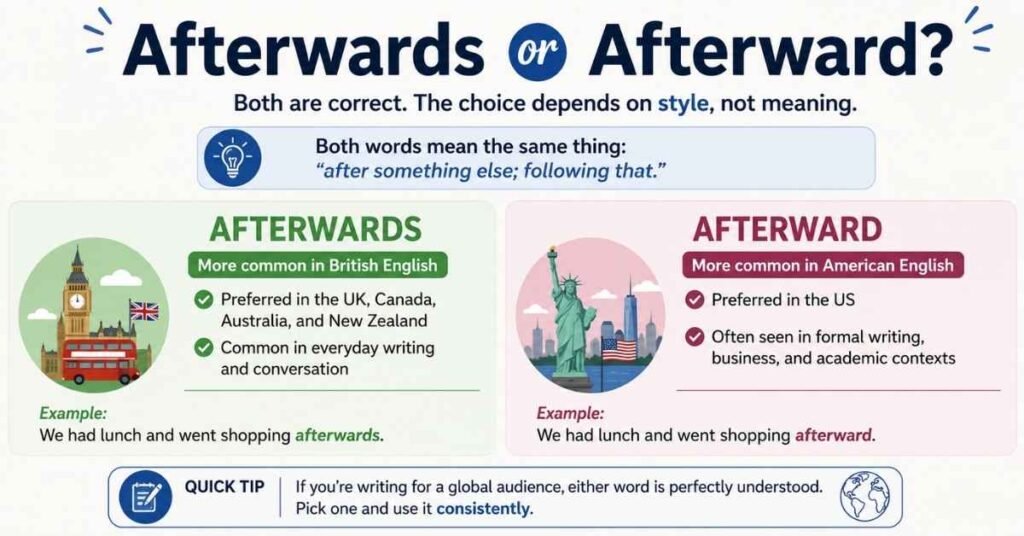
Afterwards or afterward are both correct and mean “later,” “after that,” or “at a subsequent time.” The only meaningful distinction is regional preference: American English generally favors “afterward,” while British English more commonly uses “afterwards.” If you are writing for readers in the United States, choose afterward.
The Short Answer
Use this rule when you need an immediate decision:
- United States: Prefer afterward
- United Kingdom: Prefer afterwards
- Meaning: Identical
- Grammar: Both are adverbs
- Correctness: Both are standard English
You have not necessarily made a grammar mistake if you used afterwards in American writing. It simply sounds more British to some US readers.
What Do Afterward and Afterwards Mean?
Afterward and afterwards refer to something that happens later than an event already mentioned.
We finished dinner and went for a walk afterward.
In this sentence, the walk happened after dinner.
The words may be replaced by expressions such as:
- Later
- After that
- Subsequently
- Following that
- At a later time
Cambridge explains that afterwards is commonly used as an adverb and distinguishes it from the broader grammatical roles of after. Cambridge Dictionary
What Part of Speech Are They?
Both words are adverbs of time. They describe when an action happened.
Maya submitted the application and called me afterward.
Here, afterward modifies the verb called by telling us when the call occurred.
Neither word is normally used as an adjective before a noun. For example, “an afterward meeting” is not standard phrasing. Write “a later meeting” or “a follow-up meeting” instead.
How Are They Pronounced?
The two forms are pronounced almost identically. Afterwards simply adds a final z-like sound in normal speech.
- Afterward: AF-ter-werd
- Afterwards: AF-ter-werdz
The pronunciation does not create a difference in meaning.
Afterward vs. Afterwards: The Key Difference
| Feature | Afterward | Afterwards |
|---|---|---|
| Meaning | At a later time | At a later time |
| Part of speech | Adverb | Adverb |
| US English | Preferred | Correct but less preferred |
| British English | Understood and acceptable | More common |
| Formality | Neutral | Neutral |
| Final s | No | Yes |
| Meaning change | None | None |
American English Prefers Afterward
In American English, writers generally choose afterward, without an s.
We can discuss the results afterward.
This is the most natural choice for a US-focused:
- School assignment
- College essay
- Business email
- News article
- Blog post
- Technical document
- Marketing page
Using afterwards will still be understood, but afterward better matches established American usage.
British English Often Prefers Afterwards
In British English, afterwards is more common:
We went to the theatre and had dinner afterwards.
This spelling also appears naturally in Australia, New Zealand and other regions influenced by British English.
The distinction is a regional convention, not a difference in grammar or meaning.
Does the Final S Change the Meaning?
No. The final s does not make afterwards plural, possessive or more emphatic.
Compare:
I thanked her afterward.
I thanked her afterwards.
Both sentences communicate exactly the same sequence of events.
The -ward and -wards variation also appears in words such as toward/towards and backward/backwards. Usage differs by dialect, but the added s does not automatically create a new meaning.
How to Use Afterward in a Sentence
Afterward can appear at the beginning, middle or end of a sentence.
At the Beginning of a Sentence
Afterward, we reviewed what had gone wrong.
Afterward, the manager sent everyone a written summary.
Beginning with afterward creates a clear transition from one event to the next.
In the Middle of a Sentence
The team afterward admitted that the original estimate was unrealistic.
This position is grammatically possible but may sound stiff. In everyday US writing, the beginning or end usually feels more natural:
The team admitted afterward that the original estimate was unrealistic.
At the End of a Sentence
We ordered coffee afterward.
She completed the interview and sent a thank-you email afterward.
The end position is concise and common in both conversation and writing.
Does Afterward Need a Comma?
Afterward does not always require a comma. Punctuation depends on its position and the rhythm of the sentence.
Use a Comma After an Introductory Afterward
A comma is usually helpful when afterward introduces a new sentence or a clear transition:
Afterward, we drove home.
In a very short sentence, some styles may omit the comma:
Afterward we drove home.
Both versions may be readable, but the comma makes the transition easier to see.
Do Not Automatically Add a Comma at the End
We drove home afterward.
No comma is needed because afterward fits directly into the sentence.
Use Commas for a Parenthetical Interruption
The director, afterward, apologized for the confusion.
This construction is grammatical, but it can sound overly formal. A smoother version is:
The director apologized for the confusion afterward.
Afterward, Afterwards, After or Afterword?
These terms are related in appearance but do not function in exactly the same way.
Afterward and Afterwards
These are interchangeable adverbs:
We talked afterward.
We talked afterwards.
For US writing, the first version is preferred.
After
After can serve as a preposition, conjunction or adverb. Unlike afterward, it can introduce a noun phrase or clause.
We talked after the meeting.
We talked after everyone left.
You cannot make the same construction with afterward:
Incorrect: We talked afterward the meeting.
Correct: We talked after the meeting.
Correct: The meeting ended, and we talked afterward.
Use after when you need to name the event directly. Use afterward when the earlier event is already clear from the context.
Afterword
An afterword is a section placed near the end of a book. It may contain comments from the author, editor or another contributor.
The historian wrote an afterword for the new edition.
A simple memory trick is:
- Afterward relates to when
- Afterword contains words in a book
Common Mistakes to Avoid
Treating Afterwards as a Plural
The final s is not a plural ending. Afterward is an adverb, and adverbs do not become plural in this context.
Using Afterward Before a Noun
Avoid:
We arranged an afterward discussion.
Use:
We arranged a later discussion.
We discussed the issue afterward.
Mixing Regional Styles
Both spellings are correct, but repeatedly switching between them can make a document look unedited.
If your audience is American, use afterward consistently. If you follow a British house style, use afterwards.
Confusing Afterward With Afterword
Correct: We ate afterward.
Correct: I read the book’s afterword.
Incorrect: We ate afterword.
A spellchecker may not catch this error because afterword is a real word.
Which Version Should You Use?
In US Academic Writing
Choose afterward unless your instructor or required style guide states otherwise.
The participants completed a questionnaire afterward.
In Business and Professional Writing
For US clients, companies and readers, afterward is the conventional choice.
We will review the proposal and contact you afterward.
In many business sentences, however, later may sound even more direct:
We will review the proposal and contact you later.
In Fiction and Dialogue
Match the speaker’s regional voice. A British character may naturally say afterwards, while an American narrator may prefer afterward.
Dialect consistency can make dialogue feel more authentic.
In International Content
Either version will be understood. Choose the form that matches:
- Your primary target country
- Your brand’s house style
- The surrounding spelling conventions
For example, a page using American forms such as color, center and organize should normally use afterward.
Natural Synonyms for Afterward
You can prevent repetition by choosing a synonym that fits the context.
| Alternative | Best Use |
|---|---|
| Later | Natural everyday language |
| After that | Clear chronological narration |
| Later on | Informal conversation |
| Subsequently | Formal or technical writing |
| Thereafter | Legal, historical or highly formal contexts |
| Following that | Reports and explanations |
| Eventually | When time passes before the later event |
Be careful with eventually. It suggests that something occurred after a delay or sequence of developments, so it is not always an exact substitute.
LEARN MORE: GIF or JIF
Quick Editing Test
Ask these three questions:
- Am I writing for Americans?
Use afterward. - Am I writing for a British audience?
Use afterwards. - Am I referring to a section of a book?
Use afterword.
If the event must follow the word directly, use after:
After the presentation, we answered questions.
If the event is already understood, use afterward:
The presentation ended. We answered questions afterward.
Frequently Asked Questions
Is Afterwards Incorrect in American English?
No. Afterwards is grammatically correct in American English, but afterward is more conventional in US usage.
Is Afterward More Formal Than Afterwards?
No meaningful difference in formality exists. Both are neutral. Their main distinction is regional preference.
Can You Start a Sentence With Afterward?
Yes:
Afterward, we compared our notes.
It works as an introductory adverb that connects the sentence to an earlier event.
Can Afterward Appear at the End of a Sentence?
Yes. This is one of its most natural positions:
We went out for lunch afterward.
Is Afterward One Word or Two?
Afterward is one word. Do not write after ward when you mean “later.”
Is Afterwards the Plural of Afterward?
No. Neither word is plural. They are two regional forms of the same time adverb.
Is It Shortly Afterward or Shortly Afterwards?
Both are correct:
The power returned shortly afterward.
The power returned shortly afterwards.
Use the first for an American audience and the second for a British audience.
Can I Use Afterward in Formal Writing?
Yes. Afterward is acceptable in academic, professional and formal writing. Depending on the context, subsequently may sound more technical, but it is not automatically better.
Final Rule to Remember
Afterward and afterwards have the same meaning and are both correct. Use afterward for American English and afterwards for British English. Whichever form you select, use it consistently throughout the document.

1 thought on “Afterwards or Afterward: Which Is Correct in American English?”