

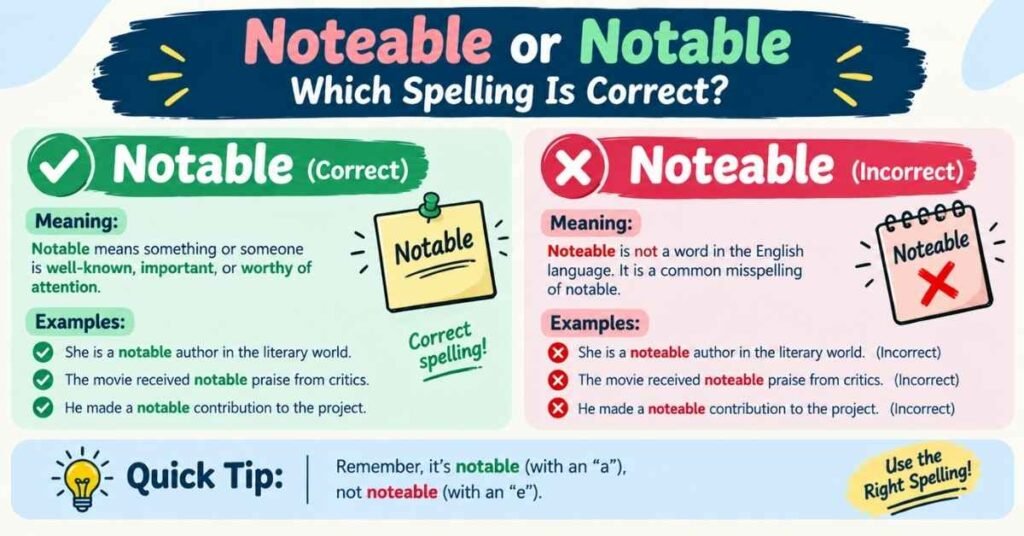
Noteable or notable has one standard answer: notable is the correct spelling when you mean important, remarkable, distinguished, prominent, or worthy of attention. Noteable is a common misspelling in ordinary modern English. Write “a notable achievement,” not “a noteable achievement.” However, preserve Noteable if it is the official name of a company, product, application, or creative project.
Noteable vs. Notable at a Glance
| Form | Status | Meaning | Example |
|---|---|---|---|
| Notable | Correct standard word | Important, remarkable, or worthy of attention | She made a notable contribution. |
| Notable | Correct noun | An important or distinguished person | Several local notables attended. |
| Noteable | Misspelling in ordinary prose | No separate standard meaning | Avoid: a noteable result |
| Noteable | Possible proper name | Meaning determined by its owner | Preserve an official brand spelling |
Merriam-Webster defines notable as “worthy of note,” “remarkable,” “distinguished,” or “prominent.” Merriam-Webster
What Does Notable Mean?
Notable most commonly functions as an adjective describing a person, thing, event, change, or quality that deserves attention.
Its core meanings include:
- Worthy of attention
- Important
- Remarkable
- Prominent
- Distinguished
- Significant enough to mention
Notable Meaning Important or Remarkable
The research produced a notable result.
The result is important or interesting enough to deserve attention.
The neighborhood experienced a notable increase in new businesses.
The increase is large, meaningful, or worth mentioning.
Notable Meaning Prominent or Distinguished
She is a notable historian of the early United States.
The historian is respected, prominent, or recognized for her work.
Several notable authors attended the festival.
The authors are distinguished or publicly recognized.
Notable as a Noun
Notable can also function as a noun meaning an important, influential, or distinguished person.
Local notables gathered for the ceremony.
The guest list included politicians, artists, and other notables.
This noun use is correct, but it is less common in everyday conversation than the adjective.
Is Noteable a Word?
In ordinary modern English, noteable is not the standard spelling. Dictionaries generally treat it as a misspelling of notable.
Incorrect: The report identified several noteable trends.
Correct: The report identified several notable trends.
YourDictionary, for example, labels noteable a common misspelling. YourDictionary
When Noteable May Be Correct
A nonstandard spelling can still be valid when it is part of a proper name.
Examples may include:
- Company names
- Product names
- Mobile applications
- Music platforms
- Usernames
- Creative projects
- Website names
- Deliberately stylized brands
If an organization officially calls itself Noteable, do not silently change its name to Notable.
Compare:
The achievement was notable.
She opened the Noteable application.
The first sentence uses a common adjective. The second may use an official proper name.
Why Is Notable Spelled Without the E?
The spelling noteable feels reasonable because the meaning can be understood as “able or worthy to be noted.” However, the established English word is notable.
The Practical Spelling Rule
English often drops a final silent e before a suffix beginning with a vowel:
- Admire + able → admirable
- Desire + able → desirable
- Value + able → valuable
- Note + able → notable
This pattern gives learners a useful modern memory rule:
Drop the final e before adding -able: note → notable.
The Historical Explanation
The word is older than a simple modern combination of note and able. English notable developed through French and Latin, connected with Latin notabilis, meaning worthy of notice or being noted.
Therefore, “note + able” is a useful memory aid, but it is not the complete historical origin.
Why Does Noticeable Keep Its E?
This is where many writers become understandably confused.
Compare:
- Note → notable
- Notice → noticeable
Noticeable retains the final e partly because dropping it would produce noticable, which could suggest a hard c sound. Keeping the e helps preserve the soft c pronunciation in notice.
These spellings are correct:
- Notable
- Noticeable
- Serviceable
- Changeable
- Manageable
English suffix rules have exceptions designed to preserve pronunciation or readability. Do not assume every word ending in silent e behaves identically.
How Do You Pronounce Notable?
In standard American English, notable is commonly pronounced approximately:
NOH-tuh-buhl
Merriam-Webster represents the main pronunciation as approximately:
/ˈnō-tə-bəl/
It has three syllables:
- NO
- tuh
- buhl
The incorrect spelling noteable would not normally create a different pronunciation, which is one reason the mistake is difficult to detect in speech.
The Notable Word Family
| Word | Part of speech | Meaning | Example |
|---|---|---|---|
| Note | Noun/verb | A record, observation, or act of noticing | Please note the deadline. |
| Notable | Adjective | Worthy of attention | A notable improvement occurred. |
| Notable | Noun | An important person | Local notables attended. |
| Notably | Adverb | Especially; in a notable manner | Sales increased, notably online. |
| Notability | Noun | The quality of being notable | Her notability grew rapidly. |
| Noteworthy | Adjective | Deserving attention or mention | The result is noteworthy. |
Notably
Notably often introduces an important example or exception:
Several departments improved, notably customer service.
The project succeeded despite several challenges, most notably its limited budget.
Notability
Notability refers to prominence, importance, or the condition of being noteworthy:
The artist achieved national notability.
In online publishing, notability may also refer to whether a person or topic has received enough significant independent coverage to justify an encyclopedia entry.
How to Use Notable Correctly
Notable Achievement
Winning the regional competition was a notable achievement.
The accomplishment deserves recognition or attention.
Notable Difference
There is a notable difference between the two proposals.
This means the difference is important or worth mentioning. It does not necessarily mean the difference is visually obvious.
Notable Improvement
The student showed notable improvement in reading comprehension.
The improvement is meaningful enough to deserve attention.
Notable Exception
Most locations close at 6 p.m., with one notable exception.
This phrase introduces an important exception to a general pattern.
Notable Contribution
Her most notable contribution was the development of the new training program.
This identifies a contribution that stands out because of its importance or effect.
Notable Person
He became a notable figure in American journalism.
She is a notable scientist in the field of renewable energy.
The person is prominent, distinguished, or recognized for meaningful work.
Notable Absence
One notable absence from the report was customer-retention data.
A notable absence is something missing that deserves attention.
Notable Feature
The building’s most notable feature is its glass atrium.
The atrium is the feature most worthy of notice or discussion.
Notable Example
One notable example is the city’s rapid expansion of public transit.
The example has particular relevance or importance.
Notable vs. Noticeable
These words are related but not interchangeable.
- Notable means important or worthy of attention.
- Noticeable means easy to see, hear, detect, or recognize.
Compare the Meanings
There was a notable change in company policy.
The change was important or worth discussing.
There was a noticeable change in the room’s temperature.
The change could be physically perceived.
A Difference Can Be Both
The medication produced a noticeable and notable improvement.
- Noticeable: The improvement could be observed.
- Notable: The improvement was important enough to mention.
Quick Decision Test
Ask:
- Is it important? Use notable.
- Is it easy to detect? Use noticeable.
Notable vs. Noteworthy
These words are close synonyms.
Notable
Often emphasizes importance, prominence, or distinction:
a notable author
a notable increase
a notable exception
Noteworthy
Emphasizes that something deserves attention or mention:
a noteworthy discovery
a noteworthy detail
a noteworthy effort
Compare:
She is a notable historian.
This suggests she is prominent or distinguished.
Her analysis contains several noteworthy observations.
The observations deserve attention.
In many sentences, either word works. Notable is usually broader and more common before people, trends, changes, and exceptions.
Notable vs. Remarkable
Remarkable often carries a stronger sense of surprise, unusualness, or admiration.
She made a notable recovery.
The recovery is important enough to mention.
She made a remarkable recovery.
The recovery is unusually impressive or surprising.
Use remarkable when you want greater emotional emphasis.
Notable vs. Significant
Significant can mean:
- Important
- Meaningful
- Large enough to matter
- Statistically significant in research
Notable means worthy of attention but does not automatically carry a statistical meaning.
The report found a notable increase in participation.
This is an observational or editorial judgment.
The experiment found a statistically significant increase in participation.
This makes a technical statistical claim that requires supporting analysis.
In academic or scientific writing, do not replace statistically significant with notable if the statistical result is essential.
Notable vs. Famous
Famous means widely known. Notable means important, distinguished, or worthy of attention.
She is a famous actor.
Many people know her name.
She is a notable theater director.
She is distinguished or important in her profession, even if the general public does not know her.
A person can be:
- Notable but not famous
- Famous but not especially distinguished
- Both notable and famous
- Neither
Notable vs. Prominent
Prominent often emphasizes position, visibility, or influence:
a prominent political leader
Notable emphasizes being worthy of attention:
a notable contribution to public policy
The words overlap when describing recognized people.
Is “Most Notable” Grammatically Correct?
Yes. Most notable is grammatical and common.
Her most notable achievement was expanding access to education.
The report’s most notable finding involved customer retention.
It identifies the person, thing, or quality that stands out above the others.
Most Notable vs. Most Notably
- Most notable modifies a noun:
The most notable feature is the new dashboard.
- Most notably modifies a statement or introduces an example:
Several features changed, most notably the dashboard.
Is Notable Positive or Negative?
Notable is usually neutral to positive, but its tone depends on the noun it modifies.
Positive
a notable achievement
a notable success
a notable contribution
Neutral
a notable difference
a notable exception
a notable trend
Negative
a notable decline
a notable failure
a notable omission
The word means “worthy of attention,” not necessarily “good.”
Correct and Incorrect Examples
Academic Writing
Incorrect:
The study found a noteable difference between the groups.
Correct:
The study found a notable difference between the groups.
More precise when supported:
The study found a statistically significant difference between the groups.
Business Report
Incorrect:
Revenue showed a noteable improvement.
Correct:
Revenue showed a notable improvement.
Résumé
Incorrect:
Achieved noteable growth in customer retention.
Correct:
Achieved notable growth in customer retention.
Stronger with evidence:
Increased customer retention by 18% in one year.
Biography
Incorrect:
She became a noteable public figure.
Correct:
She became a notable public figure.
Journalism
Incorrect:
One noteable absence was the mayor.
Correct:
One notable absence was the mayor.
Historical Writing
Incorrect:
The period produced several noteable artists.
Correct:
The period produced several notable artists.
Proper Name
Potentially correct:
The workshop used the Noteable platform.
If Noteable is the official product name, preserve that spelling.
When Notable Is Too Vague
Notable is useful, but stronger writing often explains exactly why something deserves attention.
Vague
The campaign achieved a notable result.
Specific
The campaign increased qualified leads by 31% in eight weeks.
Vague
She made a notable contribution.
Specific
She designed the onboarding process that reduced employee turnover by 15%.
In data-driven writing, use evidence instead of relying entirely on evaluative adjectives.
Better Synonyms by Context
| Intended meaning | Better choices |
|---|---|
| Important | Significant, consequential, meaningful |
| Unusual | Remarkable, striking, exceptional |
| Respected person | Distinguished, prominent, eminent |
| Widely known | Famous, renowned, celebrated |
| Worth mentioning | Noteworthy, relevant |
| Easy to observe | Noticeable, visible, apparent |
| High quality | Outstanding, excellent |
| Memorable | Unforgettable, distinctive |
No synonym works in every sentence. Select the word that expresses the precise relationship you intend.
A Three-Step Spelling and Meaning Test
Step 1: Check the Meaning
Do you mean important, remarkable, or worthy of attention?
If yes, use notable.
Step 2: Check the Spelling
Write:
N-O-T-A-B-L-E
There is no e after the t.
Step 3: Check the Context
- Important or distinguished → notable
- Easy to detect → noticeable
- Official company/product name → preserve its official spelling
Memory Trick
Something worthy of a note is notable—but the extra e is not able to stay.
A shorter visual reminder is:
NOT + ABLE = NOTABLE
This is only a memory device, not the word’s historical derivation.
LEARN MORE: Grately vs Greatly
Proofreading Framework
Before publishing:
- Search the document for noteable.
- Replace common-word uses with notable.
- Leave official proper names unchanged.
- Check whether noticeable better matches the intended meaning.
- Review every use of significant in research contexts.
- Replace vague claims with evidence when possible.
- Check related forms:
- notable
- notably
- notability
- Read the complete sentence once for naturalness.
Quick Practice Quiz
Choose notable, noteable, noticeable, notably, or noteworthy.
- The company reported a ___ increase in online sales.
- The paint color looked different, but the change was barely ___.
- Several departments improved, most ___ customer support.
- She is a ___ expert in constitutional law.
- The essay contains several ___ observations.
- The software named ___ launched a new feature.
- The word ___ is incorrect in ordinary modern prose.
Answers
- Notable — the increase deserves attention
- Noticeable — the change is visually detectable
- Notably — the adverb introduces a prominent example
- Notable — she is distinguished or prominent
- Noteworthy or notable — both can work; noteworthy emphasizes deserving mention
- Noteable — potentially correct if it is the official product name
- Noteable — the misspelling is being discussed as a word
Frequently Asked Questions
Which is correct: noteable or notable?
Notable is correct in standard English. Noteable is normally a misspelling.
Is noteable a real word?
It is not the standard common word meaning important or worthy of attention. However, Noteable may be valid as an official brand, product, title, or proper name.
What does notable mean?
Notable means important, remarkable, distinguished, prominent, or worthy of attention.
How do you spell notable?
Spell it:
N-O-T-A-B-L-E
Do not place an extra e after the t.
Why is notable spelled without an e?
The established form is notable, historically related to Latin notabilis. As a practical spelling rule, the final silent e in note is dropped before -able.
Is notable an adjective?
Yes:
She made a notable contribution.
Can notable be a noun?
Yes. A notable is an important or distinguished person:
Several local notables attended.
What is the adverb form of notable?
The adverb is notably:
The second proposal was notably less expensive.
What is the noun form of notable?
The abstract noun is notability. Notable itself can also be a concrete noun for an important person.
What is the difference between notable and noticeable?
Notable means important or worthy of attention. Noticeable means easy to perceive or detect.
Is most notable correct?
Yes:
Her most notable achievement was creating the scholarship program.
Does notable mean famous?
Not always. A notable person is distinguished or important. A famous person is widely known.
Is notable positive?
It is usually neutral or positive, but it can modify negative ideas such as a notable decline or notable failure.
Is noteable a British spelling?
No. Notable is the standard spelling in both American and British English.
What is another word for notable?
Depending on context:
- Remarkable
- Significant
- Noteworthy
- Distinguished
- Prominent
- Outstanding
- Memorable
- Renowned
Final Verdict: Noteable or Notable?
Notable is the correct spelling when you mean important, remarkable, distinguished, prominent, or worthy of attention.
Use:
- Notable achievement
- Notable difference
- Notable improvement
- Notable exception
- Notable contribution
- Notable person
- Most notably
Avoid noteable in ordinary prose. Keep Noteable only when it is an official proper name whose spelling must be preserved.
