

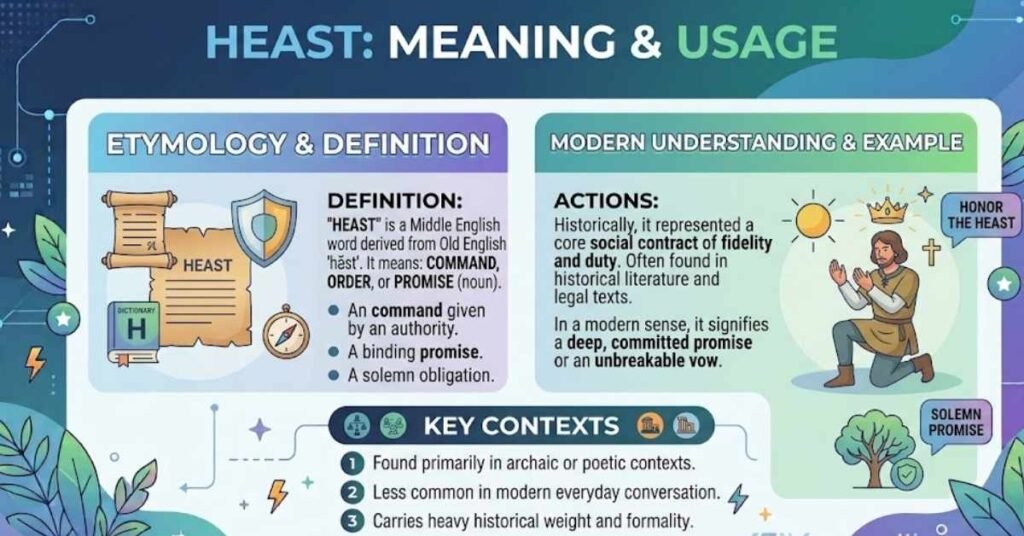
Have you come across the word heast and wondered what it means? The heast meaning is mainly connected with “command” or “order” in older or dialectal English, although the word is uncommon in modern everyday English. In some historical contexts, heast appears as a variant or dialect form related to commanding or urging someone to do something.
Because it is an uncommon word, its meaning can change depending on the text, dialect, or historical period where you found it. Let’s look at its possible meanings, origins, and uses in simple terms.
What Does Heast Mean?
Heast is an uncommon English word that may appear in historical, dialectal, or older forms of English. It is not a standard word that most English speakers use in ordinary conversation today.
In older usage, words such as heast could be associated with the idea of a command, order, or urging. Therefore, the surrounding sentence is important when determining its exact meaning.
In simple terms, heast may be understood as:
- Command
- Order
- Instruction
- Urging
- A direction to do something
However, you should not automatically replace every occurrence of heast with “command.” Historical spelling and dialect can affect the interpretation.
Heast Meaning in English
When someone searches for heast meaning in English, they are often looking for a straightforward modern definition. The difficulty is that heast is rare and archaic, rather than a commonly used contemporary English word.
Modern English normally uses words such as:
- Command
- Order
- Request
- Instruction
- Direction
- Urge
For example, instead of using an old or dialectal term, a modern speaker would usually say, “He gave an order” or “She instructed him to leave.”
Is Heast an Old English Word?
Heast can be encountered in older English or dialectal material, but it should not automatically be classified as a standard Old English word simply because it looks unusual.
Old English refers specifically to the English language used roughly from the fifth century to the eleventh century. Middle English followed it, while Modern English developed later.
This distinction matters because historical dictionaries may record words according to different periods and regional dialects.
If you found heast in an old manuscript, poem, genealogy, dictionary, or historical document, the surrounding text can help identify the intended sense.
Heast Meaning in Different Contexts
The meaning of an uncommon word often becomes clearer when you examine the sentence around it.
Heast as a Command
One possible interpretation connects heast with the idea of an order or command.
For instance, a historical text might use a rare term to describe someone directing another person to take an action.
Heast as an Urging
In some dialectal contexts, a related sense may involve urging or encouraging someone to act.
That meaning is slightly different from a strict command because an urge can be forceful without necessarily being an official order.
Heast in Historical Texts
Historical texts frequently contain spellings that look unfamiliar to modern readers. A word may have changed spelling, pronunciation, or meaning over hundreds of years.
As a result, it is better to consider heast alongside the date, region, and type of document in which it appears.
Heast vs. Modern English Words
Since heast is uncommon today, comparing it with familiar words can make its possible meaning easier to understand.
| Word | General meaning | Modern usage |
|---|---|---|
| Heast | Command, order, or urging in certain historical/dialectal contexts | Rare |
| Command | An authoritative instruction | Common |
| Order | A direction that someone should follow | Common |
| Instruction | Information about how to do something | Common |
| Urge | Encourage someone strongly to act | Common |
| Request | Ask someone to do something | Common |
The key difference is usage. Modern speakers generally choose familiar terms rather than heast.
Why Does Heast Look Unfamiliar?
English has changed considerably over time. Words that were once used in particular regions or periods can disappear from everyday speech.
Several factors can make a historical word look strange:
- Spelling changes – English spelling was not always standardized.
- Regional dialects – Different areas developed their own vocabulary.
- Language evolution – Some words gradually disappeared.
- Historical documents – Older texts preserve vocabulary that modern speakers rarely encounter.
- Literary usage – Writers sometimes deliberately use archaic words for a particular effect.
Therefore, encountering heast does not necessarily mean that the word is a spelling mistake.
Is Heast a Common English Word?
No. Heast is not a common word in contemporary standard English.
Most English speakers are unlikely to use it in everyday conversation. If you are writing modern English, words such as command, order, instruction, or urge will usually communicate the intended idea more clearly.
However, rare vocabulary can still be useful when reading historical documents, dialect literature, older dictionaries, or specialized linguistic material.
LEARN MORE: Taim Meaning
Could Heast Be a Spelling Mistake?
Yes, depending on where you encountered it.
Because heast is uncommon, it may sometimes be a typo, OCR error, transcription error, or unusual spelling of another word. This is especially possible when the word comes from a scanned historical document.
Before deciding what it means, check:
- The complete sentence
- The original spelling
- The document’s publication date
- The geographical region
- Nearby words
- Whether the source is handwritten or digitally scanned
Context can make a significant difference.
Heast Meaning: Frequently Asked Questions
What does heast mean?
Heast is an uncommon historical or dialectal English term that can be associated with a command, order, or urging, depending on its context.
Is heast a modern English word?
No. Heast is rare in modern standard English and is more likely to appear in historical or dialectal material.
Is heast an Old English word?
The term may appear in historical English sources, but calling it specifically “Old English” requires checking the particular source and historical period. An unusual-looking word is not automatically Old English.
What is the modern word for heast?
Depending on the context, possible modern equivalents include command, order, instruction, direction, or urge.
Can heast be a name?
It is possible to encounter unusual words as surnames, names, or family names. If you found Heast as a surname or personal name, its meaning should be researched separately because names can have different origins from ordinary vocabulary.
Why can’t I find heast in common dictionaries?
Because heast is rare and potentially dialectal or historical, modern general-purpose dictionaries may not provide the same coverage as historical or regional dictionaries.
Final Thoughts on Heast Meaning
The heast meaning is best understood through its historical or dialectal context. The word is uncommon in modern English and can be associated with ideas such as command, order, or urging, but the exact interpretation depends on the source where it appears.
If you found heast in a book, old document, poem, surname record, or online post, look at the surrounding sentence before choosing a definition. That small step can prevent a historical or dialectal word from being given an inaccurate modern meaning.

1 thought on “Heast Meaning: Definition, Origin & Usage”