

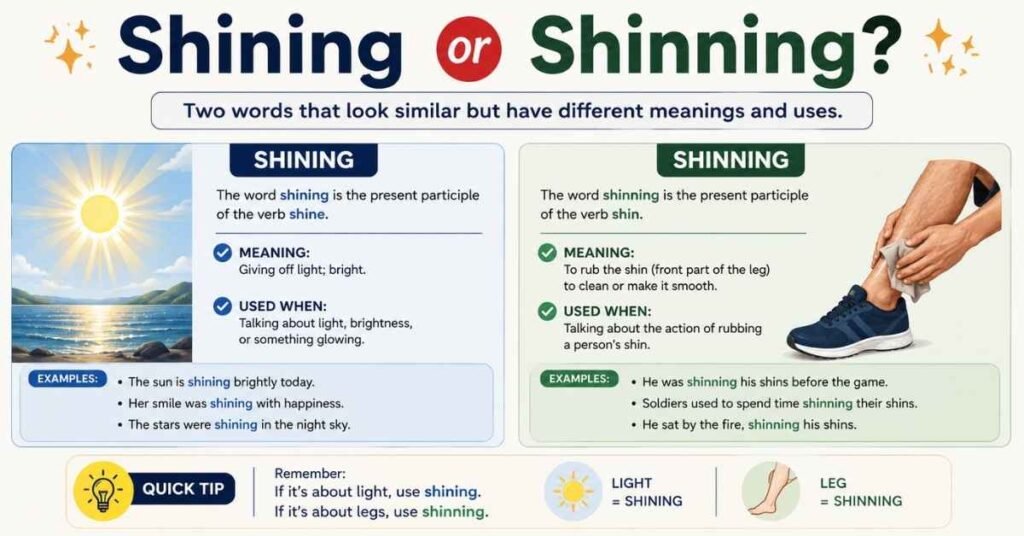
Shining or shinning can both be correct, but they describe completely different actions. Use shining when something gives off or reflects light, looks bright, is being polished, or performs exceptionally well. Use the much rarer shinning when someone is climbing a tree, rope, or pole using their arms and legs. Therefore, “The sun is shining” is correct.
The Difference in One Sentence
The easiest way to separate the words is to identify their base verbs:
- Shine → shining: producing light, reflecting light, polishing, or excelling
- Shin → shinning: climbing by gripping something with the arms and legs
The extra n is not an alternative spelling. It signals that the word comes from shin, not shine.
Shining and Shinning Come From Different Verbs
| Word | Base Verb | Meaning | Example |
|---|---|---|---|
| Shining | Shine | Giving off light, reflecting light, polishing, or excelling | The moon was shining. |
| Shinning | Shin | Climbing using the arms and legs | He was shinning up the pole. |
Shine Becomes Shining
Shining is the present participle and -ing form of the verb shine.
The stars are shining tonight.
She is shining her flashlight toward the path.
He spent the morning shining his shoes.
It can appear in continuous verb tenses or function as an adjective.
Shin Becomes Shinning
Shinning comes from the verb shin. In its best-known verbal use, to shin means to climb something by gripping it with your arms and legs.
The sailor was shinning up the mast.
Because shin ends in a short vowel followed by one consonant, the final n is doubled before -ing:
Shin + n + ing = shinning
What Does Shining Mean?
Shining has several connected meanings. All of them come from the idea of brightness, visibility, polish, or excellence.
Producing or Reflecting Light
Something is shining when it emits or reflects light.
The sun was shining through the bedroom window.
Her silver bracelet was shining in the afternoon light.
The wet road was shining beneath the streetlamps.
Words with similar meanings include:
- Glowing
- Gleaming
- Radiant
- Luminous
- Sparkling
- Glittering
- Bright
Merriam-Webster’s related terms for shining include glowing, luminous, dazzling, bright, gleaming, and radiant. Merriam-Webster Thesaurus
Directing a Light
The verb can be transitive, meaning that someone directs light toward an object or place.
The officer was shining a flashlight into the vehicle.
She stood at the entrance, shining her phone’s light down the stairs.
In these examples, shining takes an object: a flashlight or a light.
Polishing a Surface
Shining can also mean polishing something until it becomes glossy or reflective.
Marcus was shining his shoes before the ceremony.
She finished shining the silverware.
This meaning explains the familiar expression “shoe shining.”
Performing Exceptionally Well
The word is frequently used figuratively to describe someone who is succeeding, displaying talent, or attracting positive attention.
The young pitcher has been shining throughout the season.
She is shining in her new leadership role.
He truly shines when solving complicated problems.
No literal light is involved. The idea is that the person’s ability is so noticeable that it resembles brightness.
Shining as an Adjective
Shining can describe a noun directly:
She is a shining example of patience.
The program became a shining success.
He arrived in shining armor.
As an adjective, shining may mean bright, polished, excellent, or highly admirable.
What Does Shinning Mean?
Shinning is the present participle of the verb shin. It usually describes climbing quickly or awkwardly by gripping an object with the legs and arms.
The boy was shinning up the tree to retrieve his kite.
The worker reached the platform by shinning up the pole.
The sailor was shinning down the rope.
The movement may involve pressing the lower legs or shins against the object for support.
Why Shinning Is Uncommon but Correct
People rarely need to describe this specific climbing motion in everyday conversation. They normally use the more familiar verb climbing:
He was climbing the tree.
As a result, shinning looks like an error even when it is being used correctly.
However, it is incorrect when the intended meaning involves light:
Incorrect: The stars are shinning.
Correct: The stars are shining.
Why Shining Has Only One N
The different spellings follow ordinary English word-formation patterns.
The Silent-E Rule
The base verb shine ends in a silent e. When adding -ing, English normally removes that silent e:
Shine − e + ing = shining
The same pattern appears in:
- Make → making
- Write → writing
- Hope → hoping
- Smile → smiling
- Drive → driving
- Shine → shining
This is why shining has one n.
Why Shineing Is Incorrect
Do not retain the final e:
Incorrect: shineing
Correct: shining
The silent e affects the vowel sound in the base word shine, but it is removed before the -ing suffix.
Why Shinning Doubles the N
The base verb shin contains a short vowel followed by a final consonant. Before adding -ing, that consonant is doubled:
Shin + n + ing = shinning
Compare:
- Run → running
- Sit → sitting
- Swim → swimming
- Shin → shinning
Therefore, the number of n’s depends on the base verb and intended meaning.
Shining vs. Shinning Examples
Correct Uses of Shining
The sun is shining brightly today.
A full moon was shining over the lake.
Her eyes were shining with excitement.
Daniel is shining in his new position.
She was shining the kitchen counter.
He gave a shining performance on opening night.
The polished car was shining in the driveway.
Correct Uses of Shinning
The child was shinning up the tree.
We watched the sailor shinning up the mast.
He escaped by shinning down the drainpipe.
Incorrect Uses
Incorrect: The sunlight was shinning through the curtains.
Correct: The sunlight was shining through the curtains.
Incorrect: She is a shinning example of good leadership.
Correct: She is a shining example of good leadership.
Incorrect: The stars are shineing tonight.
Correct: The stars are shining tonight.
Is It Sun Shining or Sun Shinning?
The correct phrase is sun shining:
The sun is shining.
The sun produces light, so the word must come from the verb shine. Because shine becomes shining, only one n is used.
Sun shinning would incorrectly suggest that the sun is climbing something with its arms and legs.
Other correct expressions include:
- Shining sun
- Sunshine
- Sunlight
- The sun shines
- The sun shone
- Bright sunshine
Can Shining Describe a Person?
Yes. A person can be shining literally or figuratively.
Literal Use
Her face was shining with perspiration.
His eyes were shining in the candlelight.
Figurative Use
She is shining in her first semester at college.
The new employee has been shining since joining the team.
His kindness made him a shining example for others.
In figurative contexts, shining suggests that a person’s talent, character, confidence, or success is clearly visible.
Shining, Shiny, Shone or Shined?
These related forms serve different grammatical purposes.
| Word | Typical Function | Example |
|---|---|---|
| Shining | Present participle or adjective | The sun is shining. |
| Shiny | Adjective describing a glossy surface | The floor looks shiny. |
| Shone | Past tense, especially for emitted light | The moon shone brightly. |
| Shined | Past tense, often for polishing or directing light | He shined his shoes. |
Shining vs. Shiny
Shining often describes an active or visible process:
The floor was shining after she polished it.
Shiny describes a quality or appearance:
The floor was smooth and shiny.
Compare:
Her eyes were shining with joy.
She wore a shiny silver jacket.
Shone vs. Shined
In common American usage, shone is often used when something emitted light:
The moon shone through the clouds.
Shined is commonly used when someone polished something or directed a light:
He shined his shoes.
The guard shined a flashlight through the window.
This distinction is useful, though actual usage can vary by context.
Is Shining Spelled Differently in American and British English?
No. Both standard American and British English use shining for the -ing form of shine.
- US English: The sun is shining.
- UK English: The sun is shining.
Similarly, shinning retains its separate climbing-related meaning in both varieties. This is not a regional spelling pair like color/colour.
Common Mistakes That Spellcheck May Miss
Adding an Unnecessary N
Incorrect: Her smile was shinning.
Correct: Her smile was shining.
This error often occurs because writers associate -ing forms with doubled consonants, as in running and sitting.
Keeping the Silent E
Incorrect: The light is shineing.
Correct: The light is shining.
Drop the silent e before adding -ing.
Assuming Shinning Is Always a Misspelling
Shinning is valid when it comes from the verb shin:
He was shinning up the pole.
Calling the word universally incorrect would ignore its established meaning.
Trusting Spellcheck Without Reading the Sentence
A spelling checker may accept both words because both appear in English dictionaries. It may not recognize that you selected the wrong one for the sentence.
Always inspect the meaning:
- Light or excellence: shining
- Climbing: shinning
A Two-Question Editing Test
When proofreading, ask:
1. Does the Sentence Involve Light, Polish, Happiness, or Success?
Use shining.
The silver was shining.
Her talent is shining through.
2. Does the Sentence Describe Someone Climbing With Their Limbs?
Use shinning.
He was shinning up the tree.
If neither interpretation seems right, consider whether you need a different word such as climbing, glowing, polishing, or succeeding.
LEARN MORE: Afterwards or Afterward
An Easy Memory Trick
Look at the base words:
- SHINE contains one n, so use SHINING for light.
- SHIN ends in n, which doubles in SHINNING for climbing.
You can also remember:
Light is shining; legs are shinning.
The second half refers to using your legs and shins to climb.
Frequently Asked Questions
Which Is Correct: Shining or Shinning?
Shining is correct when describing light, brightness, polish, happiness, or excellent performance. Shinning is correct only when it comes from the verb shin, usually meaning to climb with the arms and legs.
Is It “The Sun Is Shining” or “The Sun Is Shinning”?
Write “The sun is shining.” The word comes from shine, so it contains one n.
Is Shinning a Real Word?
Yes. Shinning is the -ing form of shin. It can describe climbing a tree, pole, rope, or similar object by gripping it with the limbs.
Why Does Shining Have Only One N?
Shining comes from shine. The final silent e is removed before adding -ing, and the n is not doubled:
Shine − e + ing = shining
Is Shineing Ever Correct?
No. Shineing is a nonstandard misspelling. The correct form is shining.
Is Shining a Verb or an Adjective?
It can be both:
- Verb: The moon is shining.
- Adjective: She is a shining example.
What Does “Shinning Up a Tree” Mean?
It means climbing the tree by gripping it with the arms and legs, often without a ladder or climbing equipment.
Is It “Shining Star” or “Shinning Star”?
Use shining star. It may describe a star producing light or, figuratively, an exceptionally talented person.
Is It “Shining Bright” or “Shinning Bright”?
Use shining bright. In edited prose, shining brightly is also natural because brightly functions as an adverb.
What Is the Opposite of Shining?
Depending on the context, possible antonyms include:
- Dull
- Dim
- Dark
- Tarnished
- Cloudy
- Failing
- Struggling
The Rule to Remember
Use shining for light, brightness, polish, happiness, talent, or success. Use shinning only when describing an action related to the verb shin, especially climbing with the arms and legs.
When in doubt, identify the base verb:
Shine → shining
Shin → shinning

2 thoughts on “Shining or Shinning: Which Spelling Is Correct?”