

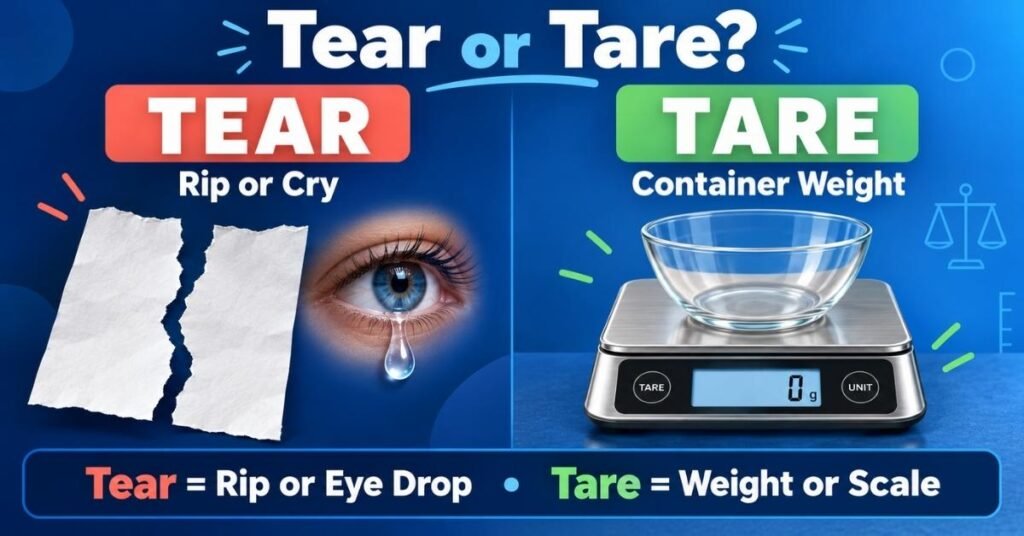
Tear or tare—which word should you use? Use tear when you mean to rip something, a rip in a material, or a drop from the eye. Use tare when referring to the weight of an empty container or resetting a scale so that the container’s weight is excluded.
The confusing part is pronunciation. Tear, meaning “rip,” sounds like tare and rhymes with air. However, tear, meaning a drop from the eye, rhymes with ear. Context therefore determines both the meaning and, in the case of tear, the pronunciation.
Tear or Tare at a Glance
| Word | Meaning | Example |
|---|---|---|
| Tear | To rip or pull apart | Do not tear the envelope. |
| Tear | A rip or eye drop | There is a tear in my shirt. |
| Tare | Empty-container weight or zeroing a scale | Tare the scale before adding flour. |
The quickest rule is:
Rip or cry = tear. Weight or scale = tare.
What Does Tear Mean?
Tear can function as a noun or verb. Its meaning and pronunciation change according to context.
Tear Meaning “to Rip”
As a verb, tear means to pull, split, or damage something by force.
- Be careful not to tear the page.
- The nail could tear the fabric.
- Please tear the paper along the dotted line.
- The dog tried to tear the toy apart.
In American English, this meaning is commonly pronounced /ter/ and rhymes with air.
Tear Meaning “a Rip or Split”
Tear can also be a noun describing the damage produced by ripping.
- I found a small tear in the curtain.
- The seam opened into a large tear.
- A tailor repaired the tear in his jacket.
If you are describing a hole, rip, or split in paper, fabric, or another material, tear is the correct spelling. A “tare in the fabric” is normally an error.
Tear Meaning “a Drop from the Eye”
A tear is also a drop of fluid produced by the eye because of emotion, pain, irritation, or normal eye function.
- A tear rolled down her cheek.
- The ending brought tears to his eyes.
- Smoke made my eyes fill with tears.
This meaning is pronounced /tɪr/ and rhymes with ear.
The spelling remains the same, but the pronunciation changes:
- Tear a sheet of paper: rhymes with air
- Shed a tear: rhymes with ear
Other Uses of Tear
The verb can also describe moving rapidly, dividing something emotionally, or damaging a body part.
- The child tore through the hallway.
- The disagreement tore the group apart.
- The athlete tore a ligament.
- The criticism began to tear at his confidence.
These meanings belong to tear, not tare.
Tear, Tore, and Torn
Tear is an irregular verb.
| Verb Form | Word | Example |
|---|---|---|
| Base form | tear | Do not tear the label. |
| Third-person singular | tears | The machine tears the paper. |
| Present participle | tearing | She is tearing the receipt. |
| Past tense | tore | He tore the box open. |
| Past participle | torn | The package was torn. |
Do not write teared when you mean “ripped.” However, teared up may occasionally describe eyes filling with tears, although teared up or began to tear up is more natural in that emotional context.
What Does Tare Mean?
Tare is primarily a measurement term. It most often means the weight of an empty container, wrapper, vehicle, or other packaging that should not be counted as part of the product.
You are most likely to see it in:
- Kitchens
- Grocery stores
- Laboratories
- Warehouses
- Freight operations
- Packaging facilities
- Shipping documents
Tare Weight Explained
Suppose a jar filled with honey weighs 28 ounces. The empty jar weighs 8 ounces.
- Gross weight: 28 ounces
- Tare weight: 8 ounces
- Net weight: 20 ounces
The jar is the packaging, so its 8-ounce weight is the tare.
Tare as a Verb
Tare can also be a verb. To tare a scale means to account for the container and return the displayed measurement to zero before weighing the contents.
- Place the bowl on the scale and tare it.
- The technician tared the balance before adding the sample.
- Always tare the container before measuring ingredients.
Unlike tear, tare is a regular verb:
- Tare
- Tares
- Tared
- Taring
What Does the Tare Button Do?
The tare button resets the displayed reading to zero while an empty bowl, jar, or container is sitting on the scale.
For example:
- Put an empty bowl on the scale.
- The display shows 12 ounces.
- Press tare.
- The display returns to 0 ounces.
- Add flour.
- The new reading shows the flour’s weight rather than the combined weight of the flour and bowl.
Taring changes the displayed reference point. It does not make the physical bowl weightless, and you should not assume it increases the scale’s maximum safe capacity.
The Less Common Plant Meaning
Tare can also refer to certain weedy plants, particularly kinds of vetch. The word appears in older agricultural and biblical language, including references to wheat and tares.
This meaning is legitimate but uncommon in everyday American English. Unless the subject is agriculture, botany, or a historical text, tare probably refers to weighing.
How to Pronounce Tear and Tare
| Word and Meaning | Pronunciation Guide | Rhymes With |
|---|---|---|
| Tear meaning “rip” | /ter/ | air, care, pair |
| Tare meaning “container weight” | /ter/ | air, care, pair |
| Tear meaning “eye drop” | /tɪr/ | ear, near, clear |
This pronunciation difference explains why the words cause trouble. You cannot always select the spelling by sound alone.
Are Tear and Tare Homophones?
Tear and tare are homophones only when tear means “rip.” In that context, both are pronounced like air.
- Tear the wrapper.
- Tare the wrapper before weighing the contents.
However, the eye-related tear sounds like ear, so it is not pronounced the same as tare.
The word tear is also a heteronym: one spelling has different pronunciations and meanings.
Tear vs. Tare: Key Differences
| Feature | Tear | Tare |
|---|---|---|
| Main meanings | Rip, split, eye drop | Container weight, zero a scale |
| Common context | Paper, fabric, injuries, emotion | Cooking, shipping, laboratories |
| Part of speech | Noun and verb | Noun and verb |
| Pronunciation | Rhymes with air or ear | Rhymes with air |
| Past tense | Tore | Tared |
| Past participle | Torn | Tared |
Gross, Tare, and Net Weight
These three measurement terms have a simple relationship:
Gross weight = contents + container
Net weight = gross weight − tare weight
Tare weight = gross weight − net weight
A Simple Tare-Weight Calculation
A shipping box and its contents weigh 42 pounds. The empty box and packaging materials weigh 4 pounds.
42 lb gross − 4 lb tare = 38 lb net
The product itself therefore weighs 38 pounds.
This is why tare weight, not “tear weight,” is the correct term on shipping, inventory, retail, and packaging records.
How to Choose the Correct Word
Look for contextual clues.
Use Tear When the Sentence Mentions:
- Eyes
- Crying
- Emotion
- Ripping
- Paper
- Fabric
- Holes
- Physical damage
- Muscles or ligaments
- Pulling something apart
Use Tare When the Sentence Mentions:
- A scale
- Weight
- Packaging
- A bowl or jar
- Gross and net measurements
- Shipping
- Freight
- A laboratory balance
- An empty container
Consider these two instructions:
- Tear the bag before disposal.
Rip the bag. - Tare the bag before filling it.
Exclude the empty bag’s weight from the measurement.
One letter completely changes the required action.
LEARN MORE: Shining or Shinning
Common Tear or Tare Mistakes
| Incorrect | Correct | Explanation |
|---|---|---|
| Press the tear button. | Press the tare button. | A scale uses a tare function. |
| There is a tare in my jeans. | There is a tear in my jeans. | A rip is a tear. |
| A tare rolled down her face. | A tear rolled down her face. | Eye fluid is a tear. |
| The tear weight is 2 pounds. | The tare weight is 2 pounds. | Container weight is tare. |
| He tared the letter in half. | He tore the letter in half. | Tore is the past tense of tear. |
| The box was tore open. | The box was torn open. | Torn follows “was” as a past participle. |
| Normal wear and tare | Normal wear and tear | The established expression uses tear. |
Tear and Tare Examples in Sentences
Examples of Tear Meaning “Rip”
- Do not tear the receipt.
- The sharp branch may tear your sleeve.
- She tore the photograph in half.
- The old flag was badly torn.
- We noticed a tear near the pocket.
The Examples of Tear Meaning “Eye Drop”
- One tear escaped from the corner of his eye.
- Her eyes filled with tears of relief.
- The speech made several audience members tear up.
- He wiped away a tear and smiled.
Examples of Tare
- Press tare before adding the sugar.
- The crate has a tare weight of 11 pounds.
- The operator tared the scale correctly.
- Subtract the tare from the gross weight.
- The laboratory balance includes a tare function.
Common Expressions Using Tear
These expressions always use tear, not tare:
- Wear and tear: ordinary damage caused by use
- Tear apart: rip physically or separate emotionally
- Tear down: demolish or criticize
- Tear into: attack, criticize, or begin eating eagerly
- Tear through: move rapidly or use something quickly
- Tear up: rip into pieces or begin to cry
- On a tear: experiencing a period of intense activity or success
Notice that tear up has two possible pronunciations:
- Tear up the document rhymes with air.
- Tear up during the movie rhymes with ear.
The surrounding context reveals the intended meaning.
Easy Ways to Remember Tear and Tare
The Weight Rule
If the sentence involves weight, use tare.
The Eye Rule
Tear contains the word ear. An eye tear rhymes with ear.
The Action Rule
If you can replace the word with rip, choose tear.
Do not rip the paper.
Do not tear the paper.
The Scale Image
Picture the word TARE printed on a digital kitchen scale. That visual association connects the spelling with measurement.
Frequently Asked Questions
Is it tear or tare a piece of paper?
Use tear: “Please tear the piece of paper.” Here, tear means to rip or pull apart.
Is it tear weight or tare weight?
Tare weight is correct. It means the weight of an empty container, vehicle, or packaging.
Is it tear or tare on a scale?
The correct word is tare. The tare function returns the displayed measurement to zero so you can weigh the contents without including the container.
How do you spell tear as in crying?
It is spelled tear. This meaning rhymes with ear.
How do you spell tear as in ripping?
It is also spelled tear, but it rhymes with air.
Is a rip in clothing a tear or tare?
A rip in clothing is a tear. Tare does not normally describe physical damage to fabric.
What is the past tense of tear?
The past tense is tore, and the past participle is torn:
- She tore the paper.
- The paper was torn.
What is the past tense of tare?
The past tense and past participle are both tared:
- He tared the scale.
- The scale had already been tared.
Is it wear and tear or wear and tare?
Wear and tear is correct. The expression describes damage that develops through ordinary use.
Is tare always related to weight?
Not always. Tare can also name a type of plant or weed in older agricultural usage. In modern everyday contexts, however, it usually concerns weighing.
The Final Rule
Use tear for ripping, damage, injuries, or drops from the eyes. Use tare for container weight or resetting a scale.
Remember the simplest distinction:
You tear the package, but you tare the scale.

2 thoughts on “Tear or Tare: What Is the Difference?”