

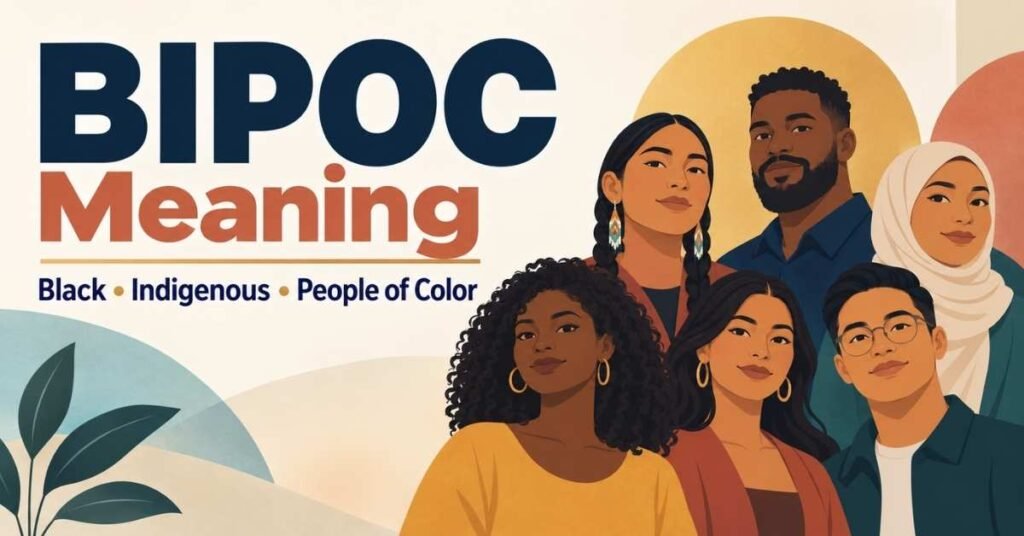
BIPOC meaning: BIPOC stands for Black, Indigenous, and People of Color. It is a U.S.-centered umbrella term that explicitly names Black and Indigenous people while also including other people of color. Many organizations use the acronym, but it is not universally preferred, and specific identity terms are usually more accurate when you know which people or communities you mean.
If you are worried about saying the wrong thing, focus on accuracy, context, and self-identification. No single label represents every person’s identity or experience.
What Does BIPOC Stand For?
BIPOC is an acronym for Black, Indigenous, and People of Color. It is usually used when discussing several racialized communities together, particularly in conversations about discrimination, representation, racial equity, and social policy in the United States.
The term deliberately places Black and Indigenous before the broader phrase “People of Color.” This wording is intended to recognize that different communities experience racism in different ways and that Black and Indigenous histories hold particular significance in the United States.
BIPOC meaning in simple words
In simple words, BIPOC is a collective term for Black, Indigenous, and other people of color.
However, it is important to understand what this definition does not mean:
- BIPOC is not one race
- It is not one cultural identity
- It is not an official universal classification
- It does not mean every included person has the same experiences
- It is not a label that every person accepts
- It should not automatically replace specific group names
What Does Each Part of BIPOC Mean?
Understanding each part of the acronym helps explain both its intended purpose and its limitations.
B: Black
Black is a broad racial and cultural identity. It can include people from the United States, Africa, the Caribbean, Latin America, Europe, and other parts of the world.
Black and African American are not always interchangeable. For example, a person from Jamaica living in the United States may identify as Black or Jamaican American without identifying as African American. A Black immigrant from Nigeria may prefer Nigerian American, Black, or both.
When writing about an individual, use the identity the person uses for themselves whenever that information is known and relevant.
Avoid using “Blacks” as a noun for a group. Use Black people, Black Americans, Black communities, or a more specific identity instead.
I: Indigenous
Indigenous broadly refers to the original peoples of a place and their descendants. In the United States, this may include American Indian, Alaska Native, Native Hawaiian, and other Indigenous peoples, depending on the specific context.
Indigenous identity should not be treated as only a racial category. Native nations have their own:
- Names
- Histories
- Cultures
- Languages
- Citizenship rules
- Political relationships
- Sovereign status
When possible, name the specific nation, tribe, community, or people. For example, Navajo Nation, Cherokee Nation, Lakota, Yup’ik, or another community name may communicate far more than a broad umbrella term.
Preferences also differ. Some individuals use Native American, some use American Indian, and others prefer Indigenous, Native, or the name of their nation.
POC: People of Color
POC stands for People of Color. In contemporary U.S. usage, it is a broad umbrella term for racial and ethnic groups that are not generally treated as white.
Depending on the context, People of Color may include people who identify as:
- Black
- Indigenous
- Asian or Asian American
- Latino or Hispanic
- Native Hawaiian
- Pacific Islander
- Middle Eastern or North African
- Multiracial
- Members of other racialized communities
This does not mean every person within these populations identifies as a person of color. Personal identity, family history, geography, culture, and social experience can all influence how someone describes themselves.
“People of Color” should not be confused with “colored people,” an outdated phrase with a different and often offensive history in the United States.
How Do You Pronounce BIPOC?
BIPOC is usually pronounced:
BYE-pock
It is commonly spoken as one word rather than as five separate letters.
- BIPOC: “bye-pock”
- POC: Usually pronounced letter by letter as “P-O-C”
Pronunciation may vary slightly, but “bye-pock” is the most widely recognized form in American English.
Should BIPOC Be Capitalized?
Yes. BIPOC is normally written in all capital letters because it is an acronym.
The words Black and Indigenous should also generally be capitalized when they refer to racial, cultural, or ethnic identities.
Examples:
- The organization supports Black and Indigenous artists.
- The report discusses several BIPOC communities.
- Participants described themselves as people of color.
Individual publications and institutions may follow different capitalization policies, so professional writers should also check the relevant style guide.
Why Are Black and Indigenous Named Separately?
A common question is: If Black and Indigenous people are already people of color, why do they need separate letters?
The B and I are named deliberately to foreground Black and Indigenous experiences. In the United States, this emphasis is often connected to histories of:
- Slavery
- Anti-Black racism
- Colonization
- Forced removal
- Land dispossession
- Indigenous boarding schools
- Cultural erasure
- Racial segregation
- Continuing structural discrimination
The intended message is that people of color do not all experience racism in identical ways.
However, explicitly naming Black and Indigenous people does not mean their histories are the same. It also should not suggest that Asian, Latino, Pacific Islander, Middle Eastern, multiracial, or other communities have experienced insignificant discrimination.
The intended purpose and possible limitation
| Intended purpose | Possible limitation |
|---|---|
| Make Black and Indigenous experiences more visible | Naming groups does not guarantee their meaningful inclusion |
| Recognize distinct histories of racism | Other communities may feel pushed into an unnamed remainder |
| Build solidarity among racialized communities | One label can flatten important differences |
| Avoid terms such as “minority” | The new umbrella can remain imprecise |
| Support collective action | It may not fit group-specific issues or data |
The tension between these goals explains why some people value BIPOC while others reject it.
Who Is Included in BIPOC?
BIPOC is a social and political umbrella term, not a scientific classification or a single official demographic category. Inclusion may depend on the context and how individuals or organizations define their populations.
Are Black people BIPOC?
Yes. Black people are explicitly represented by the B.
However, a Black person may prefer to be described as Black, African American, Afro-Caribbean, Afro-Latino, Jamaican American, Nigerian American, or another more specific identity.
Being included within an umbrella term does not mean someone personally uses that term.
Are Indigenous people BIPOC?
Yes. Indigenous people are explicitly represented by the I.
When the specific community is known, naming it is often more accurate than using BIPOC. For example:
Broad: The project involved BIPOC community leaders.
More precise: The project was developed with Cherokee and Muscogee community leaders.
The second sentence communicates who actually participated.
Are Asian people BIPOC?
Asian and Asian American people are generally included through the People of Color portion of BIPOC in U.S. usage.
However, Asian is itself an extremely broad category. It may include people with origins in East Asia, South Asia, Southeast Asia, and many distinct national, ethnic, cultural, and linguistic communities.
A Filipino American, Korean American, Indian American, Vietnamese American, or Japanese American person may have very different experiences. Some identify with BIPOC, while others do not.
Are Latino or Hispanic people BIPOC?
Some Latino and Hispanic people identify as BIPOC or People of Color, while others do not.
Latino and Hispanic do not describe one race. People with Latin American heritage may identify as:
- Black
- Indigenous
- White
- Asian
- Multiracial
- Another racial identity
Hispanic generally relates to heritage connected with Spanish-speaking cultures. Latino generally relates to Latin American origin or heritage. Neither term automatically determines whether a person identifies as BIPOC.
When possible, use the individual’s specific and stated identity.
Are Middle Eastern and North African people BIPOC?
Some Middle Eastern and North African people identify as BIPOC or People of Color, while others do not.
Identity may be shaped by:
- National origin
- Ethnicity
- Religion
- Family history
- Government classifications
- Lived experience
- Personal preference
Avoid assigning the term to a person simply because you believe they look nonwhite.
Are Pacific Islanders BIPOC?
Native Hawaiian and Pacific Islander people are often included under the broad BIPOC umbrella.
However, Pacific Islander identities should not automatically be collapsed into Asian identity. Native Hawaiian, Samoan, Chamorro, Tongan, Fijian, Marshallese, and other Pacific communities have distinct histories and cultures.
Specific terminology is preferable when the particular community is known.
Are multiracial people BIPOC?
Some multiracial people identify as BIPOC, People of Color, mixed race, biracial, or through their specific family backgrounds. Others do not use any of these terms.
You cannot reliably determine someone’s identity from appearance. Follow the person’s stated preference when identity is relevant to the discussion.
Is BIPOC the Same as POC?
BIPOC and POC are related, but they are not exactly the same.
| BIPOC | POC |
|---|---|
| Stands for Black, Indigenous, and People of Color | Stands for People of Color |
| Explicitly names Black and Indigenous people | Uses one broad collective phrase |
| Intends to foreground particular U.S. histories | Emphasizes a wider coalition |
| Became especially visible in recent institutional language | Has a longer history in U.S. social and political language |
| May appear more specific in purpose | Is shorter but remains broad |
| Is not universally preferred | Is also not universally preferred |
Is BIPOC better than POC?
Neither term is automatically better.
BIPOC may be useful when the intended emphasis on Black and Indigenous experiences is genuinely relevant. POC may be appropriate when discussing a broad coalition without giving two groups special emphasis.
In many situations, neither is the clearest choice. Naming the actual communities involved may be more informative and respectful.
Is BIPOC an Acceptable Term?
BIPOC remains an accepted and widely recognized term in many U.S. workplaces, universities, nonprofits, and advocacy organizations. However, it is contested and not universally embraced.
Its appropriateness depends on:
- Who is being described
- Why several groups are being discussed together
- Whether shared experiences are relevant
- Whether the people use the term themselves
- Whether a governing style guide accepts it
- Whether more specific language is available
Why some people use BIPOC
Supporters may value the term because it:
- Explicitly recognizes Black and Indigenous communities
- Signals solidarity
- Avoids defining people solely as minorities
- Acknowledges that racism does not affect every group identically
- Creates shorthand for some cross-community programs
- Can support collective advocacy
Why some people dislike BIPOC
Critics argue that the term:
- Groups distinct communities together
- Can erase important historical and cultural differences
- Treats other people of color as an unnamed remainder
- May center Black and Indigenous people only symbolically
- Can obscure unequal outcomes in data
- Suggests a unity that individuals may not claim
- Is sometimes used to appear inclusive without producing meaningful change
Both perspectives matter. A balanced explanation should neither require people to accept the label nor insist that the term is always inappropriate.
Is BIPOC offensive?
BIPOC is not universally regarded as a slur or inherently offensive. Many people and organizations use it intentionally.
At the same time, some individuals find it inaccurate, impersonal, or excluding. If someone says the label does not fit them, respect that preference rather than arguing that an umbrella definition includes them.
When Using BIPOC May Make Sense
BIPOC may be appropriate when:
- A coalition uses the acronym in its official name
- An organization defines a program using the term
- A group self-identifies with it
- Multiple racialized communities are participating in a shared initiative
- A source uses BIPOC as a clearly defined category
- The discussion genuinely concerns shared patterns across several communities
- Black and Indigenous experiences are intentionally relevant to the subject
For example:
The BIPOC student coalition includes Black, Native, Asian American, Latino, Pacific Islander, and multiracial student organizations working together on campus discrimination.
The sentence is stronger because it explains which groups form the coalition instead of assuming every reader interprets BIPOC identically.
When Should You Avoid BIPOC?
Avoid or reconsider the term when:
- You are discussing only one racial or ethnic group
- The specific communities are known
- The people involved reject the label
- Differences between groups are important
- Research data was collected separately
- The umbrella would hide unequal outcomes
- The subject concerns a particular Native nation
- You are using the term mainly to make your writing sound inclusive
- You are applying U.S. terminology to another country without context
If you mean Black people, say Black people
Too broad:
BIPOC residents experienced anti-Black discrimination.
More accurate:
Black residents experienced anti-Black discrimination.
The revised sentence identifies the population actually affected.
If several groups are involved, name them
Broad:
The survey examined BIPOC families.
More precise:
The survey included Black, Navajo, Filipino American, and Mexican American families.
Specific language helps readers understand who participated and prevents assumptions that every racialized group was represented.
Can You Call One Person BIPOC?
An individual may describe themselves as BIPOC, but you should not automatically assign the label based on appearance.
Avoid using “a BIPOC” as a noun. It can reduce a person to a category.
“BIPOC person” is grammatically possible, but a specific identity is usually more informative when known.
Instead of:
Maria is a BIPOC.
Write:
Maria identifies as Afro-Latina.
If the broader identity is relevant and self-chosen, you might write:
Maria describes her experience as a BIPOC professional in the technology industry.
The second version makes clear that the term reflects Maria’s own identification and is relevant to the context.
Should You Say “The BIPOC Community”?
The phrase “the BIPOC community” can imply that millions of people with different histories, cultures, and political identities form one uniform community.
In many cases, the plural is more accurate:
- BIPOC communities
- Communities of color
- Black, Indigenous, and other communities of color
- People from several racial and ethnic backgrounds
- The names of the groups involved
The singular may make sense when referring to one clearly defined coalition or organization that uses the term for itself.
How to Use BIPOC in Workplace Writing
Workplaces often use BIPOC in discussions about hiring, leadership, employee experiences, or representation. The term should not replace precise information.
Workplace email example
Vague:
We want to support BIPOC employees.
More useful:
We are reviewing promotion outcomes for Black, Native American, Asian American, Latino, and multiracial employees and meeting with each employee resource group.
The second version explains both the populations and the action being taken.
Hiring and representation
Organizations should avoid:
- Treating BIPOC as one workforce category
- Assuming every group faces the same barrier
- Reporting one combined representation percentage without subgroup data
- Using inclusive terminology without changing policies
- Claiming BIPOC leadership without defining what that means
- Assigning identities to employees
A broad statistic can hide meaningful differences. An organization could appear to have strong BIPOC representation while particular groups remain almost entirely absent from leadership.
Employee resource groups
Use the name selected by the group itself. Do not rename a Black, Indigenous, Asian American, Latino, Pacific Islander, or multiracial employee group under a broad label for administrative convenience.
How to Use BIPOC in Academic and Research Writing
Academic writers should define the acronym on first use:
Black, Indigenous, and People of Color (BIPOC)
However, defining the term does not automatically make it appropriate.
Match your wording to the evidence
- Use the categories reported by the study
- Explain how participants were classified
- State whether participants self-identified
- Do not replace specific study populations with BIPOC
- Avoid presenting the acronym as a biological category
- Explain why groups are being combined
- Disaggregate results whenever possible
Why disaggregated data matters
Combining several communities under one label can hide important differences in:
- Health outcomes
- Educational achievement
- Income
- Employment
- Housing
- Exposure to discrimination
- Access to services
- Political participation
Weak:
BIPOC participants experienced poorer outcomes.
More informative:
Outcomes declined among Black and American Indian participants but remained unchanged among the Asian American and Latino groups studied.
The second sentence shows what the data actually found.
How to Use BIPOC in Journalism
Journalists and public writers should ask:
- Which groups are actually part of the story?
- Did the source use BIPOC?
- Does the term clarify or obscure?
- Are Black and Indigenous people both central to the subject?
- Is the label being used for a coalition, demographic category, or individual?
- What does the publication’s style guide recommend?
- Can the communities be named directly?
Avoid using BIPOC as a vague substitute for:
- Black voters
- Cherokee citizens
- Asian American business owners
- Latino students
- Native Hawaiian educators
- Pacific Islander healthcare workers
Specificity is not exclusion. It is often the clearest form of inclusion.
BIPOC Examples in Sentences
Contextually appropriate examples
- The coalition describes itself as a BIPOC-led organization.
- The university consulted several BIPOC student groups.
- The report uses BIPOC as an umbrella term but publishes results separately by race and ethnicity.
- She identifies as a BIPOC professional and writes about her experience in the industry.
- The conference includes Black, Indigenous, Asian American, Latino, and other BIPOC speakers.
Examples that need more specificity
BIPOC people have the same experiences.
This is inaccurate because the term includes many different communities and experiences.
The BIPOC community supports the proposal.
This implies that one uniform community exists and shares the same opinion.
BIPOC students struggle in school.
This is an unsupported generalization that hides differences among students, schools, and communities.
We interviewed a BIPOC about racism.
This wording reduces a person to a category and does not identify the relevant experience.
The History of the Term BIPOC
“People of color” has a longer history in U.S. political and coalition language. BIPOC developed as an expanded umbrella intended to give explicit visibility to Black and Indigenous people.
The acronym became especially prominent in American institutions, workplaces, universities, media, and public discussion around 2020, although examples of earlier use exist.
Claims about one definitive inventor or exact first use should be treated cautiously. Language often develops through multiple communities and communication networks rather than one documented act of invention.
The term’s rapid institutional adoption was followed by criticism and reconsideration. Some organizations continue using BIPOC, while others now prefer to name specific communities or use different collective language.
Race, Ethnicity, and Nationality Are Different
Discussions of BIPOC often become confusing because race, ethnicity, nationality, and Indigenous affiliation are treated as though they mean the same thing.
| Concept | What it generally describes | Example |
|---|---|---|
| Race | A social classification shaped partly by perceived physical traits | Black, white, Asian |
| Ethnicity | Shared culture, ancestry, history, language, or traditions | Yoruba, Kurdish, Hispanic |
| Nationality | Citizenship or national affiliation | American, Nigerian, Mexican |
| Indigenous affiliation | Connection to a specific Indigenous people or nation | Cherokee Nation, Navajo Nation |
These identities can overlap. One person might identify as Black, Dominican, Latino, and American. Another might identify through a Native nation, geographic community, and U.S. citizenship.
No single umbrella captures every part of a person’s identity.
LEARN MORE: Godspeed Meaning
How to Decide Whether to Use BIPOC
Use the NAME test before choosing the term.
N — Name the people involved
Can you identify the actual communities instead of using an umbrella?
A — Check accuracy
Does BIPOC accurately describe everyone being discussed, or does it create a misleading generalization?
M — Identify the shared meaning
Is a shared experience of racialization genuinely relevant to your point?
E — Respect endorsement
Do the individuals, communities, organization, or publication use this terminology?
If the specific identities are known, relevant, and manageable, name them.
Alternatives to BIPOC
No single replacement works in every situation.
| What you mean | Possible wording |
|---|---|
| Several known communities | Name each group |
| A broad U.S. coalition | Communities of color |
| Representation differences | Underrepresented racial and ethnic groups |
| A history of exclusion | Historically excluded communities |
| Research participants | Use the study’s actual categories |
| Cultural variety | People from diverse racial and ethnic backgrounds |
| One community | Use its specific name |
| One individual | Use the person’s stated identity |
Avoid using diverse as a synonym for nonwhite. One person is not individually diverse; a group can be diverse because it includes people with different identities or experiences.
Frequently Asked Questions
What does BIPOC stand for?
BIPOC stands for Black, Indigenous, and People of Color.
What does BIPOC mean in simple words?
BIPOC is a broad U.S. term for Black, Indigenous, and other people of color. It intentionally names Black and Indigenous people while grouping several racialized communities together.
How do you pronounce BIPOC?
BIPOC is usually pronounced “bye-pock.”
Should BIPOC be capitalized?
Yes. BIPOC is normally written in capital letters. Black and Indigenous are also generally capitalized when referring to identities.
Who is considered BIPOC?
The term generally includes Black and Indigenous people along with other people of color. However, it has no single universal boundary, and not everyone included by an organization personally accepts the label.
Are Asian Americans BIPOC?
Asian Americans are commonly included through “People of Color” in U.S. usage, but individuals may or may not identify with the term.
Are Latino or Hispanic people BIPOC?
Some are, and some are not. Latino and Hispanic are not racial categories. A person may identify as Black, Indigenous, white, Asian, multiracial, or another race.
Is BIPOC the same as POC?
No. POC means People of Color. BIPOC explicitly names Black and Indigenous people before People of Color.
Is BIPOC a respectful term?
It can be respectful when used accurately and in accordance with community preferences. It is not universally preferred, so specific and self-identified language is often better.
Is BIPOC offensive?
BIPOC is not inherently considered a slur, but some people find it impersonal, inaccurate, or excluding. Respect people who choose not to use the term.
Can you call one person BIPOC?
A person may identify as BIPOC, but do not assume the label based on appearance. Use a specific stated identity when possible and avoid using “a BIPOC” as a noun.
Is “BIPOC community” correct?
It may be grammatically possible, but BIPOC communities is often more accurate because the acronym includes many different populations.
Is BIPOC an official U.S. Census category?
No. BIPOC is an umbrella term used in social, institutional, and political language. It is not itself one official U.S. Census race category.
Should BIPOC be used outside the United States?
Use caution. The term’s logic is strongly connected to U.S. history and racial discourse. Other countries have different populations, histories, classifications, and preferred terminology.
What should you say instead of BIPOC?
Name the specific groups whenever possible. Depending on context, alternatives may include communities of color, underrepresented racial and ethnic groups, or the actual identities involved.
Final Takeaway
BIPOC means Black, Indigenous, and People of Color. It is a U.S.-centered umbrella term intended to recognize Black and Indigenous experiences while including other people of color.
The term can be useful for an intentional coalition or shared discussion, but it should not erase the different histories, identities, political relationships, and experiences of the people it groups together.
When you know who you mean, specific and self-identified language is usually the clearest and most respectful choice.
