

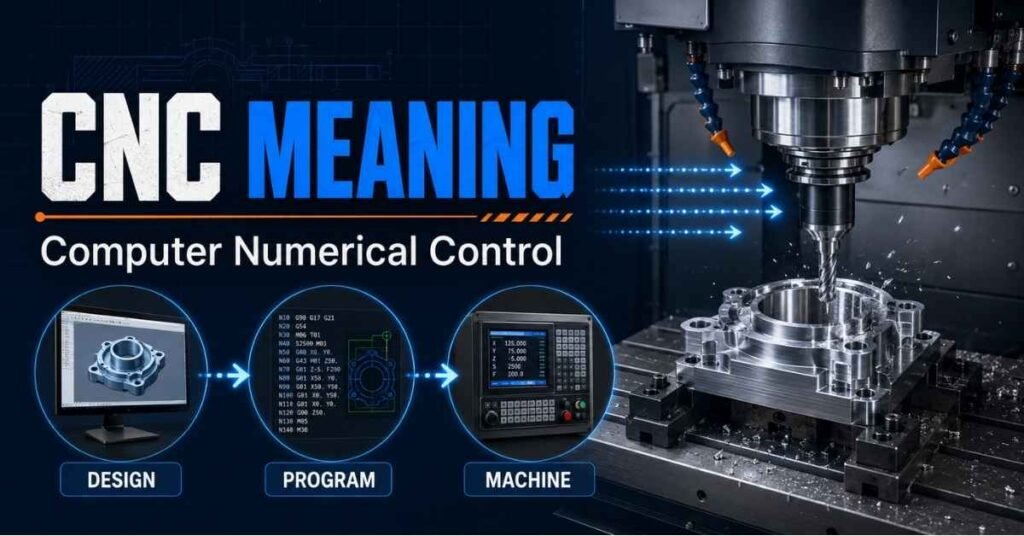
CNC meaning depends on where you see the abbreviation. In manufacturing, CNC stands for Computer Numerical Control, a system in which programmed computers direct machines that cut, drill, turn, mill, route, or shape materials. In dating profiles, social media posts, and adult conversations, CNC may instead mean consensual non-consent.
However, Computer Numerical Control remains the standard meaning in engineering, manufacturing, woodworking, job listings, and discussions involving machines.
What Does CNC Mean?
CNC stands for Computer Numerical Control. It describes a manufacturing method in which a computerized controller follows coded instructions to manage a machine’s movements and operations.
Rather than guiding a cutting tool entirely by hand, a machinist prepares a digital program that tells the machine:
- Where to move
- How fast to move
- How deep to cut
- When to change tools
- How quickly to rotate the spindle
- When to start or stop supporting functions
The machine then follows those instructions to create a physical part from metal, plastic, wood, foam, or another suitable material.
CNC Meanings by Context
Because CNC has several meanings, the surrounding conversation matters.
| Where you saw CNC | Most likely meaning |
|---|---|
| Manufacturing or engineering | Computer Numerical Control |
| Factory or machine shop | Computer Numerical Control |
| Mill, lathe, router, or laser discussion | Computer Numerical Control |
| CAD, CAM, or G-code discussion | Computer Numerical Control |
| Trade-school course or job listing | Computer Numerical Control |
| Dating profile or adult conversation | Possibly consensual non-consent |
| TikTok, Reddit, or an online joke | Depends on the surrounding language |
| Astronomy | Cnc may abbreviate the Cancer constellation |
| Message without context | Ask the writer what they mean |
If someone says, “We need a CNC operator,” they are almost certainly talking about manufacturing. If the term appears in an adult dating profile, it may have the secondary slang meaning.
Is CNC a Machine, Process, or Software?
CNC is technically a control method, not one specific machine or software program.
- A CNC machine is equipment that uses Computer Numerical Control.
- CNC machining is a production process performed with CNC-controlled equipment.
- CAD software is used to design a part.
- CAM software helps plan how the part will be manufactured.
- G-code contains instructions the controller can interpret.
People often use “CNC” casually to describe the machine itself. For example, a woodworker may say, “I cut this sign on my CNC,” meaning a CNC router.
CNC Meaning in Manufacturing
In manufacturing, Computer Numerical Control means using programmed digital instructions to control a machine tool.
Imagine that a company needs an aluminum mounting bracket. A designer creates a digital model showing the bracket’s size, holes, edges, and other features. A programmer then determines how a cutting tool should move through the aluminum. The CNC machine follows those instructions to remove material until the bracket reaches the required shape.
This process can be repeated to manufacture additional brackets with consistent dimensions.
What Does “Numerical Control” Mean?
The “numerical” part refers to representing machine movements and functions through programmed values and commands.
These instructions may define:
- Coordinates
- Cutting direction
- Travel distance
- Feed rate
- Spindle speed
- Tool number
- Cutting depth
- Coolant operation
- Program sequence
The machine uses a coordinate system to understand where the cutting tool and workpiece are located. In a basic three-axis machine:
- The X-axis usually represents side-to-side movement.
- The Y-axis usually represents front-to-back movement.
- The Z-axis usually represents up-and-down movement.
More advanced machines may add rotary axes, allowing the tool or workpiece to approach a component from different angles.
NC, CNC, and DNC
These related abbreviations describe different stages or forms of machine control:
- NC means Numerical Control. Early NC machines received instructions through methods such as punched tape.
- CNC means Computer Numerical Control. A computer controller stores, interprets, and executes the program.
- DNC may mean Direct or Distributed Numerical Control. It generally involves managing or transferring programs between a central computer and one or more machines.
Most modern manufacturing discussions use CNC.
How Does a CNC Machine Work?
A CNC machine does not turn a drawing into a finished part by itself. The complete process requires design, programming, setup, machining, and inspection.
Step 1: Create the Part in CAD
The process commonly begins with Computer-Aided Design, or CAD.
A designer uses CAD software to create:
- A two-dimensional drawing
- A three-dimensional model
- Dimensions
- Holes and threads
- Geometric features
- Material specifications
- Tolerance requirements
CAD defines what the finished part should look like. It does not automatically determine the best way to manufacture it.
Step 2: Plan the Process in CAM
The digital model is then opened in Computer-Aided Manufacturing, or CAM, software.
A programmer uses CAM to decide:
- Which machine will perform the work
- Which cutting tools are required
- How the raw material will be positioned
- Which features should be machined first
- How fast the tool should move
- How deep each cut should be
- How the tool will enter and leave the material
CAM software generates toolpaths, which are digital representations of the routes the cutting tool should follow.
The programmer can usually simulate those paths to identify potential collisions, missed material, inefficient movements, or other problems before the program reaches the machine.
Step 3: Generate Machine-Specific Code
A post-processor converts the CAM toolpaths into instructions suitable for a particular CNC controller.
This step matters because machines do not always interpret every command identically. A program created for one controller should not automatically be assumed safe or compatible with another.
The resulting program may contain:
- G-code movement instructions
- M-code machine functions
- Tool-change commands
- Spindle instructions
- Coolant commands
- Feed and speed values
- Work-coordinate references
NIST describes G-code as the long-established programming language used to communicate machining instructions between CAM systems and CNC machine tools. National Institute of Standards and Technology
Step 4: Set Up the Machine
A skilled operator or setup technician prepares the physical machine.
Setup may include:
- Confirming the correct drawing and program revision
- Selecting and installing cutting tools
- Securing the raw material
- Installing a vise, chuck, clamps, or custom fixture
- Setting work coordinates
- Measuring tool lengths
- Entering tool and work offsets
- Confirming feeds and spindle speeds
- Checking guards and interlocks
- Running a simulation, dry run, or controlled first-piece test
This is why CNC does not eliminate the need for skilled people. A correct program can still fail if the wrong tool is installed or the material is held incorrectly.
Step 5: The Controller Executes the Program
When the program is verified and the machine is ready, the controller directs the machine’s movements.
Depending on the equipment, the controller may operate:
- Linear and rotary axes
- Spindle rotation
- Cutting-tool position
- Automatic tool changes
- Coolant
- Probes
- Workpiece handling
- Other auxiliary functions
The machine follows the programmed toolpath to cut or shape the material.
Step 6: Inspect the Finished Part
The process is not complete when the machine stops.
The first finished component should be inspected against its drawing. Inspection may involve:
- Calipers
- Micrometers
- Height gauges
- Bore gauges
- Thread gauges
- Surface-finish equipment
- Optical measuring systems
- Coordinate-measuring machines
If a measurement is outside the required tolerance, the machinist may adjust an offset, replace a worn tool, correct the setup, or revise the program.
The complete process is:
CAD design → CAM toolpath → post-processing → machine setup → test run → machining → inspection → production
What Are G-Code and M-Code?
G-code and M-code are two important parts of CNC programming.
What Is G-Code?
G-code primarily controls machine movement and machining operations.
Depending on the controller, commands may tell the machine to:
- Move rapidly to a position
- Cut in a straight line
- Follow a circular path
- Drill a hole
- Pause temporarily
- Use an absolute or incremental coordinate
- Activate a machining cycle
G-code implementations can vary among controllers, machines, and manufacturers. Operators must follow the programming manual for the equipment they use.
What Is M-Code?
M-code generally controls miscellaneous machine functions.
These may include:
- Starting or stopping the spindle
- Activating or stopping coolant
- Requesting a tool change
- Pausing the program
- Ending the program
G-code typically handles movement, while M-code handles supporting machine actions. The precise functions depend on the controller.
Do CNC Operators Write Code Manually?
Some CNC programs are written or edited manually, especially for simple operations. More complex programs are commonly generated using CAM software.
Even when software generates the code, operators and programmers should understand what the important commands do. They need that knowledge to:
- Verify the program
- Correct errors
- Adjust cutting conditions
- Troubleshoot alarms
- Prevent collisions
- Improve cycle time
Using CAM software does not remove the need to understand machining.
Main Parts of a CNC System
Although designs differ, most CNC systems involve the following components.
Machine Controller
The controller is the computerized system that reads the part program and sends commands to the machine.
It manages movement, spindle functions, tools, offsets, alarms, and other operations.
Cutting Tool and Spindle
The cutting tool removes material from the workpiece. The spindle holds and rotates a tool or workpiece, depending on the machine.
On a CNC mill, the cutting tool normally rotates. On a lathe, the workpiece usually rotates while a tool removes material from it.
Machine Axes
Axes determine how the tool and workpiece move.
A three-axis mill generally moves along X, Y, and Z. A four- or five-axis machine adds rotary movement, enabling the tool to reach more sides and angles without repeatedly repositioning the component.
More axes do not automatically make every job better. Advanced machines can reduce setups and produce complex geometry, but they require appropriate programming, tooling, and operator skill.
Workholding and Fixtures
Workholding keeps the material secure while it is being machined.
Common workholding equipment includes:
- Vises
- Chucks
- Clamps
- Collets
- Vacuum tables
- Custom fixtures
Poor workholding can allow material to move, vibrate, or come loose. That can damage the part, cutting tool, or machine and create serious safety risks.
Motors and Feedback Systems
CNC machines commonly use stepper motors or servo motors to create controlled movement.
Some systems use feedback devices such as encoders to confirm axis position. This is part of the difference between open-loop and closed-loop control.
Commercial metalworking machines commonly use closed-loop systems because they require accurate position feedback and controlled movement.
Guards and Interlocks
CNC machines may contain fast-moving tools, rotating parts, sharp chips, coolant, dust, and material that could be ejected.
Guards and door interlocks help separate operators from these hazards. They should never be removed, defeated, or bypassed. OSHA requires appropriate machine guarding to protect employees from point-of-operation and related machinery hazards. OSHA
Common Types of CNC Machines
Different CNC machines are designed for different materials and operations.
| CNC machine | How it works | Common applications |
|---|---|---|
| CNC mill | A rotating tool removes material from a secured workpiece | Precision metal and plastic parts |
| CNC lathe | The workpiece rotates while tools cut it | Shafts, bushings, and round parts |
| CNC router | A rotating tool moves across sheet or block material | Wood, plastic, foam, and signs |
| CNC plasma cutter | A plasma arc cuts conductive metal | Sheet-metal profiles |
| CNC laser cutter | A focused laser cuts or engraves material | Detailed sheet cutting and engraving |
| CNC waterjet | High-pressure water and abrasive cut material | Thick or heat-sensitive material |
| CNC grinder | An abrasive wheel creates accurate surfaces | Finishing and precision dimensions |
CNC Milling Machines
A CNC milling machine uses rotating cutting tools to remove material from a secured workpiece.
Milling operations can create:
- Flat surfaces
- Slots
- Pockets
- Holes
- Threads
- Contours
- Complex three-dimensional surfaces
A vertical machining center has a vertically oriented spindle. A horizontal machining center positions the spindle horizontally and may offer advantages for chip removal, multiple-sided machining, or production work.
CNC Lathes and Turning Centers
A CNC lathe rotates the workpiece while a cutting tool moves against it.
Lathes are well suited for:
- Shafts
- Pins
- Bushings
- Threads
- Pulleys
- Round housings
- Cylindrical components
Advanced turning centers may include live tooling, additional axes, and milling capability.
CNC Routers
A CNC router is widely used for cutting, carving, drilling, and engraving materials such as:
- Wood
- Plywood
- MDF
- Plastic
- Foam
- Composites
- Some lighter metals
Routers are popular in cabinetmaking, furniture production, sign making, education, and small workshops.
A desktop or woodworking router is not automatically suitable for the same jobs as a rigid industrial metalworking mill. Machine rigidity, spindle power, tooling, and workholding all affect material capability.
CNC Plasma Cutters
A CNC plasma cutter uses an electrically conductive plasma arc to cut metal. It is commonly used for steel and other conductive sheet materials.
Plasma cutting can be fast and economical, but its edge quality, minimum detail, and heat effects differ from laser or waterjet cutting.
CNC Laser Cutters
A CNC laser cutter uses focused energy to cut or engrave material.
Laser systems are often selected for:
- Detailed profiles
- Thin sheet material
- Engraving
- Consistent repeated shapes
- Fast noncontact cutting
The appropriate material depends on the laser type and equipment specifications.
CNC Waterjet Machines
A waterjet uses high-pressure water, often mixed with abrasive material, to cut.
Because it creates little or no traditional heat-affected zone, it may be useful for materials that could be damaged or altered by high-temperature cutting.
Are 3D Printers CNC Machines?
In a broad technical sense, 3D printers use computer numerical control to manage programmed movement. However, traditional CNC machining and 3D printing use different production methods:
- CNC machining usually removes material.
- 3D printing usually adds material layer by layer.
Therefore, a 3D printer may use numerical control, but people do not normally mean a 3D printer when they refer to a CNC mill or CNC machining service.
What Materials Can CNC Machines Work With?
Material compatibility depends on the machine, cutting tools, workholding, rigidity, speed, power, and production method.
Metals
Common CNC-machined metals include:
- Aluminum
- Carbon steel
- Stainless steel
- Brass
- Copper
- Titanium
Each metal behaves differently. Aluminum is generally easier to machine than many titanium or hardened-steel alloys. The proper tool, cutting speed, coolant strategy, and machine capability must be selected accordingly.
Plastics
CNC machines can process plastics such as:
- ABS
- Acetal
- Nylon
- Acrylic
- Polycarbonate
- PEEK
Heat buildup may cause some plastics to melt, deform, or produce poor edges. Tool geometry and cutting conditions matter.
Wood and Engineered Panels
CNC routers commonly process:
- Hardwood
- Softwood
- Plywood
- MDF
- Laminated boards
Woodworking setups require effective material hold-down and appropriate dust collection.
Foam and Composites
Foam, fiberglass, carbon-fiber composites, and other specialized materials may also be machined. However, dust, fibers, fumes, tool wear, and health risks require material-specific controls.
What Is CNC Used For?
CNC technology is used wherever manufacturers need controlled movement, repeatable production, complex geometry, or digitally defined parts.
Aerospace
CNC equipment manufactures:
- Structural components
- Engine parts
- Brackets
- Housings
- Complex lightweight components
Aerospace production may require strict material traceability, inspection, documentation, and quality systems. A CNC machine alone does not guarantee aerospace-grade results.
Automotive and Transportation
Applications include:
- Engine components
- Transmission parts
- Brackets
- Molds
- Prototype components
- Performance parts
- Production fixtures
Medical Manufacturing
CNC processes can produce surgical instruments, device components, prosthetic parts, and specialized fixtures.
Medical manufacturing may require validated processes, controlled materials, traceability, cleanliness, and extensive inspection.
Electronics and Robotics
Common examples include:
- Aluminum enclosures
- Heat sinks
- Mounting plates
- Robot frames
- Sensor brackets
- Prototype assemblies
Woodworking, Furniture, and Signs
CNC routers can create:
- Cabinet panels
- Furniture components
- Decorative patterns
- Lettering
- Store signs
- Repeated joints
- Custom engravings
Prototypes and Small Production Runs
CNC machining can be useful for prototypes because it produces parts from functional materials without requiring an expensive production mold.
It is also suitable for small and medium production quantities when accuracy, material properties, and repeatability are important.
Advantages of CNC Machining
CNC offers meaningful benefits, but those advantages depend on good programming, setup, equipment, and inspection.
Repeatable Production
Once a process is stable, a CNC machine can repeat programmed movements consistently.
Repeatability still depends on:
- Tool condition
- Machine calibration
- Workholding
- Material variation
- Temperature
- Maintenance
- Measurement
- Process control
No responsible manufacturer should promise “perfect” or “flawless” repeatability without defining the actual requirements.
Complex Geometry
CNC machines can produce shapes that would be difficult, slow, or impractical to create manually.
Multi-axis equipment can reach complex angles and machine several sides of a component with fewer setups.
Faster Production After Setup
CNC can reduce production time when manufacturing multiple identical parts. However, programming, tooling, fixture preparation, and first-piece inspection may require substantial time before production begins.
Digital Reuse
A verified CNC program can be stored and reused for future orders. Digital processes also support:
- Revision control
- Repeat jobs
- Documented operations
- Easier design changes
- Standardized production
Reduced Manual Tool Control
Automation reduces the need to guide every cutting movement by hand. However, people remain responsible for design, setup, monitoring, inspection, maintenance, and safety.
CNC Limitations and Hidden Costs
CNC is not automatically the best or cheapest method for every component.
Equipment and Setup Costs
Costs may include:
- Machine purchase
- Tooling
- Fixtures
- CAD/CAM software
- Training
- Inspection equipment
- Maintenance
- Power
- Coolant
- Material
- Floor space
- Safety controls
Even when outsourcing, the customer pays indirectly for programming, setup, machine time, tooling, inspection, and overhead.
Programming Does Not Eliminate Mistakes
A CNC machine follows instructions. It does not automatically know whether those instructions are correct.
Errors may result from:
- An inaccurate drawing
- A poor toolpath
- Incorrect coordinates
- The wrong material
- An incorrect tool
- Weak workholding
- A bad offset
- Excessive cutting force
- Tool wear
- Inadequate inspection
CNC Is Not Always the Fastest Option
For a simple one-off repair, an experienced machinist may complete the work manually before a CNC program and setup could be prepared.
CNC becomes particularly valuable when a job involves:
- Multiple identical parts
- Complex geometry
- Repeat orders
- Documented processes
- Tight dimensional requirements
Machine Capacity Creates Limits
A machine’s capabilities depend on:
- Work area
- Axis travel
- Part weight
- Spindle speed and power
- Rigidity
- Tool access
- Number of axes
- Controller features
- Material suitability
A large or complex part may require multiple setups or a different machine.
Accuracy and Repeatability Are Different
Accuracy describes how closely a finished dimension matches the required value.
Repeatability describes how consistently a machine produces the same result.
A machine can be repeatable but consistently wrong if its offset, setup, or calibration is incorrect.
CNC Machining Versus Other Methods
CNC Versus Manual Machining
| CNC machining | Manual machining |
|---|---|
| Computer-controlled movement | Machinist controls movement directly |
| Strong for repeat production | Practical for some one-off jobs |
| Requires programming and setup | Relies heavily on manual skill |
| Reuses verified programs | Allows immediate manual adjustment |
| Produces complex programmed paths | Useful for repairs and simple operations |
Neither method is universally superior. The better choice depends on geometry, quantity, tolerance, schedule, and available skills.
CNC Machining Versus 3D Printing
| CNC machining | 3D printing |
|---|---|
| Usually removes material | Adds material layer by layer |
| Creates chips or waste material | Uses material only where deposited |
| Works with many production-grade materials | Material choice depends on printing technology |
| Strong surface finish may be possible | Layer lines may require finishing |
| Tool access limits some internal features | Can create complex internal geometry |
| Requires workholding and cutting tools | Requires build preparation and supports |
CNC Machining Versus Injection Molding
Injection molding normally requires dedicated tooling, making its initial cost relatively high. Once the mold is ready, it can become economical for large quantities.
CNC machining requires less dedicated tooling and can be attractive for prototypes, customized parts, and smaller production runs.
CNC Machining Versus Laser Cutting
Laser cutting is highly effective for profiles in suitable sheet materials. CNC milling can create pockets, holes, three-dimensional contours, and other features that extend beyond cutting a flat outline.
Does a CNC Machine Work Without a Person?
A CNC machine can perform programmed movements automatically, but the complete process still requires human knowledge and oversight.
CNC Operator
An operator may:
- Load and unload parts
- Start verified programs
- Monitor production
- Inspect components
- Replace tools
- Respond to alarms
- Record production information
CNC Setup Technician
A setup technician may:
- Install tools
- Prepare fixtures
- Set coordinates and offsets
- Confirm workholding
- Run the first part
- Adjust the process
CNC Programmer
A programmer may:
- Study the engineering drawing
- Select operations
- Create toolpaths
- Generate or edit code
- Simulate the process
- Reduce machining time
- Prevent tool and fixture collisions
CNC Machinist
The term CNC machinist may describe someone who performs several of these responsibilities. Job titles vary between companies. In a small shop, one person may program, set up, operate, and inspect the machine.
Quality Inspector
A quality inspector verifies that finished parts meet drawing requirements.
The inspector may use precision measuring equipment, document results, and identify changes that suggest tool wear or process drift.
Is CNC Difficult to Learn?
CNC requires technical knowledge, but beginners can learn it in stages.
A sensible learning sequence is:
- Machine safety
- Engineering drawings
- Measurement tools
- Coordinate systems
- Machine axes
- Cutting tools
- Materials
- Speeds and feeds
- Workholding
- G-code fundamentals
- CAD and CAM
- Setup and offsets
- Part inspection
Do You Need Advanced Math?
CNC work commonly requires:
- Basic arithmetic
- Decimals
- Fractions
- Geometry
- Coordinates
- Angles
- Unit conversion
Advanced mathematics may be useful in specialized programming or engineering roles, but not every entry-level operator needs advanced calculus.
Does CNC Require Coding?
CNC programming involves coded machine instructions, but it is different from developing websites or mobile applications.
CAM software generates much of the code used for complex parts. However, understanding the program remains valuable for verifying movement, correcting errors, and troubleshooting.
Common Beginner Mistakes
New CNC users may:
- Confuse machine zero with work zero
- Set the wrong offset
- Install the wrong tool
- Select an unsuitable feed or speed
- Clamp the material poorly
- Skip program simulation
- Ignore tool wear
- Fail to inspect the first part
- Assume automation prevents crashes
Good training teaches beginners to verify the process rather than trust it blindly.
CNC Machine Safety
CNC equipment can cause serious injuries. General information cannot replace employer training, the machine manufacturer’s instructions, or applicable workplace procedures.
Important principles include:
- Complete the required training.
- Use guards and interlocks.
- Secure the workpiece and tools.
- Control loose clothing, hair, and jewelry.
- Wear appropriate eye and hearing protection.
- Never reach into an operating machine.
- Stop equipment before clearing chips.
- Follow lockout procedures during maintenance.
- Never bypass a safety device.
- Know how to use the emergency stop.
Why Do CNC Machines Crash?
A CNC crash occurs when a tool or machine component collides with the workpiece, fixture, table, or another machine component.
Possible causes include:
- Incorrect coordinates
- Wrong offsets
- Programming errors
- Tool interference
- Improper setup
- Fixture collisions
- Incorrect tool data
- Inadequate program verification
Even a fully automated machine can perform a dangerous movement if the instructions or setup are wrong.
How Much Does CNC Machining Cost?
There is no universal CNC machining price. Cost depends on the part and production requirements.
Factors That Affect a CNC Quote
- Material
- Part dimensions
- Geometry
- Quantity
- Tolerances
- Surface finish
- Number of setups
- Machine type
- Programming time
- Tooling
- Cycle time
- Inspection
- Finishing
- Delivery schedule
Why One Part Costs More Per Unit
A supplier must prepare the program, tools, fixtures, setup, and first-piece inspection even if the customer orders only one part.
When the customer orders 100 identical components, those initial costs are spread across more units. The unit price may therefore decrease even though the total price increases.
What to Send With a Quote Request
Prepare:
- A CAD file
- A dimensioned drawing
- Material specification
- Required quantity
- Critical tolerances
- Surface-finish requirements
- Thread details
- Coating or finishing needs
- Inspection requirements
- Delivery date
How to Choose a CNC Machining Supplier
Look for:
- Suitable machine capacity
- Experience with your material
- Relevant quality certifications
- Inspection equipment
- Clear communication
- Real project examples
- Transparent lead times
- Design-for-manufacturing feedback
- Revision control
- Traceability where required
Do not choose solely on the lowest price if the component has critical quality, safety, or delivery requirements.
What Does CNC Mean in Text or Slang?
In adult dating, relationship, BDSM, or social-media discussions, CNC may mean consensual non-consent.
At a high level, this refers to an adult, pre-agreed role-play or power-exchange concept intended to appear nonconsensual while being based on voluntary agreement.
This meaning depends on:
- Prior communication
- Clearly established boundaries
- Voluntary participation
- Trust
- Ongoing consent
- The ability to stop
Choosing Therapy emphasizes that this adult practice is planned and consensually agreed upon, while assault is not consensual. Choosing Therapy
LEARN MORE: Calliope Meaning
What Does CNC Mean in a Dating Profile?
If CNC appears in an adult dating profile, it may refer to consensual non-consent rather than manufacturing.
Do not assume. Instead:
- Read the surrounding profile language.
- Ask the person respectfully what CNC means to them.
- Do not agree to something you do not understand.
- Be clear about your boundaries.
- Step away if you feel pressured or unsafe.
Consent Can Be Withdrawn
Prior discussion does not give someone unlimited permission to ignore another person’s current wishes.
Consent must remain voluntary and ongoing. Pressure, threats, fear, manipulation, or an inability to stop are incompatible with genuine consent.
If someone is using the term to pressure or frighten you, prioritize your safety and seek help from someone you trust or an appropriate support service.
Other Meanings of CNC
CNC can occasionally refer to other organizations, programs, or abbreviations:
| Meaning | Context |
|---|---|
| Cnc | Cancer constellation abbreviation |
| City Nature Challenge | Community biodiversity event |
| College of New Caledonia | Canadian education |
| Configurable Network Computing | Enterprise software |
| Civil Nuclear Constabulary | United Kingdom police organization |
| Cadet Nurse Corps | U.S. historical program |
These meanings are uncommon in general searches unless the surrounding topic points to them.
Frequently Asked Questions About CNC
What does CNC stand for?
In manufacturing, CNC stands for Computer Numerical Control.
What is CNC in simple words?
CNC is a system that lets a programmed computer control how a machine moves, cuts, drills, or shapes material.
What is a CNC machine?
A CNC machine is equipment that follows programmed instructions to manufacture or process physical materials.
Is CNC a machine or a process?
CNC is a control method. A CNC machine uses that method, while CNC machining is a production process performed with CNC-controlled equipment.
What is CNC machining used for?
It is used to produce metal, plastic, wood, foam, and composite components for industries such as aerospace, automotive, medical manufacturing, electronics, furniture, and robotics.
What are the most common CNC machines?
Common types include CNC mills, lathes, routers, plasma cutters, laser cutters, waterjets, and grinders.
Does every CNC machine use identical G-code?
No. Although many machines use G-code, commands, formats, and supported functions may differ between controllers and manufacturers.
What is the difference between CAD, CAM, and CNC?
CAD designs the part. CAM plans how to manufacture it. CNC controls the machine that performs the programmed operations.
Is CNC the same as 3D printing?
No. Traditional CNC machining removes material, while 3D printing usually adds material in layers.
Does a CNC machine require an operator?
Yes. People are needed to program, set up, monitor, maintain, troubleshoot, and inspect CNC production.
Is CNC difficult to learn?
It has a learning curve, but beginners can progress through safety, drawings, measurement, coordinates, tools, setup, programming, and inspection.
Does CNC require coding?
CNC uses coded instructions. CAM software can generate much of the program, but understanding the code remains useful.
Is CNC dangerous?
CNC machinery can be dangerous without proper training, guarding, workholding, and operating procedures.
Is CNC always more accurate than manual machining?
No. Results depend on the machine, setup, tooling, programming, material, maintenance, and inspection. A skilled manual machinist may outperform a poorly prepared CNC process.
What does CNC mean on TikTok or Reddit?
It may refer to Computer Numerical Control or consensual non-consent. The surrounding topic determines the likely meaning.
How can you determine which CNC definition applies?
Look for contextual clues. Machines, tools, factories, CAD, or jobs point to Computer Numerical Control. Adult dating or BDSM language may point to consensual non-consent. If the context remains unclear, ask.
The Meaning of CNC in One Sentence
CNC usually means Computer Numerical Control—a manufacturing system in which programmed computers direct machine movements to create physical parts. CNC machines can improve repeatability, efficiency, and geometric capability, but skilled people remain responsible for design, programming, setup, safety, and inspection.
In adult dating or slang contexts, CNC may have a separate consent-related meaning, so always use the surrounding conversation to identify the correct definition.

1 thought on “CNC Meaning: What It Stands For and How CNC Machines Work”