

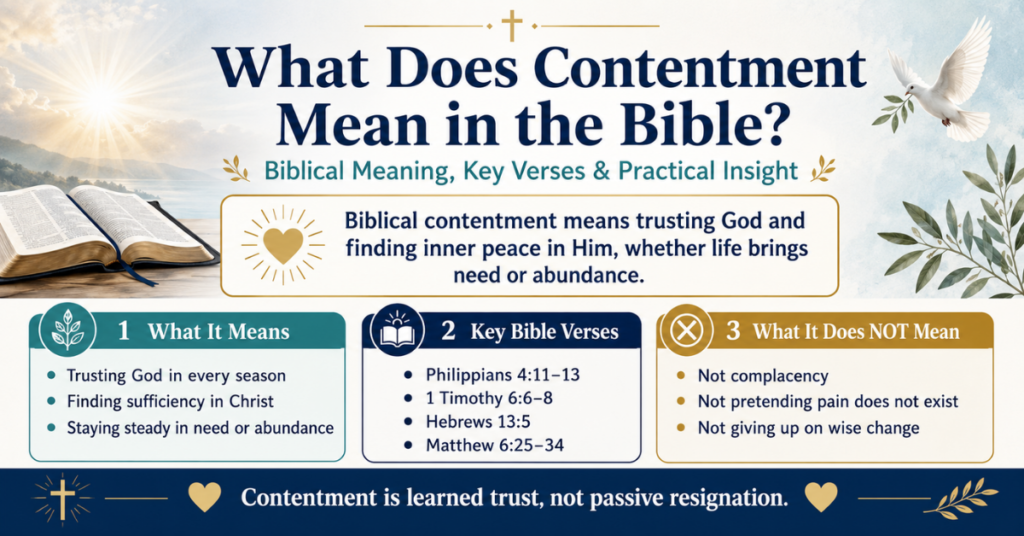
What does contentment mean in the Bible? Biblical contentment is a learned inner sufficiency rooted in trust in God, not in money, relationships, success, comfort, or perfect circumstances. It means being spiritually steady in both need and abundance, believing that God’s presence and faithfulness are enough while still taking responsible action to improve what can be changed. In Philippians 4:11–13, the apostle Paul makes it clear that contentment is something he learned, not something that came naturally.
That distinction matters.
Biblical contentment does not mean pretending everything is fine when it is not. It does not mean abandoning goals, staying in a harmful situation, suppressing grief, or convincing yourself that you should never want anything more.
You can want a better job and still be content.
You can pray for marriage and still be content.
The You can work to improve your finances and still trust God today.
You can grieve deeply and still possess a quieter confidence underneath the pain.
The Bible presents Christian contentment as the ability to live faithfully without making changed circumstances the condition for your peace.
What Does Contentment Mean in the Bible?
At its simplest, biblical contentment means having a settled confidence that your deepest security does not depend on getting more, achieving more, or controlling every outcome.
Many definitions reduce contentment to:
“Being happy with what you have.”
That is partly true, but it is too shallow for the biblical idea.
A person can have very little and still be content. Another person can possess great wealth and remain constantly dissatisfied.
That tells us contentment is not primarily about quantity.
It is about sufficiency.
Biblical contentment asks:
What am I depending on to make me feel secure, valuable, satisfied, and at peace?
If your answer is always:
- more money
- a better relationship
- more recognition
- a larger home
- a higher income
- a different body
- a better career
- more followers
- greater success
then “enough” will probably keep moving.
The Bible instead connects contentment with trust, gratitude, godliness, God’s presence, freedom from greed, peace, and dependence on Christ.
Three Parts of Biblical Contentment
A helpful way to understand the meaning of contentment in Scripture is through three ideas.
Trust: You believe God’s character remains trustworthy even when life does not unfold the way you hoped.
Sufficiency: You stop asking created things to give you the ultimate security and identity they cannot carry.
Stability: Your circumstances can change dramatically without completely determining your spiritual condition.
That does not make Christians emotionally indifferent. It makes their deepest foundation less dependent on external conditions.
Why Paul Said He Had to Learn Contentment
The clearest biblical example of contentment appears in Philippians 4:11–13.
Paul explains that he had experienced both plenty and need, both abundance and hunger. His conclusion is especially important:
He had learned to be content.
That single word—learned—changes how we should think about contentment.
Contentment Is a Learned Spiritual Skill
Many people feel guilty because they think mature Christians should naturally feel satisfied all the time.
Paul’s language suggests otherwise.
Contentment develops.
It can be learned through:
- seasons of waiting
- unexpected loss
- answered prayers
- unanswered prayers
- financial pressure
- success
- disappointment
- dependence
- generosity
- suffering
- God’s provision
You may know intellectually that God is faithful and still struggle emotionally when something important is missing.
That does not make the process meaningless.
It may actually be where contentment is being learned.
Contentment in Both Need and Abundance
An important detail in Philippians 4 is often missed.
Paul does not only say he learned to survive hardship.
He also learned how to live in abundance.
We often imagine that contentment is mainly a lesson for people who have less.
The Bible presents prosperity as a test too.
When life is going well, a person may become dependent on:
- comfort
- income
- status
- convenience
- praise
- possessions
- control
That is why true contentment must survive both:
“I don’t have enough”
and
“I have more than enough.”
What Does Philippians 4:13 Mean in the Context of Contentment?
Philippians 4:13 is one of the most quoted Bible verses:
“I can do all things through Christ…”
But the surrounding verses matter.
Paul has just described knowing how to live with:
- hunger
- plenty
- need
- abundance
So the verse is not primarily a promise that Christians can accomplish any ambition they imagine.
Its immediate context is endurance and faithful living through changing circumstances.
The relationship is:
changing circumstances → learned contentment → strength through Christ
Paul’s confidence is not:
“I can achieve anything I want.”
It is closer to:
Christ gives me strength to remain faithful whether I have much or little.
That makes Philippians 4:13 one of the most important passages for understanding true contentment in Christianity.
The Biblical Word Behind Contentment
The Bible’s vocabulary adds another layer to the meaning.
Autarkēs in Philippians 4:11
The Greek word associated with Paul’s statement in Philippians 4:11 is autarkēs.
It carries the idea of being sufficient, content, or having enough.
In the wider Greco-Roman world, similar language could be associated with self-sufficiency.
But Paul’s explanation changes the center of that sufficiency.
His point is not:
“I need nobody.”
His point is:
“My circumstances do not control my deepest stability because Christ strengthens me.”
That is a major difference between Christian contentment and purely philosophical self-sufficiency.
Autarkeia in 1 Timothy 6
A related Greek noun, autarkeia, appears in the discussion of godliness with contentment.
The idea again involves sufficiency.
But 1 Timothy connects that sufficiency directly with:
- godliness
- money
- possessions
- greed
- the temporary nature of material wealth
This creates a powerful biblical relationship:
Contentment changes what you consider true gain.
Key Bible Verses About Contentment
Several passages work together to create a fuller biblical theology of contentment.
| Bible Passage | Main Theme | What It Teaches |
|---|---|---|
| Philippians 4:11–13 | Plenty and need | Contentment is learned through Christ |
| 1 Timothy 6:6–10 | Money and godliness | Material wealth cannot define true gain |
| Hebrews 13:5–6 | God’s presence | Security is deeper than possessions |
| Matthew 6:25–34 | Worry and provision | Trust God rather than living under constant anxiety |
| Luke 12:15 | Possessions | Life is more than what you own |
| Proverbs 30:8–9 | Poverty and riches | Both lack and abundance carry spiritual dangers |
| Psalm 131:2 | Inner quiet | Contentment can look like a settled soul |
| Ecclesiastes 5:10 | Wealth | Loving money creates an appetite that is difficult to satisfy |
These Bible verses about contentment do not all say exactly the same thing.
Together, however, they create a coherent pattern:
God’s presence → trust → sufficiency → less greed → less anxiety → greater peace → greater generosity
What Does “Godliness With Contentment Is Great Gain” Mean?
1 Timothy 6:6 connects two concepts:
godliness and contentment.
This challenges the normal cultural definition of gain.
The world often measures gain through:
- income
- property
- influence
- career growth
- status
- luxury
- visibility
Scripture asks a different question:
What if becoming spiritually grounded and less controlled by possessions is itself a form of wealth?
That does not make money evil.
The passage is warning against treating wealth as the source of ultimate security.
A person may have a high income and still be deeply discontented.
Another may have modest resources and possess a remarkable degree of peace.
The Bible’s point is not that poverty automatically makes someone holy.
It is that possessions cannot guarantee contentment.
What Does Hebrews 13:5 Teach About Contentment?
Hebrews connects contentment with two things:
freedom from the love of money and confidence in God’s presence.
That relationship is important.
Why does the passage move from money to God’s promise not to abandon His people?
Because one of the deepest reasons people cling to money is security.
Money can genuinely provide:
- food
- housing
- transportation
- medical care
- education
- stability
Those are real benefits.
But money cannot guarantee:
- permanent control
- freedom from loss
- identity
- lasting peace
- immortality
- God’s presence
Biblical contentment does not require pretending money is unimportant.
It requires refusing to make money ultimate.
Contentment Is Not the Same as Complacency
This may be the most important misunderstanding to correct.
Contentment and complacency are not the same thing.
| Biblical Contentment | Complacency |
|---|---|
| Accepts present reality honestly | Avoids necessary change |
| Trusts God while acting responsibly | Uses “acceptance” as an excuse |
| Can pursue growth | Resists growth |
| Produces peace | Can produce stagnation |
| Allows healthy goals | Often avoids difficult effort |
| Does not depend on outcomes | May refuse responsibility |
Can You Want a Better Life and Still Be Content?
Yes.
Biblical contentment does not prohibit improvement.
You can:
- apply for a better job
- start a business
- pursue education
- save money
- move somewhere safer
- seek marriage
- improve your health
- work toward a promotion
- build a better future for your family
while remaining content.
The deeper question is:
Do you believe you must obtain that outcome before your life can have meaning, peace, or worth?
Contentment says:
“I can pursue this sincerely without making it my god.”
Can Christians Be Ambitious and Content?
Yes—if the ambition remains rightly ordered.
There is a major difference between healthy ambition and discontent-driven ambition.
Healthy ambition says:
“I want to grow, serve better, and use my abilities responsibly.”
Discontent-driven ambition says:
“Unless I reach this level, I am not enough.”
Healthy ambition can work hard and still rest.
Discontent-driven ambition keeps moving the finish line.
You reach one goal.
Then another appears.
You earn more.
Then your definition of “enough” increases.
You gain recognition.
Then someone more successful becomes your new comparison point.
The problem is not always the goal.
Sometimes it is the burden you have placed on the goal.
Can You Be Content and Still Be Sad?
Yes.
Contentment is not identical to happiness.
Happiness often rises and falls with circumstances.
Biblical contentment can coexist with:
- grief
- disappointment
- loneliness
- frustration
- uncertainty
- sadness
A person who loses someone they love does not become more spiritually mature by pretending the loss does not hurt.
The A person waiting for a prayer to be answered does not need to deny disappointment.
A person facing illness does not have to describe suffering as enjoyable.
Biblical Contentment Is Not Toxic Positivity
Toxic positivity tells people:
“Just focus on the good.”
Biblical faith has room for lament.
The Psalms repeatedly show people bringing:
- fear
- confusion
- anger
- sorrow
- disappointment
to God.
Contentment does not mean saying:
“Nothing hurts.”
It means pain does not have to become proof that God has abandoned you.
That is a much deeper form of spiritual stability.
Does Contentment Mean Accepting Bad or Unsafe Circumstances?
No.
This distinction matters greatly.
Biblical contentment does not require remaining in:
- abuse
- exploitation
- violence
- dangerous living conditions
- serious neglect
- preventable medical danger
- unjust treatment
You can seek safety and still trust God.
You can establish boundaries and still be content.
The You can report wrongdoing.
You can seek medical care.
You can ask for professional help.
The You can leave an unsafe environment.
You can pursue justice.
Acceptance Is Not Resignation
Acceptance means seeing the current reality truthfully.
Resignation means believing nothing should or can be changed.
Contentment means remaining spiritually grounded while taking wise action where action is appropriate.
That is why contentment should never be used as a religious excuse to keep someone trapped.
Is Discontentment a Sin?
This question needs more nuance than a simple yes or no.
Not every uncomfortable desire is sinful discontentment.
Legitimate Desires Are Not Automatically Wrong
It is normal to desire:
- food when hungry
- safety when threatened
- companionship
- meaningful work
- financial stability
- justice
- healing
- family
- progress
The Bible itself contains prayers asking God to change circumstances.
So the issue is not merely:
“Do I want something?”
The deeper question is:
“What role has this desire taken in my heart?”
When Desire Becomes Disordered
Ask yourself:
- Do I believe I cannot have peace until I get this?
- Do I resent people who already have it?
- Am I willing to compromise my values to obtain it?
- Would losing it destroy my entire sense of worth?
- Have I stopped noticing anything good because this one desire remains unmet?
Those questions help distinguish normal longing from deeper discontentment, envy, greed, or misplaced identity.
Desire, Lament, Envy, and Discontentment Are Different
| Experience | What It Says |
|---|---|
| Desire | “I would genuinely like this.” |
| Lament | “This hurts, and I bring that pain to God.” |
| Envy | “I resent that someone else has what I want.” |
| Discontentment | “I cannot be okay unless my circumstances change.” |
These categories can overlap, but separating them helps prevent unnecessary guilt.
Why Money and Contentment Are Closely Connected in the Bible
Money repeatedly appears in biblical discussions of contentment because it is closely tied to our sense of security, freedom, status, and control.
That makes it spiritually powerful.
More Money Does Not Automatically Create “Enough”
One problem with material satisfaction is that expectations adjust.
You receive a raise.
Soon, that income feels normal.
You upgrade your home.
Then another neighborhood begins to look attractive.
You buy a better car.
Eventually, you stop noticing it.
Psychologically, “enough” can become a moving target.
That is why someone earning substantially more than before can still feel financially dissatisfied.
Contentment During Financial Hardship
This is where Christian writing must be careful.
If someone is struggling to pay rent, buy groceries, or deal with debt, simply saying:
“Be content.”
can sound cruel.
Biblical contentment does not mean:
- ignoring bills
- refusing help
- avoiding budgeting
- accepting unemployment forever
- refusing to seek higher income
Responsible action may include:
- creating a budget
- reducing unnecessary expenses
- applying for assistance
- finding additional income
- improving skills
- negotiating pay
- seeking financial counsel
Contentment affects how you carry the pressure, not whether you take action.
Contentment During Prosperity
Abundance creates different dangers.
A person with plenty may struggle with:
- lifestyle inflation
- entitlement
- pride
- fear of losing wealth
- status comparison
- attachment to comfort
- decreased generosity
That is why Paul’s ability to live in abundance is just as significant as his ability to endure need.
Why Comparison Makes Contentment So Difficult
Modern comparison is relentless.
Social media exposes us continuously to other people’s:
- homes
- relationships
- careers
- vacations
- bodies
- businesses
- achievements
- purchases
The problem is that we usually compare our ordinary life with someone else’s selected moments.
That comparison can quietly turn gratitude into perceived scarcity.
You stop thinking:
“I have something good.”
and begin thinking:
“Why don’t I have what they have?”
The Psychology of “Enough”
Comparison constantly resets the standard.
A person may once have dreamed of earning $50,000.
After reaching it, $80,000 becomes the new target.
Then $100,000.
The problem is not necessarily higher income.
The problem begins when each achievement briefly satisfies you before becoming psychologically invisible.
Biblical contentment interrupts that cycle by asking:
Can I recognize what is good today without losing the ability to grow tomorrow?
A Three-Question Comparison Reset
When comparison begins to create dissatisfaction, ask:
- What exactly am I comparing?
- What assumptions am I making about the other person’s life?
- What has actually been entrusted to me today?
That final question brings your attention back to stewardship rather than envy.
What Biblical Contentment Looks Like in Real Life
Abstract definitions become more useful when applied to ordinary situations.
When You Hate Your Job
Contentment does not mean convincing yourself that a bad job is wonderful.
You can:
- improve your resume
- learn new skills
- apply elsewhere
- build professional relationships
- ask for better conditions
and still practice contentment today.
The goal is:
responsible action without letting career dissatisfaction define your worth.
When You’re Single but Want Marriage
Wanting marriage is not automatically discontentment.
You can honestly desire companionship while refusing to believe:
“My life cannot be meaningful unless I marry.”
Biblical contentment allows desire without requiring the desire to become identity.
When Money Is Tight
You may need practical change.
Contentment means you can work toward better finances without letting your bank balance become the final measurement of your value.
When Someone Else Is Ahead of You
Another person’s success is not evidence of your failure.
Their:
- promotion
- marriage
- business growth
- home
- income
- opportunity
does not automatically tell you what should have happened in your own life.
Contentment creates room to celebrate someone else without interpreting their progress as a verdict on you.
When a Prayer Remains Unanswered
Waiting is one of the hardest places to practice spiritual contentment.
You may still pray for change.
The You may still hope.
You may still feel disappointed.
Contentment simply refuses to make God’s trustworthiness depend entirely on receiving the answer you prefer.
When Life Is Going Extremely Well
Prosperity requires contentment too.
Ask:
Could I remain spiritually grounded if some of this disappeared?
That question exposes whether blessing has quietly become dependence.
How to Practice Biblical Contentment
“Trust God and be grateful” is true advice, but it often feels too vague.
A more practical approach is to work through six steps.
1. Notice What Is Creating Discontentment
Start with one specific area.
Not:
“My whole life is wrong.”
Instead:
“I feel dissatisfied every time I see friends buying homes.”
Or:
“I feel behind because I’m still single.”
Specificity makes the problem easier to understand.
2. Name What You Think the Missing Thing Will Give You
Ask:
What do I believe this thing will provide emotionally?
Examples:
Money → security
Marriage → belonging
Promotion → significance
Followers → validation
New home → status
Success → worth
Often, we are not merely chasing the thing itself.
We are chasing what we believe it will make us feel.
3. Test the Desire
Ask:
Is this a good desire, or am I asking it to carry the weight of my identity?
There is nothing wrong with wanting financial stability.
But money becomes spiritually dangerous when it must prove that you are safe.
There is nothing wrong with wanting marriage.
But marriage becomes too heavy a burden when it must prove that you are lovable.
4. Practice Specific Gratitude
Do not stop at:
“I should be grateful.”
Make gratitude concrete.
Instead write:
- I had enough food today.
- A friend called when I needed encouragement.
- I completed work that mattered.
- I have somewhere safe to sleep.
- I received an opportunity I did not have last year.
Specific gratitude is stronger than vague positivity because it directs attention toward actual provision.
5. Take Responsible Action
Biblical contentment is not passive.
If something can and should change, act.
- Submit the application.
- Create the budget.
- Ask for help.
- Schedule the appointment.
- Have the difficult conversation.
- Build the skill.
- Make the plan.
Contentment does not remove action.
It removes the belief that your peace must wait until the action succeeds.
6. Release the Outcome
This may be the hardest step.
You can work hard while acknowledging:
“I do not control every result.”
Contentment allows you to say:
“I will pursue what is wise without requiring this outcome to determine whether my life has meaning.”
A 7-Day Biblical Contentment Practice
If you want to learn contentment practically, try this simple one-week exercise.
Day 1: Identify Your Main Source of Discontent
Write one sentence:
“Right now, I believe I would be happier if…”
Finish it honestly.
Day 2: Read Philippians 4:10–13 in Context
Do not read verse 13 alone.
Notice:
- what Paul had experienced
- what he had learned
- where his strength came from
Day 3: Separate Needs From Desires
Create three categories:
Needs
Good desires
Things I have begun treating as necessities for happiness
This exercise can reveal where good desires have become emotionally oversized.
Day 4: List Five Specific Provisions
Avoid generic gratitude.
Write five actual things you received, experienced, or were able to do that day.
Day 5: Remove One Comparison Trigger
You might:
- mute an account
- reduce shopping emails
- stop checking someone’s progress
- spend less time scrolling
- avoid content that repeatedly produces envy
Day 6: Take One Responsible Action
Choose one situation you can improve and take a concrete step.
Day 7: Practice Release
Complete this sentence:
“I would genuinely like __, but I do not need __ to determine my worth, identity, or faithfulness today.”
Signs You Are Growing in Contentment
Contentment is not always a dramatic emotional transformation.
Sometimes growth appears quietly.
You may notice that:
- you compare yourself less often
- another person’s success bothers you less
- setbacks disappoint you without completely destroying your peace
- gratitude becomes more natural and specific
- your goals remain important but less controlling
- money has less influence over your identity
- you become more generous
- waiting becomes slightly easier
- you stop interpreting every delay as failure
- you can say “I want this” without saying “I need this to be okay”
These are meaningful signs of spiritual maturity.
How Contentment, Gratitude, Peace, and Joy Work Together
These concepts overlap, but they are not identical.
Gratitude
Gratitude recognizes what has already been received.
Contentment
Contentment refuses to make changed circumstances the prerequisite for peace.
Peace
Peace is the inner steadiness that can grow when trust replaces constant control.
Joy
Joy can exist beneath difficult emotions because it is not based only on immediate comfort.
Generosity
Contentment can also make generosity easier.
Why?
Because generosity becomes difficult when you constantly feel:
“I never have enough.”
When “enough” becomes less dependent on endless accumulation, giving feels less threatening.
A useful semantic relationship is:
Trust → gratitude → contentment → peace → generosity
Real spiritual growth, however, is rarely perfectly linear.
Common Misunderstandings About Biblical Contentment
“Contentment Means I Shouldn’t Have Goals”
False.
You can pursue goals without making them the foundation of your identity.
“Content Christians Never Feel Disappointed”
False.
Disappointment is an emotion. Contentment is deeper than emotional comfort.
“If I’m Struggling Financially, I Should Just Accept It”
False.
Contentment does not prohibit seeking better income, assistance, employment, or financial stability.
“Wanting More Money Automatically Means I’m Greedy”
False.
Wanting to provide for your family or improve financial stability is not automatically greed.
Greed is more closely connected to an uncontrolled desire for more and the belief that possessions will finally make you secure.
“Contentment Means Pretending Everything Is Good”
False.
Biblical faith allows honest lament.
“Mature Christians Naturally Feel Content”
False.
Paul says he learned contentment.
“Philippians 4:13 Means I Can Accomplish Anything”
Not in its immediate context.
The verse primarily describes Christ-given strength through changing circumstances, including both abundance and hardship.
LEARN MORE: Toat Definition
What Contentment Can Change
Biblical contentment can change:
- how you define success
- how you respond to money
- how you handle comparison
- how you wait
- how you pursue goals
- how you react when plans fail
- how tightly you hold possessions
- how freely you give
But contentment does not guarantee:
- wealth
- perfect health
- immediate emotional relief
- a specific relationship
- career success
- easy circumstances
- answers to prayer according to your timetable
Contentment changes your relationship to circumstances more than it guarantees particular circumstances.
A Quick Biblical Contentment Self-Assessment
Ask yourself these questions honestly:
- Is there something I believe must change before I can have peace?
- Does someone else’s success regularly make my own life feel inadequate?
- Do I treat financial success as proof that I am secure?
- Can I thank God while still asking Him to change something?
- Can I pursue a goal without believing failure would make me worthless?
- Do I confuse contentment with doing nothing?
- Can I grieve without assuming grief means I lack faith?
This is not a spiritual scorecard.
It is simply a way to identify areas where contentment may still need to be learned.
Frequently Asked Questions About Biblical Contentment
What Is the Simplest Biblical Definition of Contentment?
Biblical contentment is learned inner sufficiency rooted in trust in God rather than dependence on circumstances, possessions, achievements, or other people for ultimate security.
What Did Paul Mean When He Said He Learned to Be Content?
Paul meant that experience had taught him how to remain spiritually steady through both abundance and need. His circumstances changed, but his deepest confidence increasingly rested in Christ.
What Is the Secret of Contentment in Philippians 4?
The secret is not positive thinking or ignoring hardship. Paul connects contentment with Christ’s strength, allowing him to endure both scarcity and abundance faithfully.
What Bible Verse Best Explains Contentment?
Philippians 4:11–13 is perhaps the clearest passage because Paul directly says he learned to be content regardless of circumstances.
What Does “Godliness With Contentment Is Great Gain” Mean?
It means that true spiritual wealth is not measured only by possessions. Godliness combined with sufficiency and freedom from constant craving is itself a form of great gain.
Is Contentment the Same as Complacency?
No.
Contentment allows responsible growth while remaining at peace.
Complacency often avoids necessary effort or change.
Can Christians Be Ambitious and Content?
Yes.
Healthy ambition seeks growth without requiring achievement to prove personal worth or create ultimate security.
Is Wanting More a Sin?
Not automatically.
Desire becomes spiritually unhealthy when obtaining something becomes more important than faithfulness or when your peace becomes entirely dependent on receiving it.
Is Discontentment Always Sinful?
Not every feeling of dissatisfaction is identical to sinful discontentment. Grief, hunger, desire for justice, loneliness, and hope for change can all be legitimate. The deeper concern is whether a desire has become a controlling demand.
Can You Be Sad and Still Be Content?
Yes.
Contentment does not erase sadness. A person can grieve while still trusting God’s character and presence.
Can You Pray for Change and Still Be Content?
Absolutely.
Biblical contentment does not stop prayer. You can sincerely ask God to change circumstances while refusing to make your faith dependent on one particular outcome.
Does Biblical Contentment Mean Accepting Poverty?
No.
Scripture does not command people to avoid improving their financial condition. Biblical contentment concerns where security and identity are rooted, not whether responsible financial improvement is allowed.
Does Contentment Mean Staying in a Bad Situation?
No.
Contentment should never be used to justify staying in abuse, exploitation, danger, or preventable harm.
How Can I Become More Content With What I Have?
Start by identifying your strongest source of dissatisfaction, separating good desires from identity-level demands, practicing specific gratitude, taking responsible action where appropriate, and learning to release outcomes you cannot control.
How Does Gratitude Help With Contentment?
Gratitude trains your attention to recognize present provision instead of focusing exclusively on what is missing. It does not erase legitimate problems, but it can prevent dissatisfaction from becoming the only lens through which you see your life.
What Is the Opposite of Contentment in the Bible?
Depending on context, the opposite can involve covetousness, greed, envy, anxiety, restless craving, or distrust. These concepts all describe different ways the heart can become controlled by what it lacks or fears losing.
Final Thoughts: Contentment Is Learned Dependence, Not Passive Acceptance
What does contentment mean in the Bible? It means learning to live with a deep sense of sufficiency in God that does not rise and fall entirely with money, success, possessions, relationships, or circumstances.
Paul learned contentment in need and abundance.
That means biblical contentment is not merely about tolerating hardship.
It is learning how to hold every circumstance—good or difficult—without allowing it to become the final source of your identity or security.
You can desire change, pursue meaningful goals, improve your finances, grieve honestly, ask difficult questions, work hard, and pray for a different future while still learning to be content today.
A useful question to carry with you is this:
What am I currently asking a job, relationship, amount of money, achievement, possession, or future outcome to give me that I ultimately need to root more deeply in God?
That question moves contentment from a vague religious idea into something deeply practical—and deeply personal.

2 thoughts on “What Does Contentment Mean in the Bible? Biblical Guide”