

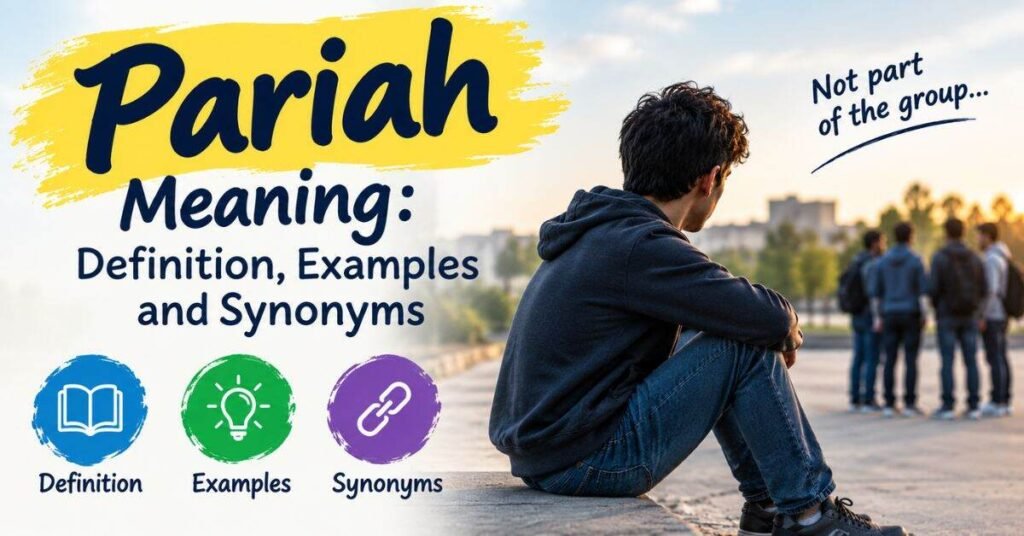
Pariah meaning: A pariah is a person who is rejected, avoided, or disliked by other people or a social group. In simple English, a pariah is an outcast: someone who is not accepted by a community.
The word is commonly used when someone loses the respect or trust of others and becomes socially isolated. It can also describe a country or government that is rejected by other nations because of its actions or policies.
For example, if someone breaks the trust of their friends and the entire group stops associating with them, that person might be described as a pariah.
The word pariah is a noun, and its plural form is pariahs.
What Does Pariah Mean?
A pariah is someone who is excluded from a group or society and treated as an outsider. People may consider someone a pariah because of their behavior, beliefs, actions, or a loss of trust.
The word can describe an individual who is socially rejected or, in political contexts, a country that other nations avoid or criticize.
Example: After betraying the trust of his colleagues, he became a pariah in the workplace.
Pariah Meaning in Simple English
In simple terms, a pariah is someone whom other people do not want to associate with or accept as part of their group.
Consider these examples:
- A student who is deliberately excluded by classmates may feel like a pariah.
- An employee who loses the trust of coworkers may become a pariah in the workplace.
- A country that faces widespread diplomatic isolation may be called an international pariah.
The word generally carries a negative meaning because it describes rejection, isolation, or a loss of social acceptance.
How to Pronounce Pariah
The American English pronunciation of pariah is:
puh-RYE-uh (/pəˈraɪ.ə/)
The word has three syllables, with the strongest stress on the second syllable.
You can break it down like this:
| Syllable | How it sounds |
| Pa | puh |
| Ri | RYE |
| Ah | uh |
Say the word slowly as “puh-RYE-uh,” then gradually increase your speed until it sounds natural.
For the standard American pronunciation, you can also listen to the audio guide in the Cambridge Dictionary.
Pariah Meaning in a Sentence
Understanding pariah becomes easier when you see how it works in different contexts. The following are original examples illustrating its everyday usage.
- Social situation: After spreading rumors about his friends, Mark became a pariah in his social circle.
- Workplace: The manager was treated like a pariah after repeatedly taking credit for other people’s work.
- School: Emma worried that disagreeing with her classmates would turn her into a social pariah.
- Community: After the neighborhood discovered the fraud, the businessman became a pariah among local residents.
- Politics: The government risked becoming an international pariah because of its controversial policies.
These examples show that pariah is usually associated with exclusion or rejection. However, the word does not necessarily mean that the person has done something wrong. Someone can be unfairly rejected because of prejudice, misunderstanding, or an unpopular opinion.
How to Use Pariah Correctly
Use pariah when you want to emphasize that a person or group has been rejected or widely avoided.
For example:
- Correct: “The scandal turned him into a pariah.”
- Correct: “She felt like a pariah after her friends stopped speaking to her.”
- Correct: “The country was increasingly viewed as an international pariah.”
A common expression is social pariah, which refers to someone who is excluded or rejected by a social group.
Synonyms and Antonyms of Pariah
Choosing the right synonym depends on the situation. Although several words have similar meanings, they do not always express exactly the same idea.
Common Synonyms of Pariah
| Synonym | Meaning | Example |
| Outcast | Someone excluded from a group or community | He felt like an outcast at school. |
| Reject | Someone who is rejected or not accepted | He believed the group treated him as a reject. |
| Exile | Someone forced or sent away from a place | The political exile lived abroad for years. |
| Outsider | Someone who does not belong to a particular group | As an outsider, she found the traditions unfamiliar. |
| Castaway | Someone abandoned or left behind | The story follows a castaway on a remote island. |
Outcast is often the closest everyday synonym for pariah. An outsider, however, is not necessarily disliked or rejected; the person may simply be unfamiliar with the group.
Antonyms of Pariah
There is no single perfect antonym for every context, but the following words can express the opposite idea.
| Antonym or opposite expression | Meaning |
| Insider | Someone who belongs to a group and understands its activities |
| Accepted member | Someone welcomed by a community |
| Insider figure | A person who is established within a particular group |
| Respected member | Someone valued by others |
| Popular person | Someone liked or admired by many people |
For example, while a pariah may be excluded from a community, an accepted member is welcomed and included.
What Does Social Pariah Mean?
A social pariah is someone who is rejected, avoided, or excluded by a social group or community.
Social rejection can happen for different reasons. A person may lose the trust of others after behaving dishonestly, violating group expectations, or becoming involved in a public controversy. In other cases, the rejection may result from prejudice or unfair treatment.
For example, imagine that a person in a close-knit community spreads private information about several friends. As a result, the friends stop inviting that person to gatherings and no longer trust them. The person may become a social pariah within that group.
However, being unpopular does not automatically make someone a pariah. The term suggests a stronger degree of rejection or exclusion than simply having a different opinion or personality.
Is Being a Social Pariah Always the Person’s Fault?
No. Social exclusion can occur for reasons that are beyond a person’s control.
Someone might be rejected because of their background, beliefs, disability, social status, or an inaccurate rumor. In these situations, calling someone a pariah describes how others treat that person; it does not establish whether the rejection is justified.
This distinction is important because the word describes a social position, not necessarily a person’s character or moral worth.
What Does Pariah State Mean?
A pariah state is a country or government that is widely rejected or isolated by other countries because of its actions, policies, or conduct.
The expression is commonly used in international politics and diplomacy. A country described as a pariah state may face diplomatic restrictions, economic sanctions, or reduced international cooperation.
For example, a government that repeatedly violates international agreements may face condemnation and restrictions from other nations. Commentators might describe that country as a pariah state if it becomes significantly isolated.
The related expression international pariah can refer to either a country or, in some contexts, an individual who has lost international acceptance or credibility.
It is important to remember that pariah state is a descriptive political expression, not a formal legal classification that automatically applies whenever a country faces criticism.
Origin and History of the Word Pariah
The word pariah entered English through a historical term associated with South India. Its etymology is linked to Tamil paṟaiyar, the plural form of paṟaiyan, a term associated with the paṟai drum and the traditional role of drummers.
Over time, the word became associated in English with a historically marginalized caste community. Its meaning subsequently broadened to describe a person who is rejected or excluded from society.
Today, pariah is frequently used in a figurative sense, particularly in social commentary, literature, journalism, and political discussion.
However, its historical background matters. The term is connected to caste-based discrimination, and its historical caste-related use is considered offensive. When discussing the history of the word or South Asian communities, it is important to use respectful and precise language.
For further etymological information, consult the Dictionary.com entry for pariah and the Merriam-Webster definition.
Is Pariah an Offensive Word?
The word pariah is commonly used in modern English to describe someone who has been rejected or ostracized. In everyday figurative usage, it is not automatically a slur.
Nevertheless, context matters. Its historical caste-related sense is offensive. The figurative sense can also offend: Merriam-Webster notes that many people of Indian descent find it inflammatory because of that caste association. Avoid assuming that the word is harmless to every audience.
Consider the difference between these situations:
- Modern figurative use: “The celebrity became a pariah after the scandal.” Here, the word describes social rejection.
- Historical caste-related use: Using the term as a label for a person belonging to a marginalized caste can carry a discriminatory meaning.
If you are writing about a person’s social exclusion, outcast or socially excluded person may sometimes be clearer alternatives. When discussing caste history, use the specific community’s preferred terminology and reliable historical sources.
Pariah vs. Outcast vs. Outsider
The words pariah, outcast, and outsider are related, but their meanings are not identical.
| Word | Main meaning | Typical implication |
| Pariah | A person who is rejected or avoided | Strong social rejection or loss of acceptance |
| Outcast | A person excluded from a group or community | Deliberate or established exclusion |
| Outsider | A person who does not belong to a particular group | May simply be unfamiliar or unaffiliated |
For example, a new employee may be an outsider because they have not yet become part of the team. If coworkers deliberately reject and avoid that employee, the person might be described as an outcast or, more strongly, a pariah.
The main difference is that an outsider does not necessarily face rejection, whereas a pariah is associated with being rejected or avoided.
Frequently Asked Questions About Pariah Meaning
1. What is the simple meaning of pariah?
A pariah is someone who is rejected, avoided, or not accepted by a group or community. In simple terms, it means an outcast.
2. What is another word for pariah?
The closest common synonym is outcast. Other alternatives include reject, exile, and castaway, depending on the context.
3. What is the plural of pariah?
The plural of pariah is pariahs.
Example: “The former allies became pariahs within their organization.”
4. Is pariah a noun?
Yes. Pariah is a countable noun. You can say “a pariah” when referring to one person and “pariahs” when referring to multiple people.
5. What does it mean to become a pariah?
To become a pariah means to lose acceptance within a group or community and become someone whom others reject or avoid.
6. What does international pariah mean?
An international pariah is a person, country, or government that is widely rejected or isolated by the international community. The expression is particularly common in political discussions.
7. Is pariah the same as an outcast?
The words are very similar. Both describe someone who is excluded or rejected. However, pariah often emphasizes being despised or avoided, while outcast more generally describes someone excluded from a group.
8. Can pariah be used for a country?
Yes. The expression pariah state describes a country or government that faces widespread international rejection or isolation.
Conclusion
The meaning of pariah is a person who is rejected, avoided, or excluded by a group or community. The word is commonly used in expressions such as social pariah and international pariah, which describe social rejection and international isolation, respectively.
Its closest everyday synonym is outcast, although outsider has a broader meaning. Understanding the context, pronunciation, and historical background of the word helps you use it accurately and respectfully.
Whether you encounter pariah in a book, a news report, or everyday conversation, remember its central idea: being treated as someone who does not belong or is not accepted.
