
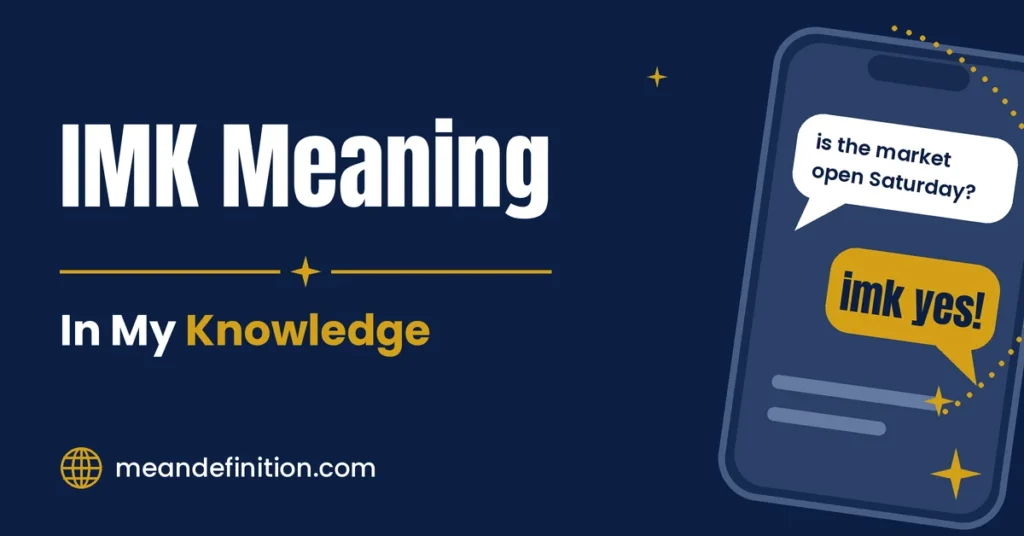
Quick answer: IMK (also written “imk”) most often means “in my knowledge” in texts and online chats. It works like “as far as I know”: the sender believes something is true but isn’t 100% sure. So “IMK the store opens at 9” means “As far as I know, the store opens at 9.” Sometimes “imk” is just “lmk” (“let me know”) with a lowercase L that looks like a capital I.
If a friend answered your question with “imk, yeah,” they gave you an answer with a small safety net. Below, you’ll find what slang references say about IMK, how people use it, how to tell it apart from LMK, other less common meanings, example chats, how to reply and better options for school or work.
What Does IMK Mean?
IMK is an initialism of “in my knowledge,” a casual way to say “to my knowledge” or “as far as I know.” It takes the first letter of each word (I-M-K), and capital letters don’t change the meaning: “imk,” “Imk” and “IMK” all work the same way.
Here’s what reference sources say:
- wikiHow says IMK stands for “In My Knowledge” and is an informal way of saying you’re pretty confident but not entirely sure the information is correct, like “as far as I know,” “as far as I’m aware” or “to the best of my knowledge.”
- Cyber Definitions defines IMK as “In My Knowledge,” used when the sender is sharing information they believe to be true, “a step below claiming full expertise.” It calls IMK another way of saying AFAIK (“as far as I know”).
- Capitalize My Title describes IMK as short-hand for “to the best of my knowledge,” used when people aren’t certain what they’re saying is true, often in response to a direct question.
An Urban Dictionary entry for “imk” dated May 2005 gives the same meaning: “In my knowledge, is used if you are almost sure of things but not entirely sure.”
IMK at a Glance
| Item | Details |
|---|---|
| Stands for | In my knowledge |
| Similar to | As far as I know (AFAIK) |
| Type | Texting and internet initialism |
| Tone | Casual, helpful, slightly unsure |
| Look-alike | LMK (let me know) |
How People Use IMK
IMK usually comes right before or after a fact the sender is fairly sure about. Capitalize My Title notes you can place it at the beginning or end of the statement. Here are the most common ways it shows up:
- Answering a question: “Is practice still on?” “imk yes, coach didn’t cancel.”
- Sharing news you heard: “IMK the library is open late during finals week.”
- Giving a gentle correction: “imk the deadline is Friday, not Thursday.” It sounds softer than “you’re wrong.”
- Admitting limits: “That’s the latest version, IMK.” The sender is telling you to double-check if it matters.
wikiHow quotes a social media marketing expert who says IMK is also a nice way of saying you’re not claiming to be an expert. That’s the heart of it: IMK is helpful and honest at the same time.
IMK or LMK? How to Tell the Difference
This is the part that confuses most people. In many fonts, a capital I and a lowercase l look almost identical, so “Imk” and “lmk” can look the same on a screen. wikiHow points out that “Imk” is often mistaken for “Let Me Know,” and an Urban Dictionary entry even jokes about people mixing up the two letters.
Use this quick test:
- If it sits next to a fact, it’s probably IMK: “imk the party starts at 8” = “as far as I know, the party starts at 8.”
- If it sits next to a request or “if,” it’s probably LMK: “lmk if you need a ride” = “let me know if you need a ride.” Wiktionary lists LMK as an initialism of “let me know.”
If you still can’t tell, swap in both phrases and see which sentence makes sense. Our guide to LYK (“let you know”) covers another close cousin you’ll see in the same chats.
Other Meanings of IMK
“In my knowledge” is the meaning you’ll see most, but a few others exist in casual use. wikiHow lists these alternatives:
- I must know: eager curiosity, as in “what happens in the next episode? IMK!”
- In my kitchen: a playful answer to “wya?” when someone is cooking.
- I’ll message you: a less common use for moving details to DMs.
Context makes it clear. A question mark or “!!!” after IMK often points to “I must know,” while a calm fact next to it points to “in my knowledge.”
IMK vs. AFAIK and Other Similar Terms
| Term | Means | How sure? |
|---|---|---|
| IMK | In my knowledge | Fairly sure |
| AFAIK | As far as I know | Fairly sure |
| TTBOMK | To the best of my knowledge | Fairly sure, a bit formal |
| IIRC | If I recall correctly | Going from memory |
| IDK | I don’t know | Not sure at all |
AFAIK is the older and more widely recognized option. Wiktionary lists it as an initialism of “as far as I know,” with TTBOMK and “to my knowledge” among its synonyms, and quotes a Usenet post from 1997. If you want everyone to understand you, AFAIK is the safer pick. IMK is shorter and more casual.
Examples of IMK in a Conversation
Weekend plans:
Sam: is the farmers market open this Saturday?
You: imk yes, they’re open until noon
School group chat:
Classmate: do we need the textbook for the quiz?
You: IMK no, it’s just the notes from Monday
Holiday travel:
Cousin: what time does Grandpa’s flight land?
You: around 4, imk. Aunt Rosa has the exact time ✈️
An IMK/LMK mix-up:
Friend: Imk if you want pizza
You: wait, IMK or LMK? 😂
Friend: lmk lol, autocorrect hates me
How to Reply to IMK
When someone answers with IMK, they’ve given you their best information. Here’s how to respond:
- Say thanks: “ok thanks!” is all it takes for small things.
- Double-check if it matters: “thanks, I’ll check the website to be sure.” This is smart for deadlines, times and prices.
- Share what you know: “I heard the same thing” or “hmm, I thought it moved to Thursday.”
- Ask for the source: “where’d you hear that?” is fine when you need to confirm.
If you’re the one who isn’t sure at all, IDK fits better than IMK. And if you think something probably isn’t true, our guide to IDTS (“I don’t think so”) explains a handy way to say it.
Is IMK Rude or Formal?
IMK isn’t rude. It’s actually considerate, because it warns the other person that your information might not be perfect. Capitalize My Title adds one caution: since IMK leaves room to be wrong, someone could use it to dodge blame later (“I said IMK!”). Cyber Definitions makes a similar point about IMK giving the sender room to deny a claim. So if you use it, use it honestly.
IMK is informal, and many people don’t know it, so skip it in school papers, work emails and messages to clients. Use a full phrase instead:
- “As far as I know, the report was sent on Monday.”
- “To my knowledge, the event hasn’t been canceled.”
- “I believe the deadline is Friday, but I’ll confirm.”
You’ll find more texting abbreviations in our Meanings section, or you can paste a confusing message into our free Text Slang Translator to decode common shorthand.
Frequently Asked Questions
What does IMK mean on Snapchat, TikTok or Instagram?
The same as in texts: usually “in my knowledge,” meaning “as far as I know.” In comments, it often comes with a fact someone is fairly sure about, like “imk that song is from 2009.”
Is IMK the same as LMK?
No. IMK means “in my knowledge,” and LMK means “let me know.” They look alike because a capital I and a lowercase l can look identical, so check whether the message shares a fact (IMK) or asks you to reply (LMK).
What does “imk” mean from a girl or a guy?
It means the same thing either way. It isn’t flirty or a secret code. The person is sharing what they know while admitting they might not have every detail.
How do you pronounce IMK?
Most people read it as the full phrase, “in my knowledge,” or simply think “as far as I know.” Cyber Definitions notes that as an initialism it can also be said letter by letter: “I-M-K.”
Is “in my knowledge” correct English?
“To my knowledge” and “as far as I know” are the usual phrases in standard English. “In my knowledge” is understandable, but in formal writing it’s better to use one of the standard phrases.
The Bottom Line
IMK means “in my knowledge,” a casual way to say “as far as I know.” It shares information while admitting you might not be completely sure. Watch out for “lmk” written with a lowercase L, which looks the same but means “let me know.” IMK is friendly and honest in texts, but in formal writing, “to my knowledge” or “as far as I know” is the better choice.
