

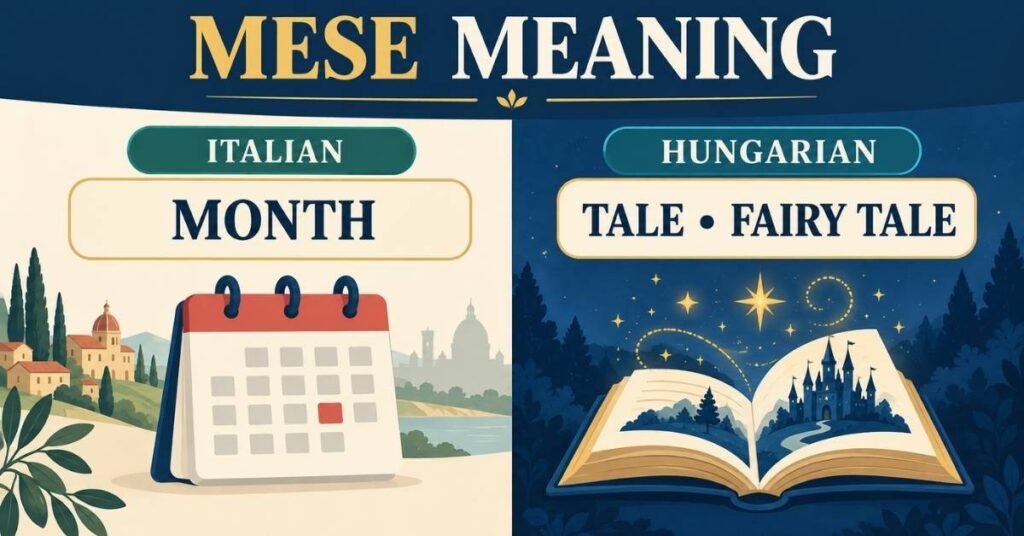
One small word can take you from a calendar to a fairy tale. Mese meaning depends on the language: in Italian, mese means “month,” while in Hungarian, mese means “tale,” “fairy tale,” or “fable.” Historical English dictionaries also record rare meanings connected with a meal, calming something, and ancient Greek music. Therefore, the sentence and language matter more than the spelling alone.
If you saw mese in a caption, name, book, song, or message, do not guess from one definition. This guide shows you how to identify the intended meaning, pronounce the word, and use it naturally.
Mese Meaning at a Glance
| Language or context | Meaning | Typical clue |
|---|---|---|
| Italian | Month | un mese, al mese, mese scorso |
| Hungarian | Tale, fairy tale, fable | esti mese, népmese, mesék |
| Obsolete English noun | Dinner or meal | Found mainly in historical dictionaries |
| Obsolete English verb | To moderate, subdue, calm, or soften | Rare historical usage |
| Ancient Greek music theory | A fixed note in a lyre’s tuning system | Specialist academic context |
| Romanian | Tables, the plural of masă | Romanian sentence or phrase |
| Finnish, dated slang | MSN Messenger | Older internet or technology discussion |
| Proper noun | A surname, place, road, or historical name | Usually capitalized as Mese |
For most modern searches, the answer will be either the Italian word for month or the Hungarian word for a story or fairy tale.
What Does Mese Mean in Italian?
In Italian, mese means “month.” It is a masculine noun, so speakers use articles such as il and un with it. The plural is mesi, meaning “months.”
The word comes from the Latin mēnsem, which also influenced month-related words in several Romance languages. Italian pronunciation normally places the stress on the first syllable.
How to pronounce mese in Italian
Standard modern Italian commonly pronounces mese approximately as MEH-zeh, represented as /ˈme.ze/. The s between vowels often sounds like the z in zero. Some traditional or regional pronunciations use an unvoiced s, closer to MEH-seh.
Common Italian phrases with mese
- un mese — one month or a month
- il mese — the month
- questo mese — this month
- il mese scorso — last month
- il mese prossimo — next month
- ogni mese — every month
- al mese — per month
- tra un mese — in a month or one month from now
- due mesi — two months
Notice the plural change: mese becomes mesi, not meses.
Italian examples in sentences
- Resto in Italia per un mese. — I am staying in Italy for a month.
- Questo mese è stato impegnativo. — This month has been busy.
- Pago cinquanta euro al mese. — I pay fifty euros per month.
- Ci vediamo il mese prossimo. — We will see each other next month.
- Il bambino ha sei mesi. — The baby is six months old.
The surrounding words often make this meaning obvious. Numbers, dates, subscriptions, rent, age, and scheduling all point toward month.
What Does Mese Mean in Hungarian?
In Hungarian, mese means “tale,” “fairy tale,” or “fable.” It can describe a traditional children’s story, an imaginative narrative, or a story with fabulous elements.
Depending on tone, it can also mean a made-up story, fabrication, or lie. English does something similar when someone dismisses a doubtful account as “just a story.” Context and tone decide whether the word feels warm and imaginative or skeptical and critical.
How to pronounce mese in Hungarian
Hungarian mese is pronounced approximately MEH-sheh, represented as /ˈmɛʃɛ/. The Hungarian s sounds like the English sh in shoe. Stress falls on the first syllable, as it normally does in Hungarian words.
That pronunciation differs clearly from Italian MEH-zeh. Hearing the middle consonant can help you identify the language.
Common Hungarian words and phrases with mese
- esti mese — bedtime story or evening tale
- népmese — folk tale
- tündérmese — fairy tale
- mesekönyv — storybook or book of fairy tales
- mesefilm — animated or fairy-tale film
- mesemondó — storyteller
- mesék — tales or stories, the plural of mese
Hungarian examples in context
- Ez egy szép mese. — This is a beautiful tale.
- A gyerek esti mesét hallgat. — The child is listening to a bedtime story.
- Szeretem a magyar népmeséket. — I like Hungarian folk tales.
- Ez csak mese. — That is only a story or fabrication.
Hungarian adds endings to nouns to show grammatical relationships. As a result, you may see forms such as mesét, mesében, meséről, and mesék. They belong to the same word family even though their endings change.
Italian Mese vs. Hungarian Mese
The spelling is identical, but the two words are unrelated in everyday meaning.
| Feature | Italian | Hungarian |
|---|---|---|
| Meaning | Month | Tale, fairy tale, fable |
| Approximate pronunciation | MEH-zeh | MEH-sheh |
| Plural | mesi | mesék |
| Common phrase | un mese — a month | esti mese — bedtime story |
| Likely context | Dates, age, payment, schedules | Books, children, folklore, storytelling |
Use the nearby words as your guide. If the text mentions a price per mese, a date, or someone’s age, it is probably Italian. If it mentions children, books, folklore, or bedtime, it is probably Hungarian.
Is Mese an English Word?
Mese exists in historical English, but it is not a normal word in modern conversation. Older sources record several separate uses.
Mese as an old word for a meal
As an obsolete noun, mese meant a dinner or meal. Related historical forms included mease, mes, and mees. The word traces through Middle English and Old English forms associated with a table, food, or a dish served at a meal.
Modern writers should normally use meal, dinner, dish, or serving instead. Using mese without historical context will confuse most readers.
Mese as a historical verb
An obsolete English verb mese meant to moderate, subdue, abate, soften, or mollify. In plain language, it described making something less intense or calming it.
Again, this sense belongs to historical vocabulary. Modern alternatives such as calm, ease, soften, reduce, or moderate communicate the idea more clearly.
Mese in ancient Greek music theory
In specialist writing about ancient Greek music, mese names a fixed note or string within a lyre’s tuning system. The term comes from Greek mesē, meaning “middle.”
This musical meaning is technical. Unless the passage discusses tetrachords, lyres, pitches, or ancient Greek theory, it is probably not the definition you need.
Other Meanings of Mese Across Languages
The word appears in additional languages, although these uses attract fewer general searches.
Mese in Romanian
In Romanian, mese is the plural of masă, a noun that can mean “table” and, in some contexts, “meal.” Therefore, mese commonly means tables.
Do not confuse this Romanian plural with Italian mesi, which means months.
Mese in Spanish
In Spanish, mese can be a conjugated form of the uncommon verb mesar, traditionally meaning to pull out or pluck hair or a beard. It can function as a present subjunctive form or a formal command.
Spanish speakers use this form far less often than everyday words such as mes, meaning month. Therefore, if you intended the Spanish word for month, write mes, not mese.
Mese in Finnish internet slang
In Finnish, mese became a colloquial shortening of Messenger, especially MSN Messenger. Because that platform belongs to an earlier era of online chat, dictionaries may label the usage dated.
Mese in Pohnpeian
Pohnpeian dictionary sources record mese with meanings including face or façade, the upper part of certain crops, and the edge of a reef. This usage belongs to a Micronesian language and has no direct link to the Italian or Hungarian senses.
Is Mese a Name?
Mese can appear as a surname, personal name, or geographical name, but it does not have one universal “name meaning.” A dictionary definition from Italian or Hungarian does not automatically explain every person’s surname.
For example, Mese is the name of a municipality in Lombardy, Italy. It also appears in the name of a town in Myanmar and as a family name. Meanwhile, historical references use Mese for places, people, and concepts from other cultures.
If you are researching a family name, check:
- the family’s country and language of origin;
- older spellings in civil, church, or immigration records;
- accent marks or letters lost during romanization;
- whether the name began as a place name;
- information preserved by the family itself.
Name websites often attach one attractive definition to every spelling. However, surname history requires evidence, not a convenient translation.
What Does Mese Mean in Texting or Social Media?
There is no widely established English texting definition of mese. In a message, it may be:
- Italian for month;
- Hungarian for tale or story;
- a person’s name or username;
- a typing error for message, mess, me, or mese/mesi in another language;
- dated Finnish shorthand for Messenger;
- part of a phrase in Shona, Ewe, or another language where the entire phrase supplies the meaning.
Avoid interpreting an isolated word without the full message. Ask the sender or examine the surrounding language, especially if an automatic translation gives a strange result.
LEARN MORE: Rith Meaning
Common Mese Phrases Explained
What does “un mese” mean?
The Italian phrase un mese means “a month” or “one month.” For example, un mese fa means “a month ago.”
What does “al mese” mean?
In Italian, al mese means “per month.” You often see it in prices, salaries, rent, memberships, and subscriptions.
What does “ogni mese” mean?
Ogni mese means “every month” in Italian.
What does “esti mese” mean?
In Hungarian, esti mese means “bedtime story” or “evening tale.” The phrase often refers to a story told or read to a child before sleep.
What does “népmese” mean?
The Hungarian compound népmese means “folk tale.” Its plural, népmesék, means “folk tales.”
What does “mesék” mean?
Mesék is the Hungarian plural of mese, so it means “tales,” “stories,” or “fairy tales.”
Mese, Mes, Mesi, Messe, and Mezze
These similar-looking words cause many search mistakes.
| Word | Meaning |
|---|---|
| mese | Month in Italian; tale in Hungarian; other context-specific meanings |
| mesi | Months in Italian |
| mes | Month in Spanish; also appears in other languages |
| meses | Months in Spanish and Portuguese |
| Messe | Mass or trade fair in German, depending on context |
| mezze | A selection of small dishes in Eastern Mediterranean and Middle Eastern cuisines |
| mess | Disorder, an untidy situation, or a difficult problem in English |
The distinction matters in translation. For example, Italian due mesi means two months, while Spanish dos meses expresses the same idea. Italian does not normally use meses as the plural of mese.
How to Identify the Correct Mese Meaning
Use this quick process whenever you find the word in the wild:
- Identify the language. Words such as un, questo, and prossimo suggest Italian. Words such as esti, nép, and accented endings like -ék suggest Hungarian.
- Look at the topic. Calendars and prices point to “month.” Children and folklore point to “tale.”
- Listen to the pronunciation. Italian often sounds like MEH-zeh; Hungarian sounds like MEH-sheh.
- Check capitalization. Capitalized Mese may identify a person, town, road, or institution.
- Consider the source’s age. Historical English texts may use the meal or calming sense.
- Verify names separately. A word translation alone cannot establish a surname’s origin.
This context-first method produces a more reliable answer than copying the first definition in a search result.
Frequently Asked Questions About Mese Meaning
What is the simple meaning of mese?
In Italian, mese means “month.” In Hungarian, it means “tale,” “fairy tale,” or “fable.” The correct answer depends on the language.
What language is mese?
Mese appears in several languages, including Italian, Hungarian, Romanian, Finnish, Spanish, and Pohnpeian. It also survives in rare historical English uses.
What does mese mean in Italian?
It means month. The plural is mesi, meaning months.
What does mese mean in Hungarian?
It means tale, fairy tale, or fable. In a negative tone, it can also mean a fabrication or made-up story.
How do you pronounce mese?
In Italian, it sounds approximately like MEH-zeh. In Hungarian, it sounds like MEH-sheh. Other languages may pronounce the spelling differently.
Does mese mean month in Spanish?
No. The normal Spanish word for month is mes, and its plural is meses. Italian uses mese for month and mesi for months.
Is mese an English word?
Yes, but its English senses are obsolete or highly specialized. Historically, it could mean a meal, function as a verb meaning to moderate or calm, or name a note in ancient Greek music theory.
What is the plural of mese?
The plural depends on the language. Italian uses mesi, while Hungarian uses mesék. In Romanian, mese is already a plural form of masă in one common sense.
Is Mese a boy’s or girl’s name?
The spelling can occur as a personal or family name in different cultures. It has no dependable universal gender or meaning without information about the person’s language and heritage.
Is mese slang?
Not usually. It is a standard word in Italian and Hungarian. However, Finnish speakers formerly used mese as informal shorthand for MSN Messenger.
Does mese mean story?
Yes—in Hungarian, mese means a tale, story, fairy tale, or fable. It does not have that meaning in Italian.
Conclusion
Mese meaning changes with the language. In Italian, mese means “month,” and its plural is mesi. In Hungarian, mese means “tale,” “fairy tale,” or “fable,” and its plural is mesék. Rare English, Romanian, Finnish, Spanish, and Pohnpeian uses add further possibilities.
Therefore, check the surrounding words before choosing a translation. Dates, prices, and ages usually signal the Italian meaning; books, children, and folklore usually signal Hungarian. Next, explore related terms such as un mese, al mese, esti mese, and mesék to understand how native speakers use the word in real phrases.
