

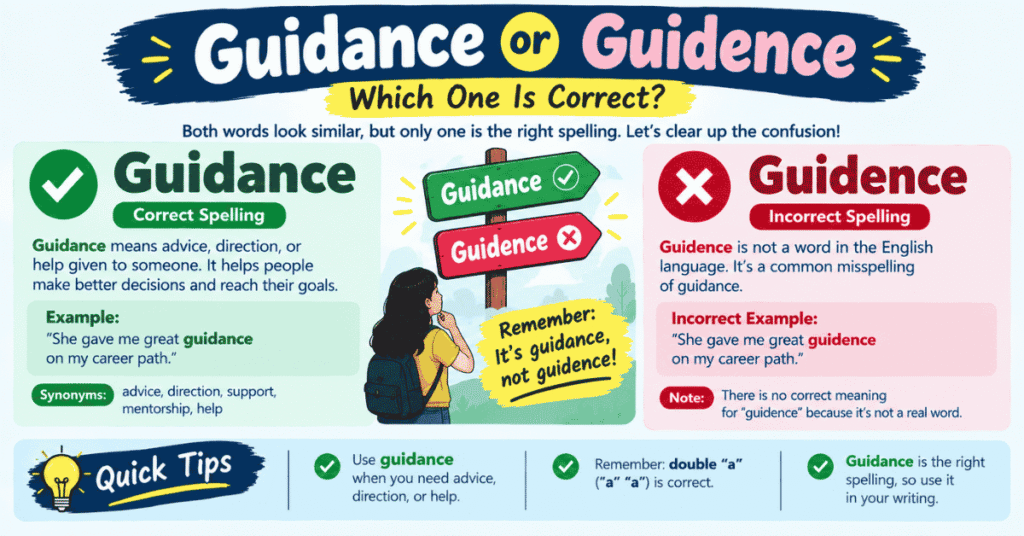
Guidance or guidence—which spelling should you use? Guidance is correct. Guidence is a common misspelling and is not accepted as a standard alternative in American or British English. Guidance means advice, direction, information or support that helps someone make a decision, solve a problem or complete a task.
The word is formed as follows:
guide − e + ance = guidance
The final silent e in guide is removed before the suffix -ance is added.
The Correct Spelling at a Glance
| Word | Correct? | Meaning |
|---|---|---|
| Guidance | Yes | Advice, direction, information or support |
| Guidence | No | A common misspelling of guidance |
Correct: Thank you for your guidance.
Incorrect: Thank you for your guidence.
If you are wondering how to spell guidance, remember that its final part is -ance, not -ence.
Why Is Guidance Spelled With an A?
The confusion comes from the base word guide. Because guide contains an e, writers may expect the noun to be spelled guidence. English uses a different formation.
Start with guide and add the noun-forming suffix -ance. Since the suffix begins with a vowel, the final silent e is removed:
- Start with guide.
- Remove the final e.
- Add -ance.
- Write guidance.
guide → guid + ance → guidance
The endings -ance and -ence frequently sound similar because their vowels are unstressed. Pronunciation alone therefore may not tell you which ending to write.
What Does Guidance Mean?
Guidance is help, advice, instruction or direction given to someone who needs to make a decision, understand a situation or follow a process.
Cambridge defines it as help and advice concerning how to do something or deal with work, educational or personal problems. The exact meaning changes slightly with context.
Advice and Direction
In everyday English, guidance means helpful direction from someone with relevant knowledge or experience.
- I asked my teacher for guidance.
- Her guidance helped me make a confident decision.
- New employees receive guidance from experienced team members.
- Parents can provide support and guidance without making every decision for their children.
Guidance usually helps someone reach their own decision. It does not always mean giving a direct command.
Educational and Career Guidance
Schools and universities commonly provide academic and career guidance.
- The counselor offered career guidance.
- Students need guidance when selecting college courses.
- Academic advisers provide guidance on degree requirements.
- She sought guidance before applying for financial aid.
In American English, a guidance counselor traditionally helps students with academic, career and personal concerns. Many institutions now use titles such as school counselor.
Official and Regulatory Guidance
Government agencies, regulators and professional organizations publish guidance explaining how rules should be interpreted or followed.
- The agency issued new guidance for employers.
- Please review the latest regulatory guidance.
- The document provides practical guidance on compliance.
- Businesses should determine whether the guidance is advisory or legally binding.
Guidance and law are not automatically the same. Guidance often explains recommended practices or an agency’s interpretation, while a statute or regulation establishes legal requirements.
Financial Guidance
In personal finance, guidance can mean professional help with financial decisions.
- Speak to a qualified professional for financial guidance.
- The adviser provided guidance on retirement planning.
- Families may need guidance when comparing mortgage options.
In corporate finance, earnings guidance or company guidance can refer to management’s forecast of future revenue, profit or other business results.
- The company raised its full-year guidance.
- Management withdrew its earnings guidance.
- Investors compared the results with the company’s earlier guidance.
Legal and Medical Guidance
- The organization sought legal guidance before signing the agreement.
- Patients should follow the guidance of qualified healthcare professionals.
- The attorney provided guidance on the filing process.
- Public-health guidance may change as new evidence becomes available.
Guidance in high-stakes areas should come from appropriately qualified professionals or authoritative institutions.
Technical Guidance
In engineering and technology, guidance can refer to systems or information that direct movement or behavior.
- The aircraft uses an advanced guidance system.
- Engineers tested the vehicle’s navigation and guidance controls.
- The documentation provides implementation guidance.
- Developers need clearer guidance on the new API.
The spelling remains guidance in every technical context.
Is Guidance a Noun or a Verb?
Guidance is a noun.
- Correct: Her guidance was helpful.
- Correct: We need additional guidance.
- Incorrect: She will guidance the team.
The corresponding verb is guide:
- She will guide the team.
- He guided us through the process.
- They are guiding the project toward completion.
| Word | Grammatical role | Example |
|---|---|---|
| Guide | Verb or noun | Please guide us. / Read the guide. |
| Guided | Past tense or adjective | She guided us. / Take a guided tour. |
| Guiding | Present participle or adjective | He is guiding us. / A guiding principle |
| Guidance | Noun | We appreciate your guidance. |
| Guideline | Countable noun | Follow the safety guidelines. |
Is Guidance Countable or Uncountable?
In ordinary English, guidance is usually an uncountable—or mass—noun. That means it normally does not take an indefinite article or a regular plural.
Natural forms
- some guidance
- helpful guidance
- additional guidance
- clear guidance
- a piece of guidance
- guidance documents
- sources of guidance
Forms to avoid in general writing
- a guidance
- one guidance
- several guidances
Instead of saying:
The manager gave me a guidance.
Write:
The manager gave me some guidance.
Or:
The manager gave me a useful piece of guidance.
Can guidances ever be correct?
Guidances occasionally appears in specialist regulatory or bureaucratic writing when referring to multiple official guidance documents. However, it can sound awkward to general readers.
Clearer alternatives include:
- guidance documents
- separate pieces of guidance
- official publications
- agency guidance
- several guidelines
For most school, workplace and everyday writing, treat guidance as uncountable.
Guidance, Advice, Guide or Guideline?
These words overlap, but they are not identical.
| Word | Meaning | Example |
|---|---|---|
| Guidance | Help or direction for handling a situation | We need guidance on the application. |
| Advice | An opinion or recommendation about what to do | She gave me useful advice. |
| Guide | A person, document or resource that shows the way | Read the installation guide. |
| Guideline | A specific principle or recommendation | Follow the safety guidelines. |
| Instruction | A direct explanation or command telling someone what to do | Read the instructions carefully. |
Guidance versus advice
Both can mean helpful recommendations. Guidance often suggests an ongoing process, broader direction or help from an authority. Advice may refer to a specific recommendation or opinion.
- The counselor provided long-term career guidance.
- She gave me one useful piece of advice.
Both are normally uncountable in general English:
- some guidance
- some advice
- a piece of guidance
- a piece of advice
Not:
- a guidance
- an advice
Guidance versus a guide
Guidance is the help or direction being provided. A guide may be the person or document providing it.
- The handbook is a guide.
- The handbook provides guidance.
Guidance versus guidelines
Guidance is broad advice or direction. Guidelines are identifiable recommendations or principles.
- The department provided guidance on workplace safety.
- The document lists ten safety guidelines.
Because guideline is countable, you can write:
- a guideline
- three guidelines
- several guidelines
Guidance On, For, About or From?
Several prepositions can follow guidance, but each expresses a different relationship.
Guidance on
Use guidance on to introduce a topic or process.
- We need guidance on completing the form.
- The agency published guidance on data protection.
- She provided guidance on preparing for the interview.
Guidance about
Use guidance about for a subject, concern or situation. It is often slightly more conversational than guidance on.
- Students requested guidance about course selection.
- I need guidance about my next step.
Guidance for
Use guidance for to identify the intended audience or purpose.
- The website offers guidance for new business owners.
- The school published guidance for parents.
- This document provides guidance for completing the application.
Guidance from
Use guidance from to identify the source.
- Seek guidance from a qualified attorney.
- She received guidance from her supervisor.
- We followed guidance from the health department.
Guidance to
Guidance to may be correct when to introduces the recipient:
- The counselor offered guidance to graduating students.
However, guidance for students or guidance on choosing a career is often more natural, depending on the intended meaning.
Common Phrases With Guidance
Natural collocations include:
- ask for guidance
- seek guidance
- provide guidance
- offer guidance
- receive guidance
- follow guidance
- issue guidance
- publish guidance
- clear guidance
- practical guidance
- expert guidance
- professional guidance
- career guidance
- legal guidance
- financial guidance
- parental guidance
- spiritual guidance
- under someone’s guidance
Examples:
- Please seek professional guidance before making the decision.
- The policy provides clear guidance for managers.
- The project succeeded under her guidance.
- We are waiting for the agency to issue guidance.
Correct and Incorrect Examples
| Incorrect | Correct |
|---|---|
| Thank you for your guidence. | Thank you for your guidance. |
| I need some guidence. | I need some guidance. |
| She gave me a guidance. | She gave me some guidance. |
| The counselor offered career guidence. | The counselor offered career guidance. |
| We received several guidances. | We received several guidance documents. |
| Please guidance the new employee. | Please guide the new employee. |
School and Career Examples
- The adviser provided guidance on course selection.
- Students can request academic guidance.
- Career guidance helped him identify suitable opportunities.
- She works as a school guidance counselor.
- The teacher’s guidance improved my research project.
Workplace Examples
- New employees need clear guidance during onboarding.
- Thank you for your guidance throughout the project.
- Managers should provide practical guidance, not vague criticism.
- We are waiting for additional guidance from the compliance team.
- Her guidance helped us avoid an expensive mistake.
Professional Email Examples
- Thank you for your continued guidance and support.
- I would appreciate your guidance on the next steps.
- Could you provide guidance on completing this section?
- We are seeking your guidance regarding the proposed change.
- Please let me know if you can offer any additional guidance.
Legal, Financial and Medical Examples
- Consult an attorney for legal guidance specific to your situation.
- The adviser offered general financial guidance.
- Follow your healthcare provider’s guidance.
- The regulator issued updated guidance.
- The company revised its full-year earnings guidance.
American and British English
There is no regional spelling difference.
- American English: guidance
- British English: guidance
- Canadian English: guidance
- Australian English: guidance
Guidence is not an accepted British variant.
How to Pronounce Guidance
Guidance is commonly pronounced:
GY-dンス or approximately GY-dəns
Its phonetic representation is typically /ˈɡaɪdəns/.
The second syllable is unstressed. This weak vowel sound helps explain why writers may be uncertain between -ance and -ence.
LEARN MORE: Bodies or Bodys
Synonyms for Guidance
Possible synonyms include:
- advice
- direction
- help
- assistance
- support
- counsel
- instruction
- leadership
- mentoring
- coaching
- supervision
- recommendation
The best alternative depends on context.
- Counsel can sound formal.
- Instruction is usually more direct.
- Mentoring suggests an ongoing developmental relationship.
- Supervision includes oversight.
- Advice may be a specific recommendation.
Antonyms and Contrasting Ideas
Guidance does not have one perfect opposite, but context-dependent contrasts include:
- confusion
- uncertainty
- misdirection
- neglect
- lack of support
- misinformation
- poor advice
Example:
- Clear guidance replaced uncertainty.
- The misleading instructions provided misdirection, not guidance.
An Easy Spelling Trick
Remember this sentence:
A guide gives guid-ance.
Then rebuild the word:
GUIDE − E + ANCE = GUIDANCE
Another memory cue is:
Guidance gives an answer—both contain “an.”
The important letter is a in the ending -ance.
A Five-Second Proofreading Check
When you see guidence:
- Find the base word guide.
- Remove its final silent e.
- Add -ance.
- Confirm the spelling guidance.
- Check whether the sentence needs the verb guide instead.
Example:
- Incorrect noun: I need your guidence.
- Correct noun: I need your guidance.
- Correct verb: Please guide me.
Test Your Understanding
Choose the correct answer.
- Thank you for your guidance / guidence.
- The counselor provided career guidance / guidence.
- Could you guide / guidance me through the process?
- We need a guidance / some guidance.
- The agency published several guidances / guidance documents.
- She gave me a useful piece of guidance / guidence.
Answers
- guidance
- guidance
- guide
- some guidance
- guidance documents
- guidance
Frequently Asked Questions
Is it guidance or guidence?
Guidance is correct. Guidence is a common misspelling.
How do you spell guidance?
Spell it g-u-i-d-a-n-c-e.
Why is guidence incorrect?
The noun is formed from guide and the suffix -ance. The final silent e in guide is removed, producing guidance.
What does guidance mean?
Guidance means advice, direction, instruction, information or support that helps someone make a decision or complete a task.
Is guidance a noun?
Yes. Guidance is a noun. The corresponding verb is guide.
Is guidance countable or uncountable?
Guidance is normally an uncountable noun. Write some guidance or a piece of guidance, not usually a guidance.
Can guidance be plural?
The form guidances occasionally appears in specialist regulatory usage, but guidance documents or pieces of guidance is clearer in general English.
Is it guidance or guidelines?
Use guidance for broad help or direction. Use guidelines for separate, identifiable principles or recommendations.
What is the difference between advice and guidance?
Advice often means a particular recommendation. Guidance may suggest broader or ongoing direction. Both are usually uncountable.
Is “thank you for your guidance” correct?
Yes. Thank you for your guidance is natural and professional English.
Is it guidance on or guidance for?
Use guidance on for a topic and guidance for for an audience or purpose:
- Guidance on filing taxes
- Guidance for small businesses
Is guidence correct in British English?
No. Guidance is correct in both American and British English.
Final Spelling Reminder
Use guidance when you mean advice, direction, instruction or support. Do not use guidence as an alternative spelling.
GUIDE − E + ANCE = GUIDANCE

1 thought on “Guidance or Guidence: Correct Spelling, Meaning & Usage”