

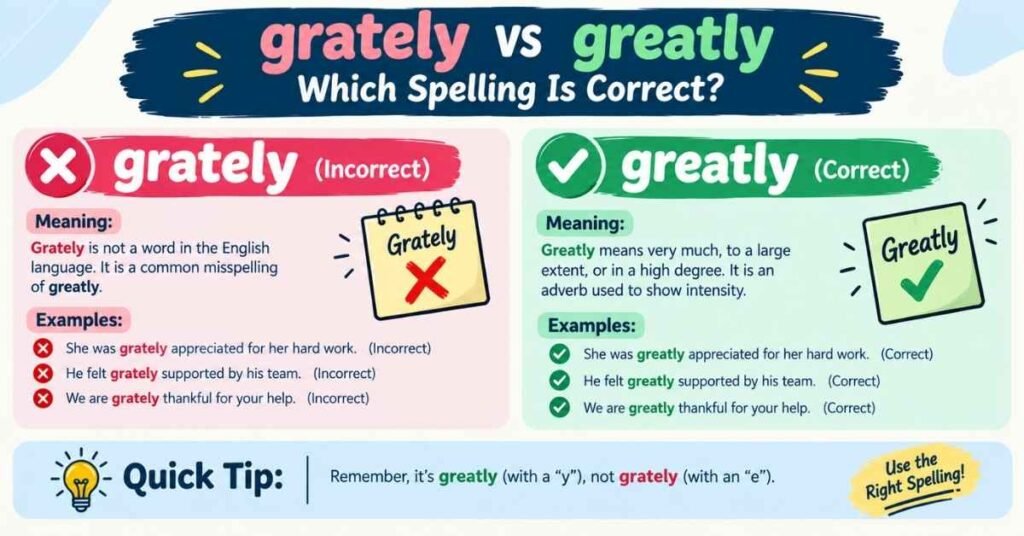
Grately vs greatly has one correct choice in modern English: greatly. It is an adverb meaning very much, significantly, or to a large extent. Grately is normally a spelling mistake, so write “Your help is greatly appreciated,” not “grately appreciated.” Although an obsolete form grately appeared briefly in the 1500s, it is not appropriate in contemporary American writing.
Grately vs Greatly at a Glance
| Form | Modern status | Meaning | Example |
|---|---|---|---|
| Greatly | Correct | Very much; to a large extent | Your support is greatly appreciated. |
| Grately | Incorrect in normal modern use | No current standard meaning | Avoid: Your support is grately appreciated. |
| Historical grately | Obsolete | Recorded in older English | Use only in historical discussion or quotation |
The easiest spelling rule is:
Great + ly = greatly
Keep every letter in great, then add -ly.
What Does Greatly Mean?
Greatly is an adverb that means:
- Very much
- To a great extent
- To a significant degree
- Considerably
Merriam-Webster defines it as “to a great extent or degree” or “very much.” Merriam-Webster
Examples:
The software update greatly improved performance.
Your advice was greatly appreciated.
Their opinions differ greatly.
The new policy greatly affected small businesses.
In each sentence, greatly increases the degree or extent of the action, condition, or effect.
Is Grately a Word?
For ordinary contemporary writing, grately is not an accepted spelling of greatly.
Do not use it in:
- Emails
- Essays
- Reports
- Cover letters
- Articles
- Academic papers
- Business messages
- Social-media captions
- Customer communication
However, saying that grately has never been a word is historically inaccurate. The Oxford English Dictionary records an obsolete adverb spelled grately, found only in mid-16th-century evidence. Oxford English Dictionary
That historical entry does not change the modern recommendation.
Modern Use
Correct: We were greatly surprised by the result.
Incorrect: We were grately surprised by the result.
Historical or Linguistic Use
You may write:
The obsolete form grately appears in sixteenth-century English.
Here, you are discussing the historical word itself rather than using it as modern vocabulary.
Why Greatly Is Spelled With “Great”
The spelling becomes easy when you identify the base word.
great + -ly = greatly
Great is an adjective:
She made a great contribution.
Add -ly to form the adverb:
She contributed greatly.
No letter needs to be removed because great does not end in a silent e. Its final letter is t.
Compare:
| Adjective | Adverb |
|---|---|
| Quick | Quickly |
| Complete | Completely |
| Serious | Seriously |
| Great | Greatly |
The incorrect spelling grately appears when a writer mistakenly treats great as though its last two letters should be simplified before adding -ly.
Why Do People Write Grately?
Several factors cause the mistake.
Rapid Pronunciation
In fast speech, the internal t of greatly may sound less distinct. A writer may consequently spell the word according to an imprecise pronunciation.
Confusion With Silent-E Rules
Some words lose a final e before a suffix:
- True → truly
- Whole → wholly
- Due → duly
But great does not end in e, so this rule cannot create grately.
Influence of the Word Grate
Grate is a real word, but it has different meanings:
- To shred food: “Grate the cheese.”
- To irritate: “The sound began to grate on me.”
- A metal frame: “The grate covered the drain.”
Adding -ly to grate does not produce the modern word meaning “very much.”
Confusion With Grateful
Writers frequently confuse these forms:
- Greatly
- Grateful
- Gratefully
- Incorrect greatful
- Incorrect modern grately
Although grateful sounds connected with great, its established spelling begins with grat-, not great-.
How Do You Pronounce Greatly?
Greatly is pronounced approximately:
GRAYT-lee
Its IPA pronunciation in standard American English is approximately:
/ˈɡreɪtli/
It has two syllables:
- great
- ly
The t belongs to the first syllable even when it sounds subtle in rapid speech.
What Part of Speech Is Greatly?
Greatly is an adverb, more specifically a degree adverb in its most common modern uses.
It tells you to what extent something happens or is true:
Sales greatly increased.
How much did they increase? To a great extent.
She was greatly admired.
To what degree was she admired? Very much.
What Greatly Commonly Modifies
Greatly often modifies:
- Verbs: differ greatly
- Past participles: greatly appreciated
- Participial adjectives: greatly concerned
- Comparative processes: greatly improved
- Changes in degree: greatly increased
It does not naturally modify every adjective. You would normally say:
I am very happy.
Not:
I am greatly happy.
Correct grammar depends partly on collocation—the combinations that sound natural to experienced speakers.
How to Use Greatly Correctly
Greatly Appreciated
Greatly appreciated means valued or welcomed to a significant degree.
Your patience is greatly appreciated.
Any assistance would be greatly appreciated.
The team’s continued support is greatly appreciated.
This phrase is grammatically correct and common in professional communication.
Greatly Improved
Use greatly improved when something has become substantially better:
Her writing has greatly improved.
The renovation greatly improved accessibility.
Response times have greatly improved since the update.
Greatly Increased
Use this phrase for a substantial rise:
Demand has greatly increased.
The new route has greatly increased local traffic.
In analytical writing, increased significantly may sound more precise:
Website traffic increased significantly after the campaign.
Greatly Reduced
The changes greatly reduced operating costs.
Better insulation greatly reduced heat loss.
Greatly Affected
The storm greatly affected coastal communities.
Her decision was greatly affected by financial pressure.
In the second example, influenced may be more natural:
Her decision was greatly influenced by financial pressure.
Greatly Admired
The professor was greatly admired by her students.
This means the students admired her very much.
Differ Greatly
The two proposals differ greatly in cost.
Individual results may vary greatly.
These are natural, established collocations.
Contributed Greatly
Her research contributed greatly to the project’s success.
Volunteers contributed greatly to the recovery effort.
Greatly Benefited
Local businesses greatly benefited from the festival.
A common alternative is:
The festival greatly benefited local businesses.
Both structures are grammatical, though they emphasize different subjects.
Is “I Greatly Appreciate It” Correct?
Yes. “I greatly appreciate it” is grammatically correct and natural, especially in formal or professional communication.
I greatly appreciate your assistance.
We greatly appreciate your patience.
I would greatly appreciate an update by Friday.
The word greatly modifies appreciate and means very much.
Greatly Appreciate vs. Greatly Appreciated
These phrases have different structures.
Greatly Appreciate
The subject performs the action:
We greatly appreciate your support.
Greatly Appreciated
Something receives appreciation:
Your support is greatly appreciated.
Both are correct.
Natural Alternatives
Depending on your tone, you can write:
- I truly appreciate your help.
- I sincerely appreciate your support.
- Thank you very much.
- Your assistance means a great deal.
- We are grateful for your patience.
- I deeply appreciate your honesty.
- Your contribution has been invaluable.
Greatly vs. Very
Both express degree, but they do not fit the same grammatical environments.
Very
Commonly modifies adjectives and adverbs:
very helpful
very quickly
very difficult
Greatly
Commonly modifies verbs and participles:
greatly improved
greatly admired
differ greatly
Compare:
The new design is very effective.
The new design greatly improved efficiency.
Do not replace very with greatly mechanically.
Greatly vs. Highly
Highly often expresses a high evaluation, status, likelihood, or recommendation.
Common combinations:
- Highly recommended
- Highly respected
- Highly successful
- Highly unlikely
- Highly skilled
Greatly emphasizes extent or degree:
- Greatly improved
- Greatly affected
- Greatly appreciated
- Greatly reduced
Compare:
She is a highly respected editor.
Her work has greatly improved the publication.
“Greatly respected” is possible, but highly respected is the more established collocation.
Greatly vs. Deeply
Deeply commonly modifies emotions, beliefs, and personal responses:
- Deeply concerned
- Deeply grateful
- Deeply disappointed
- Deeply moved
- Deeply committed
Greatly has broader degree-related use:
- Greatly increased
- Greatly reduced
- Greatly improved
- Greatly affected
Compare:
We are deeply concerned about the delay.
The delay greatly affected production.
Greatly vs. Significantly
Significantly is often better in analytical, academic, scientific, or data-driven writing.
Revenue increased significantly during the quarter.
This can imply that the increase was important, meaningful, or statistically significant.
Greatly is broader and less technical:
Revenue greatly increased during the quarter.
Both are grammatical, but significantly may provide a more professional analytical tone.
Do not use significantly to imply statistical significance unless the evidence supports that interpretation.
Greatly vs. Considerably
These words are close synonyms.
Costs were greatly reduced.
Costs were considerably reduced.
Considerably often sounds measured or analytical. Greatly can sound more general or emphatic.
Greatly vs. Substantially
Substantially often suggests a large, material, or meaningful change:
The redesign substantially reduced loading times.
It may be more precise than greatly in reports, research, and business analysis.
Great, Grate, Grateful, and Gratefully
These related-looking words cause frequent mistakes.
| Word | Meaning | Example |
|---|---|---|
| Great | Excellent, large, or important | She did a great job. |
| Greatly | Very much; to a large extent | Her work greatly helped us. |
| Grate | Shred, irritate, or a metal frame | Please grate the cheese. |
| Grateful | Thankful | I am grateful for your help. |
| Gratefully | In a thankful manner | She gratefully accepted. |
| Greatful | Incorrect spelling | Use grateful. |
| Grately | Modern misspelling of greatly | Use greatly. |
Greatly Appreciated vs. Gratefully Appreciated
Use:
Your help is greatly appreciated.
This means it is appreciated very much.
Avoid:
Your help is gratefully appreciated.
The phrase is awkward because appreciate already contains the idea of gratitude. Better options include:
Your help is greatly appreciated.
We gratefully acknowledge your help.
Is Greatly Formal or Informal?
Greatly works in formal, neutral, and some conversational contexts.
Formal
Your cooperation would be greatly appreciated.
The amendment greatly expanded the program’s scope.
Neutral
The weather greatly affected our plans.
Conversational
I greatly enjoyed the movie.
This is correct, although many speakers would naturally say:
I really enjoyed the movie.
For friendly conversation, really or very much may sound more relaxed. For reports, requests, and business correspondence, greatly often works well.
Correct and Incorrect Examples
Professional Email
Incorrect:
Your prompt response would be grately appreciated.
Correct:
Your prompt response would be greatly appreciated.
School Essay
Incorrect:
The invention grately changed transportation.
Correct:
The invention greatly changed transportation.
More precise:
The invention significantly changed transportation.
Customer Service
Incorrect:
We grately value your feedback.
Correct:
We greatly value your feedback.
Natural alternative:
We value your feedback very highly.
Workplace Message
Incorrect:
I grately appreciate your support.
Correct:
I greatly appreciate your support.
Performance Report
Incorrect:
Efficiency was grately improved.
Correct:
Efficiency was greatly improved.
More analytical:
Efficiency was substantially improved.
Personal Message
Incorrect:
I grately enjoyed spending time with you.
Correct:
I greatly enjoyed spending time with you.
More conversational:
I really enjoyed spending time with you.
When Greatly Sounds Unnatural
Even a correctly spelled word can be a poor stylistic choice.
Greatly Happy
Awkward:
She was greatly happy with the result.
Natural:
She was very happy with the result.
Greatly Beautiful
Awkward:
The landscape was greatly beautiful.
Natural:
The landscape was extremely beautiful.
Greatly Fast
Incorrect or unnatural:
The car moved greatly fast.
Natural:
The car moved very quickly.
Greatly Perfect
Awkward:
The result was greatly perfect.
Natural:
The result was nearly perfect.
Use greatly with verbs and participles that naturally accept degree modification. Do not insert it wherever you might use very.
A Three-Step Spelling Test
When you are unsure between grately vs greatly, use this quick method.
Step 1: Identify the Intended Meaning
Do you mean very much or to a large extent?
If yes, you need greatly.
Step 2: Find the Base Word
The base word is:
great
Step 3: Add the Suffix
great + ly = greatly
Nothing is removed.
Memory Trick
Something done to a great extent is done greatly.
Keep the complete word great visible inside greatly.
How to Proofread the Error
Use this practical workflow:
- Search your document for grately.
- Replace each modern use with greatly.
- Confirm that the intended meaning is very much or to a large extent.
- Check nearby phrases such as greatful and greatfully.
- Consider whether a more precise word would improve the sentence.
- Read the corrected sentence aloud.
- Preserve grately only if you are accurately quoting or discussing obsolete English.
LEARN MORE: Shining or Shinning
Quick Practice Quiz
Choose greatly, grately, highly, deeply, or significantly.
- Your patience is ___ appreciated.
- The new system ___ reduced processing time.
- She is a ___ respected physician.
- We were ___ saddened by the news.
- The two estimates differ ___.
- The report used the spelling ___, which is incorrect in modern English.
- Customer satisfaction increased ___ after the redesign.
Answers
- Greatly — established phrase: greatly appreciated
- Greatly or significantly — choose significantly for a data-focused report
- Highly — established collocation: highly respected
- Deeply — natural with strong emotion
- Greatly — established phrase: differ greatly
- Grately — mentioned as the incorrect modern spelling
- Significantly — especially suitable when supported by data
Frequently Asked Questions
Which is correct: grately or greatly?
Greatly is correct in modern English. Grately is normally a misspelling.
Is grately a real word?
It is not a standard modern word meaning “very much.” The OED records an obsolete historical form from the mid-1500s, but contemporary writers should use greatly.
What does greatly mean?
Greatly means very much, considerably, or to a large extent.
Is it grately appreciated or greatly appreciated?
The correct phrase is greatly appreciated.
Your cooperation is greatly appreciated.
How do you spell greatly?
Spell it:
G-R-E-A-T-L-Y
Keep the complete base word great and add -ly.
Why does greatly include the letter t?
Because it is formed from great + -ly. The t belongs to the base word and is not removed.
Is greatly an adjective or an adverb?
Greatly is an adverb. It commonly modifies verbs, participles, and expressions of change or degree.
Is “I greatly appreciate it” correct?
Yes. It means I appreciate it very much.
Is greatly formal?
It is suitable for formal and professional writing, but it can also appear in neutral everyday English.
Is grately an American spelling?
No. Grately is not the modern American spelling. Use greatly.
Is grately a British spelling?
No. The standard contemporary spelling in both American and British English is greatly.
What is another word for greatly?
Depending on context, use:
- Significantly
- Considerably
- Substantially
- Deeply
- Highly
- Very much
- Tremendously
- Profoundly
What is the difference between greatly and gratefully?
Greatly means to a large extent:
Your assistance is greatly appreciated.
Gratefully means in a thankful manner:
She gratefully accepted the assistance.
Is it greatful or grateful?
The correct spelling is grateful, without the first e in great.
Final Verdict: Grately vs Greatly
Greatly is the only appropriate spelling when you mean “very much” or “to a large extent” in modern English.
Remember:
great + ly = greatly
Use:
- Greatly appreciated
- Greatly improved
- Greatly affected
- Greatly increased
- Greatly admired
- Differ greatly
- Contributed greatly
Treat grately as a spelling error unless you are quoting or discussing its rare, obsolete historical use.

1 thought on “Grately vs Greatly: Correct Spelling, Meaning, and Examples”