

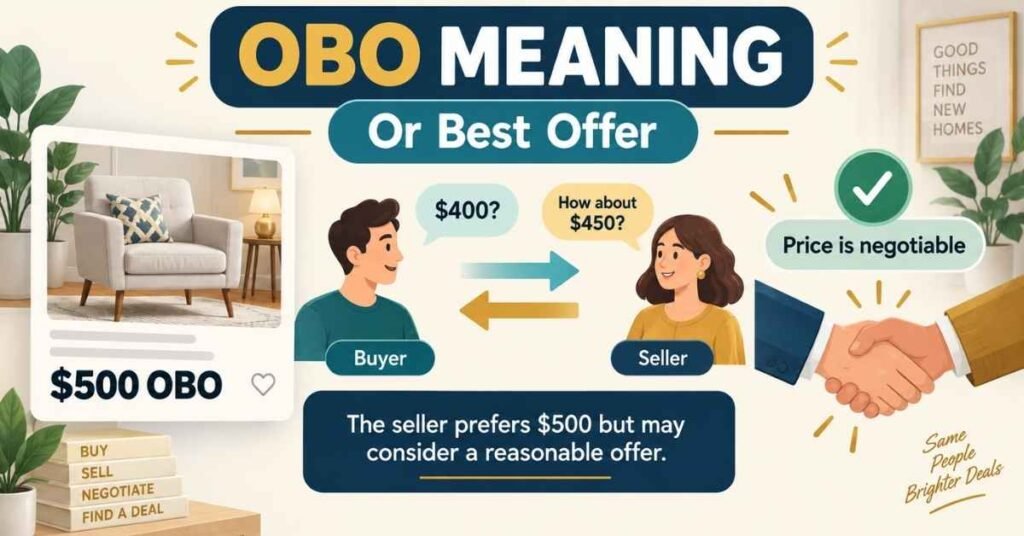
OBO meaning is “or best offer.” When you see a listing such as “$500 OBO,” the seller prefers to receive $500 but is willing to consider another reasonable offer. OBO signals that the price is negotiable, but it does not require the seller to accept a lower price—or any offer at all. For buyers, it creates an opportunity to negotiate. For sellers, it provides flexibility without immediately revealing the lowest acceptable price.
What Does OBO Mean?
OBO stands for “or best offer.” It is an abbreviation commonly placed after the asking price in advertisements for used products, vehicles, furniture, electronics, collectibles, and other items.
For example:
Used laptop: $600 OBO
This means the seller would like to receive $600 but may consider a different amount. A buyer could offer $550, $525, or another price based on the laptop’s condition and fair market value.
You will commonly see OBO in:
- Facebook Marketplace listings
- Craigslist advertisements
- OfferUp listings
- eBay descriptions
- Used-car advertisements
- Local selling groups
- Newspaper classifieds
- Garage and yard sales
- Community bulletin boards
- Private-party sales
OBO is technically an initialism because people usually pronounce the individual letters: “oh-bee-oh.”
OBO at a Glance
| Detail | Meaning |
|---|---|
| Full form | Or best offer |
| Pronunciation | Oh-bee-oh |
| Common placement | After an asking price |
| Purpose | To invite reasonable offers |
| Price status | Flexible or negotiable |
| Seller’s obligation | The seller may accept, reject, ignore, or counter |
| Common context | Used items, cars and classified advertisements |
| Example | “Dining table: $300 OBO” |
What Does “$500 OBO” Mean?
“$500 OBO” means the seller is asking $500 but will consider other offers. The listed amount remains the seller’s preferred price. It is not an invitation to offer any random amount without considering the item’s value.
A typical negotiation might look like this:
- The seller lists an item for $500 OBO.
- A buyer offers $425.
- The seller rejects $425 but counters with $465.
- The buyer agrees to $450 with same-day pickup.
- Both parties confirm the final price and collection details.
The letters OBO do not tell you the seller’s private minimum. One seller might accept $450, while another might refuse anything below $490.
Several factors can influence the final price:
- Current market value
- Product condition
- Local demand
- Time since the item was listed
- Number of interested buyers
- Seller urgency
- Pickup speed
- Payment method
- Delivery requirements
- Included accessories
What OBO Does—and Does Not—Promise
Many marketplace disagreements happen because buyers and sellers interpret OBO differently. The simplest explanation is that OBO opens the door to negotiation. It does not guarantee a particular outcome.
OBO Means the Seller Is Open to an Offer
When sellers include OBO, they are telling buyers:
“This is the amount I would like, but I am willing to hear a reasonable proposal.”
That is different from a firm price, where the seller does not want to bargain.
A buyer can respond with a lower amount, but the offer should still reflect the item’s market value, condition, and demand.
OBO Does Not Mean the Seller Must Accept Less
A seller using OBO can still:
- Receive the full asking price
- Reject a lower offer
- Make a counteroffer
- Wait for additional buyers
- Remove the listing
- Decide not to sell
- Accept a more convenient proposal
The seller does not have to accept an offer simply because it is currently the highest or only proposal.
OBO Does Not Guarantee a Discount
Some buyers assume an OBO listing automatically means the item will sell below the advertised price. That is not always true.
If the item is priced fairly and receives strong interest, another buyer may pay the full asking price. In competitive situations, a buyer may even offer more than the advertised amount to secure the item.
OBO Does Not Necessarily Mean the Seller Is Desperate
Price flexibility and desperation are not the same thing. A seller may use OBO because:
- The item is difficult to value
- There are few comparable listings
- Bargaining is expected in that category
- The seller wants more inquiries
- Demand is uncertain
- Pickup convenience matters
- The seller is willing to wait for a strong offer
- The seller wants to test the market
Phrases such as “must go today,” “moving tomorrow,” or “need gone ASAP” are stronger signals of urgency than OBO alone.
“Best” Does Not Always Mean “Highest”
The highest dollar amount may seem like the best offer, but sellers frequently consider the entire transaction.
Imagine two buyers contact a seller:
- Buyer A offers $200 but wants delivery next week.
- Buyer B offers $190, can collect the item today, and does not need assistance moving it.
The seller may choose Buyer B because the slightly lower offer requires less time, effort, and risk.
A practical way to understand this is:
Offer quality = price + convenience + certainty − risk − seller effort
This is not a legal formula. It is a simple framework showing why the best overall proposal is not always the one with the highest number.
OBO vs. Firm, Negotiable, and Other Sales Terms
Marketplace listings use several phrases to explain whether a price is flexible.
| Listing language | Practical meaning | Should you offer less? |
|---|---|---|
| $500 OBO | Seller prefers $500 but will consider offers | Yes, respectfully |
| $500 firm | Seller does not want to negotiate | Generally no |
| $500 negotiable | Seller is openly flexible | Yes |
| $500 or reasonable offer | Seller welcomes realistic alternatives | Yes |
| Make an offer | Seller has not published a firm target | Yes |
| Best offer by Friday | Seller may compare proposals before deciding | Yes |
| No lowballs | Seller may negotiate but rejects extreme discounts | Carefully |
| Price reduced | Seller has already lowered the amount | Possibly |
OBO vs. Firm
A firm price means the seller expects the listed amount and does not want lower offers.
Compare:
- “Desk: $250 OBO” — negotiation is welcome.
- “Desk: $250 firm” — the seller expects $250.
You can still ask a factual question about condition or included accessories on a firm listing. However, repeatedly requesting a discount after the seller has clearly said the price is firm can appear disrespectful.
OBO vs. Negotiable
Both OBO and negotiable indicate price flexibility. The difference is subtle.
“Negotiable” emphasizes the seller’s willingness to discuss the price. “OBO” may suggest that the seller is willing to compare several offers and select the most attractive one.
Neither phrase guarantees that the seller will accept less.
OBO vs. ONO
ONO means “or nearest offer.” It is more common in some countries outside the United States.
Both terms suggest flexibility, but OBO is the more familiar expression in American classified advertisements. “Nearest offer” may suggest an amount close to the asking price, while “best offer” leaves more room to consider the overall proposal.
Can a Seller Write “Firm OBO”?
The phrase “firm OBO” appears contradictory because “firm” rejects negotiation while OBO invites it.
The seller may be trying to communicate one of these ideas:
- The price is firm unless someone offers more.
- The listed price is firm for the item alone, but bundles are negotiable.
- Only offers very close to asking price will be considered.
- The seller does not fully understand the terms.
Sellers should use clearer language, such as:
“Asking $500. I may consider reasonable offers close to the listed price.”
How Much Should You Offer on an OBO Listing?
There is no universal percentage you should subtract from every OBO price. Offering 10% or 20% less may be reasonable in one situation and inappropriate in another.
Your offer should begin with the item’s realistic market value, not an automatic discount from the seller’s asking price.
Research Comparable Prices
Look for items that match the listing as closely as possible:
- Same brand
- Same model
- Similar age
- Similar condition
- Same storage capacity or specifications
- Comparable accessories
- Similar local availability
Whenever possible, examine completed sales, not only active listings. A seller can advertise an item for any amount, but the actual selling prices show what buyers have recently paid.
Examine the Item’s Condition
Condition can significantly change a product’s value.
Consider:
- Scratches, cracks, stains, or dents
- Mechanical problems
- Battery health
- Missing components
- Signs of water damage
- Required repairs
- Original packaging
- Warranty status
- Maintenance records
- Included chargers or accessories
- Whether the item works as described
Do not invent or exaggerate defects to pressure the seller. Use visible or documented problems to explain a lower offer.
Consider the Listing’s Age
A new listing may have several interested buyers, giving the seller little reason to negotiate immediately.
An item that has remained unsold for several weeks may offer more bargaining room. However, an older listing does not automatically mean the seller is desperate. The seller may simply be willing to wait.
Include Your Additional Costs
Your total cost may include:
- Repairs
- Replacement parts
- Transportation
- Delivery
- Registration
- Sales tax
- Professional inspection
- Cleaning
- Installation
These expenses help you calculate what the item is worth to you, but the seller is not required to absorb every personal cost.
Set a Walk-Away Price
Your walk-away price is the maximum amount you can reasonably pay without regretting the purchase.
Set this limit before negotiating. It protects you from increasing your offer simply because you are emotionally invested or worried that another buyer will get the item.
A practical estimate is:
Reasonable offer = realistic market value − condition adjustments − immediate required costs
This calculation is a starting point, not an inflexible rule.
When a Lower Offer Is Reasonable
A meaningfully lower offer may be justified when:
- The asking price exceeds comparable sales
- The item has visible damage
- Repairs are required
- Important accessories are missing
- The listing has been active for a long time
- The seller requests urgent collection
- You are buying several items
- You can save the seller delivery or moving costs
- The description does not match the item’s actual condition
For example, suppose a used laptop is listed for $600 OBO, but comparable models sell for approximately $525. If it also needs a $75 replacement battery, an offer near $450 may have a reasonable basis.
The seller can still reject it, but the offer is supported by evidence rather than guesswork.
When a Lower Offer May Be Unreasonable
A large discount may be difficult to justify when:
- The item is already priced below market value
- The listing was published recently
- Demand is high
- The condition is excellent
- The model is rare
- Several buyers are interested
- Valuable accessories are included
- You expect delivery or additional services
- Your offer is based only on wanting a bargain
An offer is more likely to be ignored when it provides the seller with less money and more inconvenience.
The FAIR Framework for Making an OBO Offer
Use the FAIR framework to develop an offer that is reasonable, persuasive, and easy to evaluate.
F — Find the Fair Market Value
Research recent prices for genuinely comparable items. Do not compare a damaged older model with a new or upgraded version.
Market value creates a rational starting point for negotiation.
A — Assess the Condition
Identify defects, age, repairs, missing parts, and included accessories. Separate cosmetic wear from problems that affect safety or function.
A small scratch may have little effect on value. A failing battery, damaged screen, or mechanical defect may justify a larger adjustment.
I — Introduce a Specific Offer
Give the seller an exact amount rather than asking:
“What’s your lowest?”
A specific proposal moves the negotiation forward. It also shows that you have considered the purchase seriously.
R — Reduce the Seller’s Effort
Make your proposal more attractive by offering:
- Prompt pickup
- Flexible collection time
- A secure payment method
- Clear communication
- Help with moving or loading
- A simple transaction
- A bundle purchase
Convenience can sometimes make a lower price more competitive.
How to Write an OBO Message That Gets a Response
A strong offer should be specific, respectful, and easy to complete.
A Good General Offer
“Hi, I’m interested in the desk. Would you consider $180? I can collect it this evening and pay after checking it in person.”
This message works because it includes:
- A polite greeting
- The specific item
- A clear offer
- A collection plan
- A straightforward payment arrangement
A Condition-Based Offer
“I’m interested in the laptop. Similar models appear to sell near $450, and this one will need a replacement battery. Would you consider $390?”
This offer explains the lower amount without insulting the item or seller.
A Same-Day Pickup Offer
“Would you accept $225 if I can collect it today at a time that works for you?”
The seller can immediately compare the lower price against the convenience of completing the sale.
A Bundle Offer
“Would you take $240 for the desk and both chairs? I can collect everything tomorrow.”
A bundle reduces the number of separate transactions the seller must manage.
A Full-Price Offer
“I can pay the listed $300 and collect it this afternoon. Is it still available?”
When demand is high, paying the asking price may be the most effective strategy. OBO does not mean you must begin below the listed amount.
OBO Messages That Often Fail
“What’s Your Lowest?”
This asks the seller to reduce the price before you have made an offer. Many sellers view it as low-effort negotiation.
A stronger alternative is:
“Would you consider $425 if I can collect it today?”
“$100 Cash”
A short message without a greeting or explanation can feel dismissive, particularly when the asking price is much higher.
“Take It or Leave It”
This unnecessarily makes the conversation confrontational. The seller can simply decline or stop responding.
“Nobody Will Pay That”
Insulting the seller’s judgment rarely leads to a productive negotiation. If the price is unrealistic, provide relevant comparisons or move on.
Repeated Messages After Rejection
If a seller declines and does not invite another offer, respect the answer. Repeated pressure can lead to blocking or reporting.
What Is a Lowball Offer?
A lowball offer is a proposal significantly below a reasonable market value, usually without sufficient justification.
There is no universal percentage that turns an offer into a lowball. Context matters.
An offer 20% below asking price might be reasonable if:
- The item is overpriced
- Repairs are needed
- The seller wants immediate removal
- Comparable products sell for less
The same 20% discount might be unreasonable if:
- The item is already underpriced
- It is in excellent condition
- Demand is high
- The listing is new
Low Offer vs. Lowball Offer
| Type | Characteristics | Example |
|---|---|---|
| Lower but reasonable offer | Based on market value, condition or convenience | “Would you consider $420 because the battery needs replacement?” |
| Lowball offer | Far below value with no explanation | “$150 cash” on a fairly priced $500 item |
| Conditional offer | Depends on inspection or verification | “$450 subject to confirming it works properly” |
| Convenience-based offer | Lower amount paired with fast, easy completion | “$440 with pickup this evening” |
The amount matters, but the reasoning and presentation also affect how the seller perceives it.
How Sellers Should Use OBO
Sellers should not add OBO automatically. Use it when you are genuinely willing to consider alternatives.
Establish Your Private Minimum
Before publishing the listing, decide:
- Your ideal price
- A realistic market price
- Your acceptable range
- Your absolute minimum
- How quickly you want to sell
- Whether convenience can justify a lower amount
Keeping a private minimum prevents you from accepting an offer impulsively or reacting emotionally to every message.
Price the Item Using Evidence
Review:
- Recent comparable sales
- Similar active listings
- Local demand
- Age and condition
- Original price
- Depreciation
- Included accessories
- Seasonal demand
- Repair requirements
- Shipping or delivery costs
An inflated asking price followed by OBO can discourage serious buyers. A realistic price with modest flexibility usually produces better conversations.
Describe the Item Honestly
A detailed description helps buyers make credible offers.
Include:
- Brand and model
- Age
- Dimensions
- Working condition
- Cosmetic defects
- Missing parts
- Included accessories
- Pickup or delivery options
- Payment preferences
- Reason for selling when useful
Honest disclosure also reduces last-minute renegotiation.
Use Clear OBO Language
Good listing examples include:
“Asking $300 OBO. Reasonable offers considered. Local pickup only.”
“$1,200 OBO after inspection. Clean title and maintenance records available.”
“$75 each or $200 for all three. Open to reasonable bundle offers.”
If you are willing to accept only a narrow range, say so:
“Asking $500. I may consider reasonable offers close to the listed price.”
The BEST Framework for Evaluating Offers
Sellers can use the BEST framework to compare proposals.
B — Balance Price and Convenience
Consider the offered amount alongside pickup timing, delivery requests, and the work required to complete the transaction.
E — Establish Buyer Reliability
A dependable buyer typically:
- Communicates clearly
- Makes a specific offer
- Proposes a realistic meeting time
- Avoids suspicious payment methods
- Does not create unnecessary urgency
- Follows the agreed plan
A higher offer from an unreliable buyer may never become a completed sale.
S — Screen the Conditions
Check whether the offer includes conditions such as:
- Delivery
- A lengthy hold
- Extra accessories
- Installation
- Payment installments
- A third-party courier
- Renegotiation after arrival
- Additional repairs
Conditions can reduce the real value of an offer.
T — Tie Down the Agreement
Before meeting, confirm:
- Final price
- Exact item
- Included accessories
- Known condition
- Pickup location
- Date and time
- Payment method
- Whether the item will be held
Clear written terms reduce misunderstandings.
How to Accept an OBO Offer
Avoid replying with only “okay.” Confirm the essential details:
“Yes, I can accept $225. Please confirm that you can collect it at 6 p.m. today. The price includes the desk and two drawers.”
This gives both parties a shared understanding of the transaction.
How to Make a Counteroffer
A counteroffer keeps the negotiation open while protecting your minimum price.
“Thanks for the offer. I can’t do $180, but I could accept $220 if you collect it this weekend.”
A useful counteroffer contains:
- Appreciation
- A clear rejection of the current amount
- A new price
- Any important condition
- A practical next step
How to Reject an Offer Politely
A rejection does not need to become an argument.
You can write:
“Thank you for the offer, but that amount is below what I can accept.”
Or:
“I appreciate your interest. I’m staying closer to the asking price for now.”
These responses are professional and leave room for the buyer to improve the proposal.
How to Respond to a Lowball Offer
If you want to continue the conversation:
“I’m not able to accept that amount. My current minimum is $275.”
If the message is rude, suspicious, or extremely unrealistic, you can decline without further discussion. Sellers are not obligated to negotiate with every person who responds.
Should Sellers Reveal Their Lowest Price?
Revealing your minimum can help you sell quickly, but it reduces your negotiating leverage.
Consider sharing it when:
- You need a fast sale
- You have received few inquiries
- The item has been listed for a long time
- The buyer appears reliable
- The offered amount is already close
Keep it private when:
- The listing is new
- Demand is strong
- Several buyers are interested
- You are not in a hurry
- The current offer is far below a reasonable range
OBO on Popular U.S. Marketplaces
The core OBO marketplace meaning remains consistent across platforms, but the buying process may differ.
| Platform | How OBO is commonly used | Important consideration |
|---|---|---|
| Facebook Marketplace | Added to the price or description | Watch for local-pickup and payment scams |
| Craigslist | Common in classified advertisements | Platform protections may be limited |
| OfferUp | Used in descriptions and private messages | Follow platform safety guidance |
| eBay | Similar to the formal Best Offer feature | Built-in rules can govern offers and payment |
| Local selling groups | Written in posts or comments | Group rules may affect offer order |
| Garage sales | Added to signs or price labels | In-person bargaining is common |
| Car listings | Placed after the advertised vehicle price | Inspection, title and repairs affect value |
What Does OBO Mean on Facebook Marketplace?
OBO on Facebook Marketplace means “or best offer.” The seller is indicating that the listed price has some flexibility.
For example:
“Sofa: $400 OBO. Must be collected by Saturday.”
The collection deadline suggests that a lower offer paired with fast pickup may be attractive.
Facebook Marketplace users should still confirm:
- The seller or buyer’s identity
- Exact item condition
- Meeting location
- Agreed price
- Payment method
- Whether the listing is available or pending
What Does OBO Mean on Craigslist?
The OBO meaning on Craigslist is also “or best offer.” It has long been common in Craigslist ads for vehicles, furniture, electronics, tools, and household goods.
Because transactions may take place outside a protected checkout system, buyers and sellers should be especially cautious about advance payments, unfamiliar links, and third-party pickup stories.
What Does OBO Mean on OfferUp?
On OfferUp, OBO tells potential buyers that the seller may consider another amount. Buyers should use the platform’s messaging and safety features where available.
What Does OBO Mean on eBay?
An eBay seller may use OBO informally in a description, but eBay also has formal offer features. A platform-based “Best Offer” may follow specific rules regarding expiration, automatic acceptance, automatic rejection, and payment.
Do not assume that informal marketplace customs override the platform’s actual terms.
What Does OBO Mean When Buying or Selling a Car?
OBO in a car listing means the vehicle’s advertised price is open to reasonable negotiation.
For example:
2019 sedan, 72,000 miles: $14,500 OBO
Before making an offer, examine:
- Mileage
- Mechanical condition
- Accident history
- Title status
- Maintenance records
- Tires and brakes
- Warning lights
- Comparable local vehicles
- Immediate repair costs
- Independent inspection results
- Registration and tax expenses
Make Car Offers Subject to Inspection
A preliminary vehicle offer should not ignore unknown mechanical problems.
A buyer might write:
“I’m interested at around $13,700, subject to confirming the title and completing an independent inspection. If everything matches the listing, I can complete the purchase promptly.”
This communicates serious interest without agreeing blindly to purchase the car.
Revising an Offer After Inspection
If an inspection discovers legitimate problems, explain the adjustment with evidence:
“The inspection found that the front brakes and two tires need immediate replacement. Based on the written estimate, would you consider $13,000?”
This differs from arriving and demanding a lower price without justification.
Is an OBO Offer Legally Binding?
OBO itself is only listing language. It indicates openness to offers but does not create a complete agreement by itself.
Whether a message exchange becomes legally binding can depend on:
- Exact wording
- State law
- Type and value of the item
- Platform rules
- Whether all essential terms were agreed
- Whether payment was made
- Whether the transaction had conditions
- Whether special documentation is required
High-value assets, vehicles, real estate, business equipment, and regulated goods may involve additional legal requirements.
To reduce uncertainty:
- Confirm the agreed price in writing.
- Identify the exact item.
- List included accessories.
- State important conditions.
- Clarify pickup and payment.
- Keep relevant records.
For a significant dispute or high-value transaction, obtain advice appropriate to your state and situation.
How to Complete an OBO Transaction Safely
A good price does not matter if the transaction is fraudulent or unsafe.
Inspect Before Paying
Whenever practical:
- Confirm that the item exists.
- Check whether it matches the description.
- Test important functions.
- Examine serial numbers.
- Verify ownership.
- Confirm included accessories.
- Ask about known defects.
Choose a Safe Meeting Location
For local sales:
- Meet in a public, well-lit place.
- Consider a designated safe-exchange area.
- Tell someone where you are going.
- Avoid isolated locations.
- Bring another person for high-value transactions.
- Avoid carrying unnecessary cash.
Large furniture or equipment may require a residential pickup. In that situation, arrange appropriate help and take reasonable personal-safety precautions.
Use a Secure Payment Method
Be cautious when someone:
- Sends an unfamiliar payment link
- Claims to have overpaid
- Requests a refund before funds clear
- Asks for gift cards
- Requests a verification code
- Sends only a payment screenshot
- Introduces an unexpected third-party courier
- Pressures you to pay a deposit immediately
Confirm that payment has actually arrived through the legitimate service or financial account.
Keep Important Details in Writing
Record:
- Final price
- Item description
- Included components
- Known defects
- Collection time
- Meeting location
- Payment method
- Inspection conditions
Written details help prevent misunderstandings, although they do not eliminate every risk.
LEARN MORE: Per Se Meaning
Other Meanings of OBO
Although “or best offer” is the dominant meaning in American marketplace listings, OBO can represent other phrases in professional contexts.
On Behalf Of
In emails, letters, or administrative communication, OBO may mean “on behalf of.”
Example:
“The request was submitted OBO the department director.”
Writing the complete phrase is usually clearer, especially for readers unfamiliar with the abbreviation.
Objecting Beneficial Owner
In financial and shareholder communications, OBO may mean objecting beneficial owner. This refers to a beneficial owner who has objected to the disclosure of certain identifying information through an intermediary.
This meaning is relevant when the surrounding text discusses:
- Securities
- Shareholders
- Brokers
- Beneficial ownership
- Investor communications
- Financial regulation
Open Biomedical Ontologies
In scientific and medical-data contexts, OBO can refer to Open Biomedical Ontologies.
Related terms may include:
- Biomedical research
- Controlled vocabularies
- Scientific classification
- Data standards
- Ontology development
- Biological information
Contract- or Industry-Specific Definitions
Organizations may create their own OBO abbreviation. If you see it in a contract, technical document, or internal report, check:
- The definitions section
- The glossary
- Nearby headings
- The organization’s name
- The surrounding industry
How Context Changes the Meaning
| Context | Most likely OBO meaning |
|---|---|
| Product or vehicle price | Or best offer |
| Marketplace message | Or best offer |
| Formal email or signature | On behalf of |
| Shareholder document | Objecting beneficial owner |
| Biomedical research | Open Biomedical Ontologies |
| Internal company document | Organization-specific definition |
Common Misunderstandings About OBO
“The Seller Must Accept the Highest Offer”
An ordinary OBO listing generally allows the seller to choose whether to proceed. It is not automatically an auction.
“OBO Always Means the Seller Will Take Less”
A seller may receive the full asking price. OBO only indicates that offers will be considered.
“The First Offer Wins”
The seller may wait, compare proposals, or prioritize a buyer who can complete the transaction reliably.
“Cash Justifies a Huge Discount”
Cash may make a transaction simpler, but it does not erase the item’s value. The Cash can also introduce security concerns in high-value sales.
“Every OBO Offer Should Start 20% Lower”
Fixed discount rules ignore condition, demand, market value, and listing age. Research should determine your opening offer.
“An Accepted Message Means the Sale Is Complete”
Payment, inspection, pickup, paperwork, or platform requirements may still be outstanding. Confirm the details clearly.
A Complete OBO Negotiation Example
Consider a used dining table listed for $400 OBO.
The Seller’s Position
- Comparable tables sell for $325–$425.
- The table has minor cosmetic damage.
- The seller wants it collected within one week.
- The seller’s private minimum is $340.
The Buyer’s Assessment
- Fair value after considering the damage is approximately $350.
- The buyer can collect it the same day.
- The buyer will bring help and does not need delivery.
The Opening Offer
“Hi, would you consider $330? I can collect the table this evening and bring someone to help move it.”
The Counteroffer
“Thanks for the offer. I could accept $360 for pickup tonight.”
The Agreement
“Would you meet me at $350? I can arrive at 6:30 p.m.”
The seller accepts.
Why the Deal Worked
- The buyer researched the market.
- The opening offer was not arbitrary.
- The buyer reduced the seller’s workload.
- The seller made a clear counteroffer.
- Both parties compromised.
- The final price stayed within a reasonable range.
The buyer did not “beat” the seller, and the seller did not “defeat” the buyer. They found terms that worked for both sides.
Quick OBO Checklist for Buyers
Before making an offer:
- Confirm the exact model and condition.
- Research recent comparable prices.
- Calculate necessary repair and collection costs.
- Decide your walk-away price.
- Make a specific offer.
- Explain meaningful condition-based adjustments.
- Include a realistic pickup plan.
- Communicate respectfully.
- Inspect the item before paying.
- Use a secure payment method.
- Confirm the final terms in writing.
Quick OBO Checklist for Sellers
Before publishing or accepting:
- Research fair market value.
- Set an ideal price and private minimum.
- Describe defects honestly.
- Include important specifications.
- State pickup and payment expectations.
- Decide whether you will hold the item.
- Compare convenience as well as price.
- Screen suspicious payment requests.
- Confirm the agreed terms.
- Verify payment independently.
- Update the listing when the item is pending or sold.
Frequently Asked Questions
What does OBO stand for?
OBO stands for “or best offer.” It tells buyers that the seller will consider another amount instead of insisting exclusively on the advertised price.
What does OBO mean in a marketplace listing?
OBO means the listed amount is the asking price, but the seller is open to receiving reasonable offers.
Does OBO mean the price is negotiable?
Yes. OBO signals that the price is negotiable, although the seller can still reject, ignore, or counter any proposal.
What does “$500 OBO” mean?
It means the seller would like $500 but may consider another offer. It does not reveal the lowest amount the seller will accept.
How much less should I offer?
There is no standard percentage. Research comparable prices, examine condition, calculate necessary costs, and make an evidence-based offer.
Is offering 20% below the asking price reasonable?
It can be reasonable when the asking price is high, repairs are required, or the listing has been active for a long time. It may be unreasonable for an underpriced item in excellent condition.
Is offering half the asking price rude?
An offer at 50% of asking price may appear disrespectful if the item is fairly priced. It could be defensible only when market evidence or serious condition problems support it.
Does the seller have to accept the best offer?
No. An ordinary OBO listing does not normally require the seller to accept any particular proposal.
Is the best offer always the highest offer?
Not necessarily. A seller may prefer a slightly lower amount with immediate pickup, secure payment, and a reliable buyer.
What is the difference between OBO and firm?
OBO invites negotiation. A firm price indicates that the seller does not want lower offers.
Should I ask, “What’s your lowest?”
A specific, researched offer is usually more effective. “What’s your lowest?” asks the seller to reduce the price without receiving a concrete proposal.
Does OBO mean the seller is desperate?
No. Sellers may use OBO because they are uncertain about value, expect negotiation, want more inquiries, or value convenience.
Can a seller accept another buyer’s offer?
The seller may compare proposals unless a binding agreement or platform rule prevents it. Clear written communication helps reduce misunderstandings.
What does OBO mean on Facebook Marketplace?
On Facebook Marketplace, OBO means “or best offer.” The seller is indicating some flexibility in the listed price.
What does OBO mean when buying a car?
It means the advertised vehicle price is open to reasonable negotiation. Buyers should base offers on condition, mileage, title, comparable vehicles, and inspection results.
Does OBO mean “on behalf of”?
It can mean “on behalf of” in formal emails, letters, and administrative communications. In product listings, it almost always means “or best offer.”
Is OBO legally binding?
OBO alone is not a complete agreement. Whether later messages create enforceable obligations depends on the wording, item, platform rules, applicable law, and agreed terms.
Final Takeaway
OBO means “or best offer,” and it tells buyers that a seller is willing to consider reasonable alternatives to the asking price. It creates room for negotiation, but it does not guarantee a discount, reveal the seller’s minimum, or require acceptance.
As a buyer, research fair market value, make a specific offer, and strengthen it through reliable pickup and clear communication. As a seller, establish your minimum in advance, evaluate the entire proposal, and confirm every important term.
A successful OBO transaction is not about forcing the other person to lose. It is about finding a fair price and practical terms that both sides can confidently accept.

1 thought on “OBO Meaning: What “Or Best Offer” Means in Listings”