
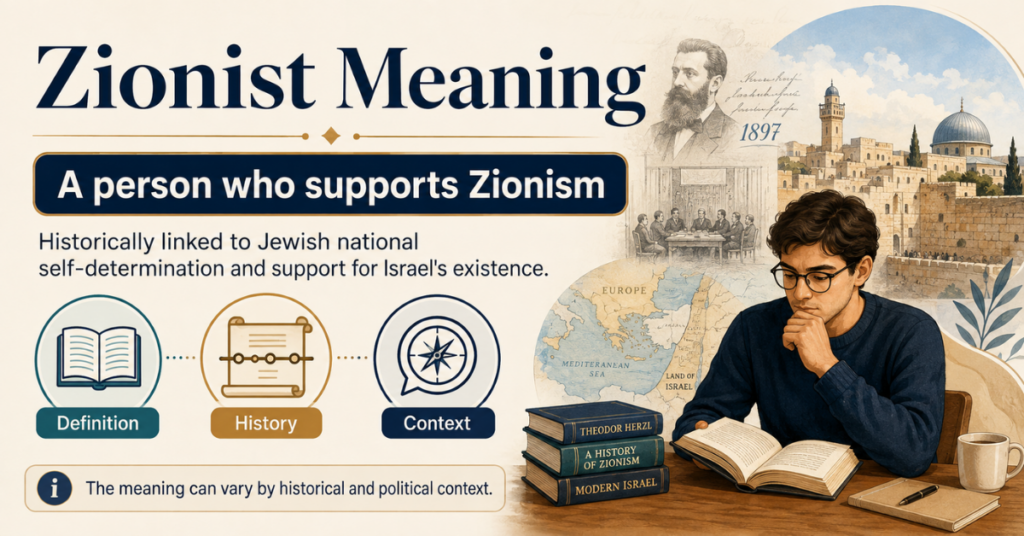
Zionist meaning refers to a person who supports Zionism, a movement historically associated with Jewish national self-determination and the establishment of a Jewish homeland or state in the historic Land of Israel/Palestine. Today, calling someone a Zionist usually means that they support some form of continued Jewish national self-determination and, commonly, the continued existence of Israel as a Jewish state. However, the label does not automatically tell you what that person believes about the Israeli government, Palestinians, settlements, borders, religion, or a specific military policy.
That distinction matters because Zionist, Jewish, Israeli, and supporter of the Israeli government are not synonyms. The word is used neutrally in dictionaries, positively as a form of self-identification, critically in political debates, and sometimes inaccurately as a catch-all label.
Understanding the term requires separating its dictionary definition, historical meaning, modern political use, and controversial interpretations.
What Does Zionist Mean?
A Zionist is, in the simplest sense, someone who supports Zionism.
Zionism developed as a modern Jewish nationalist movement centered on the idea that Jewish people should be able to exercise national self-determination in their historic homeland.
Before the State of Israel was established in 1948, Zionism was largely concerned with creating or developing a Jewish national home or state. After Israel was established, the meaning evolved. Today, Zionism often refers to supporting Israel’s continued existence as a Jewish state, although individual Zionists can disagree sharply about Israeli politics and the Israeli-Palestinian conflict.
Zionist Meaning in Simple Words
If you want the Zionist meaning in simple words, think of it this way:
A Zionist is someone who believes Jewish people should have national self-determination in their historic homeland and generally supports the existence of Israel as a Jewish state.
That definition gives you the core meaning without assuming anything about the person’s position on every modern political issue.
The Short Definition vs. the Full Meaning
A dictionary may simply tell you:
“A Zionist is a supporter of Zionism.”
That is correct, but it leaves an obvious question:
What is Zionism?
Historically, Zionism refers to a modern movement for Jewish national revival, self-determination, and statehood. Modern usage is more complicated because the Jewish state the original political movement sought already exists.
As a result, contemporary debates often ask what being a Zionist means after 1948.
For some people, it primarily means supporting Israel’s right to continue existing as a Jewish state. For others, it includes particular political, cultural, religious, or territorial ideas.
There is no single political platform followed by everyone who calls themselves a Zionist.
Zionist as a Noun and an Adjective
Zionist can function as both a noun and an adjective.
As a noun:
“She identifies as a Zionist.”
Here, Zionist describes the person’s political or national outlook.
As an adjective:
“The Zionist movement became internationally organized during the late nineteenth century.”
Here, Zionist describes something connected with Zionism.
What Does Zionism Mean?
Zionism is a form of Jewish nationalism that emerged as an organized political movement in Europe during the late nineteenth century.
Its central historical idea was that Jewish people constitute a people or nation entitled to national self-determination, particularly in the land with which Jewish history, religion, and identity have long been connected.
Zionism developed in a period shaped by several forces, including:
- European nationalism
- discrimination and antisemitism
- Jewish migration
- political debates about emancipation
- long-standing Jewish religious and cultural connections to Jerusalem and the Land of Israel
- growing nationalist movements throughout Europe and the Middle East
Different Zionists disagreed about how Jewish national revival should happen, what form it should take, and how religion, culture, socialism, borders, and political sovereignty should fit into it.
Zionism in Plain English
In plain English, Zionism is the idea that Jewish people should be able to exercise national self-determination in their historic homeland.
Historically, this became a movement seeking a Jewish national home and eventually a state.
After the State of Israel was established in 1948, Zionism became less about whether a Jewish state should be created and more about what Israel’s existence, identity, security, politics, and future should look like.
Why “Support for Israel” Can Be Too Vague
You will often see a Zionist described simply as someone who “supports Israel.”
That can be useful shorthand, but it is imprecise.
“Supporting Israel” might mean:
- supporting Israel’s continued existence;
- supporting Israel as a Jewish state;
- supporting Jewish national self-determination;
- supporting the safety of Israeli citizens;
- supporting a particular Israeli government;
- supporting particular borders or policies.
Those are not necessarily the same position.
Someone can identify as a Zionist while strongly criticizing an Israeli prime minister, opposing settlements, supporting a Palestinian state, or rejecting particular military decisions.
What Does Being a Zionist Actually Tell You?
The label Zionist tells you something about a person’s position on Jewish national self-determination.
It does not give you a complete political profile.
What the Label Usually Tells You
A person who identifies as a Zionist generally supports some form of:
- Jewish national self-determination
- continued Jewish connection to the historic Land of Israel
- a Jewish national homeland or state
- the continued existence of the State of Israel
Exactly how those principles should operate in practice varies enormously.
What the Label Does Not Automatically Tell You
Being a Zionist does not automatically mean that someone:
- is Jewish;
- is Israeli;
- is religious;
- supports the current Israeli government;
- supports every Israeli military action;
- supports Israeli settlements;
- opposes a Palestinian state;
- supports a particular prime minister;
- supports specific borders;
- rejects Palestinian national self-determination;
- holds the same ideology as every other Zionist.
This is one of the most important distinctions to understand.
Why This Distinction Matters
Political conversations often compress multiple identities into a single label.
Someone may hear:
Jewish → Israeli → Zionist → Israeli government supporter
and assume all four mean the same thing.
They do not.
A person’s religion, ethnicity, nationality, ideology, and views about a government are separate categories.
Understanding that prevents both factual errors and unfair assumptions.
Zionist vs. Jewish vs. Israeli: What Is the Difference?
These terms are commonly confused, but they refer to different things.
| Term | Primarily Refers To | What It Does Not Automatically Mean |
|---|---|---|
| Jewish | A people, culture, ethnicity and/or religion | Zionist |
| Zionist | Support for Zionism/Jewish national self-determination | Jewish or Israeli |
| Israeli | Nationality or citizenship | Zionist |
| Pro-Israel | Some form of support for Israel | Support for every Israeli policy |
Can Someone Be Jewish but Not Zionist?
Yes.
Jewish people hold a wide variety of political and religious views.
Some Jewish people strongly identify as Zionists. Others support Israel but dislike or reject the Zionist label. Some are non-Zionist, and some identify as anti-Zionist.
Being Jewish does not automatically determine a person’s political ideology.
Can Someone Be Zionist but Not Jewish?
Yes.
A Zionist does not have to be Jewish.
There are Christian Zionists, particularly in the United States, as well as other non-Jewish people who support Zionism for religious, historical, strategic, or political reasons.
This is another reason that “Zionist” and “Jewish” should never be treated as interchangeable words.
Can an Israeli Be Anti-Zionist?
Yes.
Israeli describes nationality or citizenship.
Zionist describes an ideological or political position.
An Israeli citizen may support Zionism, reject Zionism, or hold a more complicated position that does not fit neatly into either category.
Where Did the Word Zionist Come From?
To understand the word Zionist, it helps to understand Zion.
The Meaning of Zion
Zion has deep biblical, historical, and religious associations with Jerusalem and the Land of Israel.
Over centuries, Zion became more than a specific geographic reference. In Jewish religious and cultural traditions, it often represented Jerusalem, the Jewish homeland, and hopes of return or restoration.
Modern Zionism drew its name from this older concept.
How Zionism Became a Political Term
The modern political term Zionism appeared during the late nineteenth century.
Nathan Birnbaum, a Jewish writer and political activist, is commonly associated with popularizing the term in its modern political sense.
This period coincided with the growth of nationalist movements throughout Europe.
Many Jewish thinkers were confronting a difficult problem: even as some European states granted Jews greater legal rights, antisemitism, discrimination, and violent persecution remained widespread.
Some concluded that Jewish safety and political independence required a national movement of their own.
Theodor Herzl and Political Zionism
Theodor Herzl became the most famous leader associated with modern political Zionism.
An Austro-Hungarian Jewish journalist, Herzl argued that European antisemitism could not be solved through assimilation alone.
In 1896, he published Der Judenstaat (The Jewish State), arguing for Jewish political sovereignty.
Herzl did not invent every idea associated with Zionism. Jewish nationalist and proto-Zionist movements existed before him. His importance came from transforming Zionism into a more organized international political project.
The First Zionist Congress in 1897
In 1897, Herzl convened the First Zionist Congress in Basel, Switzerland.
The congress helped establish an organized international Zionist movement and created institutions that would influence Jewish political activity for decades.
This makes 1897 one of the most important dates in the history of modern Zionism.
A Short Timeline of Zionism
| Date/Period | Event | Why It Matters |
|---|---|---|
| Late 1800s | Modern Zionist thought develops | Jewish nationalism becomes an organized political movement |
| 1896 | Herzl publishes Der Judenstaat | Presents a political argument for Jewish statehood |
| 1897 | First Zionist Congress meets in Basel | International Zionist movement becomes formally organized |
| 1917 | Balfour Declaration | Britain expresses support for a Jewish national home in Palestine |
| 1920s–1940s | British Mandate period | Jewish immigration, institution-building, Arab opposition, and communal conflict intensify |
| 1948 | State of Israel established | Zionism enters a new post-state period |
| After 1948 | Zionist movements evolve | Debates increasingly focus on Israel’s character, security, borders, democracy, and relationship with Palestinians |
How the Meaning of Zionism Changed After 1948
The establishment of Israel fundamentally changed the political meaning of Zionism.
Zionism Before Israel Existed
Before 1948, political Zionism was largely concerned with questions such as:
- Should Jewish people establish a national homeland or state?
- Where should that state be located?
- How should Jewish immigration be organized?
- Should the movement prioritize diplomacy, settlement, socialism, religion, or cultural revival?
- How should relations with the Arab population be handled?
The basic political objective was still unfinished.
Zionism After Israel Was Established
After Israel declared independence in 1948, the original state-building question changed.
Zionism could no longer be defined only as a movement to establish a Jewish state because such a state now existed.
Modern Zionism therefore became associated with questions including:
- Israel’s continued existence;
- Israel’s Jewish character;
- immigration and aliyah;
- security;
- democracy;
- relations with the Jewish diaspora;
- Israel’s borders;
- Palestinian statehood;
- settlements;
- religion and state;
- peace agreements.
This explains why two people can both call themselves Zionists while strongly disagreeing about Israeli politics.
Why Modern Definitions Are More Complicated
Modern Zionism exists within the unresolved Israeli-Palestinian conflict.
That creates disagreements about:
- national self-determination;
- territorial sovereignty;
- security;
- Palestinian rights;
- settlements in the West Bank;
- refugees;
- borders;
- Jerusalem;
- one-state and two-state proposals.
A simple dictionary definition cannot answer all those political questions.
Nor should it.
The definition explains the term. Political arguments concern what the ideology has meant historically and what policies should follow from it today.
Are There Different Types of Zionism?
Yes. Zionism has never been a single uniform political ideology.
Different schools developed around competing ideas about economics, religion, culture, territory, and political strategy.
Political Zionism
Political Zionism is closely associated with Theodor Herzl.
It emphasized diplomacy and international political recognition as routes toward Jewish sovereignty.
Labor Zionism
Labor Zionism combined Zionist nationalism with socialist ideas.
It played an important role in the development of Jewish institutions and early Israeli politics.
Labor Zionists often emphasized collective agriculture, workers’ organizations, and social-democratic approaches to nation-building.
Cultural Zionism
Cultural Zionism emphasized Jewish cultural and spiritual renewal rather than focusing solely on political statehood.
Figures associated with this tradition argued that Jewish national revival required education, Hebrew culture, literature, and intellectual life.
Revisionist Zionism
Revisionist Zionism, historically associated with Ze’ev Jabotinsky, developed a more nationalist approach to Zionist politics.
Its intellectual and political legacy later influenced parts of Israel’s political right.
Religious Zionism
The Religious Zionism combines Jewish religious belief with Zionist ideas about national restoration and Jewish sovereignty.
Religious Zionists themselves hold a range of political positions.
Liberal or Progressive Zionism
People sometimes use terms such as liberal Zionist or progressive Zionist for positions combining support for Israel’s continued existence with support for:
- democratic institutions;
- Palestinian rights;
- negotiated peace;
- a two-state solution;
- opposition to settlement expansion or particular government policies.
Christian Zionism
The Christian Zionism is especially significant in the United States.
Christian Zionists generally support Jewish connection to Israel or the State of Israel, often partly because of particular interpretations of biblical prophecy or Christian theology.
They demonstrate why not all Zionists are Jewish.
What Does Zionist Mean in American Politics?
In the United States, the term Zionist appears in several overlapping contexts:
- Jewish American identity;
- evangelical Christianity;
- U.S.-Israel relations;
- Democratic and Republican politics;
- college campuses;
- activist movements;
- debates over antisemitism;
- Palestinian advocacy;
- social media.
These environments often use the word differently.
Zionist Does Not Mean “Supports Every Israeli Government”
This distinction is particularly important in American political discussion.
Consider this statement:
“I am a Zionist, but I strongly oppose the current Israeli government.”
There is no inherent contradiction.
The speaker may support Israel’s continued existence and Jewish self-determination while opposing:
- a particular prime minister;
- settlement policy;
- military strategy;
- coalition politics;
- judicial reforms;
- treatment of Palestinians.
The same distinction applies elsewhere.
Supporting the existence of the United States does not require supporting every American administration. Supporting Palestinian national self-determination does not require supporting every Palestinian political organization.
States, governments, populations, and ideologies are separate concepts.
Why Americans Often Use Different Definitions
American discussions of Zionism are shaped by very different experiences.
For some Jewish Americans, Zionism may be connected to:
- Jewish history;
- family;
- Holocaust memory;
- antisemitism;
- security;
- national self-determination.
The For some evangelical Christians, Zionism has a strong theological dimension.
For Palestinian Americans and many pro-Palestinian activists, the word may evoke:
- Palestinian displacement;
- territorial loss;
- occupation;
- refugeehood;
- unequal political power.
These perspectives explain why the same term can carry very different emotional associations.
What Does Zionist Mean on Social Media?
Many people searching “what does Zionist mean today” are not reading nineteenth-century political theory.
They have seen the word on TikTok, X, Reddit, Instagram, YouTube, news reports, protests, or college campuses.
Social media makes the term harder to interpret because political labels are often compressed into short posts with little context.
When “Zionist” Is Used as Self-Identification
Consider:
“I consider myself a liberal Zionist.”
The speaker is explicitly identifying with some version of Zionism.
You can reasonably conclude that they support Jewish national self-determination or Israel’s continued existence.
You cannot automatically conclude what they think about settlements, Gaza, a Palestinian state, the Israeli prime minister, or specific military operations.
When “Zionist” Is Used as an Accusation
Now consider:
“That journalist is a Zionist.”
Without context, the sentence tells you much less.
Is the person describing a publicly stated political identity?
Are they assuming that identity because the journalist is Jewish?
The Are they criticizing the journalist’s views about Israel?
Are they using “Zionist” simply as an insult?
The surrounding context determines whether the label is accurate and what the speaker intends.
A Practical Way to Interpret the Word
When you encounter Zionist online, ask four questions:
- Who is using the word?
- Is someone self-identifying, or is another person labeling them?
- Is the discussion about Jewish self-determination, Israel’s existence, the Israeli government, or a specific policy?
- Is the word being used descriptively, critically, or as an insult?
These questions usually reveal more than the label alone.
Is Zionist a Bad Word or an Insult?
Zionist is not inherently a bad word or a slur.
It is fundamentally a political and historical label.
People may use it:
- neutrally;
- positively;
- proudly;
- critically;
- negatively;
- or derogatorily.
Context determines tone.
When the Term Becomes Derogatory
The word can become derogatory when it is used primarily to demean, stereotype, or attack someone.
A particularly important problem occurs when “Zionist” is used as a substitute for “Jew”, especially when combined with old antisemitic stereotypes about money, secret control, media, governments, or collective conspiracies.
At the same time, criticism of Zionism as an ideology is not automatically criticism of Jewish people as a group.
The target and substance of the statement matter.
What Is Anti-Zionism?
Anti-Zionism broadly means opposition to Zionism.
An anti-Zionist is someone who rejects or opposes Zionism, but anti-Zionists do not all hold the same political position.
Some oppose Zionism because they reject nationalism generally.
The Some oppose the idea of a specifically Jewish nation-state.
Some religious Jewish anti-Zionists object to Jewish political sovereignty before a messianic era.
Some Palestinian and pro-Palestinian anti-Zionists understand Zionism primarily through its consequences for Palestinian society and displacement.
Others support alternative political arrangements, such as one binational state.
Can Jewish People Be Anti-Zionist?
Yes.
Jewish political thought has historically included Zionist, non-Zionist, and anti-Zionist traditions.
Again, Jewish identity is not synonymous with one political ideology.
Is Anti-Zionism the Same as Antisemitism?
No. Anti-Zionism and antisemitism are different concepts, although arguments continue over when they overlap.
Antisemitism refers to prejudice, hatred, discrimination, or hostility directed at Jewish people because they are Jewish.
Anti-Zionism refers to opposition to Zionism.
A person can criticize Zionism, criticize the State of Israel, or criticize an Israeli government policy without necessarily expressing hostility toward Jewish people.
However, political rhetoric can cross into antisemitism when it:
- blames Jewish people collectively for Israel’s actions;
- uses classical antisemitic stereotypes;
- assumes all Jews share one political ideology;
- targets Jewish institutions simply because they are Jewish;
- uses “Zionist” as coded language for Jews generally.
A Practical Way to Evaluate a Statement
Instead of relying only on labels, ask:
What is actually being criticized?
Is the statement criticizing:
- Zionism as an ideology?
- Israel’s existence?
- an Israeli government?
- a particular law?
- a military action?
- settlement policy?
- Israelis collectively?
- Jewish people collectively?
That distinction often matters more than the political label someone attaches to the statement.
Why Is Zionism Controversial?
Zionism is controversial because Jewish and Palestinian national histories became deeply intertwined around the same territory.
Supporters and critics often begin from different historical experiences.
How Zionists Commonly Understand the Movement
Supporters commonly understand Zionism through ideas such as:
- Jewish self-determination;
- refuge from persecution;
- historical Jewish connection to the Land of Israel;
- restoration of Jewish political sovereignty;
- national survival;
- protection from antisemitism.
For many Zionists, the Holocaust and centuries of persecution reinforce the argument that Jewish people need political security and national sovereignty.
How Critics of Zionism Understand the Movement
Critics often focus on the movement’s consequences for Palestinians.
They may emphasize:
- Palestinian displacement;
- loss of land;
- unequal national power;
- the refugee question;
- occupation;
- settlement expansion;
- competing Palestinian national claims.
Some scholars and activists analyze Zionism using colonial or settler-colonial frameworks.
Zionists and other scholars dispute, qualify, or reject those frameworks, often emphasizing Jewish indigeneity, historical connection, persecution, and national self-determination.
These are interpretive debates.
A reliable explanation should clearly identify them as such rather than presenting one political interpretation as if it were the dictionary definition.
Zionism, Palestine, and the Palestinian Perspective
Any serious explanation of Zionism eventually has to address Palestine and Palestinian history.
Zionism developed politically around a territory that was already inhabited by a substantial Arab population.
That produced competing national movements and increasingly serious conflict during the British Mandate period.
1948 and Competing Historical Memories
In 1948, Israel declared independence.
The event is remembered very differently by Israelis and Palestinians.
For Israelis and many Jews around the world, 1948 represents the achievement of Jewish statehood after centuries of statelessness and persecution.
For Palestinians, the same war is associated with the Nakba, meaning “catastrophe,” during which hundreds of thousands of Palestinians were displaced or became refugees.
Both historical memories strongly shape how people understand Zionism today.
Why This History Shapes the Word “Zionist”
For one person, Zionist may mean:
supporter of Jewish national liberation.
For another, it may evoke:
a political movement associated with Palestinian dispossession.
Understanding why the word carries such different emotional meanings does not require adopting either person’s political conclusion.
It requires understanding the history behind both.
Common Misunderstandings About Zionists
“All Jews Are Zionists”
False.
Jewish people hold diverse views about Zionism and Israel.
“All Zionists Are Jewish”
False.
Christian Zionists and other non-Jewish Zionists exist.
“Zionists Support Everything Israel Does”
False.
A Zionist may strongly criticize Israeli governments and policies.
“Zionism Is a Religion”
False.
Zionism is primarily a political and national movement, although religious forms of Zionism exist.
Judaism is a religion and a broader Jewish civilizational tradition; it is not another word for Zionism.
“Zionist and Israeli Mean the Same Thing”
False.
Israeli describes nationality or citizenship.
Zionist describes an ideological position.
“Every Critic of Israel Is Anti-Zionist”
False.
A person can support Israel’s continued existence while criticizing its government.
“Every Anti-Zionist Is Antisemitic”
That is too broad.
Anti-Zionism and antisemitism describe different things, although specific anti-Zionist rhetoric can become antisemitic depending on its content and target.
Real Examples of How “Zionist” Is Used
Examples are often more useful than abstract definitions.
Historical Example
“Theodor Herzl became an influential Zionist leader.”
Here, Zionist refers to Herzl’s role in organizing a political movement seeking Jewish national sovereignty.
Political Identity Example
“She describes herself as a Zionist.”
You can infer that she supports some form of Zionism.
You cannot automatically infer her complete position on Israeli politics.
Government-Criticism Example
“He is a Zionist but strongly opposes the current Israeli government.”
There is no contradiction.
He may support Israel’s continued existence while opposing the government’s policies.
Non-Jewish Example
“The pastor describes himself as a Christian Zionist.”
The person supports Zionist ideas but is Christian rather than Jewish.
Jewish Anti-Zionist Example
“She is Jewish but identifies as anti-Zionist.”
The sentence illustrates why Jewish identity and Zionist ideology are separate categories.
Ambiguous Social Media Example
“People in the comments called him a Zionist.”
This does not provide enough information.
You would need to know why the label was applied and whether the person actually identifies with Zionism.
LEARN MORE: PDA Meaning
How to Understand the Word When You Encounter It
A useful way to interpret the term is to apply a simple four-step framework.
1. Is the Person Self-Identifying?
A statement such as:
“I am a Zionist”
is clearer than a third party assigning the label.
Self-identification gives you stronger evidence of what a person calls their own political outlook.
2. What Kind of Zionism Are They Referring To?
Political Zionism, Religious Zionism, Labor Zionism, Cultural Zionism, Revisionist Zionism, liberal Zionism, and Christian Zionism are not identical.
The label alone may hide major ideological differences.
3. Are They Talking About Israel’s Existence or a Specific Policy?
This distinction is crucial.
Supporting the existence of Israel is not identical to supporting:
- a government;
- a settlement;
- a war;
- a border;
- a party;
- a particular law.
4. Is the Word Being Used Accurately?
Watch for cases where “Zionist” is incorrectly used as shorthand for:
- Jewish;
- Israeli;
- supporter of the Israeli prime minister;
- Israeli government;
- any supporter of Israel;
- any person critical of Palestinian political organizations.
Accurate language improves both political discussion and factual understanding.
Zionist Meaning at a Glance
| Question | Short Answer |
|---|---|
| What is a Zionist? | Someone who supports Zionism |
| What is Zionism? | A movement centered on Jewish national self-determination |
| Is Zionism a religion? | No |
| Are all Zionists Jewish? | No |
| Are all Jews Zionists? | No |
| Is Zionist the same as Israeli? | No |
| Does Zionist mean supporting every Israeli policy? | No |
| Can a Zionist criticize Israel’s government? | Yes |
| Is Zionist inherently an insult? | No |
| What does anti-Zionist mean? | Someone opposed to Zionism |
Frequently Asked Questions About Zionist Meaning
What does Zionist mean in simple words?
A Zionist is a person who supports Zionism, broadly understood as support for Jewish national self-determination and, today, commonly the continued existence of Israel as a Jewish state.
What does it mean to be a Zionist today?
Today, being a Zionist generally means supporting Israel’s continued existence as an expression of Jewish national self-determination. Individual Zionists may disagree about Israeli governments, Palestinian statehood, settlements, borders, and other policies.
Is a Zionist always Jewish?
No. Non-Jewish Zionists, including many Christian Zionists, exist.
Are all Jewish people Zionists?
No. Jewish people have diverse political views and do not all identify with Zionism.
Can Christians be Zionists?
Yes. Christian Zionism is an important political and religious movement, particularly in the United States.
Is Zionism a religion?
No. Zionism is primarily a national and political ideology or movement. Judaism is a religion and broader cultural and civilizational tradition.
Is Zionist a nationality?
No. Zionist is a political or ideological label.
Israeli is a nationality.
Is Zionist the same as Israeli?
No.
An Israeli can be Zionist, non-Zionist, or anti-Zionist. A Zionist can live outside Israel and may not be Jewish.
Is being pro-Israel the same as being Zionist?
The terms overlap but are not always identical.
“Pro-Israel” can describe many forms of support for Israel, while Zionism specifically relates to Jewish national self-determination and Israel’s existence as a Jewish state.
Can a Zionist criticize the Israeli government?
Yes.
Zionists hold many different political views and can strongly oppose individual Israeli governments or policies.
What is the difference between Zionism and Judaism?
Judaism is a religion and Jewish civilizational tradition.
Zionism is a modern political and national movement.
A person may be Jewish and Zionist, Jewish and non-Zionist, Jewish and anti-Zionist, or Zionist and not Jewish.
What does anti-Zionist mean?
An anti-Zionist is someone who opposes Zionism.
Different anti-Zionists oppose it for different political, religious, nationalist, or ideological reasons.
Can Jewish people be anti-Zionist?
Yes.
Jewish identity does not require adherence to Zionism.
Is Zionist an offensive term?
Not inherently.
It can be a neutral political description or a self-identifier. It may become insulting or derogatory depending on the context in which it is used.
Why is Zionism controversial?
Zionism is controversial largely because Jewish and Palestinian national movements developed competing claims and historical experiences connected to the same territory.
Supporters often emphasize Jewish self-determination and security, while critics frequently emphasize Palestinian displacement, national rights, occupation, and territorial conflict.
Who started modern Zionism?
No single person invented all Zionist thought, but Theodor Herzl became the central organizer of modern political Zionism during the late nineteenth century.
What did Theodor Herzl have to do with Zionism?
Herzl argued for Jewish political sovereignty, published Der Judenstaat in 1896, and helped organize the First Zionist Congress in Basel in 1897.
What does Zion mean?
Zion historically refers to Jerusalem and, more broadly in Jewish religious and cultural traditions, to the Jewish homeland or Land of Israel. The modern term Zionism developed from this older concept.
The Bottom Line on Zionist Meaning
Zionist meaning is straightforward at its core: a Zionist is someone who supports Zionism. Historically, Zionism developed as a modern movement for Jewish national self-determination and the establishment of a Jewish homeland or state. Since Israel’s creation in 1948, the term commonly refers to support for Israel’s continued existence as a Jewish state.
But the label has limits.
Calling someone a Zionist does not automatically tell you what they believe about the Israeli government, Palestinians, settlements, religion, borders, war, or a two-state solution.
That is why context matters.
The historical definition can be explained relatively clearly. The political arguments surrounding Zionism—its consequences, competing national claims, and what it should mean today—remain deeply contested.

3 thoughts on “Zionist Meaning: Definition, History & Modern Use Explained”