

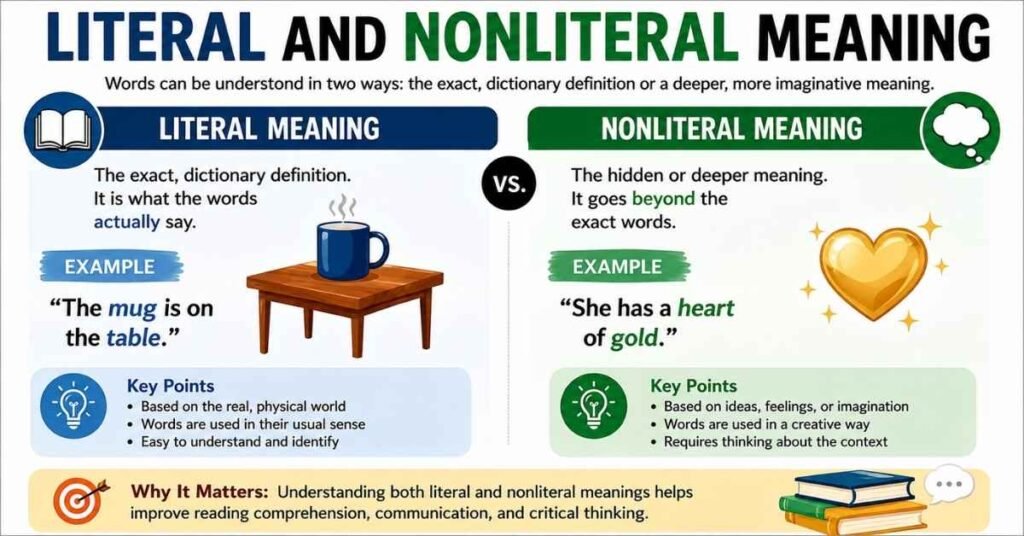
Literal and nonliteral meaning describes two different ways words and phrases can communicate an idea. Literal meaning is the direct meaning of the words as they are written or spoken, while nonliteral meaning goes beyond the exact wording to express another idea, comparison, emotion, or image. For example, “The cake is on the table” is literal, but “The test was a piece of cake” is nonliteral because piece of cake means the test was very easy.
The difference may sound simple, but context matters. The same phrase can be literal in one sentence and nonliteral in another. Learning how to recognize that difference improves reading comprehension, vocabulary, writing, and everyday communication.
Literal vs. Nonliteral Meaning at a Glance
| Feature | Literal Meaning | Nonliteral Meaning |
|---|---|---|
| Basic definition | Direct meaning of the words | Intended meaning beyond the direct words |
| Interpretation | Usually straightforward | Usually requires context or inference |
| Common use | Facts, instructions, descriptions | Conversation, stories, poetry, creative writing |
| Context needed | Sometimes | Usually important |
| Common forms | Ordinary statements | Idioms, metaphors, similes, hyperbole, personification |
| Example | “The water is cold.” | “She gave me the cold shoulder.” |
A useful rule to remember is:
Literal = what the words directly say.
Nonliteral = what the writer or speaker wants you to understand beyond the direct wording.
What Is Literal Meaning?
Literal meaning is the ordinary, direct interpretation of a word, phrase, or sentence. When language is literal, you do not need to search for a hidden comparison, exaggeration, idiom, or symbolic idea.
For example:
- “The dog is sleeping under the table.”
- “Mia opened the window.”
- “The coffee is hot.”
- “The road is five miles long.”
- “Daniel took three steps backward.”
Each sentence describes something directly. If Daniel “took three steps backward,” he physically moved backward three times. There is no second meaning that the reader needs to uncover.
Literal Meaning Examples
Consider these simple examples:
“The candle burned for two hours.”
The candle actually burned. The sentence is literal.
“The baby has tiny hands.”
The statement directly describes the size of the baby’s hands.
“The glass broke when it hit the floor.”
The glass physically broke, so the wording is being used literally.
Literal language is common in:
- instructions
- factual descriptions
- textbooks
- directions
- news reporting
- everyday statements
- technical writing
That does not mean creative writing cannot contain literal language. Most stories use a mixture of literal and nonliteral language.
Does Literal Meaning Mean the Same as “True”?
No. This is an important distinction that is often missed.
Literal does not automatically mean true.
Imagine someone says:
“There are ten elephants in my bedroom.”
The statement is almost certainly false. However, if the speaker genuinely means that ten physical elephants are standing in the room, the sentence is still being interpreted literally.
The difference is:
- Literal vs. nonliteral describes how language should be interpreted.
- True vs. false describes whether the statement matches reality.
This matters because students are sometimes taught that literal means “true to fact.” That shortcut can help at first, but it is not completely accurate.
What Is Nonliteral Meaning?
Nonliteral meaning occurs when the intended message goes beyond the exact meaning of the individual words.
Readers must often use context clues, background knowledge, speaker intention, and inference to understand what the expression really means.
For example:
“My phone is blowing up.”
The phone is probably not exploding.
The speaker means they are receiving many calls, messages, or notifications.
Another example is:
“The classroom froze when the principal walked in.”
The temperature did not suddenly drop below freezing. The sentence means everyone became still, silent, or nervous.
More Nonliteral Meaning Examples
“The test was a piece of cake.” Meaning: The test was very easy.
“Her ideas took root.” Meaning: Her ideas began to develop or become established.
“His argument fell apart.” Meaning: His reasoning stopped being convincing.
“That news was hard to swallow.” Meaning: The news was difficult to accept.
“My inbox exploded this morning.” Meaning: A very large number of emails arrived.
These are examples of nonliteral language because the intended meaning cannot be understood correctly by interpreting every word in the most direct physical sense.
What Is the Difference Between Literal and Nonliteral Meaning?
The main difference between literal and nonliteral meaning is how closely the intended message matches the direct wording.
With literal language, the words describe what the speaker or writer directly means.
With nonliteral language, the reader must interpret an additional or figurative meaning.
Compare these sentences:
Literal: “Carlos broke the ice on the pond.”
Carlos physically damaged frozen water.
Nonliteral: “Carlos told a joke to break the ice.”
Here, break the ice means to make people feel more comfortable in a social situation.
The words are identical, but context changes the meaning.
That is why you should rarely classify an isolated phrase as literal or nonliteral without seeing how it is being used.
The Same Phrase Can Be Literal or Nonliteral
One of the best ways to understand the difference is to look at the same expression in two different contexts.
Take Steps
Literal: “Emma took five steps toward the door.”
Emma physically walked.
Nonliteral: “Emma took steps to improve her grades.”
Here, took steps means she took actions or made an effort.
Cold Feet
Literal: “His feet were cold after walking through the snow.”
His feet actually had a low temperature.
Nonliteral: “He got cold feet before going on stage.”
Cold feet means he became nervous or hesitant.
Up in the Air
Literal: “The baseball stayed up in the air for several seconds.”
The ball was physically above the ground.
Nonliteral: “Our vacation plans are still up in the air.”
Here, up in the air means uncertain or undecided.
Fish Out of Water
Literal: “The fisherman placed the fish out of the water.”
A real fish was removed from the water.
Nonliteral: “I felt like a fish out of water at my new school.”
The speaker means they felt uncomfortable or out of place.
The key lesson is simple:
Do not judge a phrase by itself. Read the entire sentence and examine the context.
How to Tell If Meaning Is Literal or Nonliteral
If you are unsure whether a sentence uses literal or nonliteral meaning, use the C-L-E-A-R test.
C — Check the Whole Sentence
Never focus only on the expression.
Read the full sentence or passage and ask:
- What is happening?
- Who is speaking?
- What is the situation?
- What idea is being discussed?
L — Look at the Direct Meaning
Interpret the words exactly as written.
Ask:
Does the direct interpretation reasonably fit what is happening?
E — Examine the Context
Look for context clues.
These might include:
- emotions
- comparisons
- exaggeration
- unusual descriptions
- actions
- surrounding words
- the topic of the passage
A — Ask What the Speaker Really Means
Put the sentence into simpler words.
For example:
“I have a mountain of homework.”
Does the student literally have a mountain made of homework?
Probably not.
The speaker means:
“I have a very large amount of homework.”
R — Replace and Reread
Replace the expression with your interpretation.
Original:
“I have a mountain of homework.”
Replacement:
“I have a lot of homework.”
If the sentence still makes sense in context, your interpretation is probably correct.
Why Context Is So Important
Context is one of the strongest clues for determining literal and nonliteral meanings of words and phrases.
Compare:
“The ball is up in the air.”
and:
“The decision is still up in the air.”
In the first sentence, something is physically airborne.
In the second, up in the air means a decision has not been finalized.
The phrase itself did not change.
The surrounding situation changed its interpretation.
Readers use several types of context clues:
- surrounding vocabulary
- previous sentences
- the speaker’s emotional state
- the topic being discussed
- actions taking place
- real-world knowledge
Context Clues That Suggest Nonliteral Language
You may be dealing with a nonliteral expression when:
- the direct meaning seems unusual
- something impossible is described
- the writer makes an obvious comparison
- the statement contains deliberate exaggeration
- the phrase is a familiar idiom
- an object is given human behavior
- the literal interpretation does not fit the surrounding sentence
However, “that sounds impossible” is only a clue, not a perfect rule.
Context should always guide the final interpretation.
Types of Nonliteral Language
Nonliteral language often appears through figurative language. Several common forms are taught in English Language Arts.
Idioms
An idiom is an expression whose meaning cannot usually be understood by interpreting each individual word literally.
Examples include:
“Spill the beans.” Meaning: Reveal a secret.
“Under the weather.” Meaning: Feeling sick.
“Hit the books.” Meaning: Begin studying.
“On the same page.” Meaning: Share the same understanding or opinion.
Idioms can be particularly difficult for English learners because they often depend on cultural knowledge.
Metaphors
A metaphor describes one thing as though it were another.
For example:
“Time is a thief.”
Time is not literally a person stealing objects. The metaphor suggests that time takes moments, opportunities, or experiences away from us.
Other examples include:
- “The classroom was a zoo.”
- “Her voice was velvet.”
- “His words were daggers.”
Metaphors create vivid comparisons without using like or as.
Similes
A simile compares two things, usually with like or as.
Examples:
“He ran like the wind.”
“The water was as smooth as glass.”
“She was as busy as a bee.”
The comparison is not normally intended as a literal statement.
Hyperbole
Hyperbole is deliberate exaggeration used for emphasis.
Examples:
“I’ve told you a million times.”
“This backpack weighs a ton.”
“I waited forever.”
The speaker is not usually giving an exact measurement.
A useful distinction is:
Not all nonliteral language is exaggeration. Hyperbole is only one type of nonliteral language.
Personification
Personification gives human qualities or actions to something nonhuman.
Examples:
“The wind whispered through the trees.”
“The alarm clock screamed at me.”
“The sun smiled through the clouds.”
Wind cannot literally whisper, and the sun cannot smile. These descriptions create imagery by giving human behavior to objects or natural forces.
Is Nonliteral Meaning the Same as Figurative Language?
For most school-level English lessons, nonliteral language and figurative language are closely connected.
Idioms, metaphors, similes, hyperbole, and personification are all common ways writers create nonliteral meaning.
However, the terms are not perfectly identical in every advanced discussion of language.
In linguistics, nonliteral interpretation can sometimes include meanings influenced by context, implication, speaker intention, or convention, even when the sentence does not contain a traditional figure of speech.
For most students, though, this simple rule works well:
Figurative language is one of the main ways nonliteral meaning is expressed.
Literal Meaning vs. Figurative Meaning vs. Implied Meaning
These three ideas are related but slightly different.
| Type | Meaning | Example |
|---|---|---|
| Literal meaning | Direct meaning of the words | “Close the window.” |
| Figurative meaning | Creative meaning beyond the direct words | “The wind is biting.” |
| Implied meaning | A message suggested rather than directly stated | “It’s freezing in here.” may imply “Please close the window.” |
Suppose someone says:
“It’s freezing in here.”
The literal meaning is that the room feels extremely cold.
Depending on the situation, the speaker may also imply:
“Please close the window.”
This shows why understanding communication involves more than simply knowing dictionary definitions.
Multiple Meanings Do Not Automatically Make a Word Nonliteral
A word can have several dictionary meanings while still being used literally.
Consider the word bank.
It can mean:
- a financial institution
- the land beside a river
Both are ordinary literal meanings.
Likewise, bat can refer to:
- a flying mammal
- sports equipment
Neither use is automatically figurative.
This phenomenon is sometimes called multiple meaning or polysemy, and it is different from nonliteral interpretation.
The lesson is:
A word having more than one meaning does not automatically make one meaning nonliteral.
Again, context tells you which meaning is intended.
Why Do Writers and Speakers Use Nonliteral Language?
Nonliteral expressions are not simply decorative. They perform useful communication functions.
To Create Stronger Mental Pictures
Compare:
“The clouds moved across the sky.”
with:
“The clouds marched across the sky.”
The second sentence creates a stronger image.
To Express Emotion Quickly
“My heart sank.”
The phrase communicates disappointment or fear more efficiently than a long explanation.
To Make Comparisons Easier to Understand
“Learning a language is a journey.”
The metaphor suggests that learning involves progress, challenges, stages, and discovery.
To Add Humor and Personality
Expressions such as:
“I’m so hungry I could eat a horse.”
add exaggeration and personality to everyday speech.
To Communicate Complex Ideas Efficiently
A familiar metaphor or idiom can communicate a large idea in only a few words.
That is one reason figurative language appears so often in stories, poetry, advertising, conversation, speeches, and even everyday workplace communication.
Why Nonliteral Language Can Be Difficult for English Learners
Nonliteral English can be confusing when someone understands the individual vocabulary words but does not know the expression.
For example:
“Break a leg.”
Taken literally, this sounds like a wish for someone to get hurt.
In actual conversation, it commonly means:
“Good luck.”
Idioms can be especially difficult because translating each individual word into another language may produce the wrong interpretation.
LEARN MORE: Heast Meaning: Definition, Origin, Usage & Examples
A Practical Strategy for English Learners
When an expression sounds strange:
- Do not translate every word separately.
- Read the whole sentence.
- Consider what is happening.
- Look for an idiom or figurative comparison.
- Replace the phrase with simple language.
- Reread the sentence to see whether the new meaning fits.
This process works well for both English learners and native-speaking students.
Literal and Nonliteral Meaning in Third Grade
In the United States, literal and nonliteral meaning is commonly taught in Grade 3 English Language Arts.
Students are expected to recognize and explain the literal and nonliteral meanings of words and phrases in context.
The topic connects closely with:
- Grade 3 ELA
- Common Core
- L.3.5.a
- RL.3.4
- Vocabulary Acquisition and Use
- Craft and Structure
- reading comprehension
- context clues
- figurative language
The goal is not simply to memorize that literal means “exact” and nonliteral means “figurative.”
Students should gradually learn to:
identify → interpret → explain → use
different types of language.
Common Mistakes When Identifying Literal and Nonliteral Meaning
Mistake 1: Thinking Literal Means True
A literal statement can still be factually wrong.
Literal describes the interpretation, not factual accuracy.
Mistake 2: Assuming Every Strange Sentence Is Nonliteral
Sometimes unusual things really happen.
Always check the context before deciding.
Mistake 3: Calling Every Nonliteral Expression an Idiom
Idioms are only one category.
An expression may instead be:
- a metaphor
- simile
- hyperbole
- personification
Mistake 4: Ignoring the Rest of the Sentence
Expressions such as cold feet or up in the air cannot always be classified correctly without context.
Mistake 5: Assuming Nonliteral Means Exaggerated
Only hyperbole specifically depends on deliberate exaggeration.
Mistake 6: Confusing Multiple Word Meanings With Figurative Meaning
Words such as bank, bat, light, and trunk can have multiple literal definitions.
Mistake 7: Memorizing Without Understanding
Memorizing common idioms can help, but readers should also learn how to infer meaning from context.
That skill works even when the expression is unfamiliar.
15 Literal and Nonliteral Meaning Examples
| Sentence | Type | Meaning |
|---|---|---|
| The candle burned for two hours. | Literal | A real candle was burning. |
| She was burning with anger. | Nonliteral | She was extremely angry. |
| The baby has tiny hands. | Literal | The baby’s hands are physically small. |
| Give me a hand with these boxes. | Nonliteral | Help me carry the boxes. |
| The road bends near the river. | Literal | The road physically curves. |
| He bent the rules. | Nonliteral | He did not follow the rules strictly. |
| The glass broke. | Literal | The glass physically shattered. |
| The bad news broke her heart. | Nonliteral | The news caused deep sadness. |
| The teacher opened the door. | Literal | A physical door was opened. |
| The teacher opened my eyes to science. | Nonliteral | The teacher helped the student understand science differently. |
| The plant has deep roots. | Literal | The roots extend deep into the soil. |
| Her family has deep roots in Texas. | Nonliteral | Her family has a long history in Texas. |
| The water was freezing. | Literal | The water was extremely cold or turning to ice. |
| Everyone froze when the alarm sounded. | Nonliteral | Everyone suddenly stopped moving. |
| The box weighs 20 pounds. | Literal | The statement gives the actual weight. |
Notice how many examples become easier once you examine the whole sentence instead of only one phrase.
Try It Yourself: Literal or Nonliteral?
Before checking the answers, decide whether each sentence uses literal or nonliteral language.
- “My little brother is a night owl.”
- “An owl sat on the fence.”
- “She has a heart of gold.”
- “The ring is made of gold.”
- “Our plans hit a wall.”
- “The car hit the wall.”
- “The test was a breeze.”
- “A cool breeze entered the room.”
Answers and Explanations
1. “My little brother is a night owl.” — Nonliteral
A night owl is someone who stays awake late at night.
2. “An owl sat on the fence.” — Literal
A real bird is sitting on a physical fence.
3. “She has a heart of gold.” — Nonliteral
This means she is kind, generous, or caring.
4. “The ring is made of gold.” — Literal
The sentence refers to the physical material.
5. “Our plans hit a wall.” — Nonliteral
The plans encountered an obstacle or stopped progressing.
6. “The car hit the wall.” — Literal
A physical collision occurred.
7. “The test was a breeze.” — Nonliteral
The test was very easy.
8. “A cool breeze entered the room.” — Literal
Actual moving air entered the room.
These pairs demonstrate why context clues are so valuable.
How Parents Can Explain Literal and Nonliteral Meaning
Parents do not need a complicated grammar lesson.
Try this simple approach:
Step 1: Give the Basic Rule
Say:
“Literal means what the words directly say.”
Then say:
“Nonliteral means the words are being used to communicate another idea.”
Step 2: Use One Pair
“My feet are cold.” → literal
“I got cold feet before the game.” → nonliteral
Step 3: Ask One Question
Ask:
“Would the exact meaning make sense in this sentence?”
Step 4: Let the Child Rephrase It
If the sentence is nonliteral, ask the child to explain it using ordinary language.
That final step is important because it tests real understanding rather than guessing.
How Teachers Can Make the Concept Easier to Remember
A few teaching methods work particularly well.
Use Paired Sentences
Instead of teaching idioms separately, show the same expression in two contexts.
For example:
Literal: “The baseball flew over the fence.”
Nonliteral: “Time flew during vacation.”
This makes the role of context obvious.
Draw the Literal Version
Ask students to draw what an idiom would look like if it were literal.
For “raining cats and dogs,” they might draw animals falling from clouds.
Then discuss why that image is not the intended meaning.
Replace the Expression
Sentence:
“This test was a piece of cake.”
Replacement:
“This test was very easy.”
If the rewritten sentence makes sense, students can see the relationship between the expression and its meaning.
LEARN MORE: Rith Meaning: Name Origin, Definition & Cultural Uses
Ask What Clue Changed Their Mind
Instead of accepting “nonliteral” as the final answer, ask:
“What clue in the sentence helped you decide?”
That encourages real reading comprehension and reasoning.
Move From Easy Examples to Ambiguous Ones
Start with obvious exaggerations:
“My backpack weighs a million pounds.”
Then move to expressions such as:
“Our plans are up in the air.”
The second type requires stronger contextual reasoning.
Fast Literal vs. Nonliteral Checklist
Before deciding, ask yourself:
- Does the direct meaning fit the situation?
- Is there an unusual comparison?
- Is the writer exaggerating?
- Could this be an idiom?
- Is something nonhuman behaving like a person?
- Do surrounding words suggest another interpretation?
- Can I replace the phrase with simpler words?
- Does the new meaning make the whole sentence clearer?
If you can answer those questions, identifying literal and nonliteral meanings of words and phrases becomes much easier.
Frequently Asked Questions
What Is Literal Meaning in Simple Words?
Literal meaning is the direct meaning of words. If someone says, “The door is open,” and a physical door is actually open, the sentence is being used literally.
What Is Nonliteral Meaning in Simple Words?
Nonliteral meaning occurs when words communicate something beyond their direct meaning. For example, “I’m drowning in homework” means someone has too much homework, not that they are physically underwater.
What Is the Main Difference Between Literal and Nonliteral Meaning?
The main difference is that literal meaning follows the direct wording, while nonliteral meaning requires interpretation beyond the direct wording.
What Are Five Types of Nonliteral Language?
Five common types are:
- idioms
- metaphors
- similes
- hyperbole
- personification
Is an Idiom Literal or Nonliteral?
An idiom is usually nonliteral because its overall meaning is different from the direct meanings of its individual words.
Can the Same Phrase Be Literal and Nonliteral?
Yes. For example:
“The ball is up in the air.” is literal.
“The decision is up in the air.” is nonliteral.
Context determines the intended meaning.
Is Nonliteral Language the Same as Figurative Language?
They are closely related. At school level, most nonliteral language is taught through figurative devices such as idioms, metaphors, similes, hyperbole, and personification.
How Do Context Clues Help Determine Meaning?
Context clues show how a word or phrase fits the surrounding sentence, paragraph, situation, or conversation. They can reveal whether a direct interpretation makes sense or whether another meaning is intended.
What Grade Learns Literal and Nonliteral Meaning?
In many U.S. schools following Common Core-aligned English Language Arts standards, students study literal and nonliteral meanings in Grade 3, particularly while learning vocabulary and reading comprehension skills.
Why Do Writers Use Nonliteral Language?
Writers use it to create imagery, emotion, emphasis, comparison, humor, and memorable descriptions. It can communicate an idea more vividly than ordinary literal wording.
Conclusion
Understanding literal and nonliteral meaning becomes much easier once you stop looking at isolated words and start looking at context. Literal language communicates the direct meaning of the words, while nonliteral language asks you to interpret an intended meaning through expressions such as idioms, metaphors, similes, hyperbole, and personification.
When you are unsure, use the C-L-E-A-R test: check the sentence, look at the direct meaning, examine the context, ask what the speaker intends, then replace and reread the expression.
Once you practice that process with real examples, you will be able to identify literal and nonliteral language much more confidently in stories, conversations, schoolwork, and everyday English.

1 thought on “Literal and Nonliteral Meaning: Meaning, Examples & Differences”