
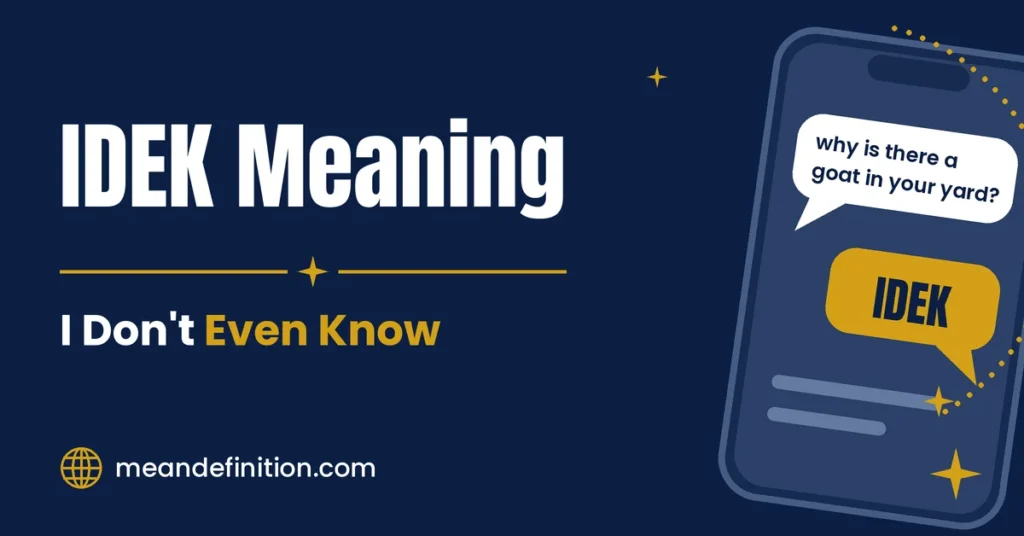
Quick answer: IDEK (also written “idek”) means “I don’t even know” in texts and on social media. It’s a stronger, more expressive version of IDK (“I don’t know”) and shows real confusion, surprise or that something makes no sense. So “idek what happened” means “I honestly have no idea what happened.”
If you asked a friend a simple question and got back “idek 😂,” they’re not ignoring you. They’re telling you they’re just as puzzled as you are. Below, you’ll find what dictionaries say about IDEK, how it differs from IDK, the main ways people use it, example chats, how to reply and when to use plain words instead.
What Does IDEK Mean?
IDEK is an initialism of “I don’t even know.” It takes the first letter of each word (I-D-E-K) and works as a quick reply or the start of a sentence. Capital letters don’t change the meaning: “idek,” “Idek” and “IDEK” all say the same thing.
Here’s what reference sources say:
- Dictionary.com says IDEK is an acronym used in texting and social media that means “I don’t even know,” and that it “expresses sheer puzzlement over something that seems inexplicable.”
- Wiktionary lists “idek” as text-messaging and Internet slang, an abbreviation of “I don’t even know,” with “IDEK” as an alternative form and IDK (“I don’t know”) as a related term.
- Slang.net calls IDEK a variation of IDK and explains that the “E” for “even” adds “a little more emphasis and exasperation.”
The term has been around for a while. Urban Dictionary has entries defining “idek” as “I don’t even know” going back to February 2004, and one from 2009 mentions its use in AIM (AOL Instant Messenger) chats.
IDEK at a Glance
| Item | Details |
|---|---|
| Stands for | I don’t even know |
| Type | Texting and social media initialism |
| Feeling | Puzzled, surprised, a bit exasperated |
| Stronger than | IDK (I don’t know) |
| Formality | Very informal |
IDEK vs. IDK: What’s the Difference?
Both admit you don’t know something, but the feeling is different. IDK is a plain “I don’t know.” It’s neutral and simple. IDEK adds the word “even,” which turns it into “I don’t even know.” That small word adds drama. It suggests the situation is so confusing, strange or overwhelming that you can’t begin to explain it.
- “What time is the game?” “idk, maybe 7?” (A simple, calm answer.)
- “Why is there a goat in your backyard?” “IDEK. It was just there this morning.” (Total puzzlement.)
A good rule: if the question has a normal answer you just don’t have, use IDK. If the whole situation makes no sense, IDEK fits better.
How People Use IDEK
IDEK can stand alone as a one-word reply or start a longer sentence. Here are the most common ways it shows up:
- Total confusion: “idek what the homework is asking 😵” means the sender is completely lost.
- Laughing at yourself: Cyber Definitions says IDEK is often used after admitting to doing something silly, in the sense of “I don’t even know why I did it.” For example: “I bought three pumpkins for a two-person dinner. idek.”
- Surprise at not knowing something: Cyber Definitions also notes it can show surprise at not knowing something you probably should, like “idek my own cousin’s birthday 😬.”
- Struggling to describe a feeling: “idek how to explain how happy I am right now” means the feeling is too big for words.
- Mild exasperation: Slang.net says people often use it when they don’t have a good answer for why something is the way it is, like a gadget that keeps breaking.
Dictionary.com’s examples show it as a hashtag too, like #idek at the end of a puzzled post. On social media, it often works like a shrug in text form.
Common Phrases With IDEK
IDEK often appears in a few set phrases. Once you know them, they’re easy to read:
- “idek anymore” means “I’ve lost track” or “I’ve given up trying to understand,” usually said with a laugh.
- “idek what to say” is often positive. People use it when good news, a gift or a kind message leaves them speechless.
- “idek how” shows surprise at your own result, as in “I passed the test and idek how.”
- “idek why” admits a choice that’s hard to explain, like “idek why I stayed up until 3 am.”
- “idek who that is” means the name or person is completely unfamiliar.
In each case, the “even” adds emphasis. “I don’t know what to say” is polite; “idek what to say” sounds more emotional and genuine.
Examples of IDEK in a Conversation
Group project confusion:
Lena: what are we supposed to put on slide 4?
You: idek, the instructions just say “be creative” 😅
Laughing at a silly choice:
Roommate: why are there 40 rolls of tape in the cabinet
You: idek, they were on sale and I panicked
A happy surprise:
Friend: wait, you got the job??
You: YES. idek what to say, I’m so excited 🎉
Holiday plans:
Cousin: how many people are coming to Thanksgiving this year?
You: idek anymore, Mom keeps inviting people 😂🦃
How to Reply to IDEK
IDEK usually means the other person is confused or overwhelmed, so a helpful or friendly reply works best:
- Help out: “I think slide 4 is supposed to be the summary. Want me to check?”
- Share the feeling: “same, I’m so lost too” or “lol idek either.”
- Laugh along: If they’re laughing at themselves, a “😂 iconic” or “honestly relatable” keeps it light.
- Celebrate: If it’s a happy “idek what to say,” answer with congratulations.
If you completely agree with what they said, an IKR (“I know, right?”) works well. And if you have a guess but doubt it, IDTS (“I don’t think so”) is a handy way to say it.
Is IDEK Rude?
IDEK isn’t rude in itself. It’s usually honest and often funny. Tone still matters, though. Slang.net notes that someone who is agitated might send IDEK as a one-word answer to a frustrating question. In that case it can sound like “I don’t know and I don’t want to talk about it.” If you want to sound friendlier, add a few words or an emoji, like “idek 😅 let me find out.”
Because it’s very informal, keep IDEK for texts, group chats, comments and DMs. In school assignments, work emails or messages to teachers and clients, use a clear phrase instead:
- “I’m not sure, but I’ll find out.”
- “I’m honestly not certain what this part means.”
- “Could you explain this step? I’m a bit confused.”
Similar Abbreviations
| Term | Means | Feel |
|---|---|---|
| IDEK | I don’t even know | Very puzzled |
| IDK | I don’t know | Neutral |
| IONO | I don’t know (spoken style) | Casual |
| AFAIK | As far as I know | Fairly sure |
| IK | I know | Sure |
Slang.net lists IDK, IONO, dunno, IK and AFAIK as related slang. Wiktionary’s entry for the capitalized “IDEK” also lists IDK as a related term and quotes the 2015 book YOLO Juliet, a text-message retelling of Shakespeare’s play, where Romeo answers “IDEK who that is.”
You’ll find more texting abbreviations in our Meanings section, or you can paste a confusing message into our free Text Slang Translator to decode common shorthand.
Frequently Asked Questions
What does “idek anymore” mean?
It means “I don’t even know anymore.” People use it when a situation has become so confusing or chaotic that they’ve given up trying to make sense of it, often in a joking way.
What does IDEK mean from a girl or a guy?
The same thing either way: “I don’t even know.” It isn’t flirty or secret code. Read the rest of the message and any emoji to tell whether they’re confused, laughing or a little frustrated.
How do you pronounce IDEK?
Most people read it as the full phrase, “I don’t even know.” Saying the letters (“I-D-E-K”) is possible, but less common.
Is IDEK the same as IDK?
Almost, but not quite. Both mean you don’t know, but IDEK adds “even,” which makes it sound more surprised, puzzled or exasperated than a plain IDK.
Can I use IDEK at work?
It’s best not to. In professional messages, write “I’m not sure” or “I’ll check and get back to you.” That sounds clear and helpful instead of overly casual.
The Bottom Line
IDEK means “I don’t even know.” It’s a more expressive version of IDK that shows confusion, surprise or that something just doesn’t make sense, and people often use it to laugh at themselves. It’s friendly and honest in texts and on social media, but in formal writing, a clear “I’m not sure” is the better choice.
