

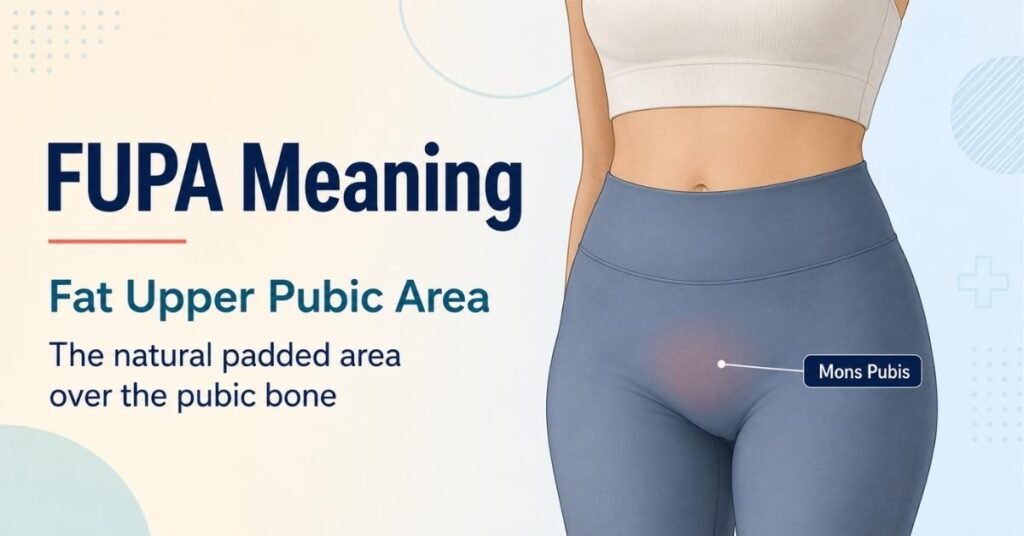
FUPA meaning refers to “fat upper pubic area,” an informal expression describing visible fullness over the mons pubis, the naturally padded area above the pubic bone. This fullness may come from fatty tissue, loose skin, scar-related changes, lower-abdominal overhang, or a combination of factors. FUPA is slang rather than a medical diagnosis, and everyone naturally has some fat in this area.
An older, vulgar version of the acronym is also used online, but “fat upper pubic area” is more appropriate when discussing anatomy and health. Having a prominent mons pubis does not automatically indicate obesity, poor fitness, or a medical problem.
What Does FUPA Mean?
FUPA stands for fat upper pubic area. It describes a visible curve, mound, or pocket of tissue between the lower abdomen and external genital area.
The acronym refers to an appearance rather than one specific medical condition. Two people may use the same word while describing completely different tissues. One person may have localized subcutaneous fat, while another has loose skin after substantial weight loss or a fold created by a C-section scar.
That difference matters because diet, exercise, and cosmetic procedures do not affect every type of tissue in the same way.
What Does FUPA Stand For?
Three expansions commonly appear online:
- Fat upper pubic area: The most neutral and widely usable version
- Fatty upper pubic area: A common variation with essentially the same meaning
- Older vulgar expansion: Frequently found in slang dictionaries and informal conversations
Professional health content generally uses fat upper pubic area because it is anatomically clearer and less stigmatizing.
Is FUPA a Medical Term?
No. FUPA is not a formal medical diagnosis.
The anatomical term for the region is mons pubis, sometimes shortened to mons. Clinicians generally describe the actual tissue involved rather than diagnosing someone with “FUPA.”
A medical assessment may identify:
- Localized fatty tissue
- Excess or loose skin
- Scar tethering
- Lower-abdominal overhang
- A combination of fat and skin
- Swelling unrelated to ordinary fat distribution
Using precise anatomical language helps determine whether reassurance, general health changes, medical evaluation, or cosmetic treatment is appropriate.
FUPA Meaning at a Glance
| Detail | Explanation |
|---|---|
| Full form | Fat upper pubic area |
| Medical name for the region | Mons pubis |
| Location | Above the pubic bone and below the lower abdomen |
| Possible source of fullness | Fat, loose skin, scar-related contour, or overlapping abdominal tissue |
| Medical diagnosis? | No |
| Can anyone have it? | Yes |
| Always unhealthy? | No |
| Treatment required? | Usually not |
Where Is the FUPA Located?
The area commonly described as a FUPA is the mons pubis, a rounded pad of tissue located:
- Over the pubic bone
- Below the lower abdomen
- Above the external genital area
- Between the groin creases
The mons naturally contains subcutaneous fat, meaning fatty tissue positioned just beneath the skin. This tissue helps cushion and protect the pubic bone.
Its size, shape, firmness, and projection vary from person to person. It may become more noticeable when someone sits, bends, wears close-fitting clothing, gains or loses weight, ages, or experiences pregnancy-related changes.
A visible mons should not be confused with the vagina, the entire vulva, or the stomach. These are different anatomical structures.
What Does the Mons Pubis Look Like?
A typical mons pubis has a naturally rounded contour. It may appear:
- Smooth or softly curved
- More prominent in fitted clothing
- Flatter while standing
- Folded or compressed while sitting
- Asymmetrical
- More visible after lower-abdominal weight loss
- Fuller after pregnancy or hormonal changes
There is no single “correct” shape. Photographs taken with different posture, lighting, camera angles, or clothing pressure can make the same body look substantially different.
Is Having a FUPA Normal?
Having fatty tissue over the mons pubis is normal. Everyone has this anatomical area, although its appearance varies.
Some people naturally store more fat around the lower abdomen, hips, thighs, and pubic region. A prominent mons can therefore occur in larger-bodied people, thin people, athletes, men, women, and people who have never been pregnant.
Appearance alone does not determine:
- Overall health
- Fitness
- Hygiene
- Fertility
- Sexual function
- Personal discipline
- Attractiveness
You do not need to treat the area simply because it is visible.
When It Is Mainly a Cosmetic Concern
Upper-pubic fullness is usually a cosmetic concern when it:
- Has been stable over time
- Does not cause pain
- Is not rapidly increasing
- Does not produce skin breakdown
- Causes concern mainly because of clothing fit or appearance
In this situation, doing nothing is a valid choice.
When It Can Cause Physical Problems
More substantial fatty tissue, skin folds, or abdominal overhang may sometimes contribute to:
- Chafing
- Friction
- Moisture buildup
- Skin irritation
- Recurrent rashes
- Hygiene difficulty
- Discomfort while exercising
- Problems with clothing fit
- Intimacy-related discomfort
- Urinary or sexual difficulties in more significant cases
These problems deserve respectful medical attention. They should not be dismissed as purely cosmetic.
FUPA vs. Lower-Belly Fat, Pannus, and C-Section Pouch
Several nearby body contours are incorrectly labeled FUPA. Knowing the difference is important because each may require a different approach.
| Term | Meaning | Same as FUPA? |
|---|---|---|
| Mons pubis fullness | Fat or tissue directly over the pubic bone | What FUPA generally describes |
| Lower-belly fat | Fat stored in the lower abdominal region | No |
| Pannus or panniculus | A hanging fold of abdominal skin and fat | No, although it can cover the mons |
| Apron belly | Informal term for a lower-abdominal overhang | No |
| C-section shelf | A fold or indentation near a cesarean scar | No, but it may coexist |
| Loose skin | Lax skin after pregnancy, aging, or weight loss | It may contribute to the appearance |
| Hernia or mass | A bulge caused by another medical issue | No; it may require evaluation |
Why These Areas Are Commonly Confused
The lower abdomen and mons pubis are positioned next to each other. When someone sits, bends, or wears a tight waistband, abdominal tissue can compress downward and overlap the pubic area.
A C-section scar can also change how tissue sits. The scar may create an indentation or tethered line that makes the skin above or below it appear more prominent.
An abdominal pannus, meanwhile, originates higher and hangs down over the mons. Calling every lower-body fold “FUPA” can lead to unrealistic fitness expectations or the wrong cosmetic procedure.
What Causes Upper-Pubic Fullness?
There is no single universal cause. The contour may reflect normal anatomy or a combination of genetics, fatty tissue, skin elasticity, pregnancy, surgery, and aging.
Genetics and Natural Fat Distribution
Genetics strongly influence where a body stores subcutaneous fat.
One person may carry more tissue around the hips and thighs, while another stores it around the lower abdomen and mons. Family members may have similar contours even when their weights and lifestyles differ.
This is why a thin person can still have a visible or prominent mons pubis.
Overall Weight Gain
When body weight increases, fat cells may enlarge throughout the body, including in the pubic region. How much the mons changes depends on individual fat-distribution patterns.
However, the appearance of one area cannot reveal someone’s complete health status.
Significant Weight Loss
Overall weight loss may reduce fatty tissue over the pubic bone. However, stretched skin does not always tighten at the same rate.
After substantial weight loss, a person may have:
- Less fatty tissue
- More visible loose skin
- A lower-abdominal fold
- Tissue descent
- A more noticeable transition between the abdomen and mons
What appears to be “stubborn fat” may therefore be skin laxity or a mixture of fat and skin.
Pregnancy and Childbirth
Pregnancy can affect:
- Skin elasticity
- Fat distribution
- Abdominal muscles
- Connective tissues
- Pelvic-floor function
- Lower-abdominal contour
These changes may remain after childbirth, even when someone returns to their previous weight. Recovery also varies greatly, and there is no universal postpartum timeline.
C-Section Scars and Tissue Tethering
A cesarean incision can create scar tissue that attaches or tethers the surrounding layers. This may form an indentation or shelf near the scar.
A C-section pouch is not automatically pubic fat. It may involve:
- Abdominal skin
- Residual fatty tissue
- Scar adherence
- Tissue positioned above the incision
- A combination of several factors
Additional abdominal exercise cannot release fixed scar tethering. A clinician must examine the area to determine which tissues create the contour.
Aging and Skin Elasticity
Skin generally becomes less elastic with age. Previous pregnancies, weight changes, sun exposure, genetics, and smoking history can also affect how well it contracts.
As skin and connective tissues change, the mons or lower abdomen may descend or develop a softer contour.
Hormonal and Metabolic Factors
Hormones influence overall body composition and fat distribution. Menopause, aging, certain medical conditions, and some medications may affect where the body stores fat.
However, claims that one hormone directly “causes FUPA” are usually too simplistic. A localized body contour cannot diagnose estrogen imbalance, insulin resistance, high cortisol, or another hormonal condition.
Medical evaluation may be appropriate if the change is sudden or accompanied by symptoms such as:
- Rapid unexplained weight change
- Irregular menstrual periods
- Significant fatigue
- New excess hair growth
- Muscle weakness
- Other unexplained physical changes
Previous Abdominal or Pelvic Surgery
Surgery may change skin tension, scar position, tissue movement, or the transition between the lower abdomen and mons.
A surgical history is therefore important when assessing whether fullness comes from fat, loose skin, a scar, or abdominal tissue.
Is It Fat, Loose Skin, Scar Tissue, or Abdominal Overhang?
A tissue-based assessment is more useful than relying on the word FUPA.
| Possible contributor | Common characteristics | What may clarify it |
|---|---|---|
| Localized fat | Soft, pinchable, relatively smooth fullness | Body and weight history plus examination |
| Loose skin | Folding, wrinkling, or hanging tissue | Pregnancy, aging, or major weight-loss history |
| Scar tethering | Shelf or indentation near a surgical scar | Scar examination |
| Abdominal pannus | Fold descending from the lower abdomen | Standing and seated examination |
| Combination | Fat, skin, and scar changes together | Individual clinical assessment |
| New swelling or mass | Recent, painful, firm, or asymmetrical enlargement | Prompt medical evaluation |
This table cannot diagnose the cause. A photograph or self-examination cannot reliably rule out a hernia, cyst, infection, swollen lymph node, or another medical condition.
Why Does the Area Look Bigger When Sitting?
Soft tissue naturally compresses and folds when the hips bend. This happens across body sizes.
The area may look different while sitting because of:
- Skin folding
- Soft-tissue compression
- Pelvic position
- Posture
- Waistband pressure
- Lower-abdominal tissue shifting downward
- Camera angle
- Lighting
A seated fold is not evidence that something is wrong. Online comparisons can be particularly misleading because images are often posed, edited, cropped, or captured while the subject is standing and flexing.
How Clothing Changes the Appearance
Low-rise waistbands may divide or compress the lower abdomen differently from high-rise clothing. Tight leggings, underwear seams, shapewear, and swimwear may make the mons more noticeable.
If you want a smoother appearance, you might prefer:
- Wider waistbands
- Seamless underwear
- Higher-rise bottoms
- Less compressive fabrics
- Clothing with structured draping
These are optional comfort and styling choices—not requirements to hide your body.
Can Exercise Get Rid of FUPA?
Exercise cannot selectively burn fat from the upper pubic area. This is known as the spot-reduction problem.
The body decides where it draws stored energy according to genetics, hormones, overall energy balance, and other factors. Exercising a nearby muscle does not guarantee fat loss directly above that muscle.
What Exercise Can Do
Regular exercise can:
- Support overall fat loss
- Improve cardiovascular health
- Build or preserve muscle
- Strengthen the abdominal wall
- Improve posture and mobility
- Support weight management
- Improve physical and mental well-being
What Core Exercises Cannot Do
Planks, crunches, bicycle crunches, leg raises, and similar exercises may strengthen abdominal muscles. They cannot directly:
- Burn only mons pubis fat
- Tighten substantial loose skin
- Remove scar tissue
- Release a C-section shelf
- Eliminate an abdominal pannus
- Treat a hernia or mass
Calling these movements “FUPA exercises” can create unrealistic expectations. They are core exercises, not localized fat-removal treatments.
Does Weight Loss Reduce FUPA?
Overall fat loss may reduce fatty tissue in the mons pubis, but the result varies.
The body does not allow you to choose:
- Where fat decreases first
- Where it decreases last
- How much one area changes
- Whether stretched skin tightens
- Whether scar-related contour improves
When Weight Loss May Help
It may reduce the area when:
- Fullness primarily comes from increased fatty tissue
- The person wants overall weight loss
- Weight reduction is appropriate for their health
- Changes are gradual and sustainable
When Weight Loss May Not Fully Change It
The area may remain visible because of:
- Genetic fat distribution
- Natural anatomy
- Loose skin
- Scar tethering
- Lower-abdominal overhang
- Previous major weight loss
- Reduced skin elasticity
A person can reach a stable, healthy weight and still have a prominent mons pubis.
A Safer Weight-Management Approach
Avoid crash diets, detoxes, or supplements promising localized fat loss.
A sustainable approach may include:
- Balanced nutrition
- Regular physical activity
- Resistance training
- Adequate sleep
- Stress management
- Support from a qualified healthcare professional when needed
One body area should not be used as the only measure of health or progress.
Can Diet, Creams, or Waist Trainers Remove Pubic Fat?
Diet
No particular food selectively creates or burns fat over the pubic bone. Overall energy intake can influence body weight, but localized fat distribution remains strongly individual.
Temporary bloating or water retention is also different from permanent fatty tissue.
Fat-Burning Creams
Topical creams cannot reliably remove a meaningful amount of subcutaneous pubic fat.
Products used close to the genital area may also cause irritation, burning, allergic reactions, or injury. Do not apply harsh or unapproved products to sensitive skin.
Waist Trainers and Compression Garments
Compression clothing may temporarily alter the area’s appearance under clothing. It does not permanently remove fat, tighten loose skin, or change scar tissue.
Excessively tight garments may cause discomfort, skin irritation, or restricted movement.
Massage and Detox Treatments
Massage may temporarily improve comfort or move fluid, but it does not permanently destroy fat cells. Claims that massage “flushes toxins” or melts pubic fat are not supported by reliable evidence.
When Should You See a Doctor?
Stable, painless fullness is different from a new lump or unexplained swelling.
Seek medical evaluation if you notice:
- A new or rapidly enlarging lump
- Significant or worsening pain
- Redness or warmth
- Drainage
- Fever
- One-sided swelling
- A bulge that changes when coughing or straining
- Persistent sores or skin infection
- Numbness or major changes in sensation
- Urinary difficulty
- An unexplained sudden change
These symptoms may have causes unrelated to ordinary fatty tissue, including a hernia, cyst, infection, or swollen lymph node.
Options for Changing the Area
If the area is healthy and does not cause functional problems, doing nothing is a valid option.
People who want a change can consider general health measures, nonsurgical treatments, or surgery. The appropriate path depends on whether the main concern is fat, loose skin, scar tethering, abdominal overhang, or a combination.
No Treatment and Body-Neutral Management
You may choose to:
- Leave the area unchanged
- Wear more comfortable clothing
- Use breathable fabrics
- Reduce friction and moisture
- Treat skin irritation with professional guidance
- Stop comparing yourself with posed or edited images
- Seek support if body-image distress affects daily life
No treatment is required simply because the mons is visible.
Sustainable Lifestyle Changes
Exercise and balanced nutrition can support overall health and may reduce fatty tissue when general fat loss occurs.
Lifestyle changes are less likely to correct:
- Significant skin laxity
- Fixed scar tethering
- A substantial abdominal pannus
- Natural mons anatomy at a stable weight
Nonsurgical Body Contouring
Certain nonsurgical procedures attempt to reduce small areas of fatty tissue using cooling, heat, ultrasound, or other technologies.
Important limitations include:
- Results are usually modest.
- More than one session may be needed.
- Loose skin may remain.
- Not every device is suitable for the mons pubis.
- Side effects and complications are possible.
- Outcomes vary considerably.
Confirm that the provider is appropriately qualified and that the device is authorized for the specific treatment area.
Liposuction, Monsplasty, Tummy Tuck, and Panniculectomy
Different procedures address different tissues.
| Procedure | Primarily addresses | Does not automatically correct |
|---|---|---|
| Liposuction | Localized fatty tissue | Significant loose skin or fixed scar tethering |
| Monsplasty or pubic lift | Excess mons skin, fat, or tissue descent | The entire lower abdomen |
| Tummy tuck | Abdominal skin, selected fat, and abdominal-wall contour | Mons fullness unless specifically included |
| Panniculectomy | Hanging abdominal skin and fat | Every cosmetic contour concern |
| Body lift | Broader tissue laxity after major weight loss | Small isolated areas without individualized planning |
Liposuction
Liposuction removes localized subcutaneous fat through a thin tube called a cannula.
It may be considered when:
- Fat is the primary concern
- Skin elasticity is reasonably good
- Weight is stable
- Expectations are realistic
Liposuction does not remove substantial loose skin. In someone with limited elasticity, removing fat can sometimes make skin laxity more noticeable.
Possible risks include swelling, bruising, infection, contour irregularity, asymmetry, changes in sensation, and dissatisfaction with the result.
Monsplasty
A monsplasty, sometimes called a pubic lift or mons reduction, can remove or reposition excess fat and skin in the mons pubis.
It may involve:
- Skin removal
- Fat removal
- Tissue lifting
- Liposuction
- Combination with abdominal surgery
The procedure creates scars and requires recovery. Changes in swelling, contour, and sensation should be discussed during consultation.
Tummy Tuck
An abdominoplasty or tummy tuck primarily addresses the abdomen. It may remove excess abdominal skin, reduce selected fatty tissue, and repair separated or weakened muscles when appropriate.
A tummy tuck does not automatically correct the mons pubis. If mons fullness or descent is a concern, it should be discussed explicitly during surgical planning.
Panniculectomy and Body Lift
A panniculectomy removes a hanging abdominal pannus. A body lift addresses broader tissue laxity around the abdomen, hips, back, or lower body.
These procedures are more extensive than isolated mons treatment. Insurance coverage, when available, generally depends on medical necessity and the individual policy.
Questions to Ask a Surgeon
Before considering treatment, ask:
- Is the fullness mainly fat, skin, scar tissue, or abdominal overhang?
- Will the proposed procedure directly address the mons?
- Where will the scars be?
- Could liposuction worsen loose skin?
- What result is realistic for my anatomy?
- What complications are possible?
- How long is the recovery?
- Can sensation change?
- What happens if my weight changes later?
- How often do you perform this procedure?
- Are you board-certified in plastic surgery?
Can Men Have a FUPA?
Yes. Men can have upper-pubic fatty tissue or loose skin because everyone has a mons pubis.
Possible contributing factors include:
- Genetics
- Overall weight gain
- Aging
- Major weight loss
- Reduced skin elasticity
- Hormonal or metabolic changes
- Lower-abdominal overhang
A male FUPA should not automatically be called an apron belly or pannus. Isolated mons fullness and a hanging abdominal fold are different anatomical concerns.
In more substantial cases, tissue may obscure the base of the penis and create hygiene, urinary, or sexual difficulties. A medical or urological evaluation may be appropriate when function is affected.
FUPA After Pregnancy or a C-Section
Pregnancy can change the abdomen and pubic area through skin stretching, altered fat distribution, connective-tissue changes, muscle separation, and postpartum hormonal shifts.
A C-section may also leave:
- Scar tethering
- An indentation
- A shelf above the scar
- Skin laxity
- Altered tissue positioning
However, a C-section does not automatically create mons pubis fat.
Postpartum healing takes time, and recovery varies. Anyone returning to strenuous activity after childbirth or surgery should follow guidance from their healthcare professional.
Body Image After Childbirth
The pressure to “bounce back” can make normal postpartum changes feel like personal failure. Social-media and celebrity photographs may use posing, lighting, styling, editing, or carefully selected angles.
You can accept postpartum changes, feel neutral about them, or eventually explore treatment. None of these responses determines your value or commitment to your health.
LEARN MORE: Zionist Meaning
A Body-Neutral Approach to FUPA
Body neutrality does not demand that you love every part of your appearance. It simply avoids treating a body feature as a moral success or failure.
Your mons pubis does not determine your:
- Health
- Discipline
- Attractiveness
- Cleanliness
- Sexual value
- Personal worth
You can leave it unchanged, manage physical discomfort, pursue general health goals, or explore cosmetic treatment without using shame as motivation.
Use the S.H.A.P.E. Decision Framework
S — Specify the Area
Determine whether your concern involves:
- The mons pubis
- Lower abdomen
- C-section scar
- Hanging abdominal fold
- A new lump or swelling
H — Review Your History
Consider:
- Pregnancy
- C-section or another surgery
- Weight gain or weight loss
- Aging
- Pain
- Skin problems
- How long the change has been present
A — Accept Anatomical Limits
Remember:
- Some fatty tissue is normal.
- Spot reduction is impossible.
- Exercise cannot remove substantial loose skin.
- A photograph cannot provide a diagnosis.
P — Pick the Appropriate Path
Your options may include:
- Reassurance and no treatment
- Comfortable clothing
- Friction or skin-care management
- Sustainable health changes
- Medical evaluation
- A qualified cosmetic consultation
E — Evaluate the Trade-Offs
Compare:
- Expected improvement
- Risks
- Scars
- Recovery time
- Cost
- Treatment limitations
- Future pregnancy plans
- Possible weight changes
- Whether the option addresses the correct tissue
Frequently Asked Questions
What does FUPA stand for?
FUPA stands for fat upper pubic area. It is a slang term describing fullness over the mons pubis, the naturally padded area above the pubic bone.
Is FUPA a medical term?
No. FUPA is informal slang, not a recognized diagnosis. Clinicians use terms such as mons pubis, subcutaneous fat, loose skin, scar tissue, or panniculus, depending on the anatomy involved.
Where exactly is a FUPA located?
It is located over the mons pubis, between the lower abdomen and external genital area. The mons lies directly over the pubic bone and naturally contains fatty tissue.
Is a FUPA the same as the mons pubis?
Not exactly. The mons pubis is a normal anatomical structure. FUPA is slang generally used when someone considers the mons unusually full or prominent.
Is having a FUPA normal?
Yes. Everyone has fatty tissue in this area, and natural size varies. A prominent mons is not automatically a medical problem or sign of poor health.
Can thin people have a FUPA?
Yes. Genetics and natural fat distribution can make the mons visible even at a lower body weight. Loose skin or scar-related contour may also contribute.
Can men have a FUPA?
Yes. Men have a mons pubis and may develop upper-pubic fullness through genetics, aging, weight changes, loose skin, or overlapping lower-abdominal tissue.
Is FUPA the same as lower-belly fat?
No. Lower-belly fat is located in the lower abdomen, while FUPA usually describes tissue over the pubic bone. The areas are close together and can overlap visually.
Is a C-section pouch the same as FUPA?
No. A C-section pouch usually refers to a fold or contour near the scar. It may coexist with mons fullness, but the tissues and causes can differ.
Is FUPA the same as a panniculus?
No. A panniculus is a hanging fold of abdominal skin and fat that may cover the mons. FUPA generally refers to fullness of the mons itself.
Can exercise get rid of FUPA?
Exercise cannot spot-reduce pubic fat. It can support overall fat loss, strengthen muscles, improve posture, and benefit health, but it cannot selectively remove fat or substantial loose skin.
Will losing weight reduce pubic fat?
It may reduce the area when fatty tissue is the main contributor. Results depend on genetics and fat distribution, and loose skin may remain after weight loss.
Why does FUPA remain after weight loss?
Possible reasons include genetic fat distribution, natural anatomy, remaining fatty tissue, loose skin, scar tethering, or an overlapping lower-abdominal fold.
Can creams or waist trainers remove it?
No cream or waist trainer can permanently remove localized fat or loose skin. Compression garments may temporarily change appearance, while harsh creams can irritate sensitive skin.
Does liposuction remove FUPA?
Liposuction can reduce localized fat, but it does not remove substantial loose skin. Suitability depends on skin elasticity, anatomy, health, and realistic expectations.
What is the difference between liposuction and monsplasty?
Liposuction primarily removes fat. Monsplasty may remove fat and excess skin or lift descended tissue. A surgeon should determine which tissue creates the concern.
Does a tummy tuck automatically correct the mons?
No. A tummy tuck primarily addresses the abdomen. Mons lifting or fat reduction must be included specifically when needed.
When should pubic swelling be examined?
Seek medical advice for a new, painful, rapidly growing, firm, red, warm, draining, or one-sided swelling, especially when accompanied by fever, urinary symptoms, or a bulge that changes with straining.
Final Takeaway
FUPA means fat upper pubic area, an informal description of fullness over the mons pubis. It is not a medical diagnosis, and a visible mons does not automatically indicate poor health.
The appearance may involve natural fat distribution, localized fat, loose skin, scar tethering, or lower-abdominal overhang. Exercise cannot spot-reduce the area, and weight loss may not correct skin or scar-related changes.
No treatment is required unless you want a change or experience physical symptoms. If you notice pain, rapid enlargement, a distinct lump, skin problems, or functional difficulty, seek medical evaluation rather than assuming the change is ordinary pubic fat.
