

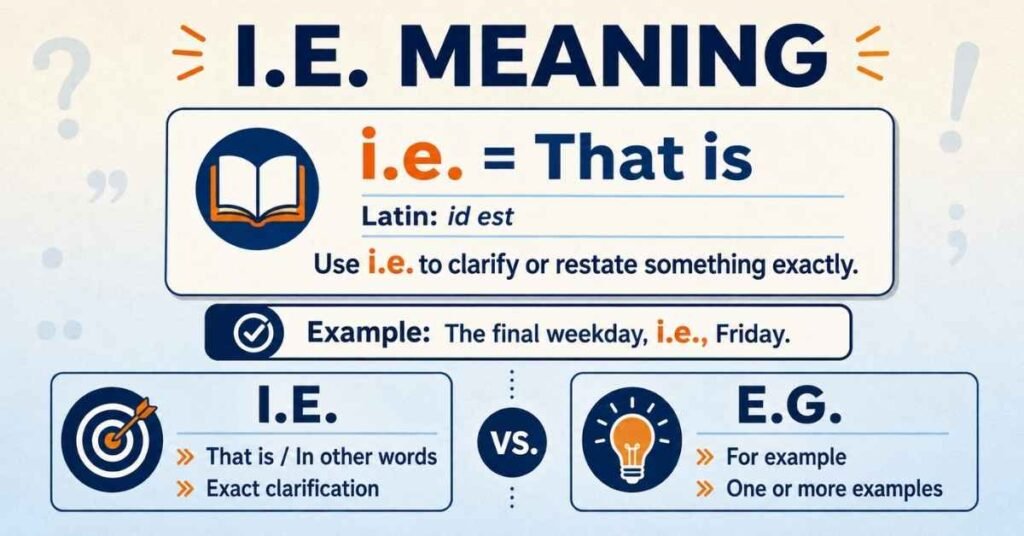
I.e. meaning comes from the Latin phrase id est and translates to “that is.” Writers use i.e. to clarify, restate, define, or identify something more precisely—not to introduce one possible example. In American English, the abbreviation is normally written with two periods and followed by a comma: i.e., An easy way to check your sentence is to replace i.e. with “that is” or “in other words.”
“The office closes on the final weekday, i.e., Friday.”
Here, Friday identifies the exact day. It is not merely one example of a final weekday.
| Detail | Quick answer |
|---|---|
| Full Latin phrase | Id est |
| English meaning | That is |
| Practical substitute | In other words |
| Main purpose | Clarification or exact restatement |
| American punctuation | Usually i.e., |
| Capitalization | Normally lowercase |
| Italics | Normally not italicized |
| Common confusion | I.e. versus e.g. |
What Does I.E. Mean?
I.e. is an abbreviation of the Latin phrase id est, meaning “that is.” It introduces information that clarifies, restates, defines, or identifies something more precisely.
The information after i.e. should explain exactly what the writer meant before the abbreviation.
Consider this sentence:
“The website has one paid plan, i.e., the Professional plan.”
The Professional plan is not one example from a larger group. It is the exact paid plan being identified.
I.e. can introduce:
- A clearer explanation
- An exact identity
- A definition
- A more precise description
- A complete list
- A restatement in different words
It does not simply add related information. The new wording should be equivalent to, or more precise than, the original statement.
What Does Id Est Mean?
The Latin phrase id est literally means “that is.” The abbreviation takes its letters from the two Latin words:
- i. from id
- e. from est
English writers have adopted i.e. as a concise way to introduce a clarification.
You may see memory tricks such as:
- I.e. = in essence
- I.e. = in other words
These are useful mnemonics, but they are not the abbreviation’s true expansion. The actual phrase is id est.
Because i.e. has become a standard abbreviation in English writing, it is not normally italicized just because it has a Latin origin.
How I.E. Works in a Sentence
The logic behind i.e. is more important than the punctuation.
A sentence using i.e. normally follows this pattern:
- The writer makes a statement.
- The statement needs more precision.
- I.e. introduces the clarification.
- The new wording identifies or restates the original meaning.
Identifying One Exact Item
“Only one department is open, i.e., customer support.”
Customer support is the exact department. The writer is not suggesting that other departments may also be open.
Clarifying a Term
“The animal is nocturnal, i.e., active primarily at night.”
The words after i.e. explain what “nocturnal” means.
Restating an Idea
“The campaign failed to convert visitors, i.e., it generated traffic but almost no sales.”
The second part makes “failed to convert” more specific.
Giving a Complete List
“The package includes all three accessories, i.e., the cable, adapter, and case.”
I.e. can introduce more than one item. The important point is that the list is intended to be complete, not merely representative.
Identifying an Exact Time or Place
“The meeting starts at midday, i.e., 12:00 PM.”
“Please use the main entrance, i.e., the door facing Oak Street.”
In both cases, the phrase after i.e. identifies exactly what the writer means.
I.E. vs. E.G.: What Is the Difference?
The difference between i.e. and e.g. is one of exactness and scope:
- I.e. means “that is” and introduces an exact clarification.
- E.g. means “for example” and introduces one or more possible examples.
| Feature | I.e. | E.g. |
|---|---|---|
| Latin phrase | Id est | Exempli gratia |
| English meaning | That is | For example |
| Purpose | Clarify or restate | Illustrate with examples |
| Scope | Exact or complete | Representative or incomplete |
| Replacement test | “That is” | “For example” |
| U.S. punctuation | i.e., | e.g., |
Complete Set vs. Representative Examples
Compare these sentences:
“We serve one hot drink, i.e., coffee.”
Coffee is the only hot drink being identified.
“We serve hot drinks, e.g., coffee and tea.”
Coffee and tea are examples. Other hot drinks may also be available.
That distinction is the key to using the two abbreviations correctly.
Does I.E. Mean “For Example”?
No. I.e. does not mean “for example.”
Incorrect:
“Visit a coastal city, i.e., Miami.”
If Miami is one of several possible coastal cities, use e.g.:
“Visit a coastal city, e.g., Miami.”
I.e. would be appropriate only if Miami were the exact city intended:
“Visit our selected coastal city, i.e., Miami.”
A Simple Memory Trick
You do not need to memorize Latin to remember the distinction:
- I.e. = in essence
- E.g. = example given
These phrases are memory aids rather than literal translations.
Another useful rule is:
Use i.e. when you mean exactly this. Use e.g. when you mean here is one example.
Use the EXACT Test Before Writing I.E.
Use the EXACT test when you are unsure whether i.e. fits your sentence:
- E — Equivalent: Does the new wording mean the same thing?
- X — Exact: Does it identify precisely what you mean?
- A — All: Does it provide the complete relevant clarification?
- C — Clearer: Does it make the original statement easier to understand?
- T — “That is”: Can you replace i.e. with “that is” naturally?
Consider this sentence:
“The subscription includes premium tools, i.e., exports and team sharing.”
Ask whether exports and team sharing are the only premium tools.
- If they are the complete set, i.e. works.
- If they are only two examples, use e.g.
- If the abbreviation feels unnecessary, rewrite the sentence:
“Premium tools include exports and team sharing.”
If neither “that is” nor “for example” fits naturally, the sentence probably needs a clearer structure rather than another abbreviation.
How to Punctuate I.E. in American English
In standard American writing, retain both periods and usually place a comma after the abbreviation:
i.e.,
The punctuation before i.e. depends on how the clarification fits into the sentence. It may appear after an opening parenthesis, comma, em dash, or semicolon.
I.E. Inside Parentheses
I.e. commonly introduces a parenthetical clarification:
“The store closes early on the final weekday (i.e., Friday).”
The standard U.S. pattern is:
- Opening parenthesis
- Lowercase i.e.
- Period after each letter
- Comma after the second period
- Clarification
- Closing parenthesis
Another example:
“Please bring government-issued identification (i.e., your passport) to the appointment.”
I.E. Between Commas
I.e. can introduce an interrupting phrase within a sentence:
“The final weekday, i.e., Friday, is our busiest day.”
The first comma introduces the clarification. The comma after Friday closes it.
This construction can become difficult to read when the sentence already contains several commas. Parentheses or an em dash may be cleaner.
I.E. After an Em Dash
An em dash creates a stronger pause:
“Only one option remains—i.e., canceling the event.”
This structure works well when the clarification deserves emphasis.
You can often improve the sentence further by using plain English:
“Only one option remains—that is, canceling the event.”
I.E. After a Semicolon
A semicolon may precede i.e. when the clarification is an independent clause:
“The deadline cannot move; i.e., the final file must arrive today.”
Although this structure is possible, it can feel stiff. A smoother alternative is:
“The deadline cannot move; in other words, the final file must arrive today.”
A period and a new sentence may be even clearer in reader-facing writing.
Can a Colon Follow I.E.?
A colon can appear after i.e. in specialized editorial constructions, but stacking punctuation often makes a sentence look unnecessarily technical.
For most American writing, i.e., followed by a comma is the familiar pattern. If the sentence requires complicated punctuation on both sides, consider replacing the abbreviation with “that is” or rewriting the sentence.
Do You Put a Comma Before and After I.E.?
In American English, a comma usually follows i.e., but the punctuation before it depends on the sentence.
Between Commas
“Our only option, i.e., postponement, remains unpopular.”
Inside Parentheses
“Our only option (i.e., postponement) remains unpopular.”
After a Dash
“We have one option—i.e., postponement.”
After a Semicolon
“We have no alternative; i.e., we must postpone.”
Therefore, “put a comma before and after i.e.” is only a simplified guideline. The more accurate rule is:
- Usually place a comma after i.e. in U.S. English.
- Choose the punctuation before i.e. according to the sentence structure.
- Follow the required style guide when writing for a publisher, university, employer, or legal organization.
American and British Punctuation Can Differ
Conflicting examples online do not always mean one writer is wrong. American and British publications may follow different conventions.
American English
American style commonly uses:
i.e.,
The periods are retained, and a comma normally follows the abbreviation.
British English
Some British publishers:
- Omit the comma after i.e.
- Remove the periods and write ie
- Follow their own house punctuation conventions
For a U.S. audience, i.e., is the safest standard form unless a required style guide says otherwise.
Consistency matters more than switching between conventions within the same document.
Should I.E. Have Periods, Capitals, or Italics?
| Question | U.S. recommendation |
|---|---|
| Should it have periods? | Usually yes: i.e. |
| Should it be lowercase? | Usually yes |
| Should it be italicized? | No |
| Should there be a space between the letters? | No |
| Should a comma follow it? | Usually yes: i.e., |
| Can it begin a sentence? | Possible, but usually awkward |
Should I.E. Be Italicized?
No. Although i.e. comes from Latin, it is well established in English and is normally written in regular type.
Correct:
i.e.,
Unnecessary:
i.e.,
A specialized publisher or legal system may have different rules, so follow its house style when required.
Can You Write “IE” or “Ie”?
In standard American prose, i.e. is normally the safest form.
Writing IE can be confusing because it may refer to other entities, including the former Internet Explorer browser. Writing Ie is generally inappropriate.
Can I.E. Start a Sentence?
It is technically possible, but it usually looks awkward:
“I.e., the office will remain closed.”
A clearer version is:
“In other words, the office will remain closed.”
Use the full English phrase when beginning a sentence.
Can I.E. Introduce a List?
Yes. I.e. can introduce a list when the list provides the complete set relevant to the statement.
“The committee has three officers, i.e., a chair, treasurer, and secretary.”
The sentence indicates that these are all three officers.
If the list contains only selected examples, use e.g.:
“The committee has several officers, e.g., a chair and treasurer.”
The second sentence allows for additional officers.
Should You Use “Etc.” After I.E.?
Usually not.
Potentially contradictory:
“The package contains all accessories, i.e., the cable, case, etc.”
I.e. suggests exact or complete clarification, while “etc.” tells readers the list continues.
If the list is incomplete, use e.g.:
“The package contains useful accessories, e.g., a cable and case.”
If it is complete, list every relevant item:
“The package contains three accessories, i.e., a cable, case, and adapter.”
I.E., Namely, and “In Other Words”
Several expressions can introduce clarification, but their tone and function differ.
| Expression | Best use |
|---|---|
| I.e. | Concise clarification, often parenthetical |
| That is | Clear general-purpose restatement |
| In other words | Conversational rephrasing |
| Namely | Precise identification or complete naming |
| Specifically | Additional precise detail |
| To clarify | Preventing or correcting misunderstanding |
I.E. vs. Namely
Namely often introduces an exact name or complete list:
“Two employees received awards, namely Ana and Jordan.”
I.e. can express similar information:
“Two employees received awards, i.e., Ana and Jordan.”
“Namely” may sound more natural when introducing names in formal prose.
I.E. vs. “In Other Words”
“In other words” works well when the writer substantially rephrases an idea:
“The campaign produced no measurable return. In other words, it failed.”
I.e. is more compact and often works best inside parentheses or concise notes:
“The campaign produced no measurable return (i.e., it failed).”
I.E. vs. “That Is”
“That is” is the closest direct English equivalent:
“The trial has one remaining phase—that is, final review.”
“The trial has one remaining phase—i.e., final review.”
The version with “that is” often feels more natural in reader-facing prose.
When I.E. Helps—and When It Hurts Clarity
I.e. can make writing concise, but concise writing is not automatically clear writing.
When I.E. Works Well
The abbreviation is useful in:
- Parenthetical definitions
- Technical documentation
- Academic notes
- Concise business communication
- Legal or analytical writing
- Tables with limited space
- Short explanatory statements
For example:
“Enable two-factor authentication (i.e., a second verification step) before continuing.”
When Plain English Is Better
Replace i.e. or rewrite the sentence when:
- The audience may not recognize Latin abbreviations.
- The clarification is longer than the original statement.
- The sentence already contains several commas.
- The information appears on a checkout or onboarding screen.
- The instructions must be understood immediately.
- The desired tone is friendly and conversational.
Instead of:
“Upload an accepted file type, i.e., PDF.”
Write:
“Upload a PDF.”
The second version is shorter, clearer, and more direct.
UX and Conversion Insight
Every abbreviation creates a small amount of mental work. In a research paper, that cost may be acceptable. On a landing page, signup screen, customer email, or call to action, it can interrupt momentum.
If readers must pause to remember whether i.e. means “that is” or “for example,” the sentence is not performing efficiently. Plain language usually converts better because it reduces uncertainty.
Using I.E. in Academic Writing
I.e. is common in academic and research writing, particularly in:
- Parenthetical definitions
- Footnotes
- Concise clarifications
- Technical descriptions
- Explanatory notes
Example:
“The participants completed the task asynchronously (i.e., at different times).”
Follow the style guide required by the university, journal, or publisher. Do not use i.e. as a substitute for fully explaining an important argument.
If the clarification is central to the reader’s understanding, it may deserve its own sentence rather than parentheses.
Using I.E. in Business Emails
I.e. is acceptable in professional communication when the reader is likely to understand it.
“Please submit the final version, i.e., the client-approved file, by noon.”
Use plain English when the message involves:
- Urgent instructions
- Customer complaints
- Payment requirements
- Legal consequences
- Safety information
- Readers with different language backgrounds
Clearer version:
“Please submit the client-approved final file by noon.”
The rewrite removes unnecessary interpretation.
Using I.E. in Technical Documentation
Technical writers may use i.e. to define exact terms or conditions:
“The account owner must verify their primary identifier (i.e., the registered email address).”
However, frequent abbreviations can make documentation feel dense. A glossary, definition box, bullet list, or direct sentence may provide a better reading experience.
Use i.e. only when it reduces complexity rather than merely reducing character count.
Using I.E. in Legal Writing
Legal writing and citations may follow specialized formatting conventions. Some systems restrict Latin abbreviations to parentheses, notes, or citation signals.
Do not assume that general web grammar advice overrides:
- Court rules
- The Bluebook
- A law firm’s internal style
- Contract templates
- A publisher’s legal-editing standards
Follow the controlling style manual consistently.
Common I.E. Mistakes and How to Fix Them
Using I.E. to Mean “For Example”
Incorrect:
“Choose a fruit, i.e., an apple.”
Correct when apple is one option:
“Choose a fruit, e.g., an apple.”
Giving an Incomplete List
Misleading:
“The plan has four stages, i.e., research and testing.”
If research and testing are only two stages, use e.g.:
“The plan has four stages, e.g., research and testing.”
Better still, list all four if the reader needs them.
Omitting the Periods and Comma
Weak U.S. formatting:
“ie research”
Preferred:
“i.e., research”
Adding “Etc.” After I.E.
Confusing:
“We support three formats, i.e., PDF, DOCX, etc.”
Correct complete list:
“We support three formats, i.e., PDF, DOCX, and TXT.”
Correct partial examples:
“We support several formats, e.g., PDF and DOCX.”
LEARN MORE: Zionist Meaning
Creating an Awkward Run-On Sentence
Awkward:
“The office is closed, i.e., no one can enter.”
Clearer:
“The office is closed; in other words, no one can enter.”
Or:
“No one can enter because the office is closed.”
Using I.E. Repeatedly
Cluttered:
“The plan failed, i.e., it did not achieve, i.e., meet, its main objective.”
Better:
“The plan failed because it did not meet its main objective.”
An abbreviation should clarify a sentence, not force readers through multiple interruptions.
Using I.E. for Unrelated Additional Information
Incorrect:
“The meeting is Friday, i.e., please bring your notes.”
Bringing notes does not restate or define Friday.
Better:
“The meeting is Friday, and please bring your notes.”
How Do You Pronounce I.E.?
When reading i.e. aloud, you may say:
- “That is”
- “In other words”
- The individual letters “I-E”
Reading it as “that is” usually sounds smoothest:
Written:
“The final weekday, i.e., Friday”
Spoken:
“The final weekday—that is, Friday”
In presentations and conversations, the English phrase generally sounds more natural than pronouncing each letter.
Frequently Asked Questions
What Does I.E. Mean in Simple Words?
I.e. means “that is” or “in other words.” It introduces information that explains or identifies something more precisely.
What Does I.E. Stand For in Latin?
I.e. stands for the Latin phrase id est, which translates directly as “that is.”
Does I.E. Mean “In Other Words”?
“In other words” is not the literal Latin expansion, but it is often a useful English replacement because i.e. introduces a clarification or restatement.
Does I.E. Mean “For Example”?
No. E.g. means “for example.” I.e. means “that is” and provides an exact clarification rather than one representative example.
What Is the Difference Between I.E. and E.G.?
Use i.e. for an exact restatement or identification. Use e.g. for one or more examples from a larger possible group.
Do You Put a Comma After I.E.?
In standard American writing, a comma usually follows i.e.: i.e., Some British and specialized house styles use different punctuation.
How Do You Use I.E. Inside Parentheses?
Write the abbreviation in lowercase with periods and, in American English, a following comma:
“The last weekday (i.e., Friday) is usually busiest.”
Can I.E. Introduce a List?
Yes, when the list identifies the complete relevant set. If the items are only examples from a larger group, use e.g. instead.
Should I.E. Be Italicized?
No. I.e. is normally written in regular type because it is an established English abbreviation, despite its Latin origin.
Can I.E. Begin a Sentence?
It can, but it usually looks awkward. Start with “That is,” “In other words,” or “To clarify” instead.
Is I.E. Acceptable in Formal Writing?
Yes, but follow the required style guide. Some authorities prefer limiting i.e. to parentheses or notes and using “that is” in polished prose.
When Should I Write “That Is” Instead?
Use “that is” when the audience may not recognize i.e., when the clarification is important, or when the sentence already contains complicated punctuation.
Final Takeaway
I.e. means “that is” and comes from the Latin phrase id est. Use it when the information that follows gives an exact clarification, complete identification, or equivalent restatement. Use e.g. when you are providing one or more examples instead. In standard American English, write the abbreviation as i.e., with both periods and a following comma. When the abbreviation makes a sentence harder to process, replace it with “that is” or rewrite the sentence in plain English.

1 thought on “I.E. Meaning: Definition, Examples, Punctuation & Usage”