

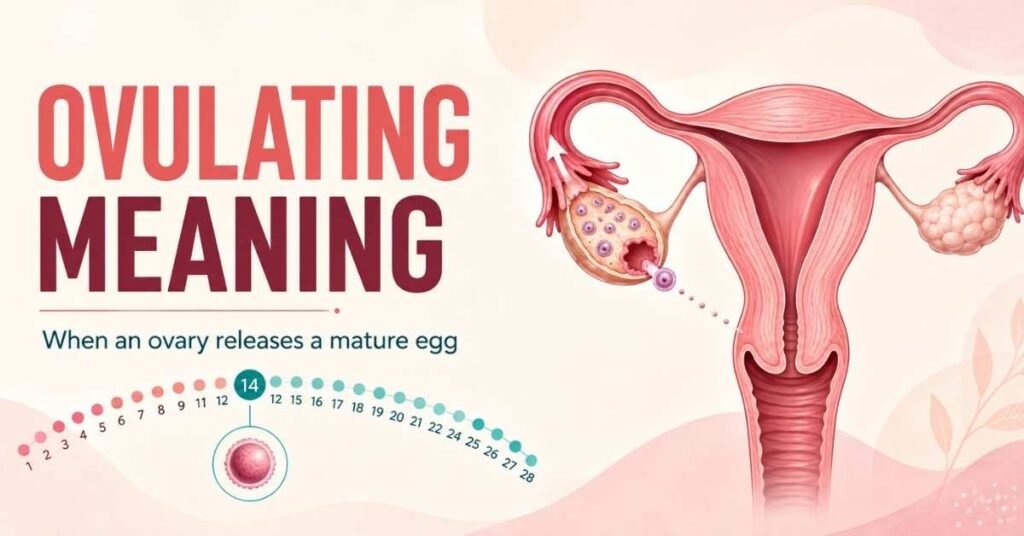
Ovulating meaning refers to the point in your menstrual cycle when an ovary releases a mature egg into a fallopian tube. This is when your body is most fertile, but ovulating does not mean you are already pregnant.
Pregnancy can only become possible if sperm fertilizes the released egg and the fertilized egg later implants in the uterus. You may notice clear discharge, mild pelvic discomfort, or other body changes around ovulation—or you may feel nothing at all.
What Does Ovulating Mean in Simple Words?
To be ovulating means that one of your ovaries is releasing an egg. The egg then enters a fallopian tube, where it may meet sperm and become fertilized.
Your body normally prepares for this event during each menstrual cycle:
- An egg develops inside a small ovarian sac called a follicle.
- Hormonal changes cause the follicle to release the mature egg.
- The egg moves into a fallopian tube.
- Sperm may fertilize it.
- If fertilization does not happen, the egg breaks down.
- Hormone levels eventually decline, and your next period begins.
The physical release of the egg is a brief event. However, the days when pregnancy is possible make up a longer period known as the fertile window.
Ovulate, Ovulating, and Ovulation: What Is the Difference?
These three words describe the same biological process in different grammatical forms:
- Ovulate is a verb describing the release of an egg.
- Ovulating means the process is happening or is believed to be happening.
- Ovulation is the noun used for the biological event.
For example, when someone says, “I’m ovulating,” they usually mean they believe they are at or near the point in their cycle when an ovary releases an egg.
Does Ovulating Mean You Are Pregnant?
No. Ovulating does not mean you are pregnant. It only means that an egg is available for possible fertilization.
Several separate events must occur before pregnancy develops:
- An ovary releases an egg.
- Sperm reaches and fertilizes the egg.
- The fertilized egg travels toward the uterus.
- It attaches to the uterine lining through implantation.
Ovulation makes conception possible, but it does not guarantee fertilization, implantation, or pregnancy.
If you recently had unprotected sex and are worried about pregnancy, do not rely only on an app or physical symptoms. Consider time-sensitive advice from a pharmacist or healthcare professional.
What Happens Inside Your Body When You Ovulate?
Ovulation may appear to be one simple event, but it results from coordinated changes involving your brain, ovaries, hormones, and uterus.
An Egg Matures Inside an Ovarian Follicle
The first part of the menstrual cycle is called the follicular phase. During this phase, the pituitary gland releases follicle-stimulating hormone, or FSH.
FSH encourages several ovarian follicles to develop. Each follicle contains an immature egg called an oocyte. Usually, one becomes the dominant follicle and continues developing while the others stop.
As the dominant follicle grows, estrogen levels rise. Estrogen helps prepare the uterine lining for a possible pregnancy and changes cervical mucus so sperm can travel more easily.
The LH Surge Triggers Egg Release
When estrogen reaches a certain level, it contributes to a rapid rise in luteinizing hormone, commonly called the LH surge.
This hormonal signal causes the mature follicle to rupture and release its egg. That release is ovulation.
An ovulation predictor kit detects elevated LH in urine. A positive test suggests ovulation may be approaching, but it does not observe the egg itself. In some situations, an LH surge can occur without confirmed egg release.
The Egg Enters a Fallopian Tube
After leaving the ovary, the egg is received by a fallopian tube. It moves through this tube toward the uterus.
If sperm is present, fertilization usually occurs in the fallopian tube rather than in the uterus. An egg generally remains available for fertilization for approximately 12–24 hours after ovulation. Sperm, however, may survive in the reproductive tract for several days. Office on Women’s Health
What Happens After Ovulation?
Following ovulation, the empty follicle develops into a temporary structure called the corpus luteum. It produces progesterone, which helps maintain the uterine lining.
Two different outcomes are then possible:
| If fertilization occurs | If fertilization does not occur |
|---|---|
| Sperm joins the egg | The egg breaks down |
| The fertilized egg begins dividing | The corpus luteum eventually stops functioning |
| It travels toward the uterus | Estrogen and progesterone decline |
| Implantation may follow | The uterine lining sheds during menstruation |
Ovulation, Fertilization, Implantation, and Pregnancy
These terms are closely connected, but they do not mean the same thing.
| Event | What it means |
|---|---|
| Ovulation | An ovary releases a mature egg |
| Fertilization | Sperm joins the egg, usually in a fallopian tube |
| Implantation | The fertilized egg attaches to the uterine lining |
| Pregnancy | Pregnancy develops following successful implantation |
People often confuse these events because they are discussed together in fertility and pregnancy articles. However, each is a separate step.
Ovulation symptoms also cannot confirm fertilization or implantation. The only reliable way to determine whether pregnancy occurred is to take an appropriately timed pregnancy test and seek medical confirmation when necessary.
When Does Ovulation Usually Happen?
Ovulation often happens approximately 12–16 days before the next menstrual period, but its exact timing varies. Your cycle length, hormonal pattern, health, age, and other factors can all influence when an egg is released.
Day one of a menstrual cycle is the first day of menstrual bleeding.
Does Everyone Ovulate on Day 14?
No. The idea that everyone ovulates on day 14 comes from using a 28-day menstrual cycle as a textbook example.
Even someone with a regular 28-day cycle may ovulate earlier or later. Normal cycle lengths and ovulation dates can also vary between individuals and from one month to another. The Office on Women’s Health notes that typical cycle length and the time leading to ovulation differ among individuals. Office on Women’s Health
The following estimates demonstrate why personal timing matters:
| Cycle length | Approximate ovulation timing | Important limitation |
|---|---|---|
| 21 days | Around day 7 | Fertility may begin shortly after bleeding |
| 28 days | Around day 14 | The actual day can still vary |
| 30 days | Around day 16 | Monthly changes remain possible |
| 35 days | Around day 21 | An app cannot confirm egg release |
These are illustrations, not guaranteed dates.
Can You Ovulate During or Right After Your Period?
Ovulating during a true menstrual period is uncommon, but pregnancy from sex during bleeding may still be possible.
There are several reasons:
- You may have a short menstrual cycle.
- You may ovulate soon after bleeding ends.
- Sperm may survive for several days.
- Mid-cycle or irregular bleeding may be mistaken for a period.
- An app may predict the wrong ovulation date.
If avoiding pregnancy, do not assume that bleeding automatically makes unprotected sex risk-free.
Can Ovulation Happen at a Different Time Each Month?
Yes. Your ovulation timing may change from one cycle to another, even when your periods are generally regular.
Possible influences include:
- Stress
- Illness
- Disrupted sleep
- Travel
- Significant weight changes
- Intensive exercise
- Breastfeeding
- Perimenopause
- Recently stopping hormonal birth control
- PCOS or another hormonal condition
One early or delayed cycle does not automatically mean something is wrong. Persistent or substantial cycle changes deserve professional attention.
How Long Does Ovulation Last?
The actual follicle rupture and release of the egg happen quickly. What people commonly call “ovulation” may refer to three different periods:
- Egg release: A brief biological event
- Egg viability: Usually approximately 12–24 hours
- Fertile window: Several days surrounding ovulation
The fertile window lasts longer because sperm may survive for up to five days under favorable conditions.
Ovulation Versus the Fertile Window
| Timing | What may be happening |
|---|---|
| Five days before ovulation | Sperm may survive until an egg is released |
| One to two days before | Fertility is generally high |
| Ovulation day | The ovary releases an egg |
| About one day afterward | The egg may still be fertilizable |
| Later | The egg is no longer available for fertilization |
ACOG explains that pregnancy may occur from sex approximately five days before ovulation until about one day afterward. American College of Obstetricians and Gynecologists
Can You Get Pregnant While Ovulating?
Yes. Pregnancy is most likely around ovulation because a mature egg is available to be fertilized.
However, pregnancy does not require sex to happen at the exact moment the egg is released. Because sperm may remain active for several days, sex before ovulation can also lead to pregnancy.
Sex after an app’s estimated ovulation day is not necessarily risk-free either. The application may have predicted the date incorrectly, particularly if your cycle changed that month.
If You Are Trying to Become Pregnant
Focus on the broader fertile window instead of attempting to identify one perfect hour.
Helpful steps may include:
- Tracking the dates of your periods
- Observing changes in cervical mucus
- Using an ovulation predictor kit
- Recording basal body temperature
- Having sex regularly during the fertile window
- Discussing persistent difficulty conceiving with an OB-GYN
Avoid allowing tracking to create excessive pressure. No home method can guarantee pregnancy, and timing is only one part of fertility.
If You Are Trying to Avoid Pregnancy
Do not use a period app’s predicted ovulation date as your only method of pregnancy prevention.
Applications normally estimate future fertile days using previous cycle data. They cannot see whether an ovary released an egg, and their predictions may be wrong when a cycle changes.
Use a reliable contraceptive method appropriate for you. If unprotected sex recently occurred, contact a pharmacist or healthcare professional promptly because some options are time-sensitive.
Signs You May Be Ovulating
Some people notice several signs of ovulation, while others notice none. Symptoms may suggest that ovulation is approaching or has passed, but most cannot confirm egg release on their own.
Clear, Slippery Cervical Mucus
One of the most recognizable ovulation signs is a change in cervical mucus, often noticed as vaginal discharge.
As estrogen increases, mucus may become:
- Clear
- Wet
- Slippery
- Stretchy
- Similar to raw egg white
This consistency creates a favorable environment for sperm movement and survival.
Clear discharge does not prove that an egg was released. Discharge accompanied by itching, burning, a strong odor, or an unusual color may have another cause and should not automatically be attributed to ovulation.
Mild One-Sided Pelvic Pain
Some people experience mild pelvic or lower abdominal discomfort around ovulation. This is called mittelschmerz, a German term meaning “middle pain.”
Ovulation pain may feel like:
- A brief sharp sensation
- A mild cramp
- A dull one-sided ache
- Pressure in the lower abdomen
The discomfort may occur before, during, or shortly after egg release. Pain alone cannot confirm that you ovulated.
Severe, persistent, or worsening pelvic pain requires medical attention because conditions such as ovarian cysts, endometriosis, infections, or pregnancy complications can produce similar symptoms.
A Small Rise in Basal Body Temperature
Basal body temperature, or BBT, is your resting temperature measured immediately after waking and before becoming active.
Progesterone can cause a small, sustained temperature increase after ovulation. This means BBT is generally more useful for identifying a past ovulation pattern than predicting the egg’s release that same day.
Temperature readings may be affected by:
- Fever or illness
- Poor or interrupted sleep
- Alcohol
- Travel
- Measuring at inconsistent times
- Getting out of bed before measuring
- Certain medications
A single higher reading is not enough. A pattern across several days and cycles is more meaningful.
Light Mid-Cycle Spotting
A small number of people experience light spotting around ovulation. It may appear pink, light red, or brown and usually remains much lighter than menstrual bleeding.
Do not assume all mid-cycle bleeding is caused by ovulation. Speak with a healthcare professional if the bleeding is:
- Heavy
- Painful
- Recurrent
- Prolonged
- Accompanied by dizziness
- Occurring after sex
- Associated with a possible pregnancy
Other Changes You Might Notice
Additional possible ovulation symptoms include:
- Breast tenderness
- Bloating
- Increased sexual desire
- Mood changes
- Changes in energy
- A higher or softer cervix
These are nonspecific symptoms. They can also occur before a period, during pregnancy, or because of unrelated physical and emotional factors.
Is It Normal to Feel Nothing During Ovulation?
Yes. Many people do not feel ovulation happening.
Having no clear discharge, pain, spotting, or other noticeable symptoms does not prove that you are not ovulating. Your body may release an egg without creating changes you can easily detect.
How to Know Whether You Are Ovulating
There is no perfect at-home method for identifying the exact moment of egg release. Some methods estimate when ovulation may happen, while others provide evidence that it may have already occurred.
Comparing Ovulation Tracking Methods
| Method | What it tells you | Predicts or confirms? | Main limitation |
|---|---|---|---|
| Period app | Estimates fertile dates | Predicts | Relies on previous cycle patterns |
| Cervical mucus | Shows estrogen-related fertile conditions | Predicts | Does not prove egg release |
| LH test | Detects an LH surge | Predicts | A surge may occur without ovulation |
| Basal temperature | Identifies a sustained temperature shift | Supports confirmation afterward | Many everyday factors affect readings |
| Progesterone test | Measures a post-ovulation hormone | Clinical evidence | Must be performed at the correct time |
| Ultrasound | Monitors follicle development and release | Strong clinical evidence | Requires professional monitoring |
A Practical At-Home Tracking Routine
If you want to understand your cycle more accurately:
- Record the first day of each period.
- Track your total cycle length for several months.
- Note changes in cervical mucus.
- Use an LH test according to its instructions.
- Measure BBT consistently if using that method.
- Compare several signals rather than relying on one.
- Look for patterns over multiple cycles.
- Discuss persistent irregularity with a healthcare professional.
What Does a Positive Ovulation Test Mean?
A positive ovulation predictor test means the test detected an increase in luteinizing hormone.
The result suggests that:
- Your body may be preparing to release an egg.
- Ovulation may occur soon.
- You may be entering your most fertile time.
It does not prove that:
- An egg was successfully released
- Fertilization occurred
- Implantation occurred
- You are pregnant
MedlinePlus confirms that home ovulation tests detect an LH rise used to predict when egg release is likely. MedlinePlus
PCOS and certain hormonal patterns can make LH tests more difficult to interpret.
Why Your App and Body Signs May Disagree
Imagine that an application predicts ovulation on Wednesday. You notice clear, slippery cervical mucus on Friday, followed by a sustained temperature rise on Sunday.
That does not necessarily mean your body is malfunctioning:
- The application made an estimate based on previous cycles.
- The mucus suggested that estrogen and fertility were increasing.
- The later temperature shift may indicate ovulation occurred later than predicted.
This is why multiple-cycle patterns are usually more helpful than one predicted date.
Can You Ovulate Without Having a Period?
It is possible to ovulate before a visible period returns. This is especially important after childbirth, while breastfeeding, after stopping contraception, or during irregular cycles.
Ovulation occurs before the menstrual period that would follow it. Therefore, pregnancy may become possible before you see your first postpartum or post-contraception period.
Can You Bleed Without Ovulating?
Yes. Bleeding does not always prove that ovulation occurred.
During an anovulatory cycle, hormonal changes may cause the uterine lining to shed unpredictably even though no egg was released. This bleeding may appear lighter, heavier, shorter, or more irregular than a typical period.
What Does Not Ovulating Mean?
Not ovulating is called anovulation. It means an ovary did not release a mature egg during that menstrual cycle.
Occasional anovulation can happen, but repeated anovulation may affect menstrual regularity and fertility.
Possible Signs of Irregular or Absent Ovulation
Possible signs include:
- Missing periods
- Highly unpredictable cycles
- Persistently long or unusually short cycles
- Irregular bleeding
- Repeatedly unclear tracking patterns
- Difficulty becoming pregnant
None of these signs can diagnose anovulation by themselves.
Why Might Someone Not Ovulate Regularly?
Possible causes include:
- Polycystic ovary syndrome
- Thyroid disorders
- Elevated prolactin
- Perimenopause
- Pregnancy
- Breastfeeding
- Significant stress
- Low calorie intake
- Intensive exercise
- Substantial weight changes
- Certain medications
- Hormonal contraception
A healthcare professional can evaluate your symptoms, cycle history, medications, and overall health before determining the cause.
How Doctors Evaluate Ovulation
Depending on your symptoms and goals, an evaluation may involve:
- Menstrual and reproductive history
- Hormone testing
- Appropriately timed progesterone testing
- Pelvic ultrasound
- Thyroid or prolactin testing
- Assessment for PCOS or other conditions
An ovarian-reserve test is not the same as an ovulation test. Ovarian reserve relates to egg quantity, while ovulation testing investigates whether and when an egg is released.
When Ovulation Symptoms Need Medical Attention
Most normal ovulation changes are mild and temporary. Seek medical advice for:
- Severe or worsening pelvic pain
- Fainting, dizziness, or unusual weakness
- Fever
- Heavy or prolonged bleeding
- Pain with a positive pregnancy test
- Foul-smelling or irritating discharge
- Pain during sex
- Persistently absent periods
- Highly unpredictable cycles
- Ongoing difficulty becoming pregnant
Do not dismiss severe pain as ordinary ovulation pain, particularly if it is new or accompanied by bleeding, fever, vomiting, or dizziness.
LEARN MORE: CNC Meaning
Common Myths About Ovulation
Myth: Everyone Ovulates on Day 14
Reality: Day 14 is only an estimate based on a 28-day cycle. Personal timing can vary.
Myth: Ovulation Lasts for Six Days
Reality: Egg release is brief, and the egg usually remains fertilizable for around one day. The longer period is the fertile window.
Myth: Clear Discharge Proves You Ovulated
Reality: Clear, stretchy mucus suggests estrogen-related fertile conditions. It does not confirm egg release.
Myth: A Positive LH Test Guarantees Ovulation
Reality: It detects a hormonal surge that usually occurs before ovulation but does not observe the egg being released.
Myth: Regular Periods Always Prove Regular Ovulation
Reality: Regular cycles make ovulation more likely, but bleeding alone does not provide absolute confirmation.
Myth: You Cannot Get Pregnant From Sex During a Period
Reality: Pregnancy may still be possible because ovulation timing varies and sperm can survive for several days.
Myth: Ovulation Symptoms Mean You Are Pregnant
Reality: Ovulation occurs before fertilization and implantation. Its symptoms do not confirm pregnancy.
What Should You Do Next?
Your best next step depends on why you searched for the meaning of ovulating.
| Your situation | A sensible next step |
|---|---|
| You only wanted the definition | Remember that ovulation means egg release—not pregnancy |
| You are trying to conceive | Track the full fertile window instead of one predicted moment |
| You are avoiding pregnancy | Use reliable contraception rather than an app prediction alone |
| You recently had unprotected sex | Seek prompt, time-sensitive advice from a pharmacist or clinician |
| Your cycles are irregular | Record several cycles and discuss persistent changes with an OB-GYN |
| You have severe pain or heavy bleeding | Seek medical assessment |
| You are unsure whether you ovulate | Ask a healthcare professional about appropriate testing |
Frequently Asked Questions About Ovulating
What does it mean when someone says, “I’m ovulating”?
It means they believe they are at or near the stage when an ovary releases a mature egg. They may base this on cycle timing, discharge, an LH test, or other symptoms.
Does ovulating mean an egg was definitely released?
Ovulation itself means egg release. However, an app prediction, symptom, or positive LH test does not always prove that the release occurred.
Does ovulating mean you are fertile?
Yes. Ovulation is part of the most fertile time in the menstrual cycle. However, the fertile window begins several days before egg release.
How many days are you fertile?
The fertile window generally includes the five days before ovulation, ovulation day, and sometimes part of the following day.
Can you become pregnant before ovulation?
Yes. Sperm may survive for several days and fertilize an egg after it is released.
Can you become pregnant after ovulation?
It may be possible for a short period while the egg remains viable. The estimated ovulation date may also be inaccurate.
What does ovulation discharge look like?
It is often described as clear, slippery, wet, and stretchy, similar to raw egg white. Not everyone notices this change.
Can you ovulate without symptoms?
Yes. Ovulation can happen without pain, discharge changes, spotting, or other noticeable symptoms.
Can you ovulate twice in one cycle?
More than one egg can occasionally be released during the same ovulatory event, which can result in fraternal twins. Separate ovulations occurring widely apart within one menstrual cycle are not the usual pattern.
Can stress delay ovulation?
Yes. Significant physical or emotional stress may affect the hormonal signals that control ovulation, although the effect differs between individuals.
Does birth control stop ovulation?
Some hormonal contraceptives suppress ovulation, but their effects differ by method. Correct use is important. Ask a qualified professional about your specific contraceptive.
Does a positive ovulation test mean you are pregnant?
No. An ovulation test detects an LH surge, not pregnancy. A pregnancy test detects a different hormone called human chorionic gonadotropin, or hCG.
When should you take a pregnancy test after ovulation?
Pregnancy tests are generally more reliable around the expected date of your next period. Testing too early can produce a negative result even if conception occurred. Follow the test instructions or ask a clinician about the correct timing.
The Essential Point to Remember
Ovulating means that an ovary is releasing a mature egg, making pregnancy possible if sperm fertilizes it. It does not mean pregnancy has already occurred. Ovulation timing and symptoms differ from person to person, and you may ovulate without noticing any obvious changes.
Period applications, cervical mucus, temperature tracking, and LH tests can provide useful clues, but they have limitations. Choose your next step based on whether you are trying to conceive, avoid pregnancy, or investigate unusual symptoms.
