

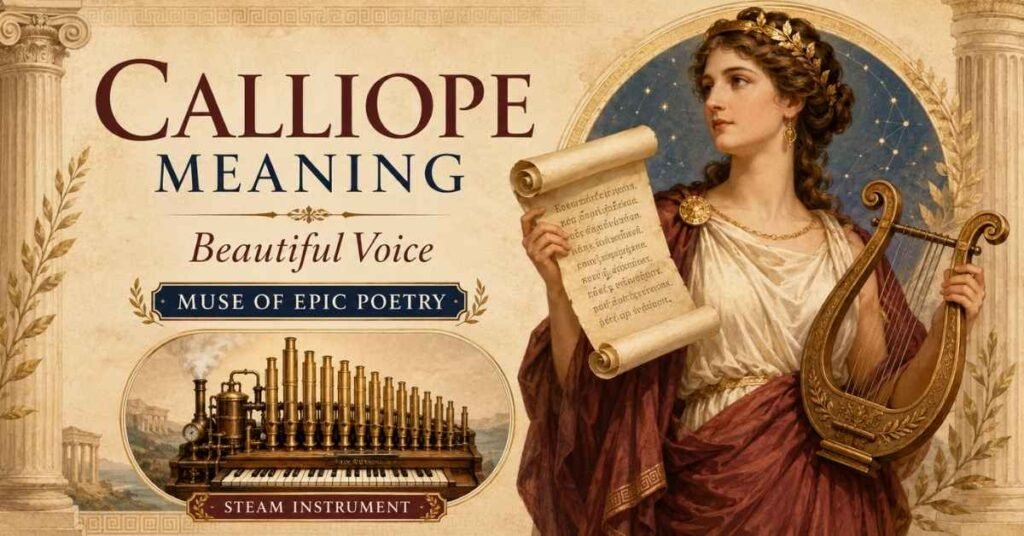
Calliope meaning comes from Greek and translates to “beautiful voice” or “beautiful-voiced.” In Greek mythology, Calliope was the Muse of epic poetry, eloquence, and powerful storytelling. Her name later became associated with a loud steam-whistle instrument commonly heard at circuses, fairs, and on riverboats.
Today, Calliope is also an established girl’s name in the United States, often shortened to Callie. Its usual American English pronunciation is kuh-LYE-uh-pee, although Greek and regional pronunciations differ.
What Does Calliope Mean?
Calliope means “beautiful voice.” The name is traditionally derived from the Greek elements kallos, associated with beauty, and ops, associated with voice.
The meaning is broader than simply having an attractive singing voice. In Calliope’s original mythological setting, a beautiful voice represented:
- Eloquent speech
- Poetry
- Storytelling
- Artistic expression
- Persuasive communication
- The ability to preserve important stories
Merriam-Webster explains that Calliope’s name literally means “beautiful-voiced” and connects this meaning to both the Greek Muse and the steam-powered instrument named after her. Merriam-Webster
Calliope Meanings by Context
Calliope can refer to different things depending on where you encounter the word.
| Context | Meaning |
|---|---|
| Baby-name list | A Greek girl’s name meaning “beautiful voice” |
| Greek mythology | The Muse of epic poetry and eloquence |
| Poetry or literature | A symbol of storytelling and artistic inspiration |
| Circus or riverboat history | A steam- or air-powered whistle instrument |
| Birding | The Calliope hummingbird |
| New Orleans | A place name with a distinctive regional pronunciation |
| Pop culture | A character name frequently shortened to Callie |
The mythological figure is normally written with a capital letter: Calliope. The musical instrument may be written as lowercase calliope.
Calliope, Kalliope, and Kalliopi
These spellings share the same origin but reflect different linguistic traditions:
- Calliope is the familiar English and Latinized spelling.
- Kalliope is a closer transliteration of the ancient Greek form.
- Kalliopi is a modern Greek form of the name.
None of these spellings changes the name’s basic association with a beautiful voice, poetry, eloquence, and artistic inspiration.
A Greek or Greek-American family may prefer Kalliopi because of its modern cultural use. English-speaking parents often choose Calliope because it is the spelling most familiar in English dictionaries, literature, and baby-name records.
How Do You Pronounce Calliope?
The most common American English pronunciation of Calliope is:
kuh-LYE-uh-pee
It has four syllables:
kuh – LYE – uh – pee
The main stress falls on the second syllable.
Modern Greek Pronunciation
A modern Greek-style pronunciation is often represented in English as:
ka-lee-OH-pee
Here, the strongest stress falls closer to the third syllable.
The difference does not mean that one family is necessarily pronouncing the name incorrectly. Personal names move between languages, and their sounds often change with local speech patterns.
Is the Calliope Instrument Pronounced Differently?
The instrument can be pronounced like the English personal name:
kuh-LYE-uh-pee
However, dictionaries and regional traditions also record a pronunciation similar to:
KAL-ee-ope
Dictionary.com lists both an American pronunciation resembling kuh-LYE-uh-pee and an instrument-related form resembling KAL-ee-ope. Dictionary.com
If you are using Calliope as a person’s name, the individual or family’s preferred pronunciation should take priority.
How Is Calliope Pronounced in New Orleans?
In New Orleans, Calliope has traditionally been used in local place names, including Calliope Street and the former Calliope housing development. A regional pronunciation resembling KAL-ee-ope has been documented in local discussions.
Place-name pronunciations frequently develop separately from dictionary or personal-name pronunciations. Someone pronouncing a New Orleans street may therefore say Calliope differently from someone introducing a child named Calliope.
An Easy Way to Remember the English Pronunciation
The ending works like several familiar Greek-derived names:
- Penelope
- Persephone
- Hermione
When Calliope is used as a personal name, it does not normally end like the word “hope.”
Where Does the Name Calliope Come From?
Calliope has an ancient Greek origin. Its meaning connects beauty with voice, but “voice” carried several cultural layers.
It could include:
- Singing
- Public speaking
- Poetry recitation
- Persuasive speech
- Oral storytelling
- Literary expression
This made the name particularly fitting for a Muse associated with heroic poetry and eloquence.
Why Memory, Poetry, and Voice Were Connected
Calliope’s mother was Mnemosyne, the divine personification of memory.
That relationship has deep symbolic relevance. Before long poems were widely written and copied, stories were preserved through oral performance. Poets needed memory to retain long narratives, rhythm to structure them, and voice to perform them.
The mythology therefore creates a meaningful relationship:
Memory → oral poetry → storytelling → cultural preservation
This is a cultural interpretation of the myth, not a scientific explanation of creativity. Still, it helps explain why the Muses were traditionally described as daughters of Memory.
How the Name Changed Across Languages
| Language or tradition | Common form |
|---|---|
| Ancient Greek transliteration | Kalliope |
| Latin | Calliope |
| English | Calliope |
| Modern Greek | Kalliopi |
Spelling and pronunciation changed as the name passed through Greek, Latin, and English usage.
Who Was Calliope in Greek Mythology?
Calliope was one of the nine Muses and the Muse of epic poetry and eloquence. Ancient and later traditions often described her as the eldest, wisest, or most prominent of the Muses.
She was associated with:
- Heroic poetry
- Persuasive speech
- Oral storytelling
- Creative inspiration
- Leadership through language
- Musical and poetic performance
The Theoi Project describes Kalliope as the eldest of the Muses, the goddess of eloquence, and the Muse assigned to epic poetry. Theoi Project
What Was a Muse?
In Greek mythology, the Muses were divine figures connected with artistic and intellectual inspiration.
They were traditionally associated with fields such as:
- Poetry
- Music
- History
- Dance
- Tragedy
- Comedy
- Astronomy
- Hymns
- Storytelling
Ancient poets sometimes invoked a Muse at the beginning of a work. This was more than the modern idea of calling someone “my muse.” It belonged to a poetic and religious tradition in which the poet asked for divine help in remembering and telling an important story.
What Is Epic Poetry?
Epic poetry is long narrative poetry centered on heroic journeys, conflicts, cultural history, gods, fate, and extraordinary events.
Famous examples include:
- Homer’s Iliad
- Homer’s Odyssey
- Virgil’s Aeneid
These works were part of an oral-performance tradition before and alongside their written preservation. A poet or performer needed a strong memory and an expressive voice, making Calliope a fitting source of symbolic inspiration.
Why Was Calliope Associated With Eloquence?
Eloquence means expressing ideas effectively, beautifully, or persuasively through speech or writing.
Calliope’s domain was therefore not limited to poetry. She could also be associated with:
- Public speaking
- Leadership
- Political speech
- Persuasive language
- Ceremonial recitation
- Powerful storytelling
Her name’s connection to a “beautiful voice” fits both poetry and persuasive communication.
Was Calliope the Leader of the Muses?
Calliope is frequently described as the chief, foremost, wisest, or eldest of the nine Muses.
Hesiod gives her a particularly prominent position, and later writers developed her reputation as their leader. However, Greek mythology does not operate like a single official biography. Ancient writers preserved different versions of stories and relationships.
It is accurate to say Calliope was often regarded as the foremost Muse, but this should not be treated as a universally fixed title in every ancient tradition.
Calliope’s Family in Greek Mythology
Parents: Zeus and Mnemosyne
Calliope and the other Muses were traditionally described as daughters of:
- Zeus, ruler of the Olympian gods
- Mnemosyne, the personification of memory
Their parentage symbolically connects divine power and memory with artistic creation.
Calliope and the Eight Other Muses
| Muse | Traditional domain |
|---|---|
| Calliope | Epic poetry and eloquence |
| Clio | History |
| Euterpe | Music and lyric poetry |
| Thalia | Comedy |
| Melpomene | Tragedy |
| Terpsichore | Dance |
| Erato | Love poetry |
| Polyhymnia | Sacred poetry and hymns |
| Urania | Astronomy |
These specialized assignments became more clearly established over time. Ancient sources and later artistic traditions do not always describe each Muse identically.
Was Calliope the Mother of Orpheus?
Many important traditions identify Calliope as the mother of Orpheus, the legendary poet and musician whose music could charm people, animals, and even nature.
Orpheus’s father is variously named as:
- Oeagrus, a Thracian king
- Apollo, god of music and poetry
The variation is normal for Greek mythology. Different poets and regions preserved different family traditions.
Calliope’s connection to Orpheus is symbolically appropriate: the Muse of epic poetry and beautiful speech becomes the mother of mythology’s most famous poet-musician.
Calliope’s Other Children
Depending on the source, Calliope was also identified as the mother of figures including:
- Linus
- Rhesus
- Certain Corybantes
These relationships are not equally consistent across ancient accounts. A source-aware article should identify them as variant traditions, not one settled family history.
Calliope’s Symbols and Appearance
Calliope does not have one fixed appearance across every ancient and modern representation.
Writing Tablet, Scroll, and Stylus
She is often shown carrying:
- A writing tablet
- A stylus
- A scroll
- A book
These objects represent poetic composition, learning, recorded knowledge, and storytelling.
Lyre and Musical Associations
Some depictions show Calliope with a lyre, a stringed instrument closely associated with ancient poetry and song.
Epic poetry was often performed aloud, sometimes with musical accompaniment. The lyre therefore connects Calliope’s poetic and musical roles.
Crown and Ceremonial Authority
In later art, Calliope may wear a gold crown or appear in a commanding position. The crown reinforces her reputation as the foremost or leading Muse.
Why Her Symbols Vary
Greek, Roman, Renaissance, and modern artists did not work from one standardized visual guide. One artist might emphasize writing, another musical performance, and another Calliope’s authority among the Muses.
Myths and Literary Stories About Calliope
Calliope and the Pierides
One of Calliope’s best-known stories concerns the Pierides, daughters of King Pierus, who challenged the Muses to a singing contest.
Calliope performed on behalf of the Muses. After the challengers lost, they were transformed into birds—usually identified as magpies in later retellings.
The story reflects themes common in Greek mythology:
- Artistic pride
- Divine authority
- Competition
- Hubris
- The consequences of challenging the gods
Calliope and Orpheus
As Orpheus’s mother, Calliope appears symbolically connected with his extraordinary musical and poetic power.
Stories about Orpheus often explore:
- The emotional force of music
- Love and loss
- Art’s influence over nature
- The limits of human action
- Poetry’s relationship with memory
Writers Who Invoked Calliope
Calliope appears in or is associated with works by writers including:
- Hesiod
- Virgil
- Ovid
- Dante
When a poet invoked Calliope, the poet was asking for the ability to remember, organize, and powerfully tell an epic story.
Why Different Sources Tell Different Stories
Greek mythology has no single universally authoritative edition.
Stories changed across:
- Regions
- Historical periods
- Oral traditions
- Poets
- Religious practices
- Artistic interpretations
One writer may identify Apollo as Orpheus’s father, while another names Oeagrus. These differences should be preserved rather than forced into one artificial biography.
What Does Calliope Symbolize Today?
Calliope’s traditional role has inspired several modern symbolic associations.
Voice and Self-Expression
Calliope may represent:
- Speaking confidently
- Finding one’s voice
- Expressing complex ideas
- Being heard
- Communicating with purpose
Poetry and Storytelling
Writers, poets, editors, speakers, and performers may use Calliope as a symbol of:
- Literary creativity
- Narrative skill
- Artistic discipline
- Verbal expression
- Inspiration
Memory and Cultural Legacy
Because Calliope is a daughter of Mnemosyne, she can also symbolize the way stories preserve cultural memory.
A story can carry:
- Family history
- Community values
- Historical identity
- Moral lessons
- Shared experiences
Creativity and Inspiration
Calliope is naturally associated with creativity, but these qualities are symbolic, not predictive.
A child named Calliope is not automatically destined to become a singer, writer, or public speaker. A name can carry meaning for a family without determining someone’s talents or personality.
Is Calliope Used as a Baby Name?
Yes. Calliope is an established Greek feminine name used in both Greece and English-speaking countries.
It has become increasingly familiar in the United States while remaining less common than names such as Olivia, Sophia, Chloe, or Penelope.
How Popular Is Calliope in the United States?
According to current Social Security Administration data, Calliope ranked No. 451 among girls’ names in 2025, rising from No. 499 in 2024. Social Security Administration
Its recent development can be seen in the following figures:
| Year | U.S. rank | Recorded births |
|---|---|---|
| 2014 | No. 1,228 | 199 |
| 2020 | No. 692 | 409 |
| 2023 | No. 491 | 622 |
| 2024 | No. 499 | 613 |
| 2025 | No. 451 | 682 |
The name has clearly become more familiar, but 682 births across the United States still make it relatively uncommon.
Is Calliope a Rare Name?
Calliope is uncommon but established.
It is rare compared with names in the U.S. Top 100, yet it appears frequently enough to have an official national ranking. A child named Calliope may not meet many others with the same name, although the familiar nickname Callie is much more widely recognized.
Popularity also varies by community. A mythological name may feel more familiar in one school or city than another.
Why Is Calliope Becoming More Familiar?
Several cultural developments may have contributed to its growing visibility:
- Rising interest in Greek mythology
- Popularity of Penelope, Athena, Chloe, and other Greek names
- Preference for elaborate names with simple nicknames
- Increased interest in literary and mythological baby names
- The character Calliope “Callie” Torres on Grey’s Anatomy
- Familiarity of the nickname Callie
These influences may have helped, but it would be too strong to claim that one television character alone caused the name’s rise.
Is Calliope Usually a Girl’s Name?
Calliope is traditionally and predominantly used as a feminine name. Modern families may make different choices, but its history and current U.S. usage remain strongly feminine.
Nicknames for Calliope
Familiar Nicknames
Common and intuitive options include:
- Callie
- Cali
- Calli
- Cal
Callie is the most familiar choice in the United States.
Less Obvious Nicknames
Families may also use:
- Lio
- Lia
- Opie
- Poppy, particularly with Kalliopi
Not every nickname follows strict linguistic rules. Family habits and a child’s preferences often determine what lasts.
Why Callie Makes Calliope Easier to Use
Calliope provides a distinctive formal name, while Callie offers an approachable everyday alternative.
That combination appeals to parents who want:
- A historically meaningful full name
- An easy nickname
- Flexibility as the child grows
- A formal and casual option
Parents should also consider whether they would be comfortable if teachers, relatives, or friends naturally shorten Calliope to Callie.
Is Calliope a Practical Name in the United States?
Calliope has real strengths, but it also comes with practical challenges.
Advantages
- Positive meaning: Beautiful voice
- Strong history: Ancient Greek mythology
- Creative associations: Poetry, storytelling, and eloquence
- Familiar nickname: Callie
- Distinctiveness: Recognizable without being common
- Flexible style: Formal, artistic, and playful
- Multiple cultural forms: Calliope, Kalliope, and Kalliopi
Possible Challenges
- Some people will mispronounce it.
- Its spelling may not be obvious from hearing it.
- It may be confused with Calypso or Cassiopeia.
- Some people will think first of the steam instrument.
- Family members may disagree about pronunciation.
- Four syllables may feel long with some surnames.
These difficulties do not make it a poor choice. They simply mean parents should be comfortable correcting the pronunciation occasionally.
The Five-Minute Calliope Test
Before choosing the name:
- Say Calliope with the family surname.
- Repeat the full name at normal conversational speed.
- Ask several people to read it aloud.
- Ask someone to spell it after hearing it.
- Try both Calliope and Callie in formal and casual situations.
- Decide whether occasional pronunciation correction would bother you.
- Consider which pronunciation you will consistently use.
How Calliope Works With Different Surnames
A four-syllable name often flows naturally with a shorter surname, but this is not a rule.
Listen for:
- Repeated vowel sounds
- Awkward consonant transitions
- Overall rhythm
- Initials
- Family accent
- The preferred nickname
The most useful test is saying the complete name naturally rather than following an arbitrary naming formula.
Middle Names for Calliope
A shorter middle name can balance Calliope’s length.
Short Middle Names
- Calliope Jane
- Calliope Mae
- Calliope Rose
- Calliope June
- Calliope Grace
- Calliope Claire
Greek-Inspired Middle Names
- Calliope Iris
- Calliope Selene
- Calliope Daphne
- Calliope Thalia
- Calliope Zoe
Two Greek names do not automatically form the best combination. Sound, family meaning, initials, and surname flow still matter.
Family Middle Names
A family name may add more emotional value than one chosen only for style.
Consider:
- A grandparent’s name
- A family surname
- Cultural heritage
- A meaningful place
- A name connected with an important family story
Sibling Names That Pair With Calliope
Sibling names do not need to match perfectly, but some choices share Calliope’s history or style.
Greek and Mythological Names
- Penelope
- Daphne
- Phoebe
- Athena
- Thalia
- Orion
- Atlas
Literary and Elaborate Names
- Beatrice
- Cordelia
- Evangeline
- Seraphina
- Sebastian
- Theodore
A practical approach is to choose names you genuinely love rather than building a rigid theme.
Names Similar to Calliope
| Name | Shared quality | Important difference |
|---|---|---|
| Penelope | Greek, four syllables, familiar nickname | Much more common |
| Cassiopeia | Elaborate Greek sound | Longer and associated with astronomy |
| Persephone | Greek mythology and similar rhythm | Different mythological story |
| Ariadne | Distinctive Greek origin | Shorter pronunciation |
| Daphne | Greek mythology | More compact and familiar |
| Lyra | Musical and mythological | Much shorter |
| Seraphina | Elaborate, lyrical style | Different linguistic origin |
| Calista | Similar beginning and Greek roots | Easier spelling |
| Chloe | Established Greek name | Far more common |
| Thalia | One of the Muses | Shorter, with varied pronunciation |
What Is a Calliope Musical Instrument?
A calliope is a keyboard instrument that produces music by sending steam or compressed air through a series of whistles.
Its powerful sound made it useful at:
- Circuses
- Fairs
- Parades
- Carousels
- Riverboats
- Outdoor public events
How Does a Calliope Work?
A calliope produces music through a relatively direct process:
- Steam or compressed air enters the system.
- A keyboard, cylinder, or music roll controls valves.
- Each valve directs steam or air into a whistle.
- Different whistle sizes create different pitches.
- The performer controls the timing and duration of the notes.
Traditional calliopes offered limited control over volume and tone. Their musical expression came primarily from pitch, rhythm, and note duration.
Why Is a Calliope So Loud?
Calliopes were designed for outdoor settings. Their high-pressure steam or compressed air and large whistles produced sound capable of attracting attention across busy fairgrounds or open water.
This volume was useful for advertising the arrival of a circus or riverboat, even if the resulting tone could sound shrill.
Who Invented the Calliope?
Joshua C. Stoddard of Worcester, Massachusetts, received a U.S. patent for a steam-powered musical instrument in 1855.
Related steam-whistle ideas existed earlier, so it is more precise to call Stoddard the key patent figure rather than the only person ever to conceive of such an instrument.
Early versions used a pinned cylinder. Later designs included keyboards and music rolls.
Why Was It Named After Calliope?
The instrument was named after the Muse whose name means beautiful voice.
The connection is memorable, although slightly ironic. Calliope the Muse represented beautiful and eloquent expression, while the steam instrument was famous for being extremely loud and sometimes harsh.
Steam Calliope Versus Air Calliope
| Steam calliope | Air-powered calliope |
|---|---|
| Uses pressurized steam | Uses compressed air |
| Strong riverboat association | More practical in some modern settings |
| Produces visible steam | Usually lacks the same visual display |
| Requires steam equipment | Avoids some boiler requirements |
| Historically difficult to control dynamically | May offer more manageable operation |
An air-powered version may also be called a calliaphone, although that term has a particular commercial history.
Calliope Versus Carousel Organ
A calliope and a carousel organ are not automatically the same instrument.
- A calliope sounds whistles using steam or compressed air.
- A carousel or fairground organ generally uses pipes, reeds, or related organ mechanisms.
Both may appear at fairs and amusement venues, which explains the frequent confusion.
Why Calliopes Became Associated With Riverboats and Circuses
Riverboat Use
Steam-powered riverboats already had a suitable source of steam. A calliope could:
- Entertain passengers
- Announce the boat’s arrival
- Attract attention
- Advertise excursions
- Send music across open water
This gave the instrument a lasting connection with the Mississippi River and New Orleans culture.
Circuses, Fairs, and Parades
Calliopes were useful for traveling entertainment because they were:
- Loud
- Visually dramatic
- Suitable for outdoor performances
- Capable of attracting crowds
- Closely associated with industrial-age machinery
Their distinctive sound eventually became musical shorthand for circuses and festive public entertainment.
Do Calliopes Still Exist?
Yes, although they are uncommon.
Working instruments may be found on:
- Historic riverboats
- Museum grounds
- Heritage railways
- Private collections
- Parade vehicles
- Festival displays
Some have been restored, while others use compressed air instead of steam.
Calliope in Literature and Popular Culture
Ancient and Classical Literature
Calliope appears in works and traditions associated with writers such as:
- Hesiod
- Virgil
- Ovid
These writers treated the Muse as a source of poetic authority, memory, and inspiration.
Dante and Later Poetry
Later writers continued invoking Calliope as a symbol of ambitious poetic expression. Her name became a literary shorthand for the ability to tell elevated, powerful stories.
Calliope “Callie” Torres
One of the best-known modern uses is Dr. Calliope “Callie” Torres from Grey’s Anatomy.
The character helped familiarize American audiences with:
- The full name Calliope
- The nickname Callie
- Its pronunciation
- Its use as a contemporary personal name
Other Uses
Calliope also appears in:
- Jeffrey Eugenides’s Middlesex
- Television and literary character names
- Arts organizations and literary publications
- Ships and geographical locations
- The Calliope hummingbird
The Calliope hummingbird’s name continues the association with beauty, delicacy, and voice, although it is a separate subject from the Muse and musical instrument.
LEARN MORE: Zionist Meaning
What to Consider Before Choosing Calliope
| If this matters most | Consider |
|---|---|
| Meaning | It has the positive meaning “beautiful voice” |
| Heritage | Choose between Calliope, Kalliope, or Kalliopi |
| Pronunciation | Decide which pronunciation your family will use |
| Everyday use | Callie provides a familiar nickname |
| Popularity | It is distinctive but rising in the United States |
| Mythology | It is associated with epic poetry and eloquence |
| Spelling | Some people will need help spelling it |
| Full-name flow | Test it with the surname |
| Flexibility | The formal name and nicknames provide several options |
If Calliope still feels right after testing its pronunciation, spelling, nickname, and full-name rhythm, it offers a rare combination of ancient history, positive meaning, and modern flexibility.
Frequently Asked Questions About Calliope
What does Calliope mean in Greek?
Calliope means “beautiful voice” or “beautiful-voiced.”
How do Americans pronounce Calliope?
The common American English pronunciation is kuh-LYE-uh-pee.
How do Greeks pronounce Calliope?
The modern Greek form Kalliopi is commonly approximated in English as ka-lee-OH-pee.
Is Calliope a goddess or a Muse?
Calliope is one of the nine Muses, divine figures associated with arts and knowledge in Greek mythology. She is sometimes loosely called a goddess of epic poetry.
What was Calliope the Muse of?
She was the Muse of epic poetry and eloquence.
Who were Calliope’s parents?
Her parents were traditionally Zeus and Mnemosyne.
Was Calliope Orpheus’s mother?
Yes, many prominent traditions identify Calliope as Orpheus’s mother.
What are Calliope’s symbols?
Her traditional symbols include a writing tablet, scroll, stylus, book, lyre, and sometimes a crown.
Is Calliope a girl’s name?
Yes. Calliope is traditionally a feminine Greek name.
Is Calliope rare?
It is uncommon but established. It ranked No. 451 among U.S. girls’ names in 2025.
Is Callie short for Calliope?
Yes. Callie is the most familiar nickname for Calliope in the United States.
What is the modern Greek spelling?
The modern Greek form is commonly written Kalliopi in English transliteration.
What is a calliope instrument?
It is a keyboard instrument that sends steam or compressed air through whistles to produce loud music.
Is a calliope the same as a steam organ?
“Steam organ” is commonly used as another name for a steam calliope, although not every mechanical or fairground organ is a true calliope.
Why was the instrument named Calliope?
It was named after the Muse associated with a beautiful and powerful voice.
What does Calliope symbolize?
Calliope symbolizes eloquence, epic storytelling, poetry, memory, creativity, and the power of voice.
Calliope Meaning in One Sentence
The Calliope means “beautiful voice” and refers to the Greek Muse of epic poetry and eloquence, a distinctive modern girl’s name, and a loud steam- or air-powered whistle instrument.
Usually pronounced kuh-LYE-uh-pee in American English, the name carries lasting associations with storytelling, artistic expression, memory, and the power of being heard.
